This is the second article in a series on heartburn and GERD. If you haven’t read the first one, I’d suggest doing that first. The idea that heartburn is caused by too much stomach acid is still popular in the media and the public. But as Daniel pointed out in the comments section of the last post, anyone familiar with the scientific literature could tell you that heartburn and GERD are not considered to be diseases of excess stomach acid. Instead, the prevailing scientific theory is that GERD is caused by a dysfunction of the muscular valve (sphincter) that separates the lower end of the esophagus and the stomach. This is known as the lower esophageal valve, or LES. The LES normally opens wide to permit swallowed food and liquids to pass easily into the stomach. Except for belching, this is the only time the LES should open. If the LES is working properly, it doesn’t matter how much acid we have in our stomachs. It’s not going to make it back up into the esophagus. But if the LES is malfunctioning, as it is in GERD, acid from the stomach gets back into the esophagus and damages its delicate lining. Here’s the key point.It doesn’t matter how much acid there is in the stomach. Even a small amount can cause serious damage. Unlike the stomach, the lining of the esophagus has no protection against acid.
We’ve been asking the wrong question
In a recent editorialpublished in the journal Gastroenterology, the author remarked:
Treating gastroesophageal reflux disease with profound acid inhibition will never be ideal because acid secretion is not the primary underlying defect.
I couldn’t agree more. For decades the medical establishment has been directing its attention at how to reduce stomach acid secretion in people suffering from heartburn and GERD, even though it’s well-known that these conditions are not caused by excess stomach acid. Instead, the question researchers should have been asking is, “what is causing the LES to malfunction?” Since it is universally agreed upon that this is the underlying mechanism producing the symptoms of GERD, wouldn’t it make sense to focus our efforts here? That’s exactly what we’re going to do in this article.
GERD is caused by increased intra-abdominal pressure
It is well accepted in the literature that GERD is caused by an increase in intra-abdominal pressure (IAP). Acid reflux occurs when pressure causes gastric distention (stomach bloating) that pushes the stomach contents, including acid, through the LES into the esophagus. According to current thought, factors contributing to this include overeating, obesity, bending over after eating, lying down after eating, and consuming spicy or fatty foods. For example, several studies have indicated an association between obesity and GERD, and this recent paperin Gastroenterology concluded that increased intra-abdominal pressure was the causative mechanism. But while I agree that all of the currently accepted factors play a role, I do not think they are the primary causes of the increased IAP seen in GERD.
The two primary causes of increased intra-abdominal pressure
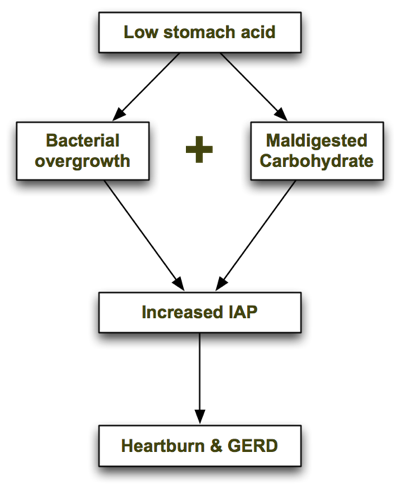
In his excellent book, Heartburn Cured, microbiologist Dr. Norm Robillard argues that carbohydrate malabsorption leads to bacterial overgrowth, resulting in IAP which drives reflux. Dr. Robillard makes a strong case that carbohydrate malabsorption plays a significant role in IAP, and I agree. But as I researched this issue I couldn’t help asking: what might be causing the carbohydrate malabsorption in the first place, and are there any other causes of bacterial overgrowth that may precede carbohydrate malabsorption? I believe the one answer to both of those questions is low stomach acid. Low stomach acid can contribute to both bacterial overgrowth (independently of carbohydrate intake) and carbohydrate malabsorption, as I describe below. In a nutshell, the process looks like this:
Let’s look at each step in turn.
Low stomach acid causes bacterial overgrowth
As I will explain in the next article, one of the chief roles of stomach acid is to inhibit bacterial overgrowth. At a pH of 3 or less (the normal pH of the stomach), most bacteria can’t survive for more than 15 minutes. But when stomach acid is insufficient and the pH of the stomach rises above 5, bacteria begin to thrive. The gastrin knockout mouse, which is incapable of producing stomach acid, suffers from bacterial overgrowth – as well as inflammation, damage and precancerous polyps in its intestines. It is also well documented that acid-suppressing drugs promote bacterial overgrowth. Long-term use of Prilosec, one of the most potent acid suppressing drugs, reduces the secretion of hydrochloric acid (HCL) in the stomach to near zero. In one trial, 30 people with GERD were treated with a high dose of Prilosec (40g/day) for at least 3 months. 11 of the 30 Prilosec-treated people had developed significant bacterial overgrowth, compared with only one of the ten people in the control group.
Low stomach acid causes maldigestion of carbohydrates
Stomach acid (HCL) supports the digestion and absorption of carbohydrates by stimulating the release of pancreatic enzymes into the small intestine. If the pH of the stomach is too high (due to insufficient stomach acid), the pancreatic enzymes will not be secreted and the carbohydrates will not be broken down properly.
Bacterial overgrowth + maldigested carbohydrates = GAS!
In Hearburn Cured, Dr. Robillard points out that though microbes are able to metabolize proteins and even fats, their preferred energy source is carbohydrate. The fermentation of carbohydrates that haven’t been digested properly produces gas. The resulting gas increases intra-abdominal pressure, which is the driving force behind acid reflux and GERD. From Dr. Robillard’s book:
According to Suarez and Levitt (17), 30 g of carbohydrate that escapes absorption in a day could produce more than 10,000 mL (ten liters) of hydrogen gas. That is a huge amount of gas!
When stomach acid is sufficient and carbohydrates are consumed in moderation, they are properly broken down into glucose and rapidly absorbed in the small intestine before they can be fermented by microbes. However, if stomach acid is insufficient and/or carbohydrates are consumed in excess, some of the carbs will escape absorption and become available for intestinal microbes to ferment.
Other supporting evidence
Dr. Robillard also argues that if gas produced by microbial fermentation of carbohydrates causes acid reflux, we might expect that reflux could be treated by either 1) reducing bacterial overgrowth or 2) reducing carbohydrate intake. He points to two studies which demonstrate this. In a study by Pehl, administration of erythromycin (an antibiotic) significantly decreased esophageal reflux. In another study by Pennathur, erythromycin strengthened the defective lower esophageal sphincter in patients with acid reflux. To my knowledge there have only been two small trials performed to test the effects of carbohydrate restriction on GERD. Both had positive results. A small case series showed a significant, almost immediate resolution of GERD symptoms in obese individuals initiating a very low-carb diet. A more recent study found that a very low-carb diet decreased distal esophagus acid exposure and improved the symptoms of GERD. Perhaps most importantly, the magnitude of the improvement was similar to what has been reported with treatment with proton-pump inhibitors (acid suppressing drugs). Some researchers now believe that Irritable Bowel Syndrome (IBS) is caused by bacterial overgrowth in the small intestine (SIBO). A studyperformed at the GI Motility Center in Los Angeles in 2002 found that 71% of GERD patients tested positive for IBS – double the percentage seen in non-GERD patients being examined. The high prevalence of IBS in GERD patients combined with the recognition that bacterial overgrowth causes IBS is yet another line of evidence suggesting that bacterial overgrowth is also a causative factor in GERD.
Final comments
To summarize, low stomach acid contributes to bacterial overgrowth in the bowel which in turn can lead to carbohydrate malabsorption (due to decreased pancreatic enzyme secretion). Malabsorption of carbohydrates, as Dr. Robillard has pointed out, increases intra-abdominal pressure and causes GERD. Reducing bacteria loads and limiting carbohydrate intake have both been shown to greatly improve, and in some cases completely cure, acid reflux and GERD. Where Dr. Robillard and I differ is that I believe low stomach acid is the primary problem with GERD, with carbohydrate malabsorption playing a secondary role. I do think that improper digestion of proteins can, in fact, lead to GERD whereas Dr. Robillard states in his book that putrefaction of proteins is more likely to cause flatulence. This may be so in most cases, but I’ve seen several patients in my practice on a very low carbohydrate diet that still experience heartburn, which improves upon restoring proper stomach acid secretion (which we’ll cover in a future article in this series). In the Part III of the series I discuss the connection between GERD and H. pylori, and further evidence supporting the theory that GERD is caused by bacterial overgrowth. Read on!
Like what you see? Join more than 30,000
others and subscribe for email updates.
I hate spam too. Your email is safe with me.
Follow Chris Online:
Not a diet for everyone.
A diet for you!
Discover your own ideal diet & end confusion about what to eat forever.
Learn More
Have the healthy baby you've always dreamed of.
Boost fertility naturally & promote lifelong health for you & your baby.
Learn More
Personal Paleo Launchpad
Personalized online portal with easy-to-use tools, expert advice, and the support of a passionate, intelligent community.
Learn More
Paleologix Paleo Support System
Break through the energy swings, digestive upset, and obstacles of adopting a Paleo diet.
Learn More
{ 131 comments… read them below or add one }
Great article. I will wait for the followup.
Well Chris, more interesting info. Some of this I was familiar with, but found the studies involving the use of antibiotics to treat the bacteria and resulting GERD symptoms especially strengthening the LES intrigues me.
Since I’m still in the early stages of overcoming this condition, could I possibly benefit from a course of antibiotics? And if so, is there an alterntive to erythromycin? It’s been years since I’ve taken any, but got horrible stomach pain when I did. I think it’s just a basic broad spectrum antibiotic, isn’t it?
Secondly, I sensed that dairy was a problem for me due to the milk protein. In particular, it aggravated my asthma because it does cause production of mucous. However, I have recently discovered raw milk and seem to not experience problems with it; either mucus production or reflux. I’m wondering as in the case of yogurt, if the naturally ocurring friendly bacteria in raw milk pre-digests most of the lactose that feeds the bad bacteria in the gut. In addition, perhaps those friendly bugs help keep some of the bad bugs in check that would produce the gas. Your thoughts?
Hi Kim,
I’m not sure if I mentioned this, but I am planning a follow-up to this series on the connection between asthma and GERD.
To answer your question, one of the reasons raw milk is superior to pasteurized milk is that it has lactase in it. Lactase is the enzyme we need to digest lactose, the sugar in milk. In non-dairy consuming societies, lactase production usually drops about 90% during the first four years of life (after weaning), although the exact drop over time varies widely.
Pasteurization kills lactase. This is why so many people have trouble digesting pasteurized milk. But those same people can often digest raw milk without a problem, because it has lactase in it.
The probiotics in yogurt (as well as kefir, sauerkraut, kombucha, kim chi and other fermented foods) can be helpful in re-establishing healthy gut flora.
Before resorting to antibiotics, I would try a period of time with a grain-free, very low-carb diet (< 30g/day) combined with an increase in probiotic intake and HCL w/pepsin supplements. It's important to proceed slowly as you increase the probiotics, because moving too fast can cause gas, bloating and intestinal discomfort.
What’s your take on digestive enzymes supplements?
They can be helpful for short-term use, but ultimately acidifying the chyme in the stomach (via HCL supplementation) should produce the same effects and save you $$.
I have found Aloe Vera Juice to be extremely effective with treating GERD.
One more thing: there is evidence that raw milk can prevent asthma from developing in children. I haven’t seen any studies on whether it can actually treat or cure asthma, but it’s certainly possible.
When my oldest son was transitioning to whole milk at 1 year old, he had problems digesting it. He experienced diarrhea and acid reflux. I switched him to soy which he had no problem with. After a few months I tried milk again, this time organic. He was able to digest organic milk, but not regular whole milk. I have often wondered why this was.
Very good article.
My acid reflux (very bad even at a young age) seemed to get worse during times in my life when (i) I weight lifted and (ii) drank a lot of beer. Weight lifting can cause IAP as does the bloating from beer (and maybe some carb malabsorption too).
I’ve considered going very low carb to avoid reflux but I think the other health costs weigh against it (but that’s another whole conversation).
Thanks for your very thoughtful essay.
Good catch there, Daniel.
I think that studies will make a correlation between weight lifting (or personal caregivers deadlifting their charges) and hiatal hernias. Further that there is comorbidity for hiatal hernias and GERD. It is more likely that a person with a hiatal hernia has GERD than a person without the ailment.
While I was quite prepared to be “underwhelmed” with Mr. Kresser’s article, I’m quite impressed. Most of the article has solid scientific underpinnings if not rational assumptions and correlations. I think it’s important to bear in mind the comparative methodologies of differential diagnosis and causation assessment; but in this case I think Occam’s razor cuts to the heart of it. The underlying problem is always the LES, yet that is not what doctors will diagnose, nor what insurance companies will pay to treat.
While I’m unaware of a “test” that confirms IBS, as Chris alluded to here, I do know that there is growing acceptance of the hydrogen breath test (HBT) as an indicator of SIBO. I suspect that SIBO, IBS, and GERD can all work independently, in concert or synergistically and that hiatal hernias may help reinforce a diagnosis. While I’ve not read anything that suggests that antibiotics help repair or strengthen the LES, antibiotics have proven to reduce or eliminate the symptoms of GERD. I agree with the conclusion that one would better approach these problems by reducing carbohydrates while tapering off of proton pump inhibitors. To prove a diagnosis of SIBO by undergoing prolonged treatment with antibiotics may not be the best first step. If undergoing treatments of broad spectrum antibiotics, one must be prepared to immediately reintroduce mega-doses of pro-biotics, lest an antibiotic resistant strain of bacteria overgrows.
Thanks for the good information and sources! I look forward to the next article.
Great article. I have a lot of questions :)
Except medicine, what can cause low stomach acid? I know there are people who had GERD but hadn’t taken any meds. Could it be low levels of minerals, proteins, fats? Or is it perhaps the bacterial overgrowth itself?
How do one test for low stomach acid?
I have a relative with GERD. The reflux happens when she drinks coffee. Do the bacteria like coffee? What other non-carb intense foods can cause reflux and why does this happen?
well written. I imagine that there is incredible variability in how each of our guts responds to different diets. Big protein meals for supper have always made me sleep poorly.
Tim,
Bacterial overgrowth can cause hypochlorhydria, especially h. pylori. It’s estimated that more than 50% of people in the world are infected with h. pylori, so that’s probably the primary cause aside from PPI use. Studies indicate that h. pylori infection increases with age and is the cause of higher rates of hypochlorhydria in the elderly.
The medical test for low stomach acid is called the Heidelberg capsule test. It’s a small plastic capsule with measuring equipment that is swallowed and monitored via radio.
The “low-tech” way of testing stomach acid, which I’ll describe in the article on treatment, is to do an HCL challenge test. You take a 200 mg capsule of HCL w/pepsin before a meal. If you notice no burning, you increase to two capsules the next meal. Proceed until you notice a mild burning sensation, then immediately reduce your dose to the number of capsules that preceded the burning or heat sensation.
If one or two capsules causes burning, you either don’t have low stomach acid or your reflux is so severe that you won’t be able to take HCL until you get it under control. NOTE: do not perform this test if you have an active ulcer or a history of ulcer.
The bacteria don’t like coffee, but if she has milk and sugar in it they love that. Coffee is high in tannins, which can cause indigestion.
Chris,.
I read that you mentioned not to perform the “low-tech” test if someone had a history of Ulcer . I had duodenal ulcer in 2012 caused by H Pylori. So I just recovered from it recently but what remains is the constant gnawing pain, bloating, pressure, and sometimes even shortness of breath. My doctor prescribed PPI which is giving me temporary marginal relief. Since i am one of those excluded to take HCL due to history of ulcer, what are my remedies?
Tooearly,
When stomach acid is insufficient, putrefaction of protein can cause gas and increased intra-adbominal pressure. This could certainly affect your sleep. It’s possible your stomach acid is low or borderline low, and you’re not able to digest large amounts of protein.
admin: gas and pressure, eh? I went off Aciphex today. I’ve been on a very low-carb/hi-fat/hi-protein diet, and have felt tremendous pressure all along the lower rib cage (upper colon?) especially on my right side for the past week or so, have been farting like a tuba quartet and haven’t taken a crap in a week. Maybe going off Aciphex will hopefully knock something loose.
Forty2,
My guess is your stomach acid is extremely low from the Aciphex. Try taking HCL w/pepsin capsules before meals. You might also try slowly increasing your intake of fermented foods (yogurt, kefir, raw sauerkraut, kombucha, etc.) to address the bacterial overgrowth. Constipation is almost always related to an insufficiency of healthy flora in the gut, which can also cause all of the other symptoms you describe.
Awesome article, Chris, and excellent explanations and references!
Thanks Mike!
Admin: I drink kombucha daily and some days I eat full-fat “Fage” yogurt as I did this morning right out of the container. There’s a jar of Bubbe’s fermented raw pickles in the fridge I keep forgetting about.
Do PPIs have a permanent effect? I’m loathe to try HCL supplements at this point. Psychologically, I suppose, but I don’t ever want to revisit the searing pain of reflux ever again.
Forty2,
The effect is probably not permanent. However, there have been some reports that taking Prilosec can lead to achlorydia that can last more than two years after discontinuing the drugs. I completely understand your reluctance to try HCL. However, if it is low stomach acid that is causing your digestive problems, which seems likely, HCL could have a profound effect. Just make sure to take only 200 mg to start with, and do it before a meal. I’ve had several patients that have experienced remarkable results with HCL after years of heartburn and GERD.
OK, if the burn returns I’ll pick up some 200mg HCL/pepsin thingies. So far, so good, but it’s only been 24hrs since I took the last Aciphex. I *hate* taking any sort of medication so getting off the PPIs would be a big win.
We spent the last two years making dietary changes. The SCD seems to work great for us and now I’m looking into “fine tuning”. It’s funny/lucky, or however you want to put it, that your recent topics are covering things I have wanted to know more about, especially acupuncture and this. My son spent his first 8 mos of life on Zantec, so I have often wondered about this. I wonder if HCL could improve digestion. Is there a way to ask a doctor to check a small child for this?
I really enjoy the information and your writing style is great, easy to understand. I really appreciate all of this.
Hi everyone,
I’ve just published Part III of the series. This was an unplanned article based on a study I just came across yesterday that provides further evidence that GERD is caused by bacterial overgrowth, and examines the connection between GERD and H. pylori.
Enjoy!
Chris, I’m curious…
What does spicy food have to do with it? Do you know why it is that people experience more GERD symptoms when eating spicy foods?
Also curious about the FOS connection. Does that imply that FOS makes gas and heartburn worse?
Thanks for taking the time to put together all this info.
Sarah,
Spicy foods are often rated on surveys as among the worst culprits, but studies don’t actually support that notion. It’s difficult to isolate variables because nobody eats hot spices by themselves. They’re always eaten with food, and in many cases that food contains other ingredients like industrial vegetable oils and preservatives (i.e. kung pao chicken) that could irritate the stomach.
In some cases I suppose the spices alone could irritate the gastric lining, especially if someone has an ulcer or chronic stress has inhibited prostaglandin production and their mucosal barrier is compromised. But in that case it’s not the spicy food that is the problem – it just exacerbates the underlying condition.
what about salicylate intolerance? – spices are really high in sals
Oops, forgot to answer your question about FOS.
Yes, I think FOS will increase gas and heartburn in people with bacterial overgrowth. However, the question is whether this effect is temporary, as the bacterial flora in the gut rebalance, or ongoing. I don’t know the answer to that question.
Hi folks,
The next installment in the series is up: How your acid stopping drug is making you sick (Part A). Part B will be published on Monday or Tuesday.
Enjoy!
Very nice article, Chris. That’s why drinking apple cider vinegar has been a popular home remedy for acid-reflux, for the reasons you explained. (2-3 teaspoon, with water if you feel it is too strong. It is good for blood stagnation type of chest pain too, even if it is not caused by heartburn)
Great series! After taking prilosec for over a year, my wife persuaded me that after having been on a low-carb diet for about the last 6 months of that time, my problem may well be gone. It was! Have had maybe a half dozen instances since (all due to overeating just prior to bed, and involved an abnormaly large carb intake). I used to have that many instances a week!
Smart wife! Aren’t you glad you listened to her?
Final article in the series is up.
Also, the entire series as well as recommendations for books and offsite articles can be found here.
How long does it usually take for some relief to start when using HCL and eating low-carb? My symptoms are a constant burning in my upper esophagus and throat. Will it take time for that to go away as my body heals, or should it go away as immediately?
Everyone’s different. For some relief is relatively immediate, others it takes a bit of time. Either way, it’s worth it!
Hi Chris,
I have been reading your very informative blog for a while, first found it through the podcast about fish oils. I see you are yet another advocate of a low carb diet. From everything i read here and everywhere it seems like all my problems (hypoglycemia, heartburn weight gain etc) should be cured by a low carb diet but in reality I didn’t experience any of these problems until after the first time I tried a low carb diet. Every time I lower my carbs (am trying to lose 10lbs right now) I have gas, heartburn, hypoglycemia, mood swings, weight gain etc. I think it is from the healthy fats in the fish and olive oil on the veggies so the obvious answer would be to switch back to higher carbs but I am fearful because of everything i read suggests the opposite. I did go to the dr but they really seem to do more harm than good which is what brings me here.
Amanda: problems with fat digestion are often caused by a sluggish gall bladder and/or low stomach acid. The fats in the fish and the olive oil wouldn’t be responsible for hypoglycemia, mood swings or weight gain. Try supplementing with ox bile and betaine HCL with pepsin right at the start of meals. That should help.
thank you! will order some HCL for the heartburn and keep reading for the other stuff
Do you know much about gastroparesis? I saw that it could also present with my same symptoms, but I don’t know how common it is. I sometimes get heartburn, nausea(less frequently and not necessarily after eating),bloating and belching after a meal, and sometimes it comes or continues up until a few hours after I’ve ate! Are those symptoms still a normal case of indigestion/ low stomach acid? Everything started after I had a course of antibiotics with prednisone. First was the gastritis, which started out as major belching, then ended up burning badly, which I went on Prilosec for. I also have bowel troubles sometimes. I’m worried of rushing into something and somehow making myself worse. In your opinion, should I be worried about another cause?
Brittany,
Your symptoms are what they call “non-specific”, which means they could be caused by any number of things. Based on your history (i.e. they started after antibiotics & steroids), my guess is they’re due to intestinal dysbiosis. Both antiobiotics and steroids have a profound impact on the gut flora. Dysregulated gut flora can cause IBS, IBD, GERD and several other digestive conditions. The “three R” therapy I described in my GERD articles would still apply as a general strategy, but you may want to seek out help from someone familiar with treating GI problems with natural approaches. I use a stool or breath test for H. pylori. I’m not certain of the accuracy of the blood tests.
I have the same exact problem i had a severe sinus infection and was treated with prednisone and antibiotics in the 6th grade and have had severe acid reflux/indigestion/bowelproblems/ and swallowing eversince. I can’t lay down at night or play sports anymore im in 10th grade now and im getting really to wonder what i can do, my symptoms got worse after working out but its really stressing me out and taking a toll on my life. Any suggestions? my only tests i havent done is barium swallow/gi series .
In your summary – reduce bacteria AND limit carbs. Yes I live on fiber carbs for IBS/constipation prone and dairy for osteoporosis and recently have really started bloating and having gas. I’m a senior citizen who now has time to eat and I enjoy it and hate taking pills. I’ve always been convinced that what we eat makes us sick and what we eat will make us well. If it’s not carbs does that just leave meat?? And how do we reduce the bacteria? I take a lot of GAS X and every morning I take a Jarrodophilus with FOS capsule. I also test “allergic” to brewer’s yeast and baker’s yeast which none of the Dr.s I go to recognize. I need a Holistic, Geriatric Physican that specializes in diet. Thanks for your help.
The natural human diet is high in saturated fats (65%), relatively low in carbs (20%) and moderate in protein (15%). So, yes, meat and traditional fats make up the bulk of calories, but by weight ends up being 60% plants (starchy tubers, fruits, berries & veggies) and 40% animal foods (fatty meats, seafood, eggs, healthy fats). You reduce the bacteria by reducing the carbohydrate content, and by consuming fermented foods.
I have been diagnosed with GERD, and, through an endoscopy, was told that I have a small hiatal hernia. Isn’t that a structural issue that prevents the LES from functioning properly? Is there anyway, other than medication, that I can manage my reflux?
I bet people note spicy food on surveys because the reflux is that much more painful. The one time I saw a digestive disease doctor (who was useless) I completely gave him the bitchface when he suggested not eating spicy foods. I make very spicy foods at home and I already knew that raw jalapeno and crushed red hot peppers, etc, did not exacerbate my symptoms. I’m glad the science has borne that out.
The one exception is when I had an active ulcer. OW!!
Btw, Doc, since I had a prior H. pylori infection (which the doctors I went to would not give me antibiotics for–I thought antibiotics were standard of care?–though they did waste my money on a “magic 8 ball says ‘results murky’” gall bladder ultrasound), should I undergo a course of antibiotics? My digestion has been slowly deteriorating and I finally cut out wheat/barley/rye and all but small amounts of un-nixtamalized maize (i.e. corn meal) from my diet. (To clarify, I am eating nixtamalized maize, aka masa, products, such as tortillas. They go down like butter!) This did 86 the GERD symptoms (less than a week–much faster than Prilosec), but you have me worried about my acid production.
I came across several studies which show that there exists an unbuffered layer of “acid pocket” post meals which could be responsible for reflux symptoms. Here are the links:
http://www.ncbi.nlm.nih.gov/pubmed/11606490
http://gut.bmj.com/content/57/3/285.extract
Here is a latest one done last year:
http://www.ncbi.nlm.nih.gov/pubmed/19651625
If these findings are true then, woudnt increasing stomach acid be a bad idea? since the problem may not be related to low stomach?
Shyam
Chris,
What about hiatal hernias as a cause for GERD? What is the current information you have about this?
Great article, Chris. As a Nutritional Therapist, I’ve found starting people on jsut a low carb diet (or in some cases just removing gluten) often reduces symtpoms of heartburn and GERD. If things don’t improve or improve only mildly, I’ll then bring in the HCl. No need to supplement if diet alone can take care of the problem!
Hi I just joined your email list.
A friend told me about taking vinegar before a meal, I started out doing it before every meal, for a few days.
Now I am doing it before Breakfast and Dinner.
Which is the right way or am I completely wrong in both ways.
I work at a Health food store as Cashier. And a friend told me to take Papaya Tabs when I get the heart burn in between, and it has also helped me.
I was taking the Meds for about 7 to 10 years, and I am determined to not take any more, altho they did work for me and after finding out what they do to your body, I really want to quit them.
Any Help you can give me will sure be appreciated. Thank you so much, Rosalyn
Make sure to check out all of the articles in this series: http://chriskresser.com/heartburn
Thank you I am in the middle of trying to read this stuff.
It is a lot to read. But I have learnt a couple of things already.
Always eat Bubbies–Kombucha we sell and tried it, Yuk, but I will try to drink it again–We sell DGL.
I will get some of the Herbs, and try 5 drops in water. How often should that be a day.
Thank you so very much Rosayn
I have hit a Road Block.
I have High Blood Presure and was told by Karen that is in charge of the Suppliment Isle at the store where I work, that I shouldn’t really take the DGLs as it may put up the BP.
Is that right??? Nd if so what sould I do go back to doing the Vinegar befor eating.????
Thanks Rosalyn
Rosalyn, I hope it’s not too late to reply to your question about DGL. It is SAFE to take. It does NOT raise blood pressure. The reason it is safe is because the natural licorice has been “denatured” to remove the substance that causes the kidneys to retain water and thereby raise blood pressure. (Notice that DGL stands for DE-Glycyrrhizinated Licorice.) If you’re still not convinced, do a Google search on DGL.
I always keep a bottle on hand.
All the best,
Pat
Hi Kris!
I First want to say, I enjoyed reading your articles and hope to try some of your changes soon. My case seems to be a little different and thought you may be able to provide some insight. Had an upper endoscopy three years ago which resulted in diagnosis of Gerd and Hitias Hernia. Tried a variety of medications. Was still having other symptoms to include chest discomfort, belching, gas etc. Recently had a 24 hour PH Probe test done as well as motility on esophogus. I was taking Prevacid twice a day prior to test. Test revealed that despite me taking medication I still had higher than normal acid as well as bile reflux? I was told to up my dose of Prevacid. I haven’t noticed any changes since the increase in dosage. Additionally I recently had bloodwork done to show enemia and low vit D. My gastro now wants to do another endoscopy to biobsy for allergies or celiac? My questions are, since I seem to have higher acid and not lower, is it still possible to have the bacteria that is causing the preasure or maybe the bile? Secondly is there any correlation between celiac and acid reflux or esophogeal issues that you are aware of?
Hello Chris,
Thank you very much for the very informative article!
It would be great to get your suggestions on how to increase stomach acidity (besides following the low carb diet).
I find that raw milk, vitamin C and ground mustard seeds work really well for me, but I can’t really take them with each meal. I’d like to stay away from the HCI supplements if possible.
Any thoughts?
Thanks,
Beth
Hi Chris
I loved your article. It is simply great. I want to learn more about alternatives medicine now.
I have acid reflux. I want to learn more about I started having it when I was about 30 years old and had frequent heartburn. I did few treatments with drugs that doctors prescribed me but it never worked so I started taking omeprazol on my own. It has kept my heartburn away but I am having too much bloating and my bowel movement is not good. I have taken it for about 2 years. I did an endoscopy last month and my doctor said my esophagus lining was fine and he recommended me to continue with omeprazol. I try to eat healthy as possible but before I started taking the anti acid it made very hard for me to eat. If I had garlic, for example it made sick. I was afraid to eat. I did not know that carbohydrates were the food to avoid until now. In the brochure that my doctor gave me it says that I should avoid acidic foods, fattening foods, and caffeine and dairy. I tested for the H. Pylori a year ago and came negative. So I am going to stop the anti acid now because I know I damaging myself with it. Do you have any suggestions besides decreasing my carbohydrates intake. I eat my carbohydrates more from fruits, legumes, leafy vegetables and whole wheat products.
Hi Chris
I just wanted to let you know I am doing much better on the Acid Reflux, and Haven’t taken any of the Meds since I started taking the Vinegar in the a,m and the DGL and spices that you recomended to me.
I am soooo thankfull for your Great Advice.
Waiting to read #3 in this subject. Keep them coming.
Many Many Thanks Rosalyn
THEY HAVE SAID THAT WITH A SCOPE THAT MY VOCAL CORDS ARE SWALLEN AND MY TONSILETS –I HAVE HAD MY TONSILS OUT WHEN I WAS 12 – NOT SURE WHAT TONSILETS ARE. I AM A SINGER AND HAVE NOT BEEN ABLE TO SING FOR MANY YEARS DUE TO CLEARING OF THE THROAT, AND SWELLING LIKE IN THE THROAT WHEN DOING SO. I USUALLY DON’T HAVE HEART BURN WHERE YOU CAN FEEL IT, BUT ONCE IN A WHILE DO HAVE THE REFLUX THAT LETS FLUID COME UP INTO THROAT AND MOUTH. sO DOES THIS SOUND LIKE (GERD) AND WHAT MIGHT I HAVE TO DO TO STOP THIS.
JUDY L.
I was plagued by indigestion and gas for a number of years before the serious reflux symptoms started. I’ll never forget the first time I felt that violent, stabbing pain. For a couple weeks I was afraid to eat – especially in public for fear the pain would strike and I’d be buckled over, unable to control myself.
My doctor prescribed Tagamet, which I took before every meal for months.
In 2003 I went on a low carb diet for weight loss (I was about 50 lbs overweight), and at some point along the way I ran out of Tagamet. I ate rather cautiously for a few days but felt pretty good. Intrigued, I bought more Tagamet but decided I’d wait to take it until I experienced symptoms. I never opened the box of Tagamet, and threw it away a couple years later.
It’s been 8 years now and my GERD has never come back. I still eat moderately low carb most of he time. I always attributed the disappearance of my GERD to low carb but never knew for sure. It all makes perfect sense now!
Hi Chris,
I have been suffering with Acid Reflux very badly since the summer, but last year had to take Ferrous iron as I was anaemic. Do you think that low stomach acid might have been the cause of the anaemia? I had a colonoscopy and all was fine there and was tested for Coeliac disease and that was fine, so they decided that my periods must be heavy. I think that they were wrong!
I am quite worried about it now, as I wonder what other nutrients I have not been absorbing. I have read Dr.Wrights book with great interest, and as I live in England (where H2, PPI’s are also given out like sweeties) there is no way to have your stomach acid levels assessed, the Heidelberg capsule is not used by UK doctors. (I emailed Heidelberg to find out!). So I decided to take the plunge and start taking Betaine HCL with Pepsin – after being prescribed by the doctors one lot of omeprazole for 2 weeks and one lot of Zantac (about a month later), both of which made me feel worse. Also I am following Dr.Wrights ideas by supplementing with vitamins, DGL before eating and am about to start taking digestive enzymes too. I have ordered an organic kefir starter kit to start to encourage the good bacteria. However, I am definitely feeling quite unwell (was before the HCL) and am still having some reflux and heartburn. I am very thin already and am worried about reducing carboydrates as I am worried that I will lose more weight. I am taking on average 5-6 HCL capsules (648mg) with every meal. If I take them towards the start of the meal I have no burning or warming sensation at all. My tongue is coated with white and I am generally feeling very exhausted, with huge bags under my eyes! I am nearly 47 years old and feel about 80. Last year I was very fit, a ten mile a week runner who only realised my iron levels were low when I lost all stamina. On the 16th December I am having an endoscopy to look at the esophagus but feel that this will only make my doctors say “You need acid blocking drugs” when I am sure the reason is otherwise. I have been on 5/6 capsules for a week, and the previous week worked up from one to two to three etc over the period of that week. I have stopped at 5/6 as Dr. Wright recommends that 5-7 seems to be the optimum number. I know that I am only 2 weeks in, but is there any idea how long it will take to kick in? I think my reflux is slightly lessened which is good, and the belching is lessened but still not gone. My lower guts seem to have given up and I am very constipated which is a nightmare. I would be very grateful if you could give me an idea of which carbohydrates to avoid..are all veg and fruit alright to eat? I’m a little muddled and more than a little sorry for myself! Thank you.
Yes, HCL (stomach acid) is required for iron absorption, so low stomach acid can certainly cause anemia. Restricting carbohydrates (of all types) to less than 50g for a period of time can be helpful.
Thank you, I will continue with the HCL Pepsin and cut down the carbohydrate..and stop with any grains, try and introduce good bacteria. I notice that you advocate a Paleo approach to diet, funnily enough I had started to embark on this when the reflux started – maybe a sign that the low acid in my stomach just was not able to cope with the higher levels of protein were introduced? Thank you for all your invaluable advice, it is great to hear a voice that is looking at ALL the evidence to provide answers, rather than following the conventional medicines route of PPI’s and acid blockers.
Hi, I have absolutely been put through the ringer. I was having throat pain almost 6 months ago. To make a short story of the affair I went through a normal doctor, an ENT, and finally a GI. I have been given a z-pac, antihistamines, prilosec, prevacid, carafate, gaviscon, In that order. I had burped a few times before this ordeal and food would come up. I never really thought about it till the throat problems.I had loose stools from time to time (ate lots of cereal, fats (cheese), carbs (bread), and popcorn) also I always get sick from eating really greasy or sugary food (runs in the family) but otherwise no pain or bloating etc. After being put on these meds I can’t eat more than a bite without feeling nauseous, bloated, etc. I had been having gas for a few days that smelled absolutely rotten from both ends (It is embarrassing however I have never produced anything that rancid before). I felt mildly normal while on the last set of meds (gaviscon and carafate) until I stopped taking them to gauge the rebound effect and it is excruciating. One of these two meds is what has caused the smelly death farts and what I assume is gas pain and/or acid burning from the food in my stomach putrefying. The gas and continued stomach upset are what finally prompted me to disregard my doctors advice. So now I am taking something called ‘probiotic multi-enzyme by nature valley’ and it is chocked full of enzymes: Calcium 144mg, Phosphorus 110mg, Betaine Hydrochloride 100mg, Pancreatin 100mg, Amalase 50 mg, Protease (papaya extract)50mg, Bromelain (600GDU per gram) 25mg, Papain (papaya extract) 25mg, Pepsin 25mg, Ox Bile25mg, Lipase 25mg, Cellulase25mg, Lactobacillus Acidophilus 1 billion. The death gas is gone but otherwise I am not noticing any immediate relief upon taking these enzymes. I have been on them for a little over three days. I want to take more HCL on its own but my stomach constantly HAS a burning sensation, I don’t want to take more than I should (if I even need it) but I am having trouble coming up with a way to gauge the burn. Endoscopy no ulcers, negative for H. Pylori. I am also leaning toward a possibility of food intolerance.
Hi Chris,
41 year old male. No major health issues. I have never had any issues with heartburn until last Monday, November 28, 2011. Shortly after dinner I noticed I had a little heartburn afterwards. I went to gym 3 hours later and still had the heart burn. Now, 5 days later I still have it. Last night, in the evening the heart burn went completely away until I awoke today when it came back after dinner. Can acid reflux come on that quick? My stomach is sour. Looser than normal stool. And occasional burps. Before I found this site I was thinking I might have some type of stomach bacteria or virus? My father has a hiatus hernia which he has had for years. And my fathers sister has the same condition. I was a heavy Red Bull drinker for a year. But I stopped drinking them about 3 months ago. Not sure if that could be related or not.
Chris I had one other though. A long shot but I thought I would ask. My nephew recently had mono. And I was reading how Esophagitis can be caused from Herpes. Now mono is in the Herpes family, correct? Is it possible I contracted a strain of the mono virus from my nephew which is not attacking my Esophagus?
I don’t have any food coming back up. No vomiting or nauseousness. No weird tastes in my mouth. Just heartburn sensations, sour stomach occasionally. And sometimes a sore throat when I eat.
Hi, Chris thank you very much!
I’ve suffered from GERD for years without relieve from conventional drugs (PPI & antacids). From your articles I am able to put almost all puzzle pieces about GERD’s causes, symptoms, & treatment in its place after years of researching.
But one thing still isn’t resolved. It’s hunger sensation, which constantly afflict many GERD sufferers including me .
Is it caused by excess gas in guts and stomach? Thanks.
Great article, I really enjoyed it! My husband experienced terrible GERD for his entire adult life until he started taking Prilosec. It seemed like magic. But what was truly magical is that he didn’t “need” Prilosec once he switched to a low-carb, paleo diet.
I am 7 1/2 months pregnant and suddenly have terrible GERD 24/7. I follow the diet in the Healthy Baby Code, consuming lots of raw milk, egg yolks, pastured meats, etc. and avoiding food toxins. It is no mystery what is causing pressure in my abdomen, but I was wondering if you have any suggestions on remedies that are safe during pregnancy. I do not have any gas or other digestive issues, just GERD. I’ve thought about trying the apple cider vinegar but I want to confirm that it is safe during pregnancy. Any tips would be greatly appreciated! Also, it might be a great addition to the reference material in the Healthy Baby Code.
Hello Chris, thank you so much for these article series — they really are a life saver for me!
I do have two questions though:
1) What do you recommend to eat for breakfast? I seem to have zero stomach acid early in the day and I find that paleo foods, in fact any meat/fish, first thing in the morning does not digest at all.
2) This question is related to the first one. I am breastfeeding right now and was told I cannot take HCl by my doctor as well as my lactation consultant. I have tried ACV, lemon juice, fennel seed, raw sauerkraut, probiotics, DigestGold, but I can’t seem to raise my stomach acid sufficiently. I have taken HCl a couple of times and it made me feel fantastic, but since I can’t take it for now, is there anything else you can suggest? Fats do seem to help a bit (coconut oil, butter, bacon grease), but I don’t always have access to these foods at every meal, but breakfast is the most problematic. Please help!
Thanks!
Jean
Hi Chris,
I’m a mom of a one year old that has had suspected reflux and possible milk protein intolerence since she was 2-3 months old. She’s been on zantac and now Nexium (currently 15mg in the morning). I HATE that she has been on these meds. She has had constipation problems and still has suspected reflux symptoms on and off. She can’t talk so it’s hard to ever really know what’s going on but she has never been a good sleeper and is always being woken up in the middle of the night by something and then often can’t return to sleep. After reading all of your articles, I’m more determined than ever to get her off of the meds. Any suggesstions for a 1 year old on weaning and how to manage the reflux symptoms she may still have from an underdeveloped anatomy?
i’m a female age 30 years and have never had a good stomach, recentley i have had a very difficult time, that started with an Iron Deficiency and weight loss.I was put on Iron theapy but was malabsorbing so was referred to a gastro and had a gastroscopy and colonoscopy to see what was happening, the gastroscopy showed that i had 50+ ulcers in my stomach !!!! I was put on 40mg of Nexium a day to heal them, the gastroenterologist was astounded i had no gastro symptoms of the ulcers at all. I have been fine for just over a year, i’ve put weight and started to feel more healthy, untill just before Christmas when i started with reflux, i thought i had a throat infection to start with because my throat was sore and i had a horrid taste in my mouth, my GP tried various combinations of things, none of which seemed to help. Over the course of Christmas i came to the conclusion it may be caused by lactose intolerance so i canged my diet and it went well for a week or so and then started up again although the lactose free diet seems to have cured the bloating.I feel constantly sick and its really starting to get me down. I thought i must have had loads of acid otherwise what caused all the ulcers, because they still dont know, i was tested for zollinger ellisons and it wasnt that. Any thoughts welcome
I had problems with daily acid reflux for more than 15 years, until a few years ago when I was diagnosed with hiatal hernia…My doctor was “assuring” me that there is very good medicine for this(proton pump inhibitors ) that I will have to take all my life. I didn’t really accepted that a physiological deformation can’t be fixed, so I started to do some googling… After I tried a few things, including abdominal massage and some speciffic physical exercises the most effective way to reduce my acid reflux was by losing weight! I lost weight using a low carb diet inspired by the Atkins diet, but not that brutal…I’m basicaly cured from my chronic acid reflux and free from any medicine. I’m really glad that I discovered this website and this article and now I’m making sens of how negatively refined carbs affects digestion. I just wish that more people with similar problems would find out about this “cure”…! Thanks!
Chris, do you feel that paleo diet is best for someone with polycystic kidney disease? Eating paleo does help my reflux and does raise my stomach acid, but eating low protein alkaline diet seems better for my kidneys. I’m really confused. Thanks for your input!
So glad I found your website! I have been on Fluticasone Propionate Nasal Spray, Symbicort inhaler and then had a Kenalog Injection (all corticorteriods Triaminolone Acetonide) for allergies. Now do I have stomach and intestine problems. Gas, bloating, constipation, stomach gurgles bad (especially at night) sometimes indigestion. I feel like a wreck! What should I do??Thanks!
Hi
I did have the acid test and i do have low acid but when i take hcl it makes the problem worse! I have small bowel bacterial overgrowth.
Why would i feel worse?
WOW
I am profoundly grateful and impressed by your article. I have suffered from a “weak” LAS for years and this is the first article I have read that emanates deep study, good sense and intelligence.. Congrats!
I’ve been taking 20 mg of Omeprazol daily for about 10 years (I’m 40 now) and I really want to stop taking it. I tested negative for Pilory and my concern is if I stop taking Omeprazole, even if I don’t show gerd symptoms, I’ll have a high risk of cancer of the esophagus because of the sphincter. I know this med causes side effects, specially with bones (osteoporosis?), so shall I risk going off it?
Thanks for your article!!!!
I am kind of in the same boat. I have suffered from gerd or “weak” LAS for so many years. I feel like mine was brought on by diet and heavy alcohol consumption and then exacerbated by stress. Every time I went to the doctor, I was prescribed a different medicine. I have been on Omeprazol and other antacids for over 10 years. I am so mad at the Medical community, because the worse my condition got, the more antacids I took. Recently I went off of them and have been taking pribiotics. My problem is always when I lay down at night. Every morning I wake up with acidic taste in my mouth and there are certain foods that make me have severe gerd for days including garlic and cloves. I just wonder what it is about garlic that makes me have really bad acid reflux. Also I would love a sample diet or list of foods that we should eat to help combat the side effects of taking antacids for years and that can take away the bad bacteria that we have built up.
Very elegant demonstration.
Just to understand clearly : the increase in intra-abdominal pressure occurs because of too much H2 in the gut, which then compresses the stomach, which pushes acid into the oesophagus. Is that correct?
Hello,
I am having frequent sore throats.I think this might be because of the acid refux.Please suggest what to do?
Is it safe to take HCL when pregnant..I had amazing results before I got pregnant, but am reading a lot about questioning the safety when pregnant..I am taking 150 mg tablets 3 x’s per day..thanks!
Please let me know where I can find out more information and more articles from Chris Kresser.
Great article. I had just forwarded it to my husband to read since he is the one who has this occasional heartburn, a couple days a week.
I do have a question about this. His heartburn is kind of predictable, it depends on what he eats first thing in the morning… If he drinks tea with honey, he’ll get one and it’ll last all day long. Or a bowl of soup for example, basically almost any liquid meal/drink will cause it. Except coffee though, maybe because he has that cup after his hearty breakfast of eggs. Why would his body have a heartburn after tea or soup but not after coffee or any other ‘heavy’ food. He is overweight and I always thought it was because of the pressure as explained in this article. OH and he loves his carbs. I would love to hear your thoughts on this!
Thank you! I’m not new to all this info but am new to your site
With the honey I would have said that it’s feeding the bad gut bacteria that are contributing to the gas and pressure against the LES, but that doesn’t make sense with soup. Perhaps he’s sensitive to the free glutamate in the soup broth and the tanins in the tea.
I stumbled across your website today and it’s really great. I ended up here through an extensive Google search trying to figure out why I am extremely bloated, constipated (I go maybe once a day or every other day but I feel like it’s not all getting out–or maybe I’m filled with gas, although I’m not able to pass it often), and never really feel hungry. When it’s time to eat I already feel full within a bite or two!
I think through your info the lightbulb is starting to go on…several years ago I had a couple episodes of food regurgitating back into my throat, lots of burping, and a burning sensation at the top of my chest. Never having experienced that before I went to the doctor and they sent me to a specialist for an endoscopy. I was in my late twenties at the time and 40 pounds heavier–I ate horribly and hardly ever had whole fruits and veggies.
They told me I had a mild case of GERD, said to avoid mint, chocolate, caffeine, and fatty foods, and prescribed Aciphex which I took for about 3 years. Now that I am wiser and trying to eat well, I wonder why they just didn’t send me to a nutritionist and make changes there! Three years into taking the Aciphex, I started having noticeable lower right abdominal discomfort. I had a hernia ruled out at the time. So I stopped taking the Aciphex against the advice of the specialist who told me to also take Citrucel for my ab pain, which he thought was just constipation. I felt sick taking the Citrucel so I stopped.
Between then and now, I discovered I had a wheat allergy—possibly Celiac—and they recommended another endoscopy. I said I didn’t want another one so I just started eating as if I were Celiac and as a result I’ve felt SO good and dropped 40 pounds. However, for the past few months the right abdominal discomfort is back and sometimes almost painful, but it comes and goes and so I think it’s intestinal.
Sorry for the life report, but after all that—do you think that even after all this time I might have hypochlorhydria and could benefit from the HCL? It’s been especially worse since in the last few weeks I have been eating more fiber to ease what I think is the constipation because of the ab pain and also lower back pain on the right side (not the spine, but muscle area). Once I stopped the Aciphex, added more veggies and fruit, stopped the wheat and stayed away from the mint, chocolate, caffeine, and fatty foods I have not had a SINGLE case of acid reflux symptoms in all this time. I just feel so bloated, gassy, and full but can’t seem to find relief. I tried one of those Activia yogurts today and two slices worth of lemon juice…it felt a little better…but??? Would wine at dinner help? Or grapes?
Thank you, Chris!
I am grateful that you published an extensive & thorough discussion about acid reflux and GERD. It’s very enlightening and informative.
I was diagnosed of acid reflux 6 years ago and I’m still suffering from it until now. It frequently occurs at the middle of the night. When it attacks I also have heart palpitation. What is the relation of reflux to palpitation?
I hope you could help me with this.
Thank you very much. God bless.
Chris
Nice summary of the current research (2 years after your posting)! Provocative way of looking at GERD. I wanted to clarify one point in your article: the studies on erythromycin improving GERD symptoms you cited were pointing to the immediate improvement of symptoms following IV administration of e-mycin pre-meals. They were postulating the prokinetic and direct effects on LES tone that e-mycin has, rather than the antibiotic treating SIBO, per se.
That said, antibiotics are indeed used for treating SIBO, but the symptoms usually take longer than the above mentioned studies report for resolution. Here is an article talking about e-mycin (and antibiotics in general) being used for SIBO/IBS:
http://www.ncbi.nlm.nih.gov/pubmed/20574504
http://www.ncbi.nlm.nih.gov/pubmed/2028847
Thanks again!
I get very bad gas and reflux in morning. What is weird is I was so fed up with nothing working I drank a few beers to burp the gas out. Was difficult at first to swallow it but It worked like a charm, and every time I drank beer it went away and i became regular again instead of constipated all the time. What do you think that is from? I havent drank any beer for about a week, figured not a good long term plan haha. I have only had this bad gas/reflux 2 weeks and it is unbearable. Just purchased digestive enzymes, hci and apple cider vinegar. Going to give the digestive stuff a try but if it doesnt work I will go right back to the beer (i can’t handle how bad it gets) until the Doc figures it out, I think it is a bacteria. Tuesday hopefully it will be diagnosed correctly
Hi Everyone,
Well, I have Gerd with hiatal hernia and I rarely pass gas or burp, but my main symptom is severe abdominal distention and weight gain. One day I went to bed skinny, in shape, and full of energy, the next day woke up distended and fatigued and my life has been hell ever since. Then gained 30 pounds in a month. I also have SIBO and now Hashis and anemia. I have been suffering for 4 years now and they just found the Hashis. I also have a high ph as verified by the 24 hour capsule test. I take Prevacid(the only one that does anything), Levoxyl because levothyroxine has lactose, which I cannot tolerate, iron, and colostrum. My story is that I have tried antibiotics for the SIBO with no success. In fact, xifaxin exacerbated my symptoms to where I will never take it again. The others just lasted a couple of weeks. My GI dr. doesn’t even want to see me anymore because he says there is nothing he can do. I have changed my diet because most foods I can’t eat anyway, to no avail. I have gotten to the point I barely eat and it doesn’t matter. I haven’t tried vivonex, but something similar for 3 weeks, 250 calories a day, and I was still terribly bloated and only lost 5 pounds. I have tried a variety of probiotics, cleanses, charcoal, garlic, enzymes, domperidone, everything. Right now, I am at a loss, I feel like the fattest anorexic you have ever seen and just plain disgusted and no one listens because I am not emaciated looking but puffy and bloated so they think I am fat and happy. By the way all this is happening as I am almost graduating with my Master’s, which made it worse, and with no health insurance. Oh, before I forget, most times, the only thing that somewhat helps the distention is the prevacid, for whatever that is worth and believe me I will take as many as I need to to stop the distention. For me, that is by far the worst of all of this. So, when I read all this stuff it just doesn’t make sense to me because a lot of it doesn’t fit me and it doesn’t work on me. Any help here? Thank you!
Does the same apply for silent reflux or laryngopharyngeal reflux? Whenever I take HCL and digestive enzymes of any kind, my throat symptoms get markedly worse. In fact, prior to taking HcL and pepsin, my throat symptoms were managed, except that I still suffered from very low stomach acid and digestive enzymes. After 3 weeks of taking a product called Zypan that has HCL and pepsin, I developed a granuloma in my larynx. When I stopped the product, the irritation gradually went away, as did the granuloma. I only wish I had GERD instead of LPR. With LPR, I can’t seem to get my gut and the rest of me healthy. At least I’m able to stay off of proton pump inhibitors through diet.
I take a digestive enzyme that has 100 mg of betaine and 100 mg of Pepsin with every meal for the last 2 years since I had my gallbladder removed 2 years ago and they told me I had a hiatal hernia that did not require surgery. I got reflux a month ago, and after the doc put me on Dexilant, I took myself off it after 2 weeks (these medicines are NO GOOD) and decided to figure out the cause of my reflux. I have a feeling that low stomach acid and bacteria overgrowth may be the cuprit. Because I have been eating low fat foods for 2 years now, I am not overweight and have difficulty keeping weight on me. Instead of having Indian chai in the morning (which I loved and miss) that has milk and black tea and sugar along with toast and peanut butter, I have been eating organic oatmeal or gluten free rice cereal for breakfast in a desparate attempt to get carbs in my body so I don’t get thinner. But after reading this, I’m not sure about what to do. Sounds like carbs could be making my reflux worse. What do you recommend for breakfast or meals to someone who doesn’t need to lose weight but has low stomach acid? My reflux is feeling bad right now so I’m worried about eating anything that will burn me. I tried an apple cider drink for the first time yesterday and it gave me some relief from the heartburn.
Hi Chris ,
thanks for the great article, I would really appreciate a response in regards to my situation and would love to book a consultation over skype with you ( I’m in the UK ). This is probably the most helpful piece of writing on the entire internet I’ve ever come across regarding GERD and similar problems.
I’m only 20 and have been suffering with quite severe acid reflux for the last year or so. It all started when I was prescribed antibiotics ( tetracycline ) for acne. That was the biggest mistake of my life right there !. Ever since then my lower abdomen will burn every single night , I’ll feel nauseous and for some reason will also feel panicky. I’ve lost 2 stone and now I’m underweight, I also have multiple food allergies and I’m deficient in vitamin B12 and B9. I’ve also been getting heart palpitations. My doctor just keeps prescribing me omeprazole and despite helping the burning in my stomach slightly they just don’t resolve anything and I can’t live like this. I can no longer work , I can’t eat anything , I look anorexic and my family think I’m going crazy.
I purchased a bottle of betaine HCL and took one but it made me really ill that night and seemed to make my reflux ten times worse !. I think my acid is actually genuinely high and not low.
With antibiotics having started all of this I suspected Candida overgrowth but all the diets and anti fungals in the world just don’t help me !. All I drink is water and I have a very very small amount of carbs and virtually no sugar. Cutting out carbs helped me quite a lot but it’s never resolved the situation. I’m not getting nearly enough calories anymore and with the diet I have I’ll never gain weight but I’d rather be skinny and pain free !. I used to go to the gym and have quite a good social life but I’m virtually a hermit hiding in a shell now through this.
Could you offer any advice on what you might think is going on inside my body ?.
Thanks again for the great article.
Tay
I, too, am curious about why HCL could be making my night time reflux worse. I am certain that I have low stomach acid, but for some reason, the HCL has helped symptoms during the day, but the reflux is MUCH WORSE at night. It never used to wake me up, but now I’m only averaging 3-4 hours of sleep per night because of the burning, coughing, etc.
Thanks for your help with this,
Jacqui B.
avoiding grains and such is a good palliative approach since you can see empirically that it works.
the cause is a lack of communication between pyloric valve and the gall bladder.
when the gall bladder is choked with stones (95% of all people? unless they are uncommonly healthy or have worked on it) the pyloric valve and gall bladder go into a feedback loop. the stomach knows not to empty when no bile will be released so food sits there too long and the acid backs up.
restoring the gall bladder to proper function will eliminate the root cause of gerd.
then people can eat paleo, grains, or whatever they want.
What sort of medications can you take for indigestion? For HCL supplements, what brand is best and are there chewable tablets? Oh and for constipation, are there gentle laxatives which you recommend?
Where on earth was this article hiding for the last 2 years!? I must thank you for your thorough and brilliant research on a topic that hits right in the gut-haha.
I am a recovered(ing) bulimic. Due to all of the trauma to my stomach, I battled bloating, gas and malabsorption for years. Then, a brilliant healer (Jennifer Adler) put me on HCL therapy 3 years ago and my life changed. I was never an antacid person as I have always practiced a very holistic approach to my health, so I didn’t have to dig out of that hole. My gas and bloating have diminished greatly and my food digests. I now work with HCL therapy in my health coaching practice with great success.
My one question… Does HCL retrain your body to produce normal acid levels on its own again? I understand proper diet and lifestyle to support such balance. Thank you for your time in addressing this.
Jamie
Great article…Perhaps someone in here can give me some advice. I’ve talked to a TON of Dr’s, specialists and even Robb Wolf himself.
I was diagnosed with GERD but have never had heartburn. I have the throat congestion, glop and the annoying need to clear it often. There is also the feeling of swallowing something else with allot of water and horseness. All fall in line with some GERD symptoms. They also ran a thin scope down my nose for added fun.
My Diet..Paleo, low carb and zero dairy. No soda…Water/Tea and recently cut coffee. :/
I tried the Dr’s protocol of Acid blockers and nothing. Tried taking HCL for low stomach acidity..yikes that made it worse sometimes. Now they want to do an endoscopy whch runs about 1k with my insurance.
Any advice?
Thanks..
Chris,
I have a concern about taking antibiotics to treat H. Pylori. In the past, antibiotics have triggered (as you mentioned in one of your comments above) problems with my intestines and my stomach for several weeks after finishing the treatment. It appears that taking antibiotics to eradiate the bacterium that may be causing GERD will cause more GERD. Therefore, is there a natural way of getting rid of H. Pylori? Does the increase in the stomach pH following a low carb diet kill the bacterium?
Thanks
Sonia
I am now taking Betaine HCL with Pepsin and I have had significant improvements over the past 2 weeks. It this supplement harmful over a long period of time? Will I eventually be able to stop taking it, or is it a good idea to keep this as a normal regimen?
Great article Dr Kresser! I’m so glad I found you, I’m looking forward to listening to your podcasts on my walks.
Have you considered adding alignment to your list of causes for IAP? I’m attaching an article by Katy Bowman, biomechanical scientists, she explains how alignment creates IAP. http://www.alignedandwell.com/katysays/under-pressure-part-1/
Best, Barbara
I am a bit skeptical of your conclusions. I mean, you’re right in asserting that the issue is a nonfunctioning esophageal sphincter as opposed to having too much acid, but how would pressure cause a permanent dysfunction of it (you can get tested to see how responsive your sphincter is) especially in people who had never taken acid reducers before symptoms? Also, people who had fundoplication wouldn’t be on meds in the first years after their surgeries. Their symptoms return with the gradual loosening of the wrap.
I suppose we might be talking about multiple causes of GERD, but I think the jury is still out on the root cause of the problem, especially when obesity, H Pylori, medicinal, and lifestyle has been ruled out.
Makes a lot of sense. Thanks for the article.
BLESS YOU!!!! I’m a celiac (diagnosed via biopsy 10 months ago) and immediately went on the gluten free diet. All symptoms went away within weeks… yay! except one- GERD with burping. It reared it’s ugly head and sadly, has continued to plague my life. Four GI specialists later, I’m totally frustrated by the medical community and their inability to treat the CAUSE instead of throwing meds at the symptoms.
Your article on GERD is the first one that has FINALLY made sense. I’m now trying the SCD w/ Culturelle tablets and see great improvement since burping is totally gone within 2 days (gas from bad intestinal flora?) but reflux pain is still there. Is it too much to ask to be able to eat… and sleep… again? I’m now back on Carafate before each meal (unfortunately, it has a sugar in it) and have been on 1 evening Dexilant to try to help me sleep through the night. Sometimes have to revert to Gaviscon- ugh.
How do I get rid of this GERD and how do I wean myself off these meds without totally destroying my esophagus?
Hi I’m so glad that I found you article..I’m new ,,thank you so much for all your information,,I want to ask you a question please,,,I have sever avid reflux for a year now,my Dr put me on nexiem for three months it did work for a bit then it stop working for me ,then he put me on prevacid for another three months and did the same result ,then he sent me to a special Dr and she told me the my lower valve ( les) is got lazy and don’t close all the way ,,so she suggested a surgery to solve theproblem, I realy don’t want to go for it ,,cause I was told it might mot be 100% successful one ,,I’m 40 years old and I lost so much weight cause I’scared to eat anything will cause more acid ,,oh note I forgot to mention the the special Dr put me on two antibiotic for ten days to treat my bacteria,,but didst work for me ,,that’s y she suggested a surgery,,can u help me,
Suzie,
I had reflux for a few years – it started at age 40 – and my doc also recommended a surgery( Nissan fundiplication). Instead I went to a good acupuncturist who, with acupuncture and herbs, has gotten me completely off of acid reflux medicine. I also am gluten free, watch my carb intake, and take probiotics. I highly recommend trying the natural route before doing the surgery, which often does little for sufferers of reflux. Also, how do you know that your LES is weak? Did they do any tests? If you have any questions, dont hesitate to reply to this email. Take care.
Chris,
I hope you will have the time to respond to my note. Your article was the closest I could find to my issue, but not entirely. Please be patient with me as I explain.
I’m a 46 mail in excellent shape. I weigh 140 (same as I did in college). I avoid almost all fast foot and high carbs already. NEVER drink/eat high fructose poison. Lots of salad, fruits, soups, nuts, fish and sushi. Very little red meat. Enjoy a hamburger and fries no more than twice a month (not fast foot chains), but only as a treat. I drink skim milk, dark chocolate, don’t smoke, don’t drink much at all, drink lots of water, Chobani yogurt, etc. I also swim 1.5 miles per week (I’ve gone 60 miles year to date). Heart rate and blood pressure very low. Resting heart beat of about 52 from all my swimming. I’m taking no drugs and have been told by my doctor that I’m as healthy as I look (look and feel 35).
Last Sunday we went out to our favorite sushi restaurant. No issues at all. Had the same things we always have. Only exception was we had an appetizer which was spicier than usual. I tolerate spicy foods very well (rarely get heartburn – maybe once a year at most – very strong stomach). The spicy food had no effect on me post meal. I’m not sure if this had anything to do with what I’m going to discuss, but I just wanted to mention it.
All of a sudden on Sunday night I woke up at 3am (never happens) with a “churning” stomach and cycling dull burning pain. My wife has had GERD issues in the past and said it’s excess acid. It was not horrible, but definitely woke me up and didn’t allow me to sleep. I took an antacid which usually works for me but it didn’t. I couldn’t sleep rest of morning. The stomach settled with breakfast but since Sunday I have this constant slight growling and “excess acid” (if that’s what it is). No food makes it worse. I easily tolerate apple cider vinegar. Meals make it better (eating fairly healthy as described above). Acidic veggies don’t seem to bother me. After dinner I’m fine but I am woken by the same issue EVERY NIGHT between 3-4am. It’s like clockwork. The stomach just gets agitated, grumbles an has some cycle pain. It’s 11:30am and as I write this I feel an “empty, growling” stomach right now (not much pain but as if it’s going to get worse). Lunch will calm it and the days are not too bad.
I want to avoid drugs. I tried Zantac once and it seemed to work. But I don’t want to solve the symptom. I want to solve the cause of the problem. This has never happened to me. This is not an “over eating carbs” problem at all, so that’s the part that doesn’t make sense per your article. I’m “skinny” and super healthy compared to most in the U.S. The pain is only intolerable at night. I just can’t believe this is happening all of a sudden when I do everything right.
The only thing I can think of is this is due to stress/anxiety, but my stress levels have been much worse in the past and I never had the problem (and I’m swimming more than ever).
I feel great in all respects except for this sudden stomach issue. Should I still try probiotics and HCL with pepsin? Could this still be a low acid problem? Could I have a bacterial imbalance in my intestine that is coming up into my stomach and creating more acid to kill the bacteria? Or is there not enough acid? The info on the web is so confusing. Not one article or post matches exactly my problem, especially given how healthy I am.
Any information or guidance would be helpful. Thank you in advance!
Michael
Yes, that’s what I’d suggest. I’d also suggest starting a Paleo diet. Skim milk in particular can be problematic, because the lactose is poorly digested by many and can provide food for pathogenic gut bacteria.
Thank you for the prompt reply! I assume live liquid cultures are better than the pills? I’m trying Ultimate Flora right now but I dont think they are live cultures. I’ll get the HCL also. Appreciate your time and consideration!
Turns out I didn’t have any acid reflux or other long term problem. I had a stomach virus or what they call Gastroenteritis. I had no fever or ANY other symptoms. It went from stomach cramps that were just like acid reflux to later vomiting. In fact during the first four or five days before vomiting I swam twice. The entire thing lasted 10 days which is within the range of a stomach virus. In other words perhaps a mild case of food poisoning but a virus and not a bacteria.
I’m 100% back to normal. I just wanted to post this because while Chris is very helpful, no one can tell you what your problem is over the web. Many symptom are similar across many problems. In the end, consult the web, inform yourself, but also go see a doctor.
Chris,
I know you’re a strong proponent of taking HCL and digestive enzymes, but my understanding is that this can be caustic specifically to people like me who have LPR. In fact, when I started taking enzymes, my throat symptoms got so bad that I develped a granuloma in my larynx. According to my Chinese doctor, HCL and pepsin can be quite heating and LPR sufferers tend to get toxic heat in the throat. Perhaps this combination works for GERD, but not for LPR. Apparently, when healing the body in a balanced way, there’s no need to supplement with digestive enzymes. My throat has since healed with Chinese herbs, acupuncture and probiotics and my digestion is improving. However, my doctor recommended that I limit my intake of raw food and cook most of my food. He said that soups and stews in particular are very nourishing and that cooking food unleashes nutrients, which is a radically different idea from the raw food enthusiasts. Raw food, he said, can actually be harder on the digestive system. Another product that has been very helpful is an ancient Aryuvedic product called Chyawanprash. It’s a kind of amla paste with a host of spices and herbs that is very effective for detoxing the body. I wonder how much of acid reflux might also have to do with an overload of toxins in addition to bacterial growth, as I was diagnosed with both. Anyhow, I just wanted to share this with you for what it’s worth. It took many doctors and many years to heal myself of ” acid reflux” which, I’ve learned, is just a manifestation of other imbalances in the body and is certainly treatable without the use of harmful proton pump inhibitors which, for me, created further gut dysbiosis.
Nicole, I too have LPR and desperate to find a cure rather than take the PPIs to mask the problem. The PPIs don’t even completely provide relief. I’m 34, in great shape don’t smoke don’t drink and eat well and have no idea where this problem came from. Can you share what herbs worked best for you? And Chris, I had an ulcer in my esophagus last year. Would you say that I should not take HCL given the history of an ulcer? I just had a baby and never had a follow up to the first endoscopy. And crazy enough, I had ZERO acid reflux symptoms during my pregnancy. The minute my daughter was born they came back. This entire LPR struggle has been a complete mystery and very frustrating. It is so bad that many days I can’t even take a deep breath and my throat burns. Thanks! Kelly
Kelly
Hi Kelly,
I totally understand as I was battling with LPR and the PPIs really screwed up my digestion. What would be most helpful for you is to see a good acupuncturist who practices Traditional Chinese Medicine. The doctor will know what imbalances are causing your LPR and will customizecherbs to help get you off of medicine. The herbs that I take are customized for me, so they might not be as helpful for you. It took several months till I was able to wean off of prilosec, but I haven’t taken acid reflux medicine for 3 years now. LPR is more complex than GERD, but TCM is really good at treating this condition. It seems that LPR is a result of imbalances in the liver and spleen, which is Chinese for poor digestion and toxicity.
If you need help finding a good practitioner, I can help if you let me know the general area where you live. Otherwise, try to find a doc with a good reputation. Don’t settle for just anyone. If you have any questions, please let me know. I’m glad to help and am confident that you will get better and be off of meds.
Hi Nicole,
So great to read your reply and have a new sense of hope with Chinese Medicine! I live in NYC so there are a ton of TCM doctor options – just troubling to find a reputable one. Any chance you know of one in NYC? It’s interesting that you mention toxins and bacteria overgrowth. I did see a naturopath and they said I have a very bad food sensitivity to sugar and candida problems. While I was in labor I was put on antibotics for 24+ hours so I believe that could have ignited my current extremely severe case of LPR. So I’ve been on the zero sugar diet since my daughter was born trying to starve the bacteria and rebalance my gut. I have done so much research on this topic of LPR I feel like I can write a book – I’m sure you can relate
!
Thank so much!
Kelly
Hi Kelly,
I didn’t mean to worry you about finding a good doctor. You just don’t want to go to anyone. If you don’t know of a reputable practitioner, then just search for someone who has a good deal of experience and who went to a good school. You won’t have any trouble finding a good TCM practitioner in NYC. For one, the rent for a clinic is so high that you better be good! I did a search and this guy seems reputable: http://www.acupuncturechineseherbs.com, but I’m sure you could also find someone easily in your area.
Like you, I have food sensitivities and had candida, but I probably got that as a result of being on acid reducing medicine. I took diflucan for a couple of months and it went away. I stay away from gluten, dairy and am careful about grains, though I have brown rice and quinoa from time to time. I cook all my food and stay away from raw because it’s particularly hard to digest, though the raw food enthusiasts disagree. Soups and stews are very nutritious and are easiest on the gut, particularly bone broth soups. I also take a good quality probiotic, the 6 strain powder, from a small company called Custom Probiotics. It’s expensive but worth it. It’s good that you’re taking probiotics especially since you were taking a lot of antibiotics.
Anyhow, if there’s anything else I can do to help, please let me know. Nicole
Hi nicole ..the specialist Dr did test on me in the hospital ,she put me to sleep ,and two weeks later she called and said I do have bacteria that what causing my acid reflux ,,at the beginning she never mention anything about my les ..she only put me on two antibiotics for ten days ,then a month later I have a follow up with her ,on that day she told me that my les become lazy and don’t close all the way ,,then she give me prescription for different anti acid pills called dexilant 60 and told me try this maybe it will work better for you ,,and just before I leave she mentioned the surgery if things get worse,,I’m not realy sure what’s happening to me ,,I’m very healthy women never had problem with anything other my anxiety problem but not all the time ,,I went to my family Dr last Thursday to talk about the surgery and what he think ,all I can remember that he said the same thing to me ,,the only thing that is different that he sent me to do a blood test to c if I still have the bacteria or not ,and resulted will come back next week ,,so many nights can’t sleep at night from the acid ,,the pain is very annoying ,,it feels like couple of knife going through my back and throat,,I’m very frustrated ,,I would like to mention something that I have been having problem with bowel movement ,sometimes I’m ok and the next day very constipated ( sorry for the wrong spelling) I’m drinking herbs tea so it can help ,also I don’t drink coffee any more ,,I’m not a coca cola fan ,,I don’t like fast food at all ,,so I just don’t now what happen to me all of the sudden ,,all u can say that my whole life change with no warning ,,ps …I mention to my family Dr about my bowel movement and all he told me to take more fiber in my food ,,its been a year now with the same problem ..I’m just wondering if they now what’s going on or they r just guessing,,,ps ,,,I have been on the dexilant now for nine days and it seem to work right now but I’m worried after couple weeks it won’t work any more ,plus I don’t want to stay on med for long time ,,,thank you for replying to my previous email ..
In addition to control methods and a proper diet. GI doctors should attempt to strenghten the tonicity of the LES (Cardias) by treating the sphincter with stem cells and/or Laser rays through low invasive procedures, particularly in older patients.
Hi,
I have always suffered from a little bit of heartburn but within the last year it has gotten quite worse. Sometimes I will be in pain for a week with the burning. I also develop painful apthous ulcers in my throat, presumably from the reflux. I have been taking L Lysine to control the cankers. My doc prescribed Prevacid which I have been taking, but it doesn’t really do a whole lot. I am tired of bumping rales of TUMS and I just want to change my diet, but I already eat pretty healthy. Pain in the chest and the overall gastric discomfort is becoming a real downer. I just want to be normal! Do you have any lists of foods that someone suffering should be eating that will help/reverse the damage to the esophagus? Am I in trouble?
Andy,
Read “Dropping Acid” by Jamie Koufman, MD
Hi,
what are your thoughts about the stretta procedure to help with acid reflux? Also, when I jog, I can only go about five or ten minutes before my reflux seems to act up…any way I can prevent it?…..thanks
Hello:
Over a year ago, I started on a low-carb (Atkins) diet, to control Type II Diabetes. An immediate (within days) and totally unexpected side effect was the complete disappearance of all symptoms of GERD. Still on the diet (and loving it) over a year later, not only is my blood sugar normal, but the GERD has never returned. Excess carbohydrate intake was the culprit–cut the carbs and the heartburn and GERD are gone.
hi,
I have seen many specialist advisers here so i would like to ask you about the problem i m facing and which is getting serious day by day. I am suffering from GERD from almost an year, the problem started with the symptoms of nausea, appetite loss, bitter taste in mouth and some kind of smell related to mouth I didnt take it seriously at that time but when the condition was getting worst then I consult some gastroenterologist and went through sigmidoscopy and endoscopy, doctor diagnosed piles and acid reflux and gave me nexum capsule and motival tablet and he said the symptoms are because of stress and anxiety. I am taking those medicines from about 8 to 9 months beside this i tried homeopath medicines too but found nothing effective in both of them and i feel like there is nothing in this world which can reduce this reflux disease or give early relief to this problem. Nowadays my problem is getting worst and i am suffering from serious excessive gas problem and the food i ate comes back to the throat and cause burning effect to the throat and it happens through out the day daily. and i feel like gas is just stuck in upper opening of stomach and have to pull it to release it… plzzz help me to get rid of this or just tell me how to reduce it.. i have also restrict my diet from junk foods and too much spices… and one think i must add here i do smoking also and use some kind of weed…
Hey admin,
I was wondering if lack of stomach avoid can be caused by gall bladder removal?
Back story:
I was obese, about 135kg two years ago, my husband and I made the decision to become vegan (unrelated to weight). drastic change in diet, no more eating greasy takeaway and cakes etc, caused us to life weight very quickly. I lost about 30kg in the first 5 weeks. Then the gall stone attacks started. The doctors told me it was caused by the sudden weight loss and change from very high fat diet to low fat. I was also lucky enough to have a lot of small stones so I was constantly in pain. I was given oxy freely for three months and bumped to the top of the surgery queue. Surgery was successful no more pain. Recovery took a just over a week. Then I had what felt like another attack. Before I was diagnosed with stones they said it was gerd and I was started on ant acids, but as you can imagine they were unhelpful. The doctors kept increasing the strength of these and then they started looking for ulcers and that’s when they found the stones. So I had heaps of these medicines left over so when I got pain after the surgery I grabbed a pack and out of habit took a pill. This caused me the worst pain I have ever had and I was getting gall attacks a couple times a day so that’s saying something. Hubby rushed me to the and they have me some morphine. But this pain kept coming back. My flatmate who is naturopath gave me a bottle of hcl that she had ordered for her grandmother. WOW that changed my life. But I’m slowly learning about poor nutrient absorption and also that no one here has ever heard of this disorder! I have to order hcl of the internet because the pharmacies here have never heard of it. I always feel like an idiot asking for it, they always say like the acid? *facepalm*
So my question is should I be taking hcl with every meal? At yet moment I get pain around 2am but not every night, my food diary hasn’t revealed anything, and it’s been months now. So I just take some when I wake up with pain.
Is it possible to develop a tolerance to hcl? I’ve noticed lately I’ve had to take more and more before I get relief. What started with one pill had now before five. Which ties into the first question because it’s getting expensive.
Is it possible that a low carb diet will help, or low gluten? Previous to the surgery I had never had any stomach problems, never even heartburn or indigestion. So I’m mentality blaming this on the lack of a gall bladder and therefore I’m not sure if this is an allergy problem so to speak.
Any advice would be amazing. Sorry if you have already addressed this I read most of the comments above but not all. Also sorry for any poor grammar or spelling, it is 2am.
Thanks again
Kati
Hi,
I have GERD and Barretts disease. I am scheduled for fundoplication surgery in 2 weeks. Been on protonix for about 5 years. Last 2 years have constant chest pain and spasms in esophogus. All tests came back normal for acid levels. I have no heartburn, gas or burping. One test showed too much acid when I am in upright position for being on protonix. I also have hiatal hernia. Would rather not have the surgery. Looking for any suggestions to try so I don’t need surgery.
Thank You,
Patty
Patty,
Have you read the book “Dropping Acid” by Dr. Jamie Koufman? He speaks to “Silent Reflux” as it sounds as though that is what you are experiencing.
Another good book is “Why Stomach Acid is Good for You” by Jonathon Wright, MD.
I was experiencing Silent Reflux, but when I started taking Digestive Enzymes and Betaine HCL, those symptoms went TOTALLY away.
Good luck!
I have been suffering with acid reflux all 4 years of college and now recently ibs symptoms have come up. I have been takig Prevacid for all this time, and I have gotten multiple yeast infections and bacterial infections of the throat. I never would have thought to assosiate these with the Prevacid!! Do you have any advice on how I would wean myself off of the Prevacid. I have tried once before with bad results. I would love any help! Great article
I’ve got a tricky one for ya. My (8yr) daughter has a genetic salt-wasting kidney disorder. She takes Potassium Chloride (liquid, 213mEq per day, this is not a typo!), Magnesium Gluconate, Sodium Chloride, Indomethacin (similar to Advil), and Amiloride (potassium sparing diruetic).
A few years ago she developed a duodenal ulcer with a granulation tissue mass which obstructed her and caused vomiting. We had to give her a gasterostomy-tube and feed her pediasure for several months while we took her off her Indomethacin (and therefore had to raise her potassium) to help her heal. That’s the short version of the story. She actually underwent an octriotide scan, CT scan, PET/CT scan, Gastric Emptying test, Barium swallow. pH probe studies (2). She is now on TWO 20mg Omaprozol pills per day and has breakthrough reflux all the time. She also has fructose malabsorption.
She’s on a very low dose of Indomethacin now. 8.3mg per day, split into 3 doses.
Any recommendations? The pH probe studies indicated that she had a very low pH in her stomach when she’d reflux. They tried her on prevacid and it didn’t have any effect. Only the Omaprozol helped. Is there anything else I can do to help her?
My mother had GERD and was taking all the medication that goes with it, with no improvement. Like you mentioned, she said the sphincter wouldn’t work and close properly to protect her. Then she was accidentally cured overnight when she had a problem with her neck and took a muscle relaxant. The relaxant also fixed her sphincter, and she immediately had no more problems.
Hello Chris,
After being on Prevacid for more than 10 years, the drug stopped working. Food started backing up into my throat and I was starting to have to double up on the meds for it to stop the heartburn. At one point in conversations with my MD, I asked him if he thought it could be that I didn’t have a gallbladder. “NO” was the response. Because the meds were no longer effective, my MD sent me to a specialist to see about fundoplication surgery. I had to come off the meds to do the testing, and that turned out to be a lucky thing.
For the past 18 months, I have had heartburn, but I have had the opportunity to look at what is really causing my problems. It’s been a huge amount of trial and error, but I’ve finally found the magic combination. Digestive enzymes with bile salt and about 1500 mg of Betaine HCL with my meals.
I seriously have not felt this good in a decade. Now that I have something that seems to be working, I’m going to check with a Naturopath to see what else I can do to help with my situation, though I’m hoping that I have it well in hand.
Just wanted to share all of this with you and your website since the information you have provided has been extremely helpful.
Best regards,
Sandy
Hi Chris…i have severe reflux. I tried probiotics which were 20 billion. .the brand was megafood megaflora and it majorly worsened my reflux. Why wouldthis be? Also, if Acv worsened my reflux, does that mean i dont have low stomach acid? Thanks!
Hi Chris,
Your article was so interesting. My 4 kids have all had GERD. We have also noticed that they don’t tolerate milk with lactose well or when I nursed them and drank milk, the GERD symptoms were much worse. Recently, my oldest son (8yrs) was diagnosed with fructose malabsorbtion so we have put him on the FODMAP diet. So no carbs, milk, ect. We’ve been pleased to see there have been less headaches, heartburn, and better focus in school. I’m guessing all our children have this as well. I had no idea the connection between the GERD, lactose, and fructose malabsorbtion, until your article. Is fructose malabsorbtion the same as carb malabsorbtion? I too, can not eat an apple without getting heartburn. Can you tell me why? And do my children need to stay off carbs/limit carbs the rest of their lives or only until their guts heal?
Hi Katie! This post is interesting to me. I have told my doctors that I don’t think I can process sugars and they look at me like I’m crazy. Can you share what type of doctor diagnosed your son with this? I would love to insist that my doctors test for this to see if it indeed is causing or contributing to my debilitating GERD.
Thanks!!
Kelly
Hi Chris,
My 43 year old son has experienced decades of GERD. Despite a myriad of tests, he’s had to live with prescription medications, diet control and even bicarb swigs for much of his life. He tested negative for h.pylori.
Amazingly, he told me last night that a course of antibiotics for strep throat seems to have cured his stomach problems. “I can actually eat anything I want now!” These 2 drugs seem responsible:
500mg Cefprozil twice daily for 7 days
250mg Cefaclor thrice daily for 7 days
What do you think happened here? We are very happy but puzzled.
Thanks for your help!
Chris
Hi, I am conflicted of two of your articles – this one concerning causes of GERD and the one on histimine-intolerance and am hoping you can send me along the path of better choice…
My Hx:
I am in my early-thirties, I have had three children (between miscarriages). Eight years ago (when I was drinking two coffees a day – I now drink weak espresso-based drinks drown in milk) I was diagnosed with acid reflux disease and put on a slew of PPI’s (only having success with Nexium) in addition to a nasal corticosteriod when my symptoms are most severe after experiences of severe dysphagia and a strangling sensation around my throat. I seldom feel the sensation of “heartburn” itself.
I’ve been for a barium swallow and gastroscopy all showing “mild reflux” but the symptoms kept reccurring to various degrees and to this day I anxiety continues to accompany my meals though the food – while sometimes slow to go down, no longer feels stuck. So eventually I was sent for a swallowing study. No one was “concerned” with the results as everything looks like it is “minor”.
Three years ago I went in for a lap. cholecystectomy and since then I have found myself to often have feelings of trapped air – which is expected as normal – but I also hear gurgling in my upper GI tract, which I’ve never experienced. Again, the Nexium (40mg) relieves my symptoms while I take it (a few weeks at a time until I start getting jittery-feeling, lightheaded, and experience heart-palpatations – maybe not because of the drug, and maybe just my hormones or low iron, which is also an endless battle for me as I don’t eat red meat…I did ask my doctor to run my Mg++ levels and they came back okay). I usually stay symptom-free for a couple of weeks after, but then I need to resume if only one pill every three days.
Aside from all this – which I initally believed to be separate until I read your other article on histimine that tied it together for me – in high school one day I began to experience intense itchiness upon jogging which I had never experienced before. This problem continues to plague me though I continue to try to be active – previously it seemed that in time as I would become more fit I could build up the length of time I could walk briskly or run before my skin began to crawl – eyeballs and beneath fingernails included – and felt incredible anxiety, though each time I revisit embarking upon an excise regime, my intervals of being able to endure the horrendous pruritis seem to become shorter and shorter. Obviously, this is making life extremely frustrating and no doctor I have seen has acknowledged my condition to be a medical concern and up until now I have chalked it up to “normal” mast cell degranulation and subsequent histimine release upon exercise in response to the demands for vasodilation during my activity (however reading that it could potentially lead to anaphylaxis terrifies me, especially when my doctor will not prescribe me an epi-injector since my problem isn’t apparently medically valid).
Needless to say, I am excited at the thought of this possibly being able to be remedied – or at least better-controlled – through diet! And on a side note, my youngest has severe allergies and there are several things she eats that she was tested for and supposedly not allergic to that cause her fingers and face to puff up…which leads me to wonder if this condition could be afflicting her too and perhaps she has inherited it from me…
All that being said, I’ve recently finished a 10-day course of erythromycin for a strep infection of my throat that did not respond to seven days of amoxicillan and am wondering if I might have a “clean slate” for intestinal flora!(?) I have been taking a probiotic of 2 billion active cells of 5 different bacterial cultures (all but one that you listed to be appropriate for following a low-histimine diet which was not listed at all) and consume greek yogurt (Liberte Organic) daily. I have not taken Nexium for four weeks and my symptoms are beginning their usual rebound so I’m leaning toward resuming them, unless there is a way I could fix it through diet but I am unsure of which diet path to go down – one discusses an increase in fermented foods while the other requires staying far, far away from those same items.
Based on my history, would you think that my GERD is linked to my histimine levels and I should follow the low-histimine diet in hopes to improve both conditions simultaneously? Or does it make more sense to just focus on trying to resolve the acid-reflux through your suggested diet and get away from the drugs and deal with the histimine levels at a later time and not engage in vigorous exercise in the interim?
Thank you in advance for your time and insight.