

A few months ago I published a recipe for sourdough buckwheat pancakes. Elanne and I have done some more experimentation since then, and I think they’re pretty darn near perfection at this point.
The one quibble I had with them before is that they weren’t quite as fluffy and light as typical pancakes. Melissa McEwan from Hunt.Gather.Love made a suggestion in the comments section of the last post that solved that problem beautifully. Thanks Melissa!
Check it out and let me know what you think!
The (new and improved) recipe
Step one
- 1 C buckwheat groats (raw, not toasted)
- 2 C yogurt*
Place buckwheat in a bowl, cover with yogurt and soak for 12 – 24 hours at room temperature.
Step two
After soaking rinse yogurt from buckwheat. Put buckwheat in blender with approximately 1 cup of fresh yogurt. The amount you use depends on how thick you’d like the pancakes to be. Blend until smooth.
Rinse out bowl that buckwheat was soaking in and add the blended mixture back to the bowl.
Step three
Put a cast iron or heavy ceramic (i.e. Le Crueset) pan on the burner over medium to medium high heat and let the pan heat up while you are mixing up the batter. The secret to cooking pancakes is to make sure the pan gets hot before you add the batter.
Add to buckwheat batter: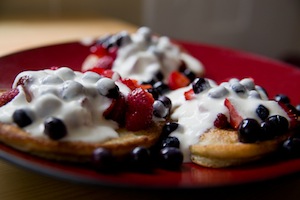
- 2 whole eggs beaten
- 1/2 c milk (or unsweetened almond milk or water); omit this step if you like thicker pancakes
- 1 tsp baking soda
- 1tsp vanilla
- pinch of salt
Mix in the wet ingredients. Then sprinkle the baking soda and salt over the surface of the batter and thoroughly mix it in.
Make sure the pan is hot and add a generous amount of fat (ghee, coconut oil, lard etc) to the pan. When fat is shimmering ladle pancake batter into the pan. Allow pancakes to cook almost all the way through before flipping. You can either continue to add fat before each new pancake or not. With more fat the pancakes are almost like fritters, with less they are more like typical pancakes.
Step four
Top with fruit, butter, kefir cream, whipped cream, coconut butter or coconut milk. You can also add a small amount of honey if you don’t have blood sugar issues, but I find they are sweet enough with the fruit alone.
*If you’re lactose intolerant, try making homemade yogurt and fermenting it for at least 24 hours. That will almost completely eliminate the lactose, and it’s likely you’ll be able to tolerate it.

Better supplementation. Fewer supplements.
Close the nutrient gap to feel and perform your best.
A daily stack of supplements designed to meet your most critical needs.

These are just brilliant! Making them with flax eggs as my son is egg-intolerant. Wonderful.
I’m new to fermenting. When soaking the buckwheat groats, do you mix them with the yogurt, or simply cover the top of them?
Thanks,
Kay
I actually commented on your original recipe not realizing this one has updated it. I have the same question about using starter that someone else asked above.
A traditional buckwheat crepe or 49er style pancake would be made with starter that has been fed the night before. Or in some cases with unfedstarter. Either way most of the starter will have been fermenting for Much more than 24 hours and with a fully developed culture. So it’s a true traditional fermented food – and even when fried the pancake has the unmistakable smell and taste of an active ferment.
The “tweak” of soaking overnight in yogurt or kefir does add in live LABs. But yogurt and kefir LABs don’t culture all that well in grains. And I guess I still have a prejudice that a traditional fully fermented sourdough cake might be healthier – perhaps in ways we don’t understand. But maybe not? You tell me!
Anyway really … Just wondering about your thoughts on how traditional starters affect the nutritional value of grains. And also whether you’d recommend buckwheat starter for those who have the inclination and the refrigerator space to maintain one.
Thanks!
hi,
(from hamburg, germany 🙂
tried your pancakes this morning and they were great.
topped them with some leftover mango-banana-sauce.
thank you for sharing the recipe.
Has anyone tried to make buckwheat sourdough breadcrumbs the fermented grouts like this? I would love to have a continuously supply like you do with traditional sour dough.
Recipes welcome!
I loved these pancakes but I would appreciate learning why one has to wash the original yogurt off the buckwheat and then blend in the fresh. Wouldn’t one get a better, stronger taste of ‘sour’, if you just blended up the fermenting mixture?
I made some changes on the pancakes – I use 1.5 cups buckwheat groats and adjust the recipe accordingly. I like to make a lot so they last for a week for the whole family. Here are some things I do to make them more flavorful: I add less yogurt (when you puree the groats) and less liquid…instead I add melted butter or coconut oil and molasses (gives them that gingersnap cookie flavor). I also add 1 TBSP vanilla (more than the recipe calls for) and 1 TBSP pumpkin pie spice (I make my own, but you can purchase this in a store). I add more salt than he calls for and sometimes I will finely chop a carrot or zucchini in the food processor and add that to the pancakes. Sometimes I will also add chia or hemp seeds. Sometimes I will add a mashed banana for sweetness. I use a large electric griddle so I can cook 8 pancakes at a time. I grease the griddle with coconut oil and cook the pancakes in that. Keep it on a medium temperature because these pancakes seem to burn more easily than regular pancakes. I keep my griddle at 300 degrees.
They sound like fabulous tweaks Liz !! I can’t wait to try.
Thanks for the recipe!
I have two questions about the first step.
1. Is the acidity of the yogurt required or the probiotics in it? I usually use store bought goat yogurt which is not really a yogurt, just a sour tasting milk goat with some fibers (no probiotics added and the milk is pasteurized). Will it work with such a “yogurt”?
2. Can I soak the groats in a mixture of water and wheat-based sourdough starter instead of the yogurt? I consume (mostly fermented) wheat products in general and I don’t mind about gluten. I also have sourdough discard to spare.
Many thanks! I can’t wait to make these. Buckwheat is so delicious and the pancakes look great.
I was planning on making those to test my tolerance to buckwheat but it comes before the eggs reintroduction… 🙁 I guess I’ll just find something else.
Why must this mixture be kept at room temperature? Does the refrigerator interfere with the process?
Refrigeration slow the fermenting process which is the point of sour dough.
I discovered a couple ways to improve on Chris’ already amazing recipe. I found the batter a tad too thin, even though I always omit every kind of milk, so I added 1 teaspoon of apple cider vinegar; voila, a beautifully thick batter resulted, with no separation occurring during refrigeration…ever. I also forego the yogurt soak, choosing instead to let the groats germinate 2 days in a strainer, then toss them in the blender on top of one cup yogurt, and add the remaining batter ingredients ( I find that 1/2 tsp salt is perfect). For those like me who are trying to eat sugar-free, one dropper of rabaudiana stevia extract sweetens just enough, with zero aftertaste. Add the vinegar last, as it causes the batter to expand instantly. It’s best to stop your blender and whisk it in by hand to avoid an overflow. Pure maple extract is a nice variation to vanilla. Even my non-healthfood eating brother finds these irresistible. He’s the acid test!
I was eager to try this recipe, but find it wasteful that one would toss yogurt in such a nonchalant manner. I lived in a third world country for years (and now live in France, where ingredients and even some of their discards are given respect), and throwing away ingredients that are not spoiled is something that I cannot do. Is that step truly necessary? I found a recipe at cultures for health where the buckwheat is soaked in yogurt or kefir and not thrown away (yes, that is the recipe I will be trying).
I have made the original version soaked in water, then rinsed, blended with more water and soured again. THEN I added yoghurt to the final blend instead of milk. Very fluffy pancakes and no waste.
Think that was Chris’s original recipe… which I came on-line looking for.
I just couldn’t find it as the amended recipe seems to over-ride it. Might the new one be ‘yoghurt soaked pancake’ perhaps so we can enjoy the choice. I loved the original and note other objections to the new…. so……
CHRIS please would you label the original recipe ‘fermented buckwheat pancakes’ to make it search friendly by your friends over here in the UK. Thanks
I use a fab ground SPROUTED buckwheat which I fermented in water very successfully with soaked almonds (this time I’m trying soaked cashews) and I got just the runny consistency that I wanted, which was a lovely thin crepe consistency just like we used to eat in France. BRAVO!!!
I was shocked, too, at no mention being made of how to possibly reuse the yogurt that the buckwheat was soaking in. If it is somehow bad for us, maybe it would be okay for livestock and certainly for the garden or compost pile. At least these things should be mentioned.
In an effort to make this more economically, could the 2 cups of soaking yogurt be modified to 1 cup yogurt, 1 cup filtered water?
Still ”no-one” has answered ”anyone” about why you rinse off the first lot of yogurt… so wasteful.
I grind my buckwheat to flour first.
I then just soak my flour in whole kefir, (not just whey), overnight and have perfect pancakes in the morning. I put in almost as much kefir as the recipe calls for liquid, and make it up to the preferred consistency with water in the morning.
I also culture a pot of cream overnight with a tbsp of whole kefir, and have lovely cultured cream to put on those suckers… all fresh and fantastic.
Ooops. I meant to post this as a new comment, but accidentally put as a reply to some comment made several years ago.
Chris, could you please notate the original directions somewhere–the ones using water instead of yogurt? I can’t do any dairy, of any sort, at any time, so the yougurt version is out for me. We just discovered and made your recipe (the water one) a few weeks ago, and I hadn’t yet had a chance to print it out yet. Thanks!
Finally made this – wow they’re fantastic 🙂
Slight modification – I only soaked in 1cup for 24 hours, then instead of rinsing I just added 2 more table-spoons and made as directed. Very nice
Second time I used home-made yoghurt which was much thinner. Soaked with 2 cups for 24 hours, again didn’t rinse but instead just sieved out 3/4 cup 🙂 Made as directed – also great!
i used to make butter milk (wheat) pancake before cutting out gluten.
this looks like one can also use butter milk (whole fat) as well. ^_^
thanks. cheers,
i tried both soaking in kifir or buttermilk. both works really well,
i found if i mix 0.5 – 1 TB of starch (potato or sweet potato or tapioca), it sticks together more easily.
yummy w/ sour cream or creme Frachie + fruits.
but it also spiked my BG momentarily to 180 @ 45 min. postcrandial. although it did come down to < 83 in < 3 hr.
cheers,
Me too please Chris
Do keep your original recipes
Might amendments be counted as new recipes please???
xx
Tapioca is one of the most toxic natural “foods” (it’s more of a poison than a food, at least for a human). It may give you all sorts of health problems in the long run.
As for the blood glucose spike: I would ferment the fruits before adding them in a recipe. That’s what causing your blood sugar spike.