
Summary
Sorry, folks. Another long one. It was unavoidable, though, because I really did want this to be a “definitive guide” that covers all (or at least most) of the relevant issues involved with choosing a fish oil. Here’s a summary for the time-challenged:
- There are seven important factors to consider when choosing a fish oil: purity, freshness, potency, nutrients, bioavailability, sustainability, and cost.
- Not all fish oils are created equal. It’s essential to do your homework and make an informed choice. Many fish oils are oxidized or made with poor quality ingredients, and may actually cause health problems instead of solving them.
- The potency of various products depends not only upon the levels of EPA and DHA, but also upon the molecular structure of the fats in the oil, which in turn affects absorption.
- Natural fish oils are better absorbed than purified fish oils. Preliminary evidence suggests that krill oil (KO) may be better absorbed than fish oil, and anecdotal reports indicate that KO may be more effective for some than fish oil for reducing inflammation in some people.
- Many fish oils are made from fish that are endangered. Choose products made from fish that are certified by organizations such as the Marine Stewardship Council.
Introduction
So far in this series we’ve looked at why fish is superior to plant-based sources of omega-3. We’ve examined the importance of reducing consumption of omega-6 fats. We’ve considered how much omega-3 is needed to support health and treat disease. We’ve revealed that concerns about the safety of fish consumption have been overblown, and that eating fish regularly is not only safe, but incredibly beneficial. And in the previous article we compared the benefits of eating fish to taking fish oil.
In this final article of the series we’re going to take a closer look at fish oil. Fish oil has become wildly popular these days. Most people who are at least relatively health conscious understand that they need omega-3 in their diet, and are probably not getting enough from food (unless they eat a lot of fish).
Health care practitioners have caught on, too. I constantly hear both conventional and alternative practitioners telling their patients to take fish oil. In fact, I was listening to a podcast last week by one popular health and fitness guru in the paleo/primal world, and he advises his clients to take up to 20 grams of fish oil a day. That made me cringe.
Why? Because what most people – including health care practitioners – don’t seem to understand is that not all fish oils are created alike. There’s a tremendous difference in the ingredients, purity, freshness and therapeutic benefit of the fish oils available today. The supplement industry is rife with false claims and unsavory companies that are far more interested in profiting on the fish oil craze than they are in your health and well-being.
Recommending that people take up to 20g/d of fish oil without conveying the importance of choosing a high quality fish oil, and teaching them how to do that, is irresponsible and possibly dangerous. Taking 20g/d of a poor quality, oxidized fish oil could dramatically increase oxidative damage and inflammation – which is of course exactly the opposite of the desired effect.
In this article, I’ll focus more on dispelling common misconceptions about fish oil and helping you to choose the best product for your needs.
Factors to consider when buying fish oil
There are seven primary variables to be aware of when shopping for a fish oil:
- Purity. The oil must meet international standards for heavy metals, PCBs, dioxins and other contaminants. Many do not – even when they claim they do.
- Freshness. Omega-3 oils are susceptible to oxidation, which makes them rancid. Rancid oils are pro-inflammatory and contribute to the diseases you’re trying to relieve or prevent by taking fish oil in the first place!
- Potency. In order to have the desired anti-inflammatory effect, fish oil must contain an adequate amount of the long-chain omega-3 derivatives EPA and DHA. DHA is especially important.
- Nutrients. All fish oils contain some amount of EPA and DHA. However, fish liver oil (from cod, skate or shark) also contains naturally occurring fat-soluble vitamins that are difficult to obtain from foods.
- Bio-availability. The ability to absorb the beneficial components of fish oil is based on the molecular shape of the fatty acids. The more natural the structure the better.
- Sustainability: The fish should be harvested in a sustainable manner and species that are under threat should be avoided.
- Cost: the product must be relatively affordable to be practical for most people.
Purity
Many species of fish are known to concentrate toxic chemicals like heavy metals, PCBs, and dioxins which can cause serious disease, especially in children and developing fetuses. In a previous article I explained how these chemicals are typically not a concern when eating whole fish, because fish also contain selenium. Selenium binds to mercury and makes it unavailable to tissues, thus protecting against any damage it may cause.
And while fish constitute only 9% of our dietary intake of dioxins and PCBs, high doses of fish oils taken every day (as is often recommended) may raise this percentage significantly and expose us to undesirable levels of these toxins.
To address this, fish oil manufacturers use a process called molecular distillation to remove the toxins from the oil. When done correctly, molecular distillation is capable of reducing the toxins in fish oil to levels considered to be safe by the EPA and other agencies.
Although almost any fish oil manufacturer will tell you their product is free of these toxins, independent lab analyses tell a different story. Just last month (March, 2010), a lawsuit was filed in California court against the manufacturers of ten popular fish oils because they contained undisclosed and (possibly) unsafe levels of contaminants.
Unfortunately, this kind of deception is all too common in the supplement industry. That’s why it’s essential that you ask for something called a Certificate of Analysis (COA) from the manufacturer before you buy their product. A COA is an analysis performed by an independent lab to measure the ingredients of a product and confirm whether it lives up to the claims made by the manufacturer.
If the manufacturer won’t provide a COA, I start to get suspicious. This is standard practice in the industry and there’s no reason they shouldn’t be happy to show you theirs. Make sure that the independent lab they use is in fact independent and is preferably accredited, sponsored by a government agency, or has a solid reputation in the field.
This may seem like unnecessary paranoia, but when it comes to the possibility of ingesting powerful neurotoxins, it pays to do your homework.
In general, fish that are lower on the food chain like sardines and anchovies naturally have a lower concentration of contaminants. For this reason, it may be wise to look for a product made from these fish.
So what levels of these toxins are safe? As you might imagine, there is some disagreement on this question since there is no single governing body that determines acceptable levels. However, the standards that are most often followed by fish oil manufacturers are summarized in the table below.
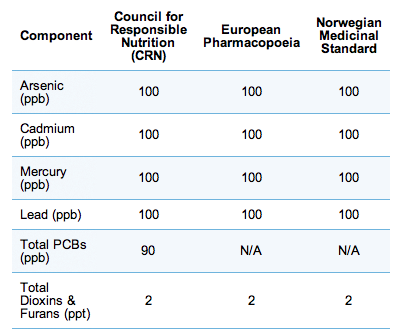
* ppt = parts per trillion
* ppb = parts per billion
In a previous article we discussed selenium’s protective effect against mercury toxicity. If you are taking large doses of fish oil, and not eating any whole fish, it may be wise to ensure another regular source of selenium. Brazil nuts are by far the highest dietary source, with 1917mcg of selenium per 100g. (But they are also very high in n-6, so watch out!)
Freshness
I have written extensively about the dangers of oxidized, rancid oils. They promote oxidative damage and increase inflammation, both of which are risk factors for nearly every modern disease. The more unsaturated an fat is, the more vulnerable it is to oxidation. Long-chain, omega-3 fats found in fish oil are the most unsaturated of the fats, and thus the most susceptible to being damaged.
This is why it’s absolutely crucial to ensure that the fish oil you select is fresh and not rancid. Once it has gone rancid, it will have the exact opposite effect on your body than you want it to.
The first thing to do is to check something called the “peroxide value” on the COA. This is a measure of rancidity reactions in the oil that have occurred during storage. and should be less than 5 meq/kg.
If this checks out, and you decide to order that product, break open a capsule once you receive it. There should be no “fishy” odors. They should smell like the ocean, but not like a rotten fish. They should also not have a strong lemon or lime scent, which could be an indicator that the manufacturer is trying to mask the rancidity.
A common misconception is that you can determine the quality of a fish oil by freezing it. The theory goes that if you freeze the oil and it is cloudy, it’s rancid. That is not the case. All fish contain saturated and monounsaturated fatty acids, albeit in small amounts. These fatty acids make the capsules appear cloudy when frozen in products that contain whole fish oil (i.e. Vital Choice’s Wild Salmon Oil).
Potency
This is another area surrounded by significant controversy. Some argue the levels of individual constituents in fish oil aren’t paramount. Scientists discovered the healthful effects of omega-3s by studying people with fish-heavy diets, before supplemental fish oil even existed. Clinical trials using supplemental fish oils over the past few decades have contained widely variable levels of both long-chain omega-3 derivatives (EPA and DHA), and not super-high concentrations of either or both.
However, due to poor conversion of ALA to EPA and DHA, unless you are eating fish it is very likely you are deficient in long-chain omega-3s.
Following this line of reasoning, the DHA content in particular of fish and fish oils does seem important if we wish to obtain the best possible therapeutic effect. Many recent studies demonstrating the anti-inflammatory potential of fish oil used a daily dosage of DHA in the range of 1-3 grams. What’s more, foods like salmon roe that have been prized by traditional cultures for their nourishing and healing effects contain large amounts of DHA. A single 6 oz. serving of salmon roe contains 1 g of DHA. (In fact, this would be the best way by far of supplementing with DHA if money were no object. (Unfortunately, wild salmon roe goes for about $28/serving.)
The suggested DHA dose will of course depend upon the condition being treated. If you have a chronic inflammatory condition (heart disease, arthritis, Crohn’s or ulcerative colitis, etc.) I would suggest taking between 1 and 2 grams per day. If you are taking it simply for health maintenance, 500 mg is probably sufficient.
Unfortunately, many fish oils do not have significant amounts of DHA. This means you’d have to take an impractically high number of capsules each day to obtain the therapeutic dose. This is not desirable, since all unsaturated oils (including fish oils) are subject to oxidative damage. We don’t want to take large quantities of them for this reason.
Remember to check the label and ensure that your product has approximately 200-300 mg of DHA per capsule. This will allow you to achieve the therapeutic dose by taking no more than 3 capsules twice a day.
Nutrients
All fish oils contain some amount of EPA and DHA, the long-chain omega-3 derivatives that provide the majority of the anti-inflammatory benefits seen in studies. However, fish liver oils (from cod, skate or shark) contain significant amounts of vitamins A and D in addition to EPA and DHA. Vitamins A and D are fat-soluble nutrients that are crucial to human health. Vitamin D, in particular, is difficult to obtain from commonly eaten foods – especially now that eating seafood carries a much higher risk of contamination with toxins.
Fermented cod liver oil is even more beneficial, because it contains vitamin K2. Vitamin K2 has been called “the missing nutrient” because it was only recently discovered, and many people are deficient in it.
It has been commonly believed that the benefits of vitamin K are limited to its role in blood clotting. Another popular misconception is that vitamins K1 and K2 are simply different forms of the same vitamin – with the same physiological functions.
New evidence, however, has confirmed that vitamin K2’s role in the body extends far beyond blood clotting to include protecting us from heart disease, ensuring healthy skin, forming strong bones, promoting brain function, supporting growth and development and helping to prevent cancer – to name a few.
Cod liver oil was traditionally processed by fermentation, which is likely to make it more absorbable and bio-available. Processing by fermentation also avoids the use of heat, which can damage the fragile fatty acids and cause fish oils to go rancid. Unfortunately, I am aware of only one company that sells fermented cod liver oil at this time (see below).
Bio-availability
The ability to absorb the beneficial components of fish oil is based on the molecular shape of the fatty acids. In short, the more natural the structure and the less it is chemically altered, the better.
This is true for any nutrient, of course, and it explains why I am always in favor of obtaining nutrients from food or food-based sources when possible. Each additional step in processing from the natural state of a food to extract or isolate nutrients introduces the potential of damaging the nutrient, or changing it’s chemical form so that it’s more difficult to absorb or affects the body in a different way.
When it comes to fish oils, there are three forms currently available on the market:
- Natural triglyercide oil. This is what you get when you “squeeze” the whole fish and extract the natural oil from it. It is the closest to eating fish oil in its natural form, and is highly bioavailable. The drawback of this form is that, because it’s not concentrated, it usually has low levels of EPA and DHA. And because it isn’t purified, it can have high levels of contaminants such as heavy metals, PCBs, and dioxins.
- Ethyl ester oil. Occurs when natural triglyceride oil is concentrated and molecularly distilled to remove impurities. The ester form is still in a semi-natural state because it is the result of a process that naturally occurs in the body. The advantage to this form is that it can double or triple the levels of EPA and DHA.
- Synthetic triglyceride oil. This form occurs when natural triglycerides are converted to ethyl esters for concentration (as above), but then re-converted into synthetic triglycerides. The original position of the triglyceride’s carbon bonds change and the molecule’s overall structure is altered, which impacts the bioavailability of the oil.
Studies on absorption of the various types of fish oil suggest that, unsurprisingly, the natural triglyceride form is absorbed better than the ethyl ester form, which in turn is absorbed better than the synthetic triglyceride form.
One study by Lawson & Hughes in 1988 showed that 1 gram of EPA and 0.67 grams of DHA as natural triglycerides were absorbed 3.4 and 2.7 fold as well as the ethyl ester triglycerides.
In the previous article we saw that fish oils were better absorbed when taken with a high-fat meal. In another study by Lawson & Hughes later the same year, they showed that the absorption of EPA & DHA from natural triglycerides improved from 69% with a low-fat meal (8g total fat) to 90% with a high-fat meal (44g total fat). Absorption of both EPA and DHA from ethyl ester oils was increased three-fold from 20% with a low-fat meal to 60% with a high fat meal.
What about krill oil?
In addition to the three types of fish oil listed above, there is another type of oil that provides EPA & DHA: krill oil. Krill oil (KO) is extracted from Anarctic krill, Euphausia superba, a zooplankton crustacean rich in phospholipids carrying EPA and DHA. Krill oil also contains various potent antioxidants, including vitamins A & E, astaxanthin, and a novel flavonoid whose properties are not yet fully understood.
Krill oil has a unique biomolecular profile that distinguishes it from other fish oils. While EPA and DHA in fish oils comes in the form of triglycerides, the EPA and DHA is already incorporated into phospholipids, which facilitates the passage of the fatty acids through the intestinal wall. This increases the bioavailability of the EPA and DHA and improves absorption and assimilation.
Werner et al demonstrated essential fatty acids in the form of phospholipids were superior to essential fatty acids as triglycerides in significantly increasing the phospholipid concentrations of EPA and DHA in mice.
In a human study, Bunea et al compared the effect of krill oil and fish oil on blood lipids, specifically total cholesterol, triglycerides, LDL, and HDL. Krill oil was given at dosages of 1g/d, 1.5g/d, 2g/d or 3g/d, and fish oil was given at a single dose of 3g/d. The authors found the following:
- KO at a daily dose of 1g, 1.5g, 2g or 3g achieved significant reductions of LDL of 32%, 36%, 37% and 39% respectively. Patients treated with 3g fish oil daily did not achieve a significant reduction in LDL.
- HDL was significantly increased in all patients receiving KO. HDL increased 44% at 1g/d, 43% at 1.5g/d, 55% at 2g/d and 59% at 3g/d. Fish oil taken at 3g/d increased HDL by only 4%.
- KO did not decrease triglycerides significantly at 1g and 1.5g. However, KO reduced triglycerides by 28% at 2g/d and 27% at 3g/d. Fish oil at 3g/d did not achieve a significant reduction of triglycerides.
- Blood glucose levels were reduced by 6.3% in patients receiving 1g/d and 1.5g/d of KO, and 5.6% in patients receiving 2g/d and 3g/d of KO. A daily dose of 3g of fish oil reduced blood glucose by 3.3%.
Thus, in this study krill oil led to a significantly greater improvement in blood lipids compared to fish oil.
Note that the dosage of KO that obtained the best results, either 2g/d or 3g/d, is quite high. However, study participants received a maintenance dose of 0.5g/d for another 12 weeks after the therapeutic period of the study ended. These patients maintained the reductions in total cholesterol they attained in the study, and LDL, triglycerides and blood glucose were further reduced from baseline. There was a moderate decrease (of 3%) in HDL, but HDL was still significantly increased from baseline.
There is also unpublished research suggesting that 300 mg/d of KO reduces biochemical and subjective measures of inflammation and improves joint function and mobility in patients with rheumatoid arthritis (RA).
However, as this research is not published or peer-reviewed, and was sponsored by Neptune Technologies (the manufacturer of Neptune Krill Oil (NKO), I am cautious about interpreting its results.
So what does all of this information about bio-availability tell us?
- Taking fish oil capsules with a high-fat meal is essential to improve absorption of EPA and DH.
- Even when taken with a high-fat meal, ethyl ester oils are absorbed only 66% as well as natural triglyceride oils.
- Krill oil appears to significantly improve blood lipids when compared to fish oils, possibly because of its unique phospholipid structure.
Sustainability
The sustainability of fish oil production is difficult to gauge. Some oils are produced as a byproduct of fish harvesting, and manufacturers claim that they are simply making use of something that would normally be discarded. While this is certainly better than harvesting fish solely for their oil, it still supports harmful fishing practices.
The safest bet is to only use fish oil that is made from fish that are certified by MSF or a similar organization, such as the Environmental Defense Fund. Vital Choice Wild Salmon Oil is one example, as is Jarrow Max DHA (which is made from anchovies and sardines, both of which are generally regarded as safe to eat from an environmental standpoint).
Cost
I cover cost in the recommendations section below.
Recommendations
Note: I have no affiliation with any of these companies. These are simply the products I recommend based on my research. It’s very likely that there are other good products that I missed in my search. This is not an exhaustive list.
Which product you might choose from this list depends in large part upon what your goals are.
I have provided product recommendations in two different categories: baseline, and supplemental. Those wishing to to maintain health and ensure adequate nutrient intake should choose a product from the “baseline” category. Those who are dealing with a chronic inflammatory condition should also choose a product from the baseline category, but should consider adding a product from the “supplemental” category.
However, keep in mind that the absorption of the natural triglyceride oils (like the Wild Salmon Oil and Fermented Cod Liver Oil below) will be 1.5 times greater than the ethyl ester oils in the supplemental section. As a rule of thumb, all purified and molecularly distilled oils are ethyl esters.
This means you have to take 1.5 times as much of the ethyl ester oils to get the same dose of DHA that you’d get from the natural triglyceride oils. For example, Vital Choice Wild Salmon Oil has 220 mg DHA per serving. To get the same amount of DHA from Jarrow Max DHA, which is an ethyl ester oil, you’d have to take a serving that provides 333 mg of DHA.
Baseline
Green Pastures Fermented Cod Liver Oil and Butter Oil Blend (GP FCLO)
Ingredients: about 270 mg omega-3 (about 139 mg EPA, 83 mg DHA), about 1,100 IU vitamin D, about 2,300 IU vitamin A. Values listed are approximate (see disadvantages).
Price: $47.00 for 120 capsules, 2 capsules per serving. $0.78/serving.
Advantages: a whole-food product in its natural form, rather than a supplement. Is relatively low in EPA & DHA compared to other products, but contains high levels of vitamin D, as well as vitamins A & K. The fat soluble vitamins A, D & K2 are important co-factors and likely improve the absorption and assimilation of EPA & DHA. Addition of grass-fed butter oil increases levels of K2. Cold-processed with fermentation, which means this is the least oxidized product available.
Disadvantages: levels of PCBs are posted on Green Pastures’ website here, but I’ve been unable to obtain information on heavy metals or dioxins. The EPA and DHA levels are what would be expected in a whole food product, but may not be high enough for a significant anti-inflammatory effect. Values for vitamins A, D, EPA and DHA are approximate and vary batch to batch due to fermentation processing method. Peroxide values are not provided, but because it is processed without heat they are likely to be very low.
Notes: because fermented cod liver oil contains vitamins A, D and K2 in addition to EPA and DHA, and because most people are deficient in some or all of these nutrients, this is currently the only product I recommend to everyone – patients, family and friends – regardless of their health status.
Vital Choice Wild Salmon Oil (VC WSO)
Ingredients: 600 mg of omega-3 (240 mg EPA, 220 mg DHA), 340 IU vitamin D, 2,060 IU vitamin A (per 3 1,000 mg softgels).
Price: $40 bottle, 180 capsules. 3 capsules/serving, $0.68/serving.
Advantages: processed without heat using micro-filtration, which retains naturally occurring vitamins A and D. Fatty acids are in their natural triglyceride form, which makes them more absorbable. Also contains astaxanthin, which protects the oil from oxidative damage and rancidity. Contains more EPA and DHA than GP FCLO. Nutrient levels are more consistent from batch to batch and certification is performed by independent, not-for-profit organization (NSF International).
Disadvantages: when compared to GP FCLO, does not have vitamin K2 and the dose of vitamin D is significantly lower. Otherwise no disadvantages.
Supplemental
Ingredients: 600 mg of omega-3 (250 mg DHA, 36 mg EPA) per capsule; one capsule is one serving.
Price: $14.85 (at Vitacost) for 180 capsules. $0.08/serving.
Advantages: even after considering the differences in absorptions between Jarrow Max (an ethyl ester) and the two natural triglyceride oils listed above, Jarrow Max is significantly cheaper. It’s possible to get 1g/d of DHA for $0.32. Made with anchovies and sardines, both of which are naturally low in contaminants. Jarrow faxed me their certificate of analysis, which checked out fine. This is a good choice for those wishing a high-dose of DHA in addition to eating fish or taking one of the natural triglyceride oils above.
Disadvantages: has a 7:1 ratio of DHA to EPA. Although I believe DHA to be more beneficial than EPA, the research is mixed on this and some people report that they do better with EPA.
Ingredients: 350 mg DHA, 50 mg EPA per serving, 2 capsules per serving.
Price: $21.95 for 60 capsules. $0.73 per serving.
Advantages: I received several emails from vegetarians asking me what I recommended they do to meet DHA needs. This is a DHA/EPA blend derived from marine algae, which is where oily fish get EPA & DHA in the first place. The algae in this product is organically grown and 100% free of toxins and contaminants. The capsules are quite small and can be easily swallowed.
Disadvantages: I haven’t seen much research on the marine-algae DHA/EPA blends. Although it’s plausible to assume their effects would be similar to fish oils, I’d like to see some studies backing that up. Likewise, I don’t know much about V-Pure as a company. Another potential issue is that the capsules have carrageenan in them, which has been shown to exacerbate intestinal inflammation in several studies. People with gut problems like IBS and IBD may want to avoid this product. Finally, at $0.73/serving this product is expensive. To get a therapeutic dose of 1g/d taking this alone, you’d have to take 9 capsules per day which be 4.5 bottles/month, or almost $100!
Tentatively Recommended
Ingredients: 300 mg of omega-3 (90 mg DHA, 150 mg EPA) per serving, two capsules per serving.
Price: $16.86 for 60 capsules. $0.56/serving, 2 capsules per serving.
Advantages: KO has a unique phospholipid structure that appears to improve the absorption of EPA & DHA. At least one study suggests that KO is superior to fish oil in improving blood lipids. KO also contains vitamins E & A, as well as astaxanthin, an antioxidant claimed to be 10 times more potent than other carotenoids. KO capsules are much smaller than fish oil capsules, are easier to swallow, and many report they don’t cause the burping common with other fish oil capsules. Several anecdotal reports suggest that krill oil can be more effective than fish oil in reducing inflammation for some people.
Disadvantages: there are few studies demonstrating the effectiveness of KO, whereas fish oil has decades of research behind it. Most of the studies that do exist on KO were sponsored by Neptune, the largest manufacturer of KO. The dosages used in the study on KO and blood lipids were very high, and taking KO at those dosages would be expensive. (However, the therapeutic dose of 2-3g/d would only be necessary for 12 weeks, as the maintenance dose of 0.5g seemed to maintain the benefits attained during the therapeutic period.) The sustainability of krill harvesting is controversial.
The reason KO gets a tentative recommendation is that there’s still comparatively little research supporting its use, and because I am still uncertain about the environmental impact of harvesting the krill for the oil. If you have information to share on either of these questions, I’m all ears!
Like what you see? Join more than 30,000
others and subscribe for email updates.
I hate spam too. Your email is safe with me.
Follow Chris Online:
Not a diet for everyone.
A diet for you!
Discover your own ideal diet & end confusion about what to eat forever.
Learn More
Have the healthy baby you've always dreamed of.
Boost fertility naturally & promote lifelong health for you & your baby.
Learn More
Personal Paleo Launchpad
Personalized online portal with easy-to-use tools, expert advice, and the support of a passionate, intelligent community.
Learn More
Paleologix Paleo Support System
Break through the energy swings, digestive upset, and obstacles of adopting a Paleo diet.
Learn More
{ 223 comments… read them below or add one }
Thanks for this info! I realize you made a point of saying that this is not an extensive list; still, I’m surprised that Nordic Naturals is not on here.
P.S. Enjoyed your recent interview with Stephen!
Thanks for distilling all your research, this is very helpful!
There is a typo:
…ethyl ester form, which in turn is absorbed better than the ethyl ester form
Thanks for catching that. Clearly my proofreader (ah hem, that’s me) is overworked.
I am 67 and just today am starting to take fish oil after reading your info I am curious how my brand stacks up. Spring valley enteric coated fish oil 1000 mg / 300 mg omega. 3
Thanks. Bachi
I have been using Source Natural’s omega 3 fish oil capsules. When I contacted them for the COA customer service told me that Artic Pure (supplier of the oil) would not give the COA to consumers. If that remains the case, this consumer will go elsewhere.
Thanks for updating us on the Source Natural product, John. It could be that it’s fine, but as I said, I get very suspicious when they won’t provide a COA. Since there are plenty of other companies that will, I don’t see a reason to buy from one that won’t.
Hi Chris,
I am curious to know that I have knee joint pain (Osteoarthritis); in this condition which Fish Oil (Cord Liver or Salmon) would you suggest.
Appreciate your help.
Thanks,
V
Nice article. I appreciate the thorough research embodied in it. I plan to make some purchases based on your recommendations.
I was surprised by your endorsement of cod liver oil. Would you like to address the citations presented by John Cannell asserting that the Vitamin A in liver negates Vitamin D activity?
http://www.vitamindcouncil.org/newsletter/2008-december.shtml
http://www.vitamindcouncil.org/newsletter/vitamin-d-vitamin-a-and-cancer.shtml
P.S. Here’s another job for the proofreader (or I misunderstood it):
” There was a moderate decrease (of 3%) in HDL, but HDL was still significantly INCREASED from baseline.”
Moises,
That’s not a typo. What I was saying is that HDL decline by 3% on the maintenance dose from the high point it reached during the active treatment phase of the trial, but even after that 3% decline was still significantly elevated compared to where it was before any treatment. Make sense?
Regarding Cannell’s assertion about vitamin A, I don’t buy it at all. None of the studies he refers to suggest causation – they only show correlation. Correlation is not causation. Remember that the confusion of the two is what confounded cholesterol research for decades and led us down a ridiculous dietary path.
Read these articles for more:
http://www.westonaprice.org/blogs/more-attacks-on-vitamin-a.html
http://www.westonaprice.org/blogs/further-questions-on-vitamin-a.html
Vitamin A does compete to some degree with vitamin D for absorption, but on the other hand vitamin A is an important co-factor for the absorption of vitamin D.
In situations where science and evolutionary nutrition conflict, I’m far more likely to trust what our ancestors ate.
Thanks for all the info Chris.
I went to vitacost to take a look at the Jarrow product you listed and found another Jarrow product called “Jarrow Formulas Max DHA Liquid Delicious Lemon” which might be better. It is still DHA dominant (750 mg DHA/450 mg EPA) but not as much as the capsules.
http://www.vitacost.com/Jarrow-Formulas-Max-DHA-Liquid
I’ve been using Carlson’s liquid fish oil, but I think I might give this Jarrow product a try in my next order.
Thanks for the tip on the Jarrow DHA liquid. One potential issue for some is that it contains soy. However, unless one has a true allergy my guess is that the amounts are minimal. 2 tsp. of this oil give you up to 1.6g of DHA, so it seems like a good choice – especially for those who have trouble swallowing the fish oil capsules. The reviews say that kids will take it, which probably means that the taste isn’t too objectionable.
This is exactly what I was looking for in the comments. I need a liquid form! Can NOT do the capsules unfortunately. Will check out the Jarrow. Thanks for this article.
Thank you for this list! I have bleeding issues with EPA and it never occurred to me that a fish-based omega-3 supplement existed that was predominantly DHA with so little EPA. This may work very well for my son and me and if it does, I’ll recommend it to my mom too.
Chris,
Thanks for the quick response to my question about Vitamin’s A and D. I will need to spend some time reviewing the evidence.
Perhaps I should do an interventional study with n=1, on myself. Take D alone, and then take it with A, then drop the A out again, and see how my 25(OH)D levels vary. Maybe there’s an easy way to measure blood levels of A. I’ll have to look into this.
Regarding the HDL, I guess I confused the matter even more because I “corrected” your text to what I thought it should have been by capitalizing the word “INCREASED.” Your text has “reduced.” Your comment above suggests that my interpretation was correct.
Thanks for the correction, Moises.
You need to calculate the amount of the useful component per unit of product. The concentration, like you said. Because every pill is a different size, and “serving size” is made up.
Each pills varies in size and concentration and composition. I’ll spoil the results for you: That Vital Choice is 15% EPA+DHA. That Jarrow is 48% EPA+DHA. NOW ultra omega is 75% EPA+DHA. And it is a 2:1 ratio of EPA:DHA commonly used in studies because it is commonly found in fish.
PS: the better absorption of undistilled oil is irrelevant because undistilled oil is a cocktail of contaminants. No doctor recommends supplementing with extra PCB and heavy metal. Every government in the world recommends capping even whole fish consumption very aggressively.
I’ve addressed all of your comments extensively in the other articles in this series. Please read them here.
I’ve made the case that DHA is more important than EPA for several reasons. See here. Also, there’s a lot of evidence suggesting that oxidation of EPA contributes significantly to aging.
The better absorption of natural oils is not at all irrelevant. Vital Choice Wild Salmon Oil is under the acceptable levels on all contaminants. So is the FCLO. Both of these oils have other nutrients and co-factors that the purified oils don’t have, as I pointed out. EPA & DHA aren’t the only considerations.
Concerns about contaminants in fish have been way overblown, as I described here.
What about Seal oil? I think it’s banned in the USA, but it’s available here in Canada. You can get it for as little as $15 for 300 500mg gelcaps, each containing 40mg of EPA, 50mg of DHA, and 25mg of DPA.
I don’t know much about seal oil, but the same criteria I outlined in the article would apply. Those are fairly low numbers for EPA and DHA, though, so even if it’s well absorbed you may have to take quite a bit of it to benefit. I also question the sustainability and environmental impact of it if it is banned in the U.S.
All Seal products are banned in the US since the Marine Mammal Protection Act (MMPA) was enacted in 1972 in order, mainly, to protect the 600,000 dolphins which were killed by tuna fishing operations each year. The Canadian Harp Seal population is estimated to be between 6.4 and 9.5 million animals, and the annual quota for hunting is about 300 thousand. So it’s not an issue of sustainability, as the seal population is one of the healthiest of any marine stock.
Thanks for clarifying this, Kevin. So the only question, then, is the EPA and DHA levels. You may have to take a bit more of it than you would the salmon oil or cod liver oil to get a therapeutic effect, but otherwise it sounds fine.
Andrew Stoll (Harvard, “The Omega 3 Connection) says that EPA is the critical element. ”EPA is the omega-3 fatty acid with anti-inflammatory actions and promotes heart and joint health,” (from the OmegaBrite web site where Dr. Stoll sells his Omega 3 pills).
It seems to me that the science on this shows mixed results and that for now, if you supplement, it should be both EPA and DHA. But I’d like to know more about your reasons for preferring DHA and the research behind that.
Also, ConsumerLabs.com has tested a dozen or so Omega 3 supplements and gives them ratings based on the tests, which include testing for contaminants. This looks like a good source for finding a supplement that meets your criteria.
This series, by the way, has been excellent and I’ve learned a great deal. I’ve started eating fish again, which I stopped doing because of all the reports of dangers.
Gary,
Thanks for your comment. I explained why I believe DHA may be more important in the first article in the series. In addition to what I wrote there, in vitro studies demonstrate DHA is superior to EPA in inhibiting the expression of inflammatory markers such as pro-inflammatory cytokines, monocyte adhesion to endothelial cells, and cell-adhesion molecules, particularly vascular cell adhesion molecule-1, intracellular adhesion molecule-1, and E-selectin.
Data now demonstrates DHA has important hemodynamic and anti-atherogenic properties. In terms of cholesterol and lipid metabolism, DHA (but not EPA) increases HDL cholesterol and increases LDL particle size, both protective against heart disease. DHA, but not EPA, can also significantly reduce heart rate, blood pressure and platelet aggregation.
Evidence also suggests that DHA plays a more important role in brain health and visual acuity, especially in developing fetuses and infants. DHA deficiency has been linked to Alzheimer’s and cognitive decline.
I agree that the data is mixed, and I could be wrong about this. But a lot of the newest evidence, as well as anthropological evidence, points towards DHA. In any event, if you take Wild Salmon Oil or Cod Liver Oil as I suggest, you’ll get a good amount of both.
Chris,
Since the Green Pastures FCLO and Vital Choice Wild Salmon Oil both contain Vit D and Vit A, I was wondering what amount of Vit A one should try not to exceed. I know how much Vit D I need to consume to keep my Vit D blood tests in a good range. I am not sure how much Vit A should be consumed. What is you opinion on the matter.
I have learned alot from your blog, Thanks for all the hard work
A normal dose of the FCLO and/or Wild Salmon Oil plus maybe eating a serving of beef liver once a week would be a good goal to shoot for with vitamin A.
Alan,
I just came across some research suggesting that the optimal ratio of vitamin A to vitamin D is between 5-8:1. This is roughly what you’d get by following the suggestions I listed above.
I found Jarrow “EPA-DHA Balance” at Whole Paycheck today so I bought some. It claims 420mg EPA and 210mg DHA (or 2:1) per capsule or “softgel”. Of the various and silly-expensive options there this had the highest DHA. So my plan is to take two a day along with two a day of WF-brand cod liver oil for vitamins A and to a much lesser extent D; I’m gonna get most of my D from sunlight, at least until winter.
I’m not interested in the Green Pastures or Vital Choice supps because I think the prices are outrageous. “Oh you can’t put a price on health!” Oh yes you can.
You’ll be fine. Keep in mind, though, that some people can’t synthesize D from sunlight very well. Age and inflammation are two factors that inhibit conversion. Best to have your levels checked to see if what you’re doing is working.
Hi chris, thanks for all the great reading
I read that cooking meat or fish at high temps can destroy some of the omega 3. Any thoughts on that?
Its interesting what you wrote about DHA reducing pro-inflammatory cytokines. I have an assignment for my acupuncture study looking at the effects of acupuncture on rheumatoid arthritis and it seems to work on the same things (cytokine TNF a etc) via the vagus nerve. So both fish oil and acupunture could be good for such inflammatory conditions.
Yes, cooking at hight temps does destroy some of the n-3. They are very fragile and susceptible to oxidative damage. Best to eat some fish raw, or to cook moderately.
There’s a lot of research on the anti-inflammatory effects of acupuncture. Adenosine is another potent mediator, and if you search for “acupuncture adenosine” in Google scholar there should be a couple of good papers that might interest you.
What do you think about fish oil in capsules versus the liquid form?
In general we absorb oils better than capsules. One less step for our digestive system to go through.
Bravo! I maintain a blog about fish oil where I chronicle all the latest research on the benefits of omega-3 from fish oil supplements and I have to say that you have some of the best articles on omega-3 I probably have ever come across! (except my own, of course
)
Allow me to be the healthy skeptic now and raise a few points:
1. There’s no research that I’m aware of that supports the notion that the absorption of synthetic triglycerides is impaired relative to natural triglycerides. The only mention of this is from Xtend-Life discussing it in the context of supporting their product over other products (and it appears you stumbled across their Buyer’s Guide too…
Furthermore, there’s nothing to support the assertion that the carbon bond position of synthetic TG has been altered. If you assume they mean the ester bond, which is where pancreatic lipase acts to break down the triglyceride, then what are our choices for carbon bond positions? Either the carboxyl group has a covalent bond with the first carbon of the fatty acid tail, or it doesn’t. Am I missing something here? I suppose he could mean stereoisomeric triglycerides, but as this study shows, pancreatic lipase doesn’t really care which way the tail bends:
http://www.sciencedirect.com/science?_ob=ArticleURL&_udi=B6WB5-4DW3G0J-1T9&_user=10&_coverDate=12%2F31%2F1958&_rdoc=1&_fmt=high&_orig=search&_sort=d&_docanchor=&view=c&_searchStrId=1405982059&_rerunOrigin=google&_acct=C000050221&_version=1&_urlVersion=0&_userid=10&md5=2610e551662f7d3d1468ec0998344a54
2. It’s interesting to note that the absorption rate of free acids, which aren’t bound to an alcohol base, has been show to be almost twice as high as TG: ( http://www.ncbi.nlm.nih.gov/pubmed/2144420). I suppose they’re probably too unstable to be bottled and sold, however.
3. Krill oil has been touted by people like Dr. Mercola as being free from the toxins that fish are susceptible to, but that’s flat-out wrong according to multiple studies. (such as http://www.ncbi.nlm.nih.gov/pubmed/16183185)
4. There is actually a voluntary testing and certification program called the International fish Oil Standards program, or IFOS. I recommend that people only buy fish oils that have every batch certified by IFOS because they are far more strict than most governing bodies. The reason they’re more strict is because this allows for much higher doses to be taken when trying to treat chronic or severe conditions.
I’m sure I will think of more too.
Marshall,
1. The literature is mixed on this, but this paper and this one both show higher absorption of natural triglycerides than ethyl esters. The second one shows that the absorption of ethyl esters improves with a high fat meal, as I stated in the article. There are other papers showing they are equally well absorbed. But what isn’t controversial is that triglycerides from whole fish are better absorbed than triglycerides from fish oil in any form. I prefer to take products in their least processed, most natural form, so in general I’d choose a natural triglyceride oil over an ethyl ester oil – provided it met standards for purity.
2. Yes, FFAs are too unstable to use in supplement form.
3. As I said in my article, I’m ambivalent about krill oil. I need to see more independent studies before I make up my mind.
4. Thanks for the tip in IFOS.
Unfortunately Dr Mercola has been wrong on so many occasions that I’ve moved him from nutritionist to alarmist.
I’m not contesting the greater bioavailability of TG over EE. That is rather indisputable, in my opinion, and it’s why EE fish oils were illegal in Canada for many years (though they’ve loosened restrictions recently). There are even more studies on this than you cite here. What I think is rather dubious is the notion that synthetic triglycerides are somehow structurally different than natural triglycerides. While the ethyl alcohol base in EE is a poor candidate for pancreatic lipase, so-called synthetic triglycerides are simply omega-3 fatty acids bonded to a glycerol alcohol base via covalent carbon bonds, just like the natural form. The only “position” that could possibly change is the bending of the fatty acid tail, but as that study I cited showed, that’s irrelevant to pancreatic lipase, which is at the heart of the bio-availability discussion. While I’m sympathetic to the “natural is better” mindset and have adopted it myself, I do recognize that not all processing is bad. In this case, all that has happened is that the alcohol base has changed from glycerol to ethyl then back to glycerol. I believe that your source for that claim had less than innocent motives.
Those sources came from Pubmed, not Xtend Life. Xtend Life sells combo ethyl ester / natural triglyceride oils, so I doubt they’d set out to prove that natural triglycerides are superior. Vital Choice probably would, though, since their salmon oils are all natural triglyceride.
Your comments about natural TG vs. EE vs. synthetic TG are almost word for word what’s displayed on Xtend Life’s website:
http://www.xtend-life.com/product/Omega_3_DHA_Fish_Oil/Bio-Availability.aspx
You wouldn’t get this information on PubMed because there are no studies comparing synthetic TG with natural TG. But I’m open to hearing if you’ve found something I haven’t?
I was talking about the references, not the comments.
Marshall,
Please provide a link to your blog.
Thanks.
Hi Moises: My blog is at fish oil blog . com (i can’t put the full url, akismet thinks it’s spam… i’m trying to resolve this with them)
Chris: My point was basically that it seems that this notion of synthetic triglycerides having impaired absorption relative to natural triglycerides isn’t supported by research, and is probably another myth started by Xtend Life to support their product that’s a combination of natural TG and EE. Just wanted to let you know so you don’t unintentionally perpetuate a health myth, in the process of exposing other myths.
Heart scan blog suggests Pharmax Finest Pure Fish Oil which also is in the healthy 1:1 – 1:2 dha: epa range.
http://heartscanblog.blogspot.com/2010/07/no-more-lovaza.html
The Pharmax manufacturer http://www.rockwellnutrition.com/Finest-Pure-Fish-Oil-Capsules-with-Essential-Oil-of-Orange-by-Pharmax_p_45.html claims the products are highly purified and contain natural triglycerides “Seroyal/Pharmax fish oils have only naturally enriched concentrated levels of EPA and DHA, avoiding the alcohol or chemical processes many fish oils undergo: conversion into ethyl esters (EPA and DHA bound to alcohol molecules); or further ethyl ester processing into reconstituted triglycerides (augmented configuration of EPA and DHA).”
Too bad he doesn’t mention anything about purity…
Thanks for this – been looking for some info on VPure as it does seem rather expensive…. but I’m a vegetarian, so I guess I’m a bit stuck really (not vegan though, so I guess I can still get DHA from eggs from grass-fed hens?) … you hear of a suppliement called Opti3? http://www.opti3omega.com/ Any opinion?
Thanks
I don’t like the Opti3. We don’t need any extra omega-6 in our diets. Most people have more than enough. Plant-based omega-3s aren’t very helpful either. You’d be better off with the VPure.
Thanks for that – will grin and bear the cost of the VPure then!
This new study sheds some light on the “synthetic” vs natural Triglyceride controversy:
http://www.nutraingredients-usa.com/Research/Omega-3-bioavailability-Scientists-lift-the-lid-on-which-forms-work-best
Re-esterified TG (what you call synthetic) is actually far more bioavailable than FFA, TG and EE. Please update your definitive guide.
I’m writing my own blog post about this…
Not quite ready to change my opinion based on a single study – especially when I don’t have access to the full text.
But your opinion wasn’t based on science to begin with! Where’s the research that shows re-esterified triglycerides have impaired bioavailability?
Isn’t this the first study you’ve seen comparing rTG to TG?
Chris (and Ruth),
I’m a vegan and I’ve been researching EPA and DHA (and generally Omega-3 and Omega-6) for a long time. In response to comments about Opti3 vs V Pure I must say I disagree.
Opti3 provides far more total Omega-3 than V Pure (DHA, EPA, ALA and SDA). Despite what they say, we found next to zero EPA in V Pure when we tested it as part of a study, and they never replied to our many emails about this! If you plan to buy V Pure, I recommend you ask them to prove it actually has any EPA in it first!
As for Omega-6, there is a lot of research showing that a balance between 3,6 and 9 is good (in fact vital for heart health - check out the many reports by searching on Google). I know from talking to the Opti3 guys during my study that a lot of thought was put into the levels and combinations they used.
Regardless of the argument of Omega-6, the level in Opti3 is very low anyway and I understand only comes from sunflower oil-based parts that are included to deliver ALA (just a tiny bit of the bigger, highly beneficial picture), completing the omega-3 spectrum.
Also Chris – Opti3 gets its most important bits, EPA and DHA - from Algae, not plants. Algaes are of course where fish their their omegas from as well. If it is of interest, I suggest you get in touch with them. They are over in UK. Seems a shame for you to discard their product so swiftly, when I know how much great research and thought has gone into it!
Hope this helps. Its not a rant and I have nothing to gain, I’m just keen to make sure fellow veggies/vegans reading this choose products correctly by having all the right information.
Ruth – forget V Pure, seriously! If not, please ask the main questions before being ripped off. I could write a book……
Thanks
Jessie
another good guide for buying omega-3s
http://www.healthiertalk.com/how-pick-right-omega-3-2897
Thank you Chris for this great guide! I was interested in ordering Green Pastures codliver oil, but unfortunately the shipping cost to Sweden would be as much as the product itself…:( So I have a question for you, do you know anything about the Scandinavian brand Möllers Tran codliver oil, from Norway? They claim they have more strict rules when it comes to both purity and freshness than the norweigan authorities and EU, the european community. Don’t think we have COA here, or is it world-wide?
BW
Malin
Hi everyone! Im new to THS and am wondering what brand of fish oil i should take. I am living in Australia so the brands that have been mentioned arent available here. I have found one called Swisse Wild Fish Oil…..”and is one of the only fish oils in the world sourced sustainably from wild fish that swim freely in the pristine waters of the Pacific Ocean free range fish. As a result, Swisse Ultiboost High Strength Wild Fish Oil is free from the high levels of environmental toxins often found in farmed fish….” EPA levels are 270mg and DHA 180mg
They also have a product called Wild Salmon Oil which has lower EPA and DHA than the fish oil..what are your opinions?
This is the Swisse website – http://www.swisse.com.au/Swisse/PRODUCTS/default.aspx#/HOME-k/
New to this space and trying to catch up. How do you view prescription product Lovaza. Is pharmaceutical industry doing a good thing bringing a product like this forward?
Nope. A blatant money grab. Nothing special about Lovaza, and in fact it’s best to balance omega-3/6 ratio by reducing omega-6 intake and eating fish. No need for Big Pharma.
Hi Chris,
You’re right about Lovaza money grab. It’s an Ethyl Ester no less, which, as the available research shows, has impaired absorption compared to re-esterified triglycerides. However, strangely, you still haven’t corrected your mistake in this “definitive” guide.
Furthermore, reducing omega-3 benefit to simply a balance of omega-6 shows an incomplete understanding of the full function of omega-3s in the body. As a single example, look at the crucial role of DHA in BDNF (brain-derived neurotropic factor), which is responsible for the production of new neurons and repair of damaged neurons in the brain.
What exactly about your guide, with its misinformation, makes it definitive?
~Marshall
I understand very well the role of DHA and have written about it here and elsewhere. That doesn’t mean we need tremendous amounts of it through fish oil supplementation. Eating fish 2-3 times a week (6 oz. serving) and reducing omega-6 to 2-3% of calories (in line with evolutionary norms) is enough to balance the ratio. Think of it from an evolutionary perspective, Marshall. And consider the studies that suggest excess omega-3 (including DHA) may promote angiogenesis and cancer in susceptible individuals. N-3s are fragile and vulnerable to oxidative damage. It’s not a “more is better” type of thing.
i was just wondering if this thread was still going on fish oil and whether you still consider DHA superior to EPA, as i read of some down sides to dha just recently but didnt note what …unfortunately… !!!! and whether it is clearer on this subject …than it was…
are you stilll recommending the fish oils above???
and if not what???
i cant do krill it seems , so need to get the right fish oil …
My recommendation is to reduce n-6 consumption to 2-3% of total calories if possible, and then eat 3 6oz. servings of fatty fish per week. Fermented cod liver oil is also a good choice, but it’s more of a fat-soluble vitamin supplement than an EPA/DHA supplement.
so you dont recommend the salmon oil any more?? If you cant get your hands on FCLO would you still recommend salmon oil as next choice?
or wuld something like sear’s omega RX (distilled and concentrated) or nordic naturals be suitable?
( fermented clo is not available where i am) to treat autoimmune inflammatory diseases like psoriasis ( that i have badly)
i understand the need to reduce n6 for inflam reduction but do you agree in the current recommendations to increase to about 4000 mg EPA/DHA per day for such conditions as some say… ??
i gather you would think that too much omega 3 is not good, but would this kind of level be too much, in your eyes…..
Having read through this thread and others across the web I’m still confused if taking Green Pastures FCLO will provide enough n-3 or should I/my family supplement with more? I did take the Carlson labs fish oil liquid (no A or D) on top, which seems to have a huge amount of both EPA and DHA in it but then thought was it too much of a good thing (and unnecessary cost and I worry about rancidity although on the upside it tastes ok and the kids will take it which they won’t do with the FCLO). We eat fish but wild local salmon is PROHIBITIVELY expensive in the UK and only available in season (I’m not counting tasteless, frozen wild Atlantic) which leaves mackerel/sardines which we probably don’t eat 3 times a week. I also use a lot of olive oil which made me worry that my n-6 is too high or at least not in balance – little or no processed food though so few seed oils. Any advice for a mother struggling to do her best appreciated, thanks, Chris!
Can you buy canned wild salmon? That’s one option. Otherwise, FCLO + grass-fed meat + very low intake of n-6 should be enough.
Thank you, Chris. I did think of trying canned but wasn’t sure if the level of n-3 etc was compromised by canning. We do eat grass fed meat and I’ll try and reduce the n-6 intake too – is olive oil v. high? Thank you so much for the fast, succinct answer!
Karen, Olive oil has no n-6, just the hormonally-neutral n-9. Carlson’s doesn’t publish regular test results of the contamination & oxidation of their fish oils. Your best bet is to check the International Fish Oil Standards program for the 5-star brands. With these, you can ensure optimal levels of purity & freshness. They test 4 different indicators of freshness (peroxide, total oxidation, anisidine leves and acid values) as opposed to the single indicator of freshness (peroxide) that this “definitive” guide suggests to check for. Furthermore, all high quality supplements will include a fat-soluble antioxidant to protect them from oxidation, but it’s worth taking more, such as Vitamin E.
Chris: grass fed beef has around 25mg of omega-3 per oz, FCLO has 270mg of omega-3. Are you saying less than half a gram per day of omega-3 is enough?
Thanks, Marshall – glad the olive oil is ok. So should I supplement with fish oil after all in your opinion? And do you know of a UK available brand that you would recommend? I’ll check out the IFSA in the meantime as you suggest, thanks for the input.
Also, I just checked the Carlson bottle and it has purity guaranteed, tested using AOAC protocols etc written all over it but maybe this isn’t enough – I know I can Nordic Naturals but am not sure if any of their products are Vit D free which I want as I take the FCLO. And also some seem higher in DHA than EPA and I never know which is more important or what the ratio should be or if it doesn’t really matter. Confused as ever so any recommendations/advice appreciated!
Hello, everyone.
Been minding my health for the longest time: effectively. Ditto, fish oil. When Barry Sears started to sell his (expensive) fish oil I wanted to make sure that Costo’s caplsules wre just as clear of toxins. At the time had an exchange with Costo’s CEO & head buyer. The Costo product has the same purity, according to them. There might be a better product, or, not. In OUR case we weekly consume enough salmon & sardines that sticking to the reasonably priced Costco capsules seems more than OK.
________________
PS. The mouth/gums are huge source of vascular inflamation. Thorough immediate oral hygiene upon getting out of bed in the morning is a HUGE inflamation deterrent. Cleanliness IS next to godliness.
A last word on the subject, having read Chris Masterjohn’s piece on the WAPF website (http://www.westonaprice.org/know-your-fats/2021-precious-yet-perilous) I’m inclined to agree with you, Chris (Kresser) that it is not necessary to supplement with vast quantities of fish oil, even very pure, as it could throw everything else out of balance. A little FCLO, a good wholefoods diet, grass-fed meat and eggs, oily fish and very limited refined foods seems ok to me. And saves me a lot of money on pricey fish-oils too!
Hi everyone
Great post here! I’m on Maxalife fish oil supplement now and i can really say that it helps and does a lot to our body. I rarely get sick now. I have more energy than before. I don’t get tired easily. It also worked as anti-inflammatory. For those who are thinking of buying fish oil supplements, just check the ingredients first before making your purchase. Make sure also that the process was cleanly done. It should also be high in EPA and DHA.
Hi,
In the comments above, some people living in Europe consider buying FCLO from Green Pasture. But doesn’t the oil get rancid during the shipping time? I live in Paris, and products from the US are usually delivered in three weeks, sometimes more. I’m worried about that. Does the oil only get rancid after you’ve opened the bottle?
Thanks to Maxalife Omega-3 Fish Oil, I’m experiencing less sleep deprivation now. I think I even gained energy because of it.
what about Carlson fish oil? they alway seemed as the top mark but I know not of there certification.
HELP!!!!!! Please can you tell me the best fish oil to buy in the UK. I have spent hours and hours researching fish oils and nearly all of them state products from the USA, Canada and New Zealand! I tried contacting the IFOS unable to. Asked in BOOTS and after a long phonecall all they would say was that it met EU standards. Not good enough I presume?
Hi Chris,
Thanks to your high praise of Paul Jaminet, I have read his blog and book and am following his diet advice very closely. I have noticed a significant improvement in many aspects of my health. I am not overweight, but I do have rheumatoid arthritis (mostly in remission) and have had skin problems on and off. Lately my skin looks and feels very good, probably due to the increase in fat because the rest of the PHD is pretty much the way I have eaten for many years. Been working on getting my gut healthy for many years and on this diet, it feels better than ever. I think it is completely healed.
Because Paul recommends no fish oil supplementation and you do, I am torn. I also have several bottles of Jarrow Max brand on my shelf, you know, ordering in bulk to save a few bucks. I hold both you and Jaminet in high regard and realize, too, that you may not have all the answers. I eat plenty of salmon and sardines, have given up nuts and am cutting down slightly on chicken (only eat it every 4 days or so anyway). Eat the pastured beef, etc., all the best stuff. Do I need supplementation just because I have RA?
Just wondered if you might want to comment on what seems like a pretty big discrepancy. Do you still stand firmly on the advice you gave in this post?
Always appreciative of all you do.
I buy Carlssons when I can. Good stuff, but expensive. Helpful tips for finding a quality fish oil: http://www.womentowomen.com/healthynutrition/omega3benefits.aspx (scroll towards the end). Thanks for the article!
Great article. Did you check out vectomega?
Carlson’s makes a high vitamin D cod liver oil that I’ve been taking for the past three years “Super D — Omega 3″. It contains 2000mg of vitamin D per teaspoon. As far as I can tell Carlson’s is top quality although it is expensive.
Me gustaría saber su opinión sobre los suplementos de Life Extensión, en particular del O3. Son recomendables también?
Great post.
For those in the UNITED KINGDOM asking for suggestions, the best I have found available on the market are;
1. Nordic Naturals – don’t expect good quality to be cheap, these are expensive but are the most recommended by Nutritional therapists – http://www.nordicnaturals.com/uk/
2. Eskimo 3 – also highly recommended slightly cheaper than Nordic Naturals http://www.eskimo3.co.uk/Default.aspx?tabid=71
3. Lamberts Pure Fish Oil – high potency EPA and DHA oil, limited information on their website however the company are happy to answer any questions. Most affordable of the 3 and I have some clients on a low budget who also don’t eat any fish so this is the next best option.
Stay away from any fish oil (or any supplements for that matter) from Boots, Holland and Barratt, Tesco and the rest of supermarkets all extremely low quality with low doses and cheap fillers.
Suzie
Excellent information here. I wish I would’ve found it like two weeks ago as I just bought some lemon flavored fish oil online. I prefer the oil to the capsules, the capsules seemed to cause me awful burps. Anyone else get that from the capsules? Also I’ve tried the orange flavor as well. I think I prefer the lemon in that case. I just put an article up that stated how basically everyone who can should be taking some sort of fish oil. Along with a multivitamin and creatine. All three of these have huge benefits, creatine helps build lean muscle mass. Thanks for putting this together.
In similar vein to the last paragraph from Suzie Walker, but with respect to Cod Liver Oil:
I’m afraid most if not all of the over-the-counter CLO sold in Britain is heat-treated, and has synthetic vitamins A and D added back in. This alone would stop me buying it, in addition to what Suzie said.
I have used a CLO from Nordic Naturals in the past (expensive), but I’m liking more the sound of the GP FCLO, although I have yet to try it.
I’ve tended to minimise fish in the past because of a slight fear of toxins, but also the inconvenience factor of fresh fish, and a distrust of canned or packaged, but I think I’ll revisit that. I do eat Craster Kippers from time to time – no cleaning required, easy to cook, nice and oily, nice taste. Last one I had I managed to eat completely, including most of the head and some of the tail, a la Inuit
I do worry about toxins due to the smoking process though, or is that another unnecessary fear?
Chris, great work as always. I was wondering if you could comment on the products below. Skate Liver Oil vs. Cod Liver Oil with the Green Pastures product (I don’t like how hard it is to find the DHA/EPA amounts on their products)? Secondly, the Carlson’s product vs. the Green Pastures Cod Liver Oil? Thanks for all you do. I love the books and the podcast.
Green Pastures Fermented Skate Liver Oil Capsules – http://www.amazon.com/gp/product/B004PAP9E8?linkCode=xm2&tag=invihand-20
Carlson Labs Very Finest Liquid Fish Oil – http://www.amazon.com/gp/product/B001LF39RO?linkCode=xm2&tag=invihand-20
Hi Chris,
Great article.
Regarding the COA. How can I get Jarrow’s COA ? Is it published online somewhere ?
I saw that some Omega 3 producers use the IFOS standard which seems safer and more strict than CRN (the one Jarrow uses). What do you think ?
Thank you,
Michael
Your definition of the ethyl ester of omega-3 is incorrect. The ethyl esters of omega-3s are produced from fish by transesterification where crude fish oil as triacylglycerols (not the old outdated term triglycerides) which is a triester is reacted with ethanol (ethyl alcohol) in the presence of a catalyst to form the DHA and EPA ethyl esters. If the fish oil says “molecular distilled” there is a high probability that it is of the ethyl ester form. In addition, the ethyl esters don’t contain saturated fat as do the triacyglycerols fish oil which is the natural molecule in fish. Fish don’t produce ethyl esters. Fish oil of ethyl esters are not really fish oil, it is a synthetic compound of omega-3 ethyl esters. See Omacor and Lorvaza.
This statement is also incorrect “The ester form is still in a semi-natural state because it is the result of a process that naturally occurs in the body. ” The body does not make the ethyl ester and it is not in a semi-natural state. When the ethyl esters of omega-3s are digested, one of the end products is ethanol (ethyl alcohol) and the other is the free fatty acids of DHA and EPA.
PIXE
PIXE — Great response!
Don’t forget about re-esterified triglycerides, which were shown in a recent study to have even better absorption rates than not only ethyl ester, but also natural triacylglycerols.
How’d you become so knowledgeable on this subject?
I have been studying fish oil dietary supplements since 2006. There is so much misinformation out there that the typical consumer is completely confused. In addition, most of the labels on the supplements are incorrect. To see some quality products visit http://www.ifosprogram.com/ifos/consumerreport.aspx that has a nice listing of products that passed 5 tests for quality and label concentrations of the DHA and EPA. Also of interest is USP verified products which I believe only shows Nature Made and Kirkland (http://www.usp.org/usp-verification-services/usp-verified-dietary-supplements/verified-supplements)
Also, the phrase “pharmaceutical grade fish oil” as you know means nothing and is just a marketing ploy.
PIXE
Thank you Pixe for your post. I find it most informative.
Thank you Marshall for your attention to details. Your posts are appreciated.
What fish oil would you suggest for Canadians ?
Janis, you can get FLCO in canada at http://www.fermentedcodliveroil.ca
How does the USP compare to IFOS ? Which one is more strict/safer ?
IFOS has more details including actual numbers on the amount of EPA and DHA vs the labels and they also report dioxans, PCB specs met. See http://www.ifosprogram.com/files/21006154%20-%20AN%20Super%20Critical%20Omega%20-%20IFOS_REPORT.pdf for a detailed report. There are many more products on IFOS as compared to USP. One issue of Consumer reports http://www.consumerreports.org/cro/2012/01/fish-oil-pills-vs-claims/index.htm reported that Nordic Naturals supplement has the USP seal of approval by failed in Consumer Reports test. It was later discovered that the lemon flavor may have interfered with the testing.
PIXE
For those in Canada looking for FCLO I have found it here http://www.fermentedcodliveroil.ca
Hi, can anyone provide an update since this article on whether krill oil is the way to go? And if so, which brand?
If anyone can help with current info on best brands of fish oil available in UK I’d be so grateful.
Many thanks, Lara
Could you address the potential dangers of consuming fish oil that has been molecularly distilled and advise whether we should avoid such molecularly distilled oils? I’ve been taking Omapure Fish Oil by Vitoria Biosciences for the past year (which is molecularly distilled), and I’ve just read information cautioning against taking any molecularly distilled oil. If we should in fact avoid consuming molecularly distilled fish oils, are there manufacturers you would recommend who produce non-molecularly distilled fish oil products? Thanks.
If the bottle says molecularly distilled, you can be about 95% sure the product is ethyl ester omega-3. The concentration of EPA and DHA are much higher that the traditional “18/12″ tracylglycerol (TAG) natural fish oil that are found naturally in fish. The ethyl ester forms of EPA and DHA are made by reacting ethanol with the free fatty acids released from the nature made natural fish oils. This reaction converts the nature-made EPA and DHA to a man-made chemical that has a less efficient bioavailablity. This reaction (transeterification) is the same reaction that is used to convert cooking oils (TAG molecules) to bio-diesel. The absorption of the ethyl esters are only effective if you take them with a high fat meal and then they are still not effective as the TAG form of the omega-3s. In addition, when the body digests the ethyl ester forms, the byproduct is ethanol. There are a few brands that are TAG and molecularly distilled such as the Nordic Naturals and Quell brands. They are more expensive but they are more absorbed when compared to the synthetic EPA and DHA ethyl esters. I don’t understand how these manufacturers get away with calling their products “fish oil” when they are not.
PIXE: Love your comments. You’re probably the smartest guy on this page when it comes to fish oil. Would you mind emailing me? I have some questions to ask you. marshallsontag =at= gmail.com
By the way: Here’s another IFOS-certified brand that’s also in the TAG form that I like because it has 80% omega-3 concentration: http://store.fishoil101.net/
One thing that you will rarely hear is that people are having adverse reactions to krill oil. I took krill oil for many months. After a while, I noticed that my heart would skip and act erratically from time to time. It eventually got to the point where I had to go to the heart clinic and get a holter monitor to find out when and why my heart was acting up. Nothing was recorded during the time of the monitor. Health care is so expensive so I decided to do some research online and was surprised to find one little forum on a remote page found on google. People were having similar issues as I was and they were all taking krill at the time of their heart problems. I stopped taking krill that day and ever since, all my heart symptoms went away. The doctors have no clue about this. This was a case where the internet helped “cure” me through simple exchange of information. That’s power! Anyway, people should know that krill oil and it’s possible adverse effects are certainly not being reported by the media, fish oil companies, or by the health industry.
It was the MegaRed softgel product that I took.
Jerry
Chris, the link you provided for Green Pasture’s FCLO is broken. Is this the same product you’ve recommended? Thanks!
http://www.greenpasture.org/public/Products/ButterCodLiverBlend/index.cfm
Has anyone looked at the New Chapter fish oil offering, WholeOmega, for purity and other characteristics?
http://tinyurl.com/6qtjgbj
Also, concerning the Jarrow products and the phrase “molecularly distilled”; doesn’t that essentially mean “heated” and therefore the quality of the oil is suspect, depending on how much heat is used in the distillation process? I was unable to find any definition about what that process actually consists of.
I read the comments above from Pixe about what comes out of the process being different in nature from what is in fish oil, so perhaps this process is simply poorly named and doesn’t involve heat.
Glenn
Glenn:
You are correct in that “molecularly distilled” does use heat to purify the oil. However, it depends on where in the fish oil refining process this occurs. Some refiners take the crude fish body oil (triacylglycerol, TAG) and molecularly distill the oil to remove PCBs etc. Then the refined fish oil undergoes further processing that will remove more impurities and damage oil due to distilling. Deodorization is another heat treatment to remove bad odors and off flavors in the oil that also uses heat. This heat can cause isomerism such as the conversion of cis to trans fatty acids in the oil or ethyl esters (not an oil). In addition, cyclic fatty acid monomers (CFAMs) which are toxic can also be produced from heat treatment. Other methods to purify the oils or ethyl esters include supercritical fluid carbon dioxide which does not use heat and does not damage the oils or ethyl esters as much.
Molecularly distilling is used to purify the man-made chemical ethyl esters of omega-3 and causes all kinds of transformations to the chemical.
A very good book titled “Long-chain Omega-3 Specialty Oils” (2007) edited by Harald Breivik is an excellent book for details on omega-3 processing, algal oils, fish sources, etc.
PIXE
Pixe, thanks for this. I appreciate your detailed comments.
I think the difficult part of this, as a food consumer and health enthusiast (in other words, and not a scientist or health professional), is that I can’t detect any positive effects on my health of any of the fish oil in capsules. There are times when you can take a nutritional supplement, and you notice a change for the better in a short period of time. It might not be enough to satisfy a scientist, but it satisfies me as a consumer that I am on the right path.
But I don’t notice this with the fish oil capsules, with any of the brands I have tried.
I did think, years ago, that the Carlson liquid fish oils were helping my daughter and I, but it was hard work to keep taking them and keep convincing my daughter. But even then, the effect was very subtle.
Tiger:
What brand of fish oil are you taking? Many times it will depend on the brand. Also, fish oil can work in a silent manner. To determine the biological effects, get a lipid profile of your blood. In addition, see if you can get your omega-3 index value. This index can assess your chances of sudden cardiac death (SCD) and your overall cardiovascular system health. There is this fishing village in Japan where they eat lots of fish (natural TAG) and other ingredients in fish. They have one of the highest omega-3 indexes (7-11%) in the world and very low cardiovascular disease. See the open source publication http://www.lipidworld.com/content/11/1/43/#B17 and references within.
This web site (http://www.genesmart.com) is selling a home test kit for the index and I will give it a try since I have been taking fish oil dietary supplements for the past 5 years. Has anyone tried the kit?
Disclaimer: I am an analytical chemistry college professor concerned with truth in omega-3 dietary supplements. I use analytical methods to separate marketing fiction from scientific fact. I receive no support from any dietary supplement manufacturers and I purchased more 400 “fish oil” and krill oil dietary supplements out of my own pocket. See part of my collection at http://www.fishoilsupplementanalysis.com/.
My apologies if any of the above information is redundant and has been posted previously.
PIXE
I think you have stated the essence of the problem, that “fish oil can work in a silent manner.” At least that is my experience.
My cardiac health is at least “not bad.” My current doctor said something like “he wished the good cholesterol number was higher” but overall, for my weight and age and all my other problems, my lipid profile wasn’t particular problematic.
(I would be happy to share the lipid numbers if anyone cares…I have another test coming up shortly)
My point was that I can’t detect feeling any different no matter which fish oil I take, or even if I stop taking it. There are other supplements (for example, pycnogenol, which reduces inflammation and corresponding pain, or 5-HTP) where you can clearly understand the benefit by seeing how you feel before and after taking the supplement. I simply can’t find any obvious improvement or noticeable change from the fish oil.
I am currently taking New Chapter WholeOmega.
http://www.newchapter.com/fish-oil/wholemega
Before that, I had taken Jarrow Max DHA, the Carlson liquid, Natural Factors…(my wife is still using this one)
http://www.iherb.com/Natural-Factors-RxOmega-3-Factors-EPA-400-mg-DHA-200-mg-240-Softgels/4251
and probably some others I have forgotten about.
I am fascinated by the test for the lipid profile, and want to hear if you think it is accurate.
By the way, the state of New York refuses to allow consumers to have access to such tests. New York consumers can’t order any of these blood tests; it is against New York law.
Tiger
Anyone else experiencing nausea after taking cod liver oil WITH a meal? I’m currently taking 1/2 tsp from Green Pasture’s FCLO. I’ve lowered the dosage from 1 tsp to 1/2 tsp but still have issues.
I’m using Xtendlife OMEGA 3 QH ULTRA.
http://www.xtend-life.com/product/Omega_3_QH_Ultra.aspx
Any thoughts/experience with this product ?
Also, wouldn’t it just be safer to use the Algae capsules that contain Omega 3 (DHA/EPA) ? No risk of contamination/more stability. Any thoughts on this point ?
Thank you,
Michael
Is there a way to tell from a Certificate of Analysis whether fish oil is in a triglyceride form or ethyl ester form?
Another high quality TAG fish oil: Quell: 60 softgels at $49.50 from Amazon ($1.38/g EPA and $2.06/g DHA). Each softgel supplies 600 mg EPA and 400 mg DHA for total = 1,000 mg. Each softgel weighs 1.71929 g.
Compare with Nordic Naturals Ultimates 180 softgels at $51.00 from Amazon (87¢/g EPA, $1.26/g DHA). Each softgel supplies 325 mg EPA and 225 mg DHA for total = 550 mg. Each softgel weighs 1.48093 g, length = 25.41 mm, and diameter = 9.70 mm.
Quell has less saturated fat than Nordic Naturals Ultimate but again cost more.
Many of the “fish oil” dietary supplements on the market do not list the chemical form in which EPA and DHA are esterified. Most of the time (99%) if the label says 180 mg EPA and 120 mg DHA or if the label says total EPA and DHA = 300 mg, then the product is triacylglycerol and are just purified natural fish oil. These are inexpensive fish oils and you have to take several in order to get the American Heart Association’s (AHA) recommended dose of at least 500-mg per day (EPA+DHA) for those without heart disease. Those with heart disease, AHA recommends 1,000 mg per day combined EPA and DHA. AHA does not mention whether the omega-3 should be EE or TAG. Remember that when the fish are caught, they are steamed cooked and pressed to release what is known as “crude fish body oils” CFBO which would be the oil you would get if you ate cooked fish. These CFBOs are barreled and sold on the open market to various refiners who convert the CFBO into refined “fish oils” that are used in encapsulated “fish oil” dietary supplements. The refined fish oils are the CFBO that have been stripped of various components such as PCBs, heavy metals, free fatty acids, and phospholipids. This is the product in the so called “18/12” fish oil dietary supplements and as I mentioned above, is mostly TAG. I only saw two products (Vitabase Value Fish Oil 180 mg EPA 120 mg DHA (http://www.vitabase.com) and Nature’s Measure Extra Strength Fish Oil 1000 mg (http://www.amazon.com/Natures-Measure-Strength-1000mg-Tablets/dp/B00395R1B4) in which these “18/12” supplements were of the ethyl esters which shows that these manufacturers tried to fool consumers by offering an inferior dietary supplement. The Natures Measure Extra Strength-1000mg “Fish oil” is being sold for 25 cents on Amazon for 30 softgels and $4.49 shipping, WOW!!
The chemical form can be obtained rarely if you look carefully on the back of the bottle for details on the label. Only a few will mention the chemical form and say as “ethyl ester” or natural “triglyceride” form. In the clinical trials with Lovaza (Omacor) (prescription EPA and DHA ethyl esters), LDL (bad cholesterol) increased in a small percentage of the patients. There are several over-the-counter omega-3 ethyl esters that have similar concentration as Lovaza.
PIXE
P.S. Sorry for the winded response.
Hey Pixie, I hope you see this, what do you think of Ethical Nutrients Hi-Strenth Liquid Fish Oil?
Much Thanks,
Regards,
Ty
Great response Piex – thank you.
I found that the fish oil I take is a mix of trig/ethlester:
http://www.xtend-life.com/product/Omega_3_DHA_Fish_Oil/Bio-Availability.aspx
I suppose that companies that do not share this info generally try to hide something….
any thoughts on axastanthin? is this as good as Mercola says it is?
Chris,
First of all great article and series, I’ve only been recently following your website and already I have learned so much. My question though relates to the COA. When asking the company for this is there some things we should look for to insure that they’re presenting us with a legitimate COA and not something that they just typed up themselves?
PIXE -
Will you please give me your recommended fish oil supplement? I’ve read most of the comments above, sorry if I’ve missed it if you already wrote one.
Chris -
I really appreciate this post. Wonderful writing, knowledge and care when putting a post like this together to educate others to be purchasing the best for their health. I will also look into your fish oil recommendations.
Marshall – What are your recommendations?
You ALL three seem very knowledgeable on this subject and I would appreciate your honest, personal advice for a general, best quality, purity, worthy fish oil that one can trust to maintain great health.
Thank You!
Hi Taylor,
I recommend Vitality Ultra-Pure by Omegor:
http://store.fishoil101.net/
I suspect PIXE will recommend Nordic Naturals. Both are highly purified triglyceride-based fish oils that have been 5-star certified by the International Fish Oil Standards program. But I like that Vitality has a much higher omega-3 concentration than Nordic Naturals, making it easy to get much more omega-3 with smaller doses. I also like how the capsules are individually sealed, protecting them from oxidation.
Taylor:
To me, one of the best omega-3 dietary supplements is Quell by Douglas Labs that one gel cap provides 600 mg EPA 400 mg DHA. This product is what they call re-esterified triacylglycerol (TAG) in which DHA and EPA have been removed from natural fish oil and then re-attached to glycerol to produce TAGs that predominantly contained DHA and EPA and very little of any of the other fatty acids. This means that many of the molecules (fat) TAG will contain let’s say DHA-DHA-DHA, EPA-EPA-EPA, or combinations of DHA-EPA per molecule of TAG. That means that each TAG will supply at least three moles (molecules) of omega-3s DHA and EPA. Comparing Nordic Naturals Ultimate and Vitality by Omegor, they do not have this profile even though they have been made by re-esterification. Nordic and Vitality’s TAGs have other fatty acids attached that are not DHA and EPA. This means that you get less DHA and EPA released per gel cap as compared to Quell. However, Quell is more expensive than Nordic and Vitality.
I also purchased a home kit to determine my omega-3 index that I will send back next week to the company to get my omega-3 index. This will give me an idea how well the Quell is working and if I can cut back since my body perhaps has reached the saturation point where taking these high doses (high prices) are not needed anymore because my omega-3s have reached a steady state concentration and I can get by on lesser amounts of DHA and EPA at which point I can switch to a lower content omega-3 supplement at a lower price. Lower amount does not mean lower quality. I will look for a product that weighs less but still has TAGs that are predominately DHA and EPA.
I am not knocking ethyl ester products but only calling attention to the fact that products labeled “fish oil” that are synthetic chemicals of ethyl esters are misleading the public and is false advertising. They are not “fish oil”. Lovaza (the prescription omega-3 ethyl esters) is not fish oil and is also falsely advertised. In addition, do a search on the term “fatty acid ethyl esters” or FAEE and you will see all the toxic properties of these chemicals that cause liver and pancreas damage. That is why it is important to take (if you must) a high purity ethyl ester omega-3 where the purity in EPA and DHA in the product is at least 80%. Because TAG products do not contain FAEE, to me they are safer and more bioavailable than omega-3 ethyl esters. In addition, one of the metabolites of omega-3 ethyl esters dietary supplements is ethanol.
PIXE
PIXE Thank you for all the great information you have provided, it is greatly appreciated. When it comes to distilled supplements, it wasn’t clear to me if your thoughts on that were to avoid these or if they are a good choice because it removes impurities? Otherwise, are they able to remove impurities without harming the quality of the oil?
As for distinguishing which supplements are TAG, did you mean that a rule of thumb for the TAG are the ones with a lower EPA/DHA (180/120) content? if so, would the Quell Brand not be a TAG since it is high in EPA/DHA concentration? I did not see the Quell Brand on the IFOS site, is it under a different section?
What are your thoughts on Krill oil as compared to other fish oils in terms of health benefits, quality and IFOS standards in general? Thanks!
Hey PIXE,
I checked out Qüell. It’s non-IFOS certified — how come you recommend it? Also, you said it’s molecularly distilled in a previous post, but their website says it’s not. They claim their process is superior, but they don’t go into much detail. Do you understand the process or have any details?
Also, I wouldn’t be so quick to dismiss omega-3s other than EPA and DHA. For example, research has shown benefits for DPA. In fact, human breast has very high amounts of DPA and DHA, but very little EPA. Here’s a couple studies that suggests DPA is much more effective at inhibiting platelet aggregation and preventing the development of arterial plaques:
http://www.ncbi.nlm.nih.gov/pubmed/8832760
http://www.ncbi.nlm.nih.gov/pubmed/11085354
This in spite of the fact that EPA is sometimes considered the most important omega-3 for preventing atherosclerosis.
So I consider it a negative that Qüell only has EPA and DPA. Vitality offers 834mg total omega-3 in the latest batch, with 718mg being EPA and DHA and 116mg of other omega-3s. I think that makes it a more balanced product — but I’m open to your feedback, PIXE!
Best,
Marshall
I meant “human breast milk”, not human breast.
I too was impressed by Marshall’s knowledge and so went to his wwbsite. Unfortunately when recommending Vitality Ultra-Pure by Omegor he omits to say that he sells the stuff! Which, for me, kind of undermines his advice.
What should undermine my advice is whether or not I’ve said anything accurate. Let me give you some background info. Since 2004, I’ve run a blog teaching people about fish oil. Why fish oil? My father suddenly died from a heart attack at 54, and I was determined not to suffer a similar fate. I then discovered fish oil, which at the time was very much undiscovered. The number 1 question I received over the years was, “which brand of fish oil?” My response was always to buy an IFOS-certified fish oil, and my preferred brand changed a few times over the years. First it was an EE brand. Then once I learned the difference, a Canadian TG brand, then a TG product from Italy. Both were hard to acquire in the US without expensive shipping charges. After a few years of running my blog, I thought: Why not make it easier for people and sell it myself? So now I sell only one single product: fish oil (which I import from Italy).
If you look back up, you’ll see my first post was in July of 2010. I didn’t suggest a product until over 2 years later, when asked directly. So I can understand your complaint if you thought my intentions here were commercial, but I hope you see that’s not the case.
Marshall, thank you for getting back – however, I find this to be a little contradicting from what you just explained in your response to Lara.. You claim that you take fish oil because you want to prevent heart issues like your father.. I grew interest in your blog and decided to check it out only to find an article you wrote on “Why I Take Fish Oil” … This was your answer:
“Like everyone else reading this blog, I know all about the long-term health benefits of omega-3s. But, if I told you that was the main reason I used supplements…
…it would be a complete crock.
To be completely and utterly honest with you — the main reason I take fish oil is to get healthy looking skin.
That’s right. I want good skin.
The truth is, I pay so much attention to the mirror because I see how my skin is effected by what I eat.
There are half a dozen other reasons why I started taking fish oil, but healthy looking skin is what usually reminds me to keep taking it.
—>”I see my skin everyday. To me, taking care of it seems more relevant than preventing heart attacks, reducing the risk of stroke, or making sure I limit my risk to 70 other health conditions that won’t develop for years.”
Doesn’t seem to match up with your explanation above. I’m not denying that you have knowledge of fish oils, it’s just hard to trust your intention after reading that.
Wow, tough crowd. I’m not the only one that writes for the blog. The post you cite was written by Jessica Johnson. It should be obvious that it’s written by a woman — I can’t remember the last time I thought about my skin.
Here’s the obituary:
http://articles.orlandosentinel.com/2000-03-31/news/0003310122_1_blountstown-butler-survivors/4
Amazing how cynical people are.
And @Taylor… my skin still looks awesome
Jessica, until this morning, your name was nowhere to be found on that blog post – it displayed “written by: Marshall Sontag. I’m happy for you that your skin looks awesome..
Marshall, it is not necessary to show your father’s obituary to prove a point. I respect that you’ve done your research and you know your stuff. The first postings you wrote on this page were to express your skepticism of Chris Kresser’s knowledge which then later on turned a bit argumentative towards him. So maybe you don’t have reason to accuse other’s of being cynical just because they feel “skeptical” towards you.
I’m sure Chris Kresser put this post out to help others, not turn it into a debate class (which is why he probably grew tired of responding to the argumentative comments being put out). People who spend time debating with others waste good time, energy and relationships – I will not be one of those and will now go enjoy my life, enjoy those around me and continue to learn about fish oil.. the original reason for reading this!
I wasn’t expressing “skepticism.” I was pointing out a pretty gross error. Chris quoted marketing text, word for word, from a fish oil manufacturer, as if it were scientific fact. It turned out that the marketing text he lifted wasn’t even true, and had no scientific support. When I pointed this out, did he change it? No. Why? I have no clue. He won’t say. Debate is not just an academic exercise for children. It has a place in real life, particularly when it comes to holding public authorities accountable for the veracity of their information. Thankfully, many others have benefitted from this information, so it’s far from a waste of energy.
Marshall, If you sell a product then you stand to benefit financially from recommending it. You are no longer impartial. If you recommend a supplement without stating that you also sell it, you yourself undermine your trustworthyness. If you made it clear each time you recommend it that you rate it so highly you also import and sell it, I would be OK with that. But you didn’t. Not here and not when I emailed you asking for your advice. I find that lack of transparency off-putting.
*Shrug* I just do what I always have done: I share information so that people can decide for themselves. I point them to IFOS to pick a brand. And if they really want to save themselves the time and energy, I recommend a brand that I also sell because it’s easier than ordering from Italy. I don’t worry about whether people trust me or not. I only concern myself with putting out high quality information. And regarding being impartial, I never was — I’m extremely partial to a few brands, and I tell people exactly why so they can decide for themselves.
Marshall, when we click on Jessica’s name it takes us to a website where every article is written by…wait for it…Marshall!
Go peddle your snake oil (fish oil) elsewhere please.
Hi Chris,
I noticed that this article is a couple of years old and I know your views on certain aspects of nutrition have changed recently; are these still your recommendations?
I am a nursing mother and, sadly, I hate the taste of fish, especially very fatty fish like salmon. I take 10 ml of FCLO and eat eggs daily, but I wonder if that is enough EPA and DHA for a nursing mother. I would like to have another baby when I am done nursing my daughter, so I also want to prep for that. I purchased your Healthy Baby Code but it doesn’t address this issue much.
I would love your opinion on whether 10 ML of FCLO per day supplies a nursing/pregnant mother with enough EPA, DHA, and other beneficial nutrients found in fish. If not, what supplement(s) do you suggest to make up for this deficiency?
Thanks,
Angela
Angela:
I will add my 2 cents. For nursing mom’s you would want more DHA for the infant’s brain and eye development. Same is true if you are pregnant. However, be careful not to take those products that are ethyl esters (not fish oil). The reason being that these synthetic chemical compounds produce ethanol as one of the metabolites. Ethanol is hazardous for the fetus a.k.a. fetal alcohol syndrome. Although the amount of ethanol produced during the metabolism of these ethyl esters is small, there is still concern. That is why the FDA’s approval of Lovaza, a prescription omega-3, comes with a warning label for pregnant and nursing women. You can read the label warnings on Lovaza’s web site. The same API (active pharmaceutical ingredient) that is in Lovaza is also in many of the OTC “fish oil” dietary supplements. However, fish don’t produce ethyl esters and many of the labels on products called “fish oil” are not fish oil but instead are a synthetic chemical compound.
PIXE
Hey PIXE,
Would you consider a re-esterified triglyceride to be a synthetic compound? Technically it is, but it’s also a great candidate for pancreatic lipase while ethyl esters are *not*. Thus, it avoids the general problems with the synthetic EE. Furthermore, the only researching comparing TG, EE and rTG shows that rTG actually has the greatest absorption rates. So isn’t the bioavailability far more important than whether it’s synthetic or not?
Marshall:
Yes, re-esterified Triacylglycerol (rTAG) are very good even though they are synthetic. However, in natural fish, you will find these same TAGs but of lesser concentrations. The rTAGs are made by removing most of the saturated and mono-saturated fatty acids from glycerol molecule and replacing them with EPA and DHA. The ideal supplement would have TAGs where all there sn positions are occupied by either DHA or EPA. This means that during digestion to MAG (mono-acylglycerol), you will get two moles of DHA per mole of TAG or two moles of EPA per mole of TAG. This is necessary to go from the intestines to the bloodstream and provide the best absorption rates and are independent of co-ingestion of a fatty meal. There are several excellent products on the market that are rTAGs. They are Quell (Douglas Labs, very expensive) and Nordic Naturals Ultimate, also very expensive. There are others less expensive but they have less amounts of EPA and DHA. I will provide names when I return to my lab on Wednesday. However, they provide more EPA and DHA per capsule than the traditional “18/12″ fish oils where one molecule of TAG will contain one molecule of esterified DHA or EPA. There have been several publications compairing the bioavaliability of rTAG vs TAG vs EE besides the one you mentioned.
PIXE
Marshall:
Here is the additional information.
r-Triacylglycerol (re-esterified Triacylglycerols) or rTAG sometimes referred to as structured triacylglycerols (sTAG) in the scientific literature.
Here are some products that we determined to be rTAGs.
Omegor Vitality
Ascenta Nutra Sea 2x Concentrated, Ascenta Health Inc
Ascenta Nutra Sea Omega-3, Ascenta Health Inc.
PurePharma Omega-3
Nordic Naturals Ultimate Omega
Paradise Omega-3
Jarrow Formulas Max DHA
Nutri Supreme Research Omega-3
Optimal Health Bridge True Omega-3
EPA/DHA Blend Distributed by George Elvore (IFOS certified on bottle)
Parmax Ultra EPA/DHA
Ortho Molecular Products Orthomega
Lahana Naturals Omega-3
Quell Products (EPA/DHA, EPA, DHA) Douglas Labs
I am sure there are others but you will not be able to determine if they are rTAGs unless you perform some complex analytical analyses. These products are excellent choices but our analysis shows that Nordic, Vitality, and Omegor are among the best. Other issues about these highly re-esterified products is that some have DAGs (di-acylglycerols, two fatty acids and one hydroxyl group on the glycerol backbone) and MAGs (mono-acylglycerols, one fatty acid and two hydroxyl groups on the glycerol backbone). What is interesting about the MAGs is that this is the product of the pancreatic lipase in the digestion step of fat (TAGs) and this molecule is the one that crosses the intestines and is re-esterified into TAGs to circulate in the blood stream. Just think that if you took a MAG with DHA or EPA in the sn-2 position, there is no need for the digestion step in the intestines. TAGs and DAGs have to be broken down by lipases into MAGs for absorption.
Sorry for the details.
PIXE
PIXIE:
What do you think of Eskimo-3? http://www.cardinova.com/
What I have been recommmended is that they are the highest quality, purity and stability.
Miriam:
I have ordered this brand and waiting for its arrival for testing. Funny that there are several products of fish oil with the name Eskimo-3. I know of three brands.
PIXE
Hi Cris,
I am living in Turkey and it is really hard to find qualified products.Even if you can find it ,it will be very very expencive.The best brand in Turkey with reasonable prices is Carlsons.Can we trust Carlson.I know they don’t declare their test results but how can we feel that we are in safe while using Carlsons products.I am using Carlsons pills and liquid form.Which one is better ?
Thanks in advance for your kind help.
Best Regards
mehmet
C.K.
You didn’t seem to have much info on algae oil. Are you aware of the Martek Biosciences Corp. that manufactures NEUROMINS algae oil, and also has research as to its efficacy ?
Are the Madre Labs fish oils suitable for vegetarians? I’m concerned over the source of the gelatin used in fish oils capsules.
Chris,
Wondering how fish oil compares to algae such as this one being promoted now..so confusing.
THey say this is the ultimate because this is what the fish eat. Would it be like saying you should eat grass rather than raw milk because this is what the cows eat?
http://www.activationproducts.com/fohn-oceansalive?AFFID=111542&utm_source=tfohn&utm_medium=email&utm_campaign=fohn-OA-isabel
Chris,
Thank you for your great work! I’ve been trying to get some more specific info from Green Pastures regarding vitamin D levels and contaminants in their FCLO and have only gotten only vague pedantic responses. This is a red flag to me. It only makes sense that anyone producing a product which could potentially contain high levels of heavy metals or dioxins, and which is often given to children or other more susceptible/ at-risk populations has a responsibility to ensure the purity of their product if possible. Since we know it’s possible to have fish oil tested, I do not understand why they refuse to make this information available (by giving me vague answers instead of sending their COA directly). There is a graph on their website, but it’s not clear what the graph is supposed to be showing. My question is whether you have been able to gather more information than what’s on their website; and if so, if you’d be willing to share it. I want to believe that they really do have a great product, and your endorsement of it gives me confidence, but I’m still wondering if they’re really as good as they say if they are not willing to give up the information to back up their claim.
Again, thank you for your work!
SB
Hey cris,
I’m 10 week pregnant and taking Nordic Naturals DHA .I was first alittle worried about mercury levels in this product but also I didnt see it on your recomendation list. In your excellent opinion is this a safe and effective product for my unborn baby and myself. Thanks cris.laren
Hello Chris,
How much FCLO should someone take if they’re suffering from depression?
I’ve actually read a study (well, the abstract of one anyway) that found that DHA from algal oil was as readily absorbed as that in fresh fish. Can’t track it down for you right now because I’m in the middle of midterms, but I’ll try to remember to check back in with it when I have time.
DHA from algae oil is probably easily absorbed, but the body also needs EPA and DPA.
Neither of which fish have the metabolic pathways to synthesize themselves. They get it from algae or from the lower order marine life that subsists on algae. For example, I take a flax oil/algal oil supplement that labels itself as having ALA, DHA and EPA, so I know you can get EPA from commercial supplements. DPA you don’t find so much on nutritional information. I regret to say I don’t even know so much about why people need it.
Superficial Internet research seems indicate that fish oil isn’t always a great source of DPA, so I’d be curious to know how algae, krill, etc., stack up. Anyone know f the top of their heads?
Merry:
Here are several references to algal oil vs fish oil and eating salmon.
http://www.ncbi.nlm.nih.gov/pubmed/18589030 (Algal-oil capsules and cooked salmon: nutritionally equivalent sources of docosahexaenoic acid) and http://jn.nutrition.org/content/early/2011/11/22/jn.111.148973.full.pdf (A Meta-Analysis Shows That Docosahexaenoic Acid from Algal Oil Reduces Serum Triglycerides and Increases HDL-Cholesterol and LDL-Cholesterol in Persons without Coronary Heart Disease. Note that algal oil does not have DPA which may turn out to be any important omega-3. Remember that the Inuit’s diet contains marine organisms such as seal that contain a high amount of DPA. All fish oils that I have analyzed contain DPA. Also see http://www.sciencedirect.com/science/article/pii/S0952327813000264 (Postprandial metabolism of docosapentaenoic acid (DPA, 22:5n−3) and eicosapentaenoic acid (EPA, 20:5n−3) in humans) you need to purchase this if you don’t have subscription. At least you can read the abstract for free from the link above.
PIXE
I’ve been taking fish oil for about 8 years at dosages of 1,000mg to 3,600mg EPA+DHA per day. Most of that time, it’s been either Trader Joe’s or Natural Factors RxOmega-3 Factors. My criteria have been molecular distillation for purity and at least 600mg EPA+DHA per capsule with a cost somewhere around $.10 per capsule. I didn’t know about the synthetic triglyceride issues.
I’ve been taking these relatively high dosages to help relieve the symptoms of Paxil withdrawal syndrome. When I started taking fish oil, I could fairly immediately feel a relaxing effect. Many people find it relieves brain zaps, a very common (and not at all benign) withdrawal symptom, and other parasthesias.
Along the way, I’ve tried pure DHA (Pharmax and Metagenics) and didn’t find it any more effective than the EPA+DHA capsules.
Years later, at age 62, I don’t actually feel the fish oil any more, but my good cholesterol (HDL) to bad cholesterol (LDL) ratio is outstanding and my blood sugar went down. (I also minimize vegetable oil intake and eat lots of nuts.)
My understanding is that EPA and DHA can convert to each other http://ajcn.nutrition.org/content/83/6/S1467.long
As for EPA vs DHA, my understanding is that
Alto:
Your Trader Joe’s molecular distilled Omega-3 Fatty Acids dietary supplement is 60% EPA and DHA as the ethyl esters. My lot 3372 D2 Exp date of 02/2015. You need to be careful of these EE brands because they don’t absorb as well as triacyl-sn-glycerol (TAG) formerly referred to as triglyceride. Your Trader Joe’s has the same two active pharmaceutical ingredients (APIs) as the prescription pro-drugs Lovaza and Vascepa. Vascepa only has EPA-Ethyl ester. They must be take with a fatty meal in order for them to be absorbed. This is because the ethyl esters are poor substrates for pancreatic lipases that cut off fatty acyls from positions 1 and 3 from TAG. These lipases operate at the oil-water interface of the emulsions formed in the gut lumen. Also, although small, the metabolite of these EE is ethanol (ethyl alcohol). See the warning labels for Lorvaza and Vascepa.
You are better off taking the Pharmax Ultra EPA/DHA 395 mg EPA and 265 mg DHA per my bottle Lot BN 25435 Exp date 08/2013. The product is made by Seroyal and it is a re-esterified TAG to get you more EPA and DHA (66%) per TAG molecule than natural fish oil which is about 30% EPA=DHA which are the so called “18/12 TAG oils.” The Pharmax has more EPA/DHA per capsule than the Trader Joe’s in addition to being more bioavalilable. See my web site http://www.fishoildetective.com
PIXE
Thanks, PIXE.
Is there a list of the ~425 products you’ve analyzed on your site? I don’t see a link.
Alto:
The list is to long to post on my web site. However, if you have a brand that you are interested in, just let me know.
PIXE
Hi PIXE, Do you know anything about Prograde’s EFA Icon Krill oil? Just received and not sure if this was a good choice. Thanks!
Hi Chris
I have just bought Jarrow Max DHA – it says in your post that it is made with anchovies and sardines, both of which are naturally low in contaminants – but it is actually made from Calamari so I am confused as I haven’t heard of Calamari being a good source.
Please can you let me know what you think about this?
Many thanks
Tried to order the liquid Jarrow, it is no longer being produced. Picked up Nordic Naturals Arctic Cod Liver Oil from WFs today. Is this a good option?
EPA 410
DHA 600
Vit A 425-1500
Vit D 0-20 (seems low?)
Other Omega 3s 225
Oleic Acid 600
http://www.nordicnaturals.com/en/General_Public/Arctic_Cod_Liver_Oil/378
Jarrows Max DHA has a soft gel made from clamari
Total Calamari Oil (source Omega-3)1200mg
DHA (Docosahexaenoic Acid) 500mg
EPA (Eicosapentaenoic Acid) 72mg
What do you think about this product. iHerb’s price $23.37
I’m confused with all the choices.
Hi has anyone read this article?
http://www.drdavesbest.com/newarticles/the-truth-about-rancid-fish-oil/
it’s an article that states that there is no proof of any damage to human health by consuming oxidized Omega 3’s.
any comments?
Hi Chris,
This is such an impressive article & clearly neededait was written 3 years ago. I learned the hard way that rancid fish oil is very bad for your body & I can not tell you the number if people I have talked to about the importance of their fish oil not being rancid. Most look at me like I’m crazy. Now I will direct them to this article.
My question for you is about fclo. I have tried taking it because I’m aware of its incredible benifits but it tastes and smells so horrible that I think it has to be rancid. Is it not? What exactly is the difference between fermented & rancid?
Chris:
Just want to inform the readers that many “fish oil” products on the market are incorrectly labeled as fish oil. In fact, many of the products are ethyl ester derivatives of the omega-3s. What is disturbing is that these products are really marine biodiesel and are flammable. Check the back of your labels and if is says as ethyl esters, it is flammable. Several companies are exploring using fish offal (fish byproducts) esterified using ethanol derived from corn to produce a renewable biofuel known as marine biodiesel. The composition of the fuel is very similar to what is being sold on the market that is incorrectly labeled as “fish oil”. These products are misbranded. See http://www.fishoildetective.com and the page burning fish oil for more information. So, many of you purchased what you thought was “fish oil” but actually got gelatin capsules filled with the flammable liquid marine biodiesel fuel. This liquid is probably the only chemical that is used as both as a dietary supplement and a fuel. Please use caution if you attempt to see if your misbranded “fish oil” burns. I am trying to contact the Federal Trade Commission to complain about false advertising.
Look for fish oil that sometimes will say “natural” but this is not 100% sure. Products that are natural fish oil are Berkley&Jensen Natural Extra Strength Fish Oil (1200 mg), Kirkland Natural Omega-3 Fish Oil, Nature Made Fish Oil 1000 mg 300 mg Omega-3, CVS Natural Fish Oil 1000 mg, Nordic Natural products, and Sundown Naturals Fish Oil 1200 mg. Check your labels. The Kirkland Enteric Coated Omega-3 Fish Oil 1200 mg, one per day is not “fish oil” and is the ethyl ester derivatives per fine print on the supplement facts label. Strangely, this product carries the USP seal of approval which is incorrect. USP defines what the definition of fish oil is in their fish oil monograph and this Kirkland product does not meet the definition and you can’t really trust the USP seal.
PIXE
PIXE,
Do you have any info on Prograde EFA Icon krill oil? Interested to hear your opinion. Thanks!
Now I’m really confused, PIXE. Are you saying fish oil containing ethyl esters is marine biodiesel fuel and should be rejected? (All oils are flammable.)
Would appreciate a response about the calamari oil in Jarrows Max DHA. (Also note: The content of DHA 500mg and EPA 72mg is in a “serving” of TWO capsules, which makes it weak fish oil in my book.)
Alto:
That is correct. The fatty acid ethyl ester profile of many of the ethyl ester products on the market have similar profile as marine biodiesel fuel.
Here are some references to using fish byproducts (offal) to make marine biodiesel fuel. This paper http://www.sfos.uaf.edu/directory/faculty/sathivel/biodiesel.pdf uses methanol instead of ethanol to make marine biodiesel. However, there are other researchers that are using ethanol because it is less toxic than methanol. See http://www.sciencedirect.com/science/article/pii/S0016236111004650 for using ethanol with waste cooking oil to make biodiesel. The composition of this fuel is similar to the ethyl ester incorrectly labeled “fish oils” that many consumers are purchasing under false advertising. See also http://www.sciencedirect.com/science/article/pii/S0306261909005297 “Production of ethyl ester from esterified crude palm oil by microwave with dry washing by bleaching earth.” Natural fish oil dietary supplements do not combust as compared to ethyl ester products. Check your supplement fact’s labels to see if your product is ethyl ester. Many of the Nature Made products are ethyl esters per listing in fine print on the supplement facts label. I am not trying to scare anyone, but be aware of the composition of your omega-3 supplements. I am sure the ethyl esters have benefit, but my concern is that many products on the market labeled as “fish oil” are not fish oil.
Your Jarrows MaxDHA is real fish oil. In this product, the oil is from calamari. They changed the formulae from 500 mg DHA and 72 mg EPA to the current formulation that is 130 mg EPA. You need to check to be sure you have the correct product from Vitacost. The newer formula (my bottle Lot# 48269K12, Exp, 11/14) is from Calamari with 130 mg EPA and not 72 mg EPA as you report.
PIXE
Hello,
I have just came across the article from Chris Kresser and this discussion thread, and find it all very useful since I’ve been taking omega-3′s for quite a while now for various health issues including inflammation and fibromyalgia/CFS and keep looking for the “right” product.
I have been using the Puritan’s Pride products (e.g., Puritan’s Pride
Triple Strength Omega-3 Fish Oil 1360 mg/60 Softgels / Item #016105) having read some time ago that it’s a reputable brand.
I have recently switched to a high DHA product – Ascenta NutraSea High DHA Omega-3 1300mg
1300 mg / 6.8 oz Liquid / Item #071343) purchased from the same Puritan’s Pride website. This is the first time I am using the liquid form of the oil and now know that I would rather take my omega-3 in a gel/capsule form.
I would like to get some advice on
a) whether the products I’ve been taking are on the “good” list,
and b) your suggestions wrt alternative better products for my situation.
Thanks in advance for your help!
Emma
Hi Emma:
Puritan’s Pride is a good brand because they manufacture their own products as evidenced from the bottle labels. Look on the back of their labels on the supplement facts and you will see that triple strength, double strength, and premium mini gels are all “ethyl esters”. Their product “Extra Strength” is real fish oil and this is the one I would take. If you are having a problem with belching, put the capsules in the freezer and take them frozen. This has worked for me. For the liquids, I would take this form only if I had a problem swallowing the capsules. The liquid is not stable and becomes rancid after opening the bottle within 60 days or depending on the manufacturer’s “use by” date could be longer or shorter.
Looking at the label on your Ascenta NutraSea High DHA Omega-3 1300mg, 400 mg EPA, 800 mg DHA, I would speculate that it is the ethyl ester form which is even more unstable than liquid TAG form.
The capsules are suppose to be sealed under “nitrogen cover” and contain tocopherols as an antioxidant. Again, read the fine print of your supplement facts labels. I have nothing against taking ethyl esters, my complaint is that products labeled as “fish oil” that contain ethyl esters are wrong and misleading. These mislabeled products violate the current FDA cGMP rules on labeling.
The efficacy and safety of taking high purity EPA and DHA ethyl esters (Lovaza and Vascepa) have been established in clinical trials and are approved FDA prescription drugs.
However, the efficacy and safety of taking high concentrations of saturated and mono-unsaturated fatty acid ethyl esters (marine biodiesel fuel) has not been evaluated or established. This is what you are getting in those 30-60% EPA and DHA incorrectly labeled “fish oil” brands.
PIXE
PIXE, this gets more and more confusing. Some ethyl esters are okay for getting your omega-3s but some are not?
I have no doubt you can determine the difference in your lab but I can’t see any way an ordinary consumer can tell one from the other.
It’s interesting that you have confidence in Puritan’s Pride. I’ve always been suspicious of their very low pricing; I’ve assumed they relabel supplements manufactured in China.
I was unable to find an omega-3 product called “Extra Strength” on the Puritan’s Pride Web site. The closest is Triple Strength Omega-3 Fish Oil 1360 mg http://www.puritan.com/fish-oils-056/triple-strength-omega-3-fish-oil-1360-mg-016105 , which claims “Contains 850 mg of active EPA/DHA per softgel” and says it’s “Ester-Omega Fish Oil” “as Ethyl Esters.”
This product is apparently one of the ethyl ester imitation fish oils. Was this the one you tested or was it another one?
Altostrata:
The Puritan’s Pride item number #035714. It is perhaps easy to tell the difference. First, read the supplement facts label. If not, get yourself some inexpensive but real fish oil such as Puritan’s Pride Extra Strength or Kirkland Natural Fish Oil 1000 mg, 400 capsules. Just open the capsule and let it spread on any smooth service. You will notice that it is viscous. Now compare with a product you know that is ethyl ester, say Kirkland Enteric Coated Omega-3 Fish Oil 1200 mg. one per day and do the same thing. You will notice that ethyl esters will spread more than natural fish oil.
PIXE
That would be http://www.puritan.com/fish-oils-056/omega-3-fish-oil-1500-mg-035714
Puritan’s Pride
Omega-3 Fish Oil 1500 mg
1500 mg / 60 Softgels / Item #035714
450 mg EPA + DHA per softgel
I’m still finding it hard to believe the cheapo brands like Puritan’s Pride, Nature Made, CVS, and Sundown contain better fish oil than the more expensive brands. (It looks to me like Nature Made and Sundown Naturals come from the same source — the supplement facts labels are identical.)
I had written Natural Factors regarding their RxOmega-3 Factors. This is their response:
“….Natural Factors RxOmega-3 Factors are molecularly distilled and are in the Ethyl Ester form. We use anchovy, sardine, and or mackerel wild caught fish.
Below is from Dr. Michael Murray regarding fish oils.
Triglyceride vs. Ethyl Ester
A triglyceride consists of a glycerol “backbone” with three 3 fatty acids attached. Fish oils naturally contain triglycerides containing DHA, EPA, and a saturated fat. During the production of all concentrated fish oils through molecular distillation, the fatty acids are liberated into free ethyl ester forms. Some fish oil products are made by synthesizing the free fatty acids back to a triglyceride form while others, including the pharmaceutical forms, maintain the purified oil in the ethyl ester (EE) form. Some companies selling fish oils claim that the triglyceride form is more natural, has better stability, and is better absorbed than the EE form. None of these claims is true. The recombined triglycerides are not necessarily in their natural form, they are not more stable, and they certainly are not better utilized by the body. My personal opinion is that the EE form actually possesses some advantages:
In order for the body to utilize the DHA or EPA in a triglyceride form they must be liberated from the glycerol backbone. The EE form provides an easier to assimilate form for many and is significantly less likely to cause burping up of a fishy smell. Think of the EE form as a pre-digested form of fish oil.
While early absorption studies showed an advantage to the triglyceride form, it turns out the studies were not taking into account the fact that the EE form is processed in a more efficient manner. Very detailed absorption studies have shown that the EE form is actually more bioavailable in that it is more easily processed by the cells that line the intestines and is also more easily incorporated into cell membranes.
Though the triglyceride form is very effective, the EE form may produce even better clinical results. For example, studies looking at the effects of fish oils on reducing factors that promote dangerous blood clots as well in the important effect of lowering triglycerides show some greater benefits with the EE form. In one study, while the EE and triglyceride forms at equal concentrations showed a similar effect on raising blood levels, the EE form showed significant advantages in lowering triglycerides and reducing platelet aggregation than the triglyceride form.
The EE form is backed by considerably more in depth scientific research and it is the form preferred when higher dosages of EPA and DHA are required.
Our own detailed quality control analysis at Natural Factors has shown exceptional stability in soft gelatin capsules and studies have shown feeding humans either pure DHA or EPA EE at a dosage of 4 grams does not increase lipid peroxides or cause oxidative damage.
The bottom line
While there are certain advantages to the EE form, the truth is that both the EE form and the triglyceride form produce great benefit to human health because they both provide EPA and DHA. That is the critical effect that both forms provide. The reasons why these fatty substances are so important revolve around their role in cellular membranes. A diet that is deficient in omega-3 fatty acids, particularly EPA and DHA, results in altered cell membranes. Without a healthy membrane, cells lose their ability to hold water, vital nutrients, and electrolytes. They also lose their ability to communicate with other cells and be controlled by regulating hormones. They simply do not function properly. Cell membrane dysfunction is a critical factor in the development of virtually every chronic disease, especially cancer, diabetes, arthritis, and heart disease. Not surprisingly, fish oil supplementation whether as the EE or triglyceride form have shown tremendous beneficial or protective effects against all of these diseases. Again, the majority of this clinical research has been conducted with the EE form.
Practical recommendations
How much fish oil should you take? According to the latest scientific evidence, a daily dosage of 1,000 mg of EPA and DHA (combined) is sufficient to produce significant protection against heart disease and strokes. When there is a therapeutic indication for EPA and DHA such as in elevated triglycerides, rheumatoid arthritis, depression, and asthma the daily dosage is usually 3,000 mg of EPA and DHA. Keep in mind that these dosage recommendations are based upon the level of EPA and DHA versus the amount of fish oil in the capsules or liquid, so you must read the label carefully to make sure you are getting the correct amount….”
This discussion reminds me of the questions around “extra virgin” olive oil from Italy. Apparently there has been a tradition for hundreds of years among Italian oil merchants to bottle any old oil and sell it as “extra virgin.” You never know what you’re getting in a bottle of Italian olive oil; it could be third-press, it could be soybean oil, it could be a cheap blend (I buy Californian olive oil myself).
http://www.webmd.com/diet/news/20111206/some-fish-oil-supplements-fishy-on-quality
Some Fish Oil Supplements Fishy on Quality
Consumer Reports: Some Popular Fish Oil Supplements May Contain PCBs
“Dec. 7, 2011….Researchers say the total PCB amounts in four brands (CVS Natural, GNC Triple Organic, Nature’s Bounty Odorless, and Sundown Naturals) were below the USP safe limit but within the range that would require a warning label under California’s Proposition 65, 90 parts per billion.
….
Two of the three samples of Kirkland Signature Enteric 1200 fish oil supplements had an enteric coating (designed to prevent a fishy aftertaste) that did not disintegrate properly. The coating may break up in the stomach rather than in the small intestine, as desired for proper absorption by the body.
Nine brands passed all quality measures tested, including:
Spring Valley Omega-3
Finest Natural
Walgreens Omega-3 Concentrate
Barlean’s Organic Oils EPA-DHA
Nature Made 1,200 MG
The Vitamin Shoppe Meg-3 EPA-DHA
Carlson Super Omega-3 Gems
Norwegian Gold Ultimate Critical Omega
Nature’s Way Fisol
One product, Nordic Naturals, could not be properly evaluated because it contained lemon oil, and there are no industry-standard tests that Consumer Reports could find that could test for spoilage in products with lemon oil.
Nordic Naturals did meet every other quality measure in the study, though…..”
Altostrata:
Most of the information posted by Dr Murray is incorrect. For example, the statement “During the production of all concentrated fish oils through molecular distillation, the fatty acids are liberated into free ethyl ester forms. ” is totally wrong. Fish are caught, cooked, squeezed, and the liquid centrifuged to separate the “crude fish body oils (CFBO)” that are sold as a commodity to fish oil refiners. They will process the oil in one of three ways. 1. Refine further to leave as “natural fish oil” and will most likely be 180 mg EPA and 120 mg DHA per 1000 mg of oil or what is known as “18/12 TAG Oil.” 2. Boil the CFBO with H2SO4 (sulfuric acid) with ethanol to make the ethyl esters of the fatty acids from natural fat (triacyl-sn-glycerols, i.e. TAG) molecules in fish, molecular distill to concentrate mainly EPA-EE and DHA-EE. This is one method how the product OMAX3 is made per US patent. 3. Take the DHA and EPA ethyl esters react with an enzyme in the presence of glycerol to make structured TAGs with high concentrations of EPA and DHA mainly in the TAG form.
Some Nordic Naturals, Quell, Pharmax, Jarrow MaxDHA, Bluebonnet, Nutri-Med Logic, and Ascentra NutraSea products to name a scarce few. Expensive production to make “synthetic fish oil.”
This is also false: “The EE form provides an easier to assimilate form for many and is significantly less likely to cause burping up of a fishy smell. Think of the EE form as a pre-digested form of fish oil.” Ethyl esters are a poor substrate for pancreatic lipases and EE is a lipid and is not water soluble. It is not “pre-digested form of fish oil” because it is toxic in the body and kills liver cells. The only way fatty acid ethyl esters exist in the body is with alcohol intoxication. They use the same FAEEs found in ethyl ester fish oils to determine if you have been drinking alcohol. It is also used as marker to determine if pregnant women have been drinking alcohol during pregnancy.
The other statement is correct about many clinical trials have been with ethyl esters but these are with high purity 95% EPA and DHA ethyl esters and not the low quality ethyl esters mislabeled as “fish oil” sold on the market today that many consumers paid for thinking they were getting “fish oil”. Taking high concentrations of saturated fatty acid ethyl esters typically found in mainly omega-3s on the market has not been proven to be safe and has not been studied.
For excellent tutorial on how your body processes fat (TAG) see: http://www.wiley.com/college/grosvenor/0470197587/animations/Animation_Lipid_Digestion_and_Absorption/Energy/media/content/dig/anima/dig5a/frameset.htm.
More information on ethyl ester bioavailability can be found at: http://www.ergo-log.com/ethylesteromega3.html and follow the link to the article for more detailed information.
PIXE
Thank you all for the input and interesting discussion.
I have found some other sources claiming that the EE form is inferior to the “natural” TAG form of fish oil, including one that comes from ProCaps Labs (Andrew Lessman – manufacturer). One of his products – “Maximum Essential Omega-3™ – Unflavored” from website http://www.procapslabs.com/Products/Details.aspx?pid=268447237 looks good to me.
What’s your opinion? Does anybody here have any other info on it as compared to what’s written on the manufacturer’s website?
Thanks again.
PIXE,
Do you know whether “Best DHA 500 from Calamari” supplement from Doctor’s Best is EE or TAG?
Here is the link for Amazon http://www.amazon.com/Doctors-Best-Calamari-Softgel-Capsules/dp/B0057M3SDM/ref=sr_1_1?s=hpc&ie=UTF8&qid=1367846326&sr=1-1&keywords=Doctor%27s+Best+DHA+500+From+Calamari
Thanks.
PIXE,
I noticed that the label for the Puritan’s Pride item number #035714 (Extra Strength Omega-3 Fish Oil 1500 mg) says that it’s “Ester Omega™ Fish Oil” and the Mason natural Omega-3 MaxEPA fish oil lists the following “Other Ingredients: Marine lipid concentrate, Gelatin, Glycerin, Purified Water, Ph Eur, Propylene Glycol Ph Eur, Ethanol B.P., Hydroxypropylmethyl Cellulose 15cp Ph Eur, Titanium Dioxide Ph Eur.”
So, both brands look like EE….
Emma
Emma:
Here is my take on Doctor’s best that is ethyl ester. Now, some manufacturers are using calamari but they end up converting it to the ethyl ester form and still call it calamari oil. However, when you look at the labels on some products using Calamarine, the chemical form is not stated. For example, Doctor’s BEST DHA500 from Calamari uses Calamarine 50/500 ethyl ester in their product but this is not listed on the bottle (Lot SB004151 Jul 2015). Appliednutrition Nordic Calamari uses EE form (not stated on bottle, Lot SB002374, Exp 10/2012) of Calamarine 140/360 when they could of used the TAG Calamarine 140/360. On the other hand, Dr. Sinatra’s Omega-3 Calamarine (SKU CAL02G11000) uses the ethyl ester derivatives of EPA and DHA and is listed on the bottle. http://www.drsinatra.com/calamarine/omega-3-calamarine. However, my bottle, ordered from http://www.drsinatra.com, does not have a lot number nor an expiration date. For details on calamari derived omega-3s, visit http://www.calamarine.com/default.aspx?menu=41. While there, check out their formulas used in their omega-3s raw materials used in dietary supplements. http://www.pharmamarine.com/default.aspx?menu=22 You can see that both ethyl esters and TG (Triacyl-sn-glycerol) forms are produced by Pharma Marine.
PIXE
Thank you, PIXE.
My latest Jarrow MaxDHA has 130mg EPA.
Thanks very much for this information, PIXE. I am sure the quality of fish oil varies widely and some may be completely counterfeit. Still, I find it hard to believe the inclusion of the word “natural” on any fish oil label means much.
Given there is no other list of good fish oils elsewhere (please publish your database!!!!), it seems IFOS http://www.ifosprogram.com/industry-home might be the best source for consumer information.
Emma:
I visited the website for “Maximum Essential Omega-3″ and it is very expensive and the claim is natural Omega-3 in Triacylglycerol form. $17.90 for 30 cap is very expensive. I just ordered this product and will let you know if it is synthetic fish oil (re-esterified). As I said previously, take the less expensive Kirkland Natural Omega-3, 1000 mg and you get 400 capsules for $7.99 or $5.99 when on sale at Costco. This product also has DPA but it is opposite in the DHA/EPA ratio. In addition, this product from Kirkland also has the USP seal of approval which claims that the contents are correct. Take two of these per day and you get more than the American Heart Association’s recommended daily dose of 500 mg/day.
From USP: “The USP Dietary Ingredient Mark & What It Means
Manufacturers of dietary ingredients that pass USP Verification can display the USP Verified Ingredient Mark on containers of verified products, as well as on an accompanying Certificate of Analysis. When the manufacturers of dietary supplement finished products see this distinctive mark on the containers of ingredients they buy, they can feel confident that
The ingredients are consistent in quality from batch to batch.
The ingredients meet label or certificate of analysis claims for identity, strength, purity, and quality.
The ingredients are prepared in accordance with accepted manufacturing practices.
The ingredients meet requirements for acceptable limits of contamination.”
However, be careful of this label because not all USP labeled products are correct and don’t meet the USP qualifications even though they have the seal. For example, the Krikland Enteric Coated Omega-3 (ethyl esters) and Sam’s Club Simply Right triple strength all natural fish oil (ethyl esters) should not have the USP label because according to USPs definition of “fish oil” these products are not fish oil (TAG).
PIXE
PIXE,
What do you think of the “Best DHA 500 from Calamari” supplement from Doctor’s Best ?
Thanks.
Emma:
This product is ethyl ester and should not be taken if you are pregnant or nursing. See my earlier post about the consumer misleading information on calamari based fish oil. Also, see my site http://www.fishoildetective.com where I discuss this product in detail. As I said, ethyl esters in high concentrations such as Lovaza (465 mg EPA-EE, 375 mg DHA-EE) or 93% EPA+DHA and Vascepa (90% EPA-EE) are prescription drugs and used to treat specific health problems. VASCEPA has this warning label “Studies with omega-3-acid ethyl esters have demonstrated excretion in human milk. The effect of this excretion is unknown; caution should be exercised when VASCEPA is
administered to a nursing mother.” lLovaza warning label: “There are no adequate and well-controlled studies in pregnant women. It is unknown whether LOVAZA can cause fetal harm when administered to a pregnant woman or can affect reproductive capacity. LOVAZA should be used during pregnancy only if the potential benefit justifies the potential risk to the fetus.”
These two drugs have the same identical active pharmaceutical ingredient (API) as all those mislabeled “fish oil” products. However, these fish oil supplements have lower concentrations and the remaining concentrations of the ethyl esters are saturated and mono-unsaturated fatty acid ethyl esters. The issue is that these other fatty acid ethyl esters (FAEE) have not been approved or studied for use as impurities in omega-3 dietary supplements. Fish oil, TAG based, have gone through the FDA process of GRAS (generally recognized as safe) process and are approved for human consumption. No ethyl ester based “fish oil” (contains high concentrations of saturated, mono-unsaturated fatty acids ethyl esters, with DHA-EE and EPA-EE) has GRAS status. See http://www.accessdata.fda.gov/scripts/fcn/fcnNavigation.cfm?rpt=grasListing&displayAll=true for the entire list of substances approved for food use (dietary supplements). Notice that krill oil, tuna oil, menhaden oil, and other fish species are on the list, all in TAG (natural fish fat).
Your first meal on your birth date was either mother’s milk (fat, TAG) or baby formula (fat, TAG). From cradle to grave, your digestive system has evolved to digest fat (TAG) and not ethyl esters. That is why there is a difference in absorption between the two chemical forms and all the prescription EPA-EE and DHA-EE products state “take with a meal”. This is not the case with TAG based fish oil. It is not how much you take, it is how much gets absorbed that matters. Why waste your money on marine biodiesel that is a fuel and the body can’t fully digest. Instead, invest in a good quality TAG fish oil that you were born with the correct pancreatic enzymes (lipase) that can more than 98% digest and absorb this type fish fat (TAG).
PIXE
PIXE, please clarify your reference to “consumer misleading information on calamari based fish oil.” From your earlier comments, it seems you approve of calamari as a source. Do you not approve of it?
Alto:
Here is my comment on misleading information. Now, some manufacturers are using calamari but they end up converting it to the ethyl ester form and still call it calamari oil. However, when you look at the labels on some products using Calamarine, the chemical form is not stated. For example, Doctor’s BEST DHA500 from Calamari uses Calamarine 50/500 ethyl ester in their product but this is not listed on the bottle (Lot SB004151 Jul 2015). Appliednutrition Nordic Calamari uses EE form (not stated on bottle, Lot SB002374, Exp 10/2012) of Calamarine 140/360 when they could of used the TAG Calamarine 140/360. On the other hand, Dr. Sinatra’s Omega-3 Calamarine (SKU CAL02G11000) uses the ethyl ester derivatives of EPA and DHA and is listed on the bottle. http://www.drsinatra.com/calamarine/omega-3-calamarine. However, my bottle, ordered from http://www.drsinatra.com, does not have a lot number nor an expiration date. For details on calamari derived omega-3s, visit http://www.calamarine.com/default.aspx?menu=41. While there, check out their formulas used in their omega-3s raw materials used in dietary supplements. http://www.pharmamarine.com/default.aspx?menu=22 You can see that both ethyl esters and TG (Triacyl-sn-glycerol) forms are produced by Pharma Marine.
These calamari oil products have the “Friend of the Sea” seal which implies that the source is sustainable.
PIXE
Thanks, PIXE. That clarifies the calamari source. My Jarrow MaxDHA says it’s from calamari, it contains 250mg DHA and 65mg EPA PER CAPSULE, which would make it TAG, correct? (It also is certified as Friend of the Sea.)
Altostrata:
Here is a partial list of only ethyl ester forms. I use EE to mean ethyl esters and I have also included the amount of EPA and DHA in mg per capsule and not per serving, which is misleading.
OM3= omega-3, FO = fish oil
Ethyl Ester
Advanta Supplements Omega-3 FO 400 EPA 300 DHA
All Natural Greenway OM3 300 total EPA DHA EE
Arctic Oils Omega Pure 780 450 EPA 330 DHA EE
ArcticOils OmegaPure EPA 660 EPA 30 DHA EE
Barleans ultra DHA triple potency 50 EPA 265 DHA EE
Brain Research Labs Omega-3 DHA 300 EPA 200 DHA
CareOne Extra strenght FO 260 EPA 175 DHA
Carlson Super Omega 3 Gems EE r2
CVS Half the size FO 300 mg Total Only
Doctors A-Z mega OM3 300 EPA 200 DHA EE
Dr Sears Zone OmegaRx 400 EPA 200 DHA EE R2
Finest triple strength 647 EPA 253 DHA EE
Fundamental Health wild caught FO 360 EPA 240 EPA EE
Jarrows Formulae balance 400 EPA 200 DHA EE
Kirkland signature omega-3 FO 410 EPA 274 DHA EE r3
Mason Natural OM3 300 Total EPA DHA EE
Meatgenics High DHA 600 DHA 60 EPA EE Calamri extract
Metagenics EPA-DHA 6 to 1 500 EPA 80 DHA EE
Minami nutrition cardio-3 FO supercrital 635 EPA 194 DHA EE
Minami nutrition MorDHA FO supercrital 465 DHA 63 EPA EE
Nature Made New Ultra Omega-3 244 EPA 89 DHA EE R2
Nature’s Blend Omega 3 1760 mg Fish Oil EE r2
Nature’s bounty triple strength 950 total OM3 EE
Nordic Calamari Higher Potency Omega-3 360 DHA 140 EPA EE R2
Nourishlife speak FO 362 EPA 137 DHA EE
Now Super Omega EPA 360 EPA 240 DHA EE
NutriGold Omega-3 Gold 647 EPA 253 DHA
O3mega extra strength 400 EPA 200 DHA EE R2
Omega DHA 900 450 DHA 112 EPA EE R2
Omega Smart Ultimate FO 780 EPA 120 DHA EE
Omegavia FO EE 700 EPA 100 DHA
OmegaWorks super OM3 300 EPA 200 DHA EE
OmegaWorks Ultra OM3 Triple strength 625 EPA 245 DHA
Pharmassure FO 240 EPA 200 DHA EE R2
Rite Aid Extra Strength FO 240 EPA 200 DHA EE R2
Rite Aid triple strength FO 647 EPA 253 DHA
Sealogix OM3 400 EPA 200 DHA gel
Source Naturals Ultra Potency 450 EPA 340 DHA EE R2
Twinlab Mega twin EPA FO 550 EPA 215 DHA EE R2
Twinlab Omega-3 270 EPA 180 DHA EE R2
Vitamin Research Ethyl EPA bot 2 300 EPA 200 DHA lot 38377 EE
Vitamin Research Products Ethyl EPA 300 EPA 200 DHA EE
Vitamin World triple strength 1360mg OM3 625 EPA 244 DHA EE
Windmill Natural Omega III EPA + DHA EE
Again, a good buy is the Kirkland Signature™ Omega-3 Fish Oil Concentrate 1000 mg, 400 Softgels for $9.99. However, get it when it is on sale for $5.99. Just to warn you that the capsules are large and maybe a choking hazard. Taking two of these gives you more than the AHA recommended dose of 500 mg EPA+DHA per day.
I still don’t understand why anyone would want to take marine biodiesel fuel for your dietary supplement when you can purchase real “fish oil”, natural TAG for less money. Your only negative is that you have to take more than one capsule and they are larger than the marine biodiesel fuel capsules.
Here is a quote from “Fatty acid ethyl esters Final report for Lot 3a of the Bioscopes project”
Authors:Carlo Hamelinck (Ecofys) – Lot 3a coordinator”
“However, with the prospects that the
production of biodiesel from oil crops could slow down at some moment and that the production of
bioethanol becomes more and more attractive, it is valuable to know the opportunities for using
ethanol in the diesel sector. One option is to use ethanol in the production of biodiesel or so-called
Fatty Acid Ethyl Ester (FAEE), thereby replacing the fossil component methanol.”
These FAEEs are the same compounds that are in your ethyl ester mislabeled “fish oil” dietary supplements. I am trying to get the FTC and FDA to require these dietary supplements to have the correct labeling so that you and I, the concerned consumers, know exactly what we are spending our hard earned money on and not some bait-and-switch inferior products.
PIXE
PIXE, first and foremost I want to thank you for doing your best to share your knowledge here.
That said, I’m finding the way you answer questions to be very confusing, to the point that I don’t know what you’re recommending. Please read my questions carefully and and answer them clearly.
I do NOT care to take marine biodiesel for my fish oil supplement. Please be aware I’m taking 3,000-4,000mg EPA + DHA per day for a neurological condition, I’ve been taking mostly concentrated ethyl esters for years, I’ve had only benefit with no adverse effects from it, and my good HDL cholesterol is very high.
I had asked for a list of your top 20 TAG fish oils. Are the above TAG or EE?
Are you recommending the EE types you’ve listed above?
If it is the good kind of EE (not marine biodiesel), how is it distinguished from the bad kind?
What does R2 mean?
Alto:
The list I posted is for only EE types of omega-3s. I am not recommending any, just posting information on these products because many are labeled “fish oil” but are really marine biodiesel fuel. R2 means “run 2″. I will post a list of TAG fish oil products shortly.
PIXE
Thank you, PIXE.
I guess I want to avoid taking 3 grams a day of “marine biodiesel,” so your help is greatly appreciated. (But — if you think of it, a biodiesel vehicle will run on soybean oil, would soybean oil be considered “plant biodiesel:?)
You may have guessed I’m going to ask for rTAGs, too. This would be IFOS Ultra type http://www.ifosprogram.com/consumer-reports.aspx , correct?: “Containing greater than or equal to 60% concentration of EPA and DHA per gram of fish oil.”
If you have your results in an Excel spreadsheet, you might just want to make it available on your site in .csv format to download.
PIXE, which of these EE types does NOT meet your definition of “marine biodiesel”???
That’s the important information for me — which EE products are preferable.
PIXE, could you clarify your statement above: “Some Nordic Naturals, Quell, Pharmax, Jarrow MaxDHA, Bluebonnet, Nutri-Med Logic, and Ascentra NutraSea products to name a scarce few. Expensive production to make “synthetic fish oil.””
My concern is as a consumer. I personally do not want to do primary research to find a good, safe fish oil. I appreciate your sharing your research but I’m finding it very hard to understand. Are we to avoid ethyl ester fish oil? Are we to look for TAG? Is some TAG acceptable and other TAG not?
Please answer the Consumer Report findings of excessive PCBs in fish oil brands you’ve identified as “natural.” Do the dangers of PCBs not outweigh the benefits of “natural” fish oil?
Altostrata:
My comment “Some Nordic Naturals, Quell, Pharmax, Jarrow MaxDHA, Bluebonnet, Nutri-Med Logic, and Ascentra NutraSea products to name a scarce few. Expensive production to make “synthetic fish oil.” is based on my analyses of the composition of certain products under these brands. For example, Nordic Naturals makes several different products from natural fish oil with typical 30% EPA-DHA to higher concentrations of what I call “synthetic fish oil” or as the trade calls them “re-esterified fish oil.” Because they are TAGs, they have most of the saturated fatty acids removed from TAG to make the TAGs have more EPA and DHA which is not the natural concentrations found in fish. Basically, they restructure the TAGs with more EPA and DHA. Few other brands also do this but it is very expensive. The brands I quoted have products that are of this type. These would be the next best type of fish oils, although synthetic and more costly, to take because you can take one re-esterified fish oil capsule instead of two Kirklands to meet the recommendation from AHA of 500 mg/day EPA+DHA.
For details on re-esterified fish oil, see http://www.nordicnaturals.com/images/supportMaterials/PDFs/DistillingFacts0311low.pdf and
http://www.nordicnaturals.com/images/supportMaterials/PDFs/rTGbrochure1011.pdf.
PCBs in these products are low based on the way in which they are processed. I will take natural fish oil over ethyl ester brands without a worry for PCB content. Unfortunately, I can’t determine the PCB content in fish oil. My expertise is in the composition of the dietary supplements i.e. TAG or EE.
PIXE
I wrote IFOS about TAG vs ethyl esters and this is what they replied:
“….Thank you for your email and for your interest in the IFOS Program.
The research in support of either TG or EE fish oils is controversial. At this time this sort of analysis is not included as part of the IFOS Program.
Please note that the second link that you sent refers to research conducted in mice, which in the scientific world, is considered inferior to human studies. From what I can see, the original published paper is also not referenced, which would lead me to question the validity of this claim….”
(I don’t remember what links I sent, possibly they were from this discussion.)
Altostrata:
Another great product in TAG form is the trade mark brand MaxEPA. This was perhaps the first prescription fish oil and it was introduced in the UK in 1992 by Seven Seas from the UK. Its efficacy and safety have been extensively tested and validated with numerous clinical trials. I purchased MasoN natural Omega-3 MaxEPA 1000 mg (Lot# 10349R Exp. 8-14). To show you the quality of their brand, “MaxEPA” is written on every capsule.
Your comment about the CVS natural fish oil failing the PCBs in consumer reports from Dec 2011 about CVS Natural Fish Oil 1000 mg was above the CA limit for PCBs may have changed. My bottle marked “New”, with lot number 112038 Exp, 4/13 may have changed the formulation.
PIXE
PIXE, great to find you here. I read with interest all of your comments on the HF krill oil thread.
You mentioned that various processing steps can produce unwanted byproducts. Do you test for any of these? And, would you expect to find them in rTag products?
Yes, PIXE, does your testing identify PCBs and other contaminants?
Up above, in his main article, Chris Kresser says this about natural triglyercide fish oil:
“And because it isn’t purified, it can have high levels of contaminants such as heavy metals, PCBs, and dioxins.”
While, he says, natural triglyercide fish oil is more bioavailable, wouldn’t you agree contamination is a major drawback of these products? Or do you think the benefits outweigh the drawbacks? Heavy metals include mercury.
PIXE, could you clarify your statement above: “Some Nordic Naturals, Quell, Pharmax, Jarrow MaxDHA, Bluebonnet, Nutri-Med Logic, and Ascentra NutraSea products to name a scarce few. Expensive production to make “synthetic fish oil.”” Are you saying those brands are the bad kind of synthetic fish oil?
Please give us a list of your top 20 TAG fish oils, if you can. This would immensely aid shopping.
Altostrata:
With all do respect, the statement “And because it isn’t purified, it can have high levels of contaminants such as heavy metals, PCBs, and dioxins.” is not correct. See the authority on marine oil processing at: http://lipidlibrary.aocs.org/processing/marine/index.htm. He has testified at several GRAS hearings on TAG based fish oils.
The ethyl ester products are misleading when they say “molecular distilled.” Molecular distilling separates or fractionates compounds based on vapor pressure and molecular weight. If this were true for ethyl ester products then they should only contain a narrow molecular weight of products such as those with carbon numbers greater than 20 i.e. EPA, DHA, and DPA ethyl esters. Based on my analyses, this is not true and they contain high concentrations of C14 (myristic), C16 (palmitic), and C18 (stearic) saturated fatty acid ethyl esters which are the identical compounds in marine biodiesel.
PIXE
PIXE, you MUST take this into consideration: Consumer Reports DID find high levels of PCBs in some natural fish oils.
I’ve read http://lipidlibrary.aocs.org/processing/marine/index.htm and what I see is extensive detail about 2 types of molecular distillation as a purification process, with mention only in passing about treatment with activated carbon as an alternative. There are no other purification processes described.
Were you referring to activated carbon as a way natural fish oils might be purified of contaminants? Which brands do this?
Altostrata:
See Table 5 and figure 16 in http://lipidlibrary.aocs.org/processing/marine/index.htm. There are two major steps in going from catch to capsule for making fish oil that is a co-product of fish meal. The first step is producing “crude fish body oil (CFBO)” by the wet rendering process. This CFBO from industrial fish such as anchovies, mackerel, and menhaden are packaged in drums under nitrogen and sold to the refiners for further processing for the second step. Usually, molecular distillation is done after cleaning up the CFBO.
I am not sure which brands process the CFBO by which method because this is proprietary information. You can follow some refiners such as Nordic Naturals and Ocean Nutrition (ONC), trade mark product MEG3 (they were purchased by Royal DSM on their web sites. ONC use to have a nice description on how they purify their fish oil but they don’t have the nice link anymore. Pronova (purchased by BASF) makes the API (active pharmaceutical ingredient) for Lovaza (prescription Omega-3 ethyl esters). See their web site
http://www.pronova.com/process-for-purity/category156.html. The two patents for making the API for Lovaza are http://www.google.com/patents/US5502077 and http://www.google.com/patents/US5656667 describe in detail how these ethyl esters in high concentrations are produced. Remember that this EPA-EE and DHA-EE are the same two APIs that are found in incorrectly labeled “fish oil” dietary supplements but at a much lower concentrations. The remaining higher concentrations are saturated and mono-unsaturated fatty acid ethyl esters (FAEE) whose efficacy and safety have not been evaluated. These FAEE (saturated and mono-unsaturated) chemicals have been removed from the prescription Lovaza and the NDA (new drug application)-Chemistry for Lovaza and Vascepa impurity removal and testing have been approved by the FDA so that these two drugs are FDA approved prescriptions. Oddly, EPA-EE and DHA-EE were used in mislabeled “fish oil” dietary supplements long before big pharma made them prescriptions.
PIXE
As I read Table 5 and figure 16 in http://lipidlibrary.aocs.org/processing/marine/index.htm, particularly figure 16, these show the processing leading through molecular distillation and resulting in the end fish oil product.
Per figure 16, there are only two variations. One goes from molecular distillation –> deodorization –> packaging and the other goes from molecular distillation –> vacuum distilled –> packaging. (The products “ethyl esters, omega-3 concentrates, etc.” are solely the result of the vacuum distilled process, which I’m guessing is an error in the chart.)
In figure 16, all the products go through molecular distillation, which, if I understand you correctly, turns all the fish oil products into ethyl esters.
The author (Bimbo) goes on to say “There are additional processing steps…” and lists 7 processes that I’m guessing are optional and perhaps further remove the fish oil from its “natural” state.
Nowhere in this paper does Bimbo indicate the relative quality for human consumption of any of the fish oil products. He is merely describing various processing steps.
Are you saying the products that follow the molecular distillation –> vacuum distilled –> packaging route are better? Having been molecularly distilled, aren’t they ethyl esters? Or are they a special kind of ethyl ester?
Alto:
In the article on the processing of fish oil, it does not have to be ethyl esters to be molecular distilled. Those diagrams and figures are the standard industry procedure for making crude fish body oils for refined fish oil for dietary supplements and drugs. All the fish oil supplements have to be purified before human consumption.
You can read more details about the entire process of making fish oil and krill oil in a detailed report (147 pages) with references and diagrams. I recommend every one read this document (Pub date 10-19-2011) for an in depth information on all aspects of fish oil. They even discuss rancid oils and all the tests used to test them. All included are definitions of what “fish oils”. “ethyl esters”, and re-esterified fish oils. Here is the link for the 147 page document that you can read.
http://www.vkm.no/dav/4be9bee090.pdf
Additional information can be found in the review article: “Production of omega-3 polyunsaturated fatty acid concentrates: A review” by Nuria Rubio-Rodríguez in Innovative Food Science & Emerging Technologies Volume 11, Issue 1, January 2010, Pages 1–12.
I hope I did not saturate any eyeballs.
PIXE
PIXE, I bow to your greater knowledge. I have no interest in becoming a fish oil processing expert. I’m a consumer, I just want to be able to find the best omega-3 fish oil supplement that’s cost-effective for me.
I’m sorry I’m so confused by the information you’ve been posting. Could you please clarify:
- Does molecular distillation always produce ethyl esters?
- Are all ethyl esters the bad kind (marine biodiesel)?
- If not, what’s an easy way a consumer can tell a good EE from a bad EE?
- Are the EEs you listed in http://chriskresser.com/the-definitive-fish-oil-buyers-guide#comment-49406 the better EEs?
- Are all TAGs the bad kind (marine biodiesel)?
- If not, what’s an easy way a consumer can tell a good TAG from a bad TAG?
- Are rTAGs always better than TAGs?
- Are the rTAGs you listed in http://chriskresser.com/the-definitive-fish-oil-buyers-guide#comment-34741 the better TAGs?
- Is oil from calamari a good source of omega-3s?
Perhaps you can write this up as a FAQ for your site. I can see it’s a work in progress and there’s not a lot of clear consumer information there.
Alto:
Somehow you got all the information I presented all twisted and backwards. Sorry if I confused you or anyone else with information overload. First, molecular distillation is used to separate (fractionate) the different compounds and to remove PCBs, dioxins and furans. It is performed on both ethyl esters and TAG based omega-3s. The consumer can tell if the ethyl ester is mainly biodiesel by the concentrations of EPA and DHA. Usually, if it is more than 70% EPA and DHA, then there are less saturated fatty acid ethyl esters (short chain) that burn.
TAGs are natural fat in fish oil and these are not biodiesel (ethyl esters). This is the same type of fat (mother’s milk, corn oil, olive oil, flax seed, ice cream, butter, etc) you have been eating since your birth date but with a much lower concentrations, or none, of EPA and DHA.
Yes, the rTAGs I posted in http://chriskresser.com/the-definitive-fish-oil-buyers-guide#comment-34741 are the better TAGs but are synthetic fish oil. I am using the term synthetic fish oil to mean that the components (fatty acids, both saturated, mono-unsaturated, and polyunsaturated) of natural fish oil TAGs have been removed from the glycerol backbone. Then, the intermediate compounds (ethyl esters) are distilled to concentrate EPA, DPA, and DHA ethyl esters. These PUFAs (polyunsaturated fatty acid ethyl esters) are reacted with a glycerol backbone in the presence of a special enzyme that will reattached these PUFAs back onto glycerol to make re-esterified TAGs or synthetic fish oil. In nature, the concentrations of having DHA, DHA, or EPA or any combinations of three PUFAs on glycerol is very rare but they do exist in very low, low, low concentrations.
The oil from calamari has less EPA and DHA than fish oil. This “calamari oil” is not really the oil extracted from calamari but instead are ethyl esters made from calamari oil and are the same as marine biodiesel fuel, and yes they make nice liquid candles.
The list of EEs I posted are both high and low concentrations of the ethyl esters and therefore low and high quality A high quality product that is made in the USA is Pure Alaska Omega-3 EPA DHA that is made from fish offal and is ethyl esters. My bottle Lot 417405 Exp 09/13 contains 80% EPA+DHA per softgel that weighs 0.91320 grams with length 20.22 millimeters and diameter 8.36 mm.. Each capsule has 356 mg EPA and 144 mg DHA. Therefore, 1 per day (500 mg) meets the AHA recommendations (strange coincidence). See their website http://purealaskaomega.com/alaskan-strength for more details. Oddly, Costco sells this.
For your rTAG, it is difficult for the ordinary consumer to tell. One potential helpful site is the IFOS site and look under the Ultra-refined Products Category. Then look for the “Product Type” “TG softgel” and this will be rTAG. Notice that Nordic Naturals PrOmega meets their IFOS seal of approval. Product is only 60% EPA+DHA but it is rTAG fish oil.
PIXE
What Costco is selling is Pure Alaska Omega™ Salmon Oil, 180 Softgels http://www.costco.com/Pure-Alaska-Omega%E2%84%A2-Salmon-Oil%2c-180-Softgels.product.11745704.html
In TWO softgels:
“The Total Omega Fatty Acids 600 mg – ** (Supplying DHA (Docosahexaenoic Acid) 220 mg, EPA (Eicosapentaenoic Acid) 180 mg).”
Which in my book is 200mg EPA+DHA per softgel. There may be a higher strength Pure Alaska product out there — the “Clinical Strength” Pure Alaska Omega-3 EPA DHA you tested — but Costco is not carrying it.
I contacted the manufacturer of Pure Alaska and they said the better “Clinical Strength” Pure Alaska Omega-3 EPA DHA is sold in the stores. The Costco Web site carries the lesser product.
A great round up on the various types and quality of oils.
I found through a contact who was manufacturing a kind of multi for eye health containing high dose omega 3s, that after much research their company preferred the natural triglyceride form of oil for their product. Aside from increased bio-availability, his research over quite some time had led him to the belief that the ethyl ester forms potentially retain too much residual ethanol through the distillation process.
This was all several years ago however and perhaps things have changed with fish oil production.
What I also find fascinating is Dr Leo Galland’s extensive research and clinical experience with fatty acid deficiency. And that fatty acid conversion to prostaglandins can be disturbed via a missing enzyme called delta-6 needed for converting Linolenic acids to n-3s. In this instance, you need EPA and DHA supplementation. Period. However, how many people ever find out they have a chronic fatty acid /prostaglandin deficiency for this reason? I’d hazard a guess, very few.
A 1990 study discussed the the role PG deficiency plays in a number of chronic diseases. It also hypothesized that the PG deficiency potentially has a much larger role to play in any number of diseases with unknown etiology. Dr Galland’s case studies seem to suggest that, in part, this may well be true.
Fascinating stuff.
Does anyone have any thoughts on Vital Choice Salmon Oil? It seems very high quality…
Angela:
Your VitalChoice Wild Alaskan Sockeye Salmon Oil is a waste of money in my opinion. The reason being that you are paying $24.00 for 90 capsules with each capsule providing only 80 mg EPA and 73 mg DHA. For the off sale price of Costco Kirkland Natural Omega-3 1000 mg fish oil provides 180 mg EPA and 120 mg DHA per softgel for $9.99 for 400 softgels (I paid $5.99 in January 2013 on sale). The math is easy. Also, you need to be careful of the term “wild salmon” because wild salmon will usually have the DHA concentration greater than the EPA and this is not the case for this product. My bottle (Lot 377069-01, Exp 04/15) of Vitamin World Cold Water Salmon oil (240 rapid release softgels) 1000 with 400 mg “active EPA/DHA” has 90 mg EPA and 110 mg DHA per softgel. I paid $15.99 for 240 but this is still to expensive. What is your reasoning for taking salmon oil?
Again, a better deal is the Kirkland natural (my bottle Lot 395187-01 EXP 11/16) and it has the USP label that is correct. This product has the same natural fish oil as BJs Berkley & Jensen (my bottle Lot 1055108, EXP JAN 2015) “Natural Extra Strength Fish Oil 1200 mg” with 300 softgels. However, you get less softgels at a higher price. They both claim low Hg and PCBs.
PIXE
Note: This study found absorbability of krill oil was the best, but it contains more fat overall. rTAGs were absorbed about 20% better than EEs (thereby indicating to me a price premium of only 20% is justfied). To varying degrees, all raised omega-3 levels in plasma.
http://www.ncbi.nlm.nih.gov/pmc/articles/PMC3168413/
Lipids Health Dis. 2011 Aug 22;10:145. doi: 10.1186/1476-511X-10-145.
Incorporation of EPA and DHA into plasma phospholipids in response to different omega-3 fatty acid formulations–a comparative bioavailability study of fish oil vs. krill oil.
Schuchardt JP, Schneider I, Meyer H, Neubronner J, von Schacky C, Hahn A.
Abstract
BACKGROUND:
Bioavailability of omega-3 fatty acids (FA) depends on their chemical form. Superior bioavailability has been suggested for phospholipid (PL) bound omega-3 FA in krill oil, but identical doses of different chemical forms have not been compared.
METHODS:
In a double-blinded crossover trial, we compared the uptake of three EPA+DHA formulations derived from fish oil (re-esterified triacylglycerides [rTAG], ethyl-esters [EE]) and krill oil (mainly PL). Changes of the FA compositions in plasma PL were used as a proxy for bioavailability. Twelve healthy young men (mean age 31 y) were randomized to 1680 mg EPA+DHA given either as rTAG, EE or krill oil. FA levels in plasma PL were analyzed pre-dose and 2, 4, 6, 8, 24, 48, and 72 h after capsule ingestion. Additionally, the proportion of free EPA and DHA in the applied supplements was analyzed.
RESULTS:
The highest incorporation of EPA+DHA into plasma PL was provoked by krill oil (mean AUC0-72 h: 80.03 ± 34.71%*h), followed by fish oil rTAG (mean AUC0-72 h: 59.78 ± 36.75%*h) and EE (mean AUC0-72 h: 47.53 ± 38.42%*h). Due to high standard deviation values, there were no significant differences for DHA and the sum of EPA+DHA levels between the three treatments. However, a trend (p = 0.057) was observed for the differences in EPA bioavailability. Statistical pair-wise group comparison’s revealed a trend (p = 0.086) between rTAG and krill oil. FA analysis of the supplements showed that the krill oil sample contained 22% of the total EPA amount as free EPA and 21% of the total DHA amount as free DHA, while the two fish oil samples did not contain any free FA.
….
Conclusion
By comparing plasma PL FA compositions in response to almost identical doses of EPA+DHA in different chemical forms (rTAG vs. EE [both derived from fish oil] vs. krill oil), we demonstrated that EPA+DHA were absorbed in the following order: krill oil > rTAG > EE. While this is the first study to report these differences in bioavailability after oral administration, the study is limited by an endpoint that is not representative for tissue composition. In future long-term studies, such a parameter should be addressed (e.g. the omega-3 index), together with parameters representative for the biological effects of EPA+DHA, such as serum TAG levels, blood pressure and others. Addressing these issues seems important in order to make the use of marine n-3 FA more efficient. Finally, the unexpected high content of free EPA and DHA in krill oil, which might have a significant influence on the bioavailability, should be investigated in more depth and taken into consideration in future trials.
Hi! I was wondering if you could tell me the difference between fermented and rancid? I know that rancid oils are very bad for your body and I am definitely effected by rancid oils. I also know one way to tell that they are rancid is to smell them and if they smell like stinky fish then they are bad. I’ve also heard how wonderful Fermented Cod Liver Oil is for you and I have tried taking Green Pature’s FCLO & Butter Oil. I got the chocolate paste kind and it was so terrible that I really have to work at taking it. And there is NO way my kids will take it. It smells and tastes like stinky fish. Why is it not concidered rancid and why does it not effect a person body the same way rancidness does?
Also, my family currently takes Eskimo PurEFA 1000mg by Integrative Therapeutics. I have trouble with it as it makes me feel sick to my stomache about 10mins after I take it and I can get a headache from it. Is this a good type of Fish Oil to take and why might I have those sympotms? Could there be a binder in it that bothers me?
Thanks for your time! You article is the best resource I have found yet on this confusing subject.
Kristen
Kristen:
My bottle of Integrative Therapeutics Tyler Eskimo-3 “Natural Stable Fish Oil” (Lot U1 121211 EXP 4/30/2013) is real fish oil but lower in EPA and DHA compared to cheaper brands. However, these are pearls size. On the low end based on label, there is only 22.6% EPA and DHA as compared to say Kirkland which is 30% but in a larger harder to swallow capsule. The Eskimo-3 is a reputable brand source. The capsule I analyzed contains a trace amount of trans fat and I will look into the possible reasons. This is one of the few products I have analyzed that shows a larger than normal trans fat content. You could try putting them in the freezer and take them frozen to lesson the stomach problems. This has worked for me. Check the label because there are several items like “natural lime flavor” etc.
At least this product tells who made it “Manufactured by Cardinova International, Uppsala, Sweden” whereas many other dietary supplement products don’t list who made them. They only list “distributed by” or “manufactured for” which leaves the consumer to wonder where and how they were produced.
PIXE
Hi , can you recommend a product that I could buy easily in London ?
Emma:
Costco Chingford
1 Shadbolt Avenue
Off Harbet Road
Chingford
London
Get the Kirkland Natural Omega-3 Fish Oil 1000 mg (400 capsules) and it has the USP seal of approval. This is natural “18/12″ fish oil that has the similar quality as MaxEPA from Seven Seas in the UK. MaxEPA was the first prescription natural fish oil drug that has proven efficacy and safety. However, as all dietary supplements also carry the warning “check with your health care provider before use”, this would be a good idea.
See my web site http://www.fishoildetective.com for more information on fish oils.
PIXE
PIXE, thanks, as ever, for your patience and knowledge.
This is very important to me, so I want to bring it to your attention again. In http://chriskresser.com/the-definitive-fish-oil-buyers-guide#comment-49406 you list some EE-type fish oil products. Some you say are of “high quality” and some of “low quality.”
Which EEs on that list are “high quality” (meaning NOT “marine biodiesel”)? Next to rTAGS, this seems like my best option, as I take 3-4 grams EPA+DHA per day.
Please post the subset of EEs responding to this question.
Alto:
I don’t want to try discuss personal situations with you here because I feel it is not fair to others on the site. See http://www.fisholidetective.com and respond vial private e-mail.
PIXE
E-mail sent. Thank you. (I think the others reading this also would be interested to know which EEs are NOT “marine biodiesel.”)
Alto:
My suggestions are based on chemical analysis and I am not a physician. In addition, I did not determine the concentrations of PCBs, heavy metals, and dioxin in these products. My main interest was in determining which products were mislabeled and contain marine biodiesel fuel. The products that are of high purity in ethyl esters EPA and DHA with very, very low concentrations of saturated and mono-saturated fatty acid ethyl esters (found in cheaper low quality products, same as marine biodiesel) are:
Minami Cardio-3 which is made in the EU which has stricter rules than those products made in the US and OMAX3. My bottle Minami Cardio-3 Lot 25982C Exp 4/14 has 60 capsules providing 635 mg EPA and 194 mg DHA has 82.9% of these two PUFAs in a capsule that weighs 1.46164 g with diameter 9.65 mm and length 25.06 mm.
For OMAX-3, my box Lot 1106083 Exp 4/13 has 562.5 mg EPA and 137.5 mg DHA in a softgel that weighs 1.22488 g with length = 22.20 mm and diameter = 9.31. This product is made by boiling natural fish oil with H2SO4 (concentrated sulfuric acid, yes car battery acid) with ethanol to make the ethyl esters. The ethyl esters are then extracted with hexane (Page 11 and 12 of patent). You can read the detail production process for this product in US Patent 7652068. Product also claims in the patent to cure baldness.
PIXE
Thanks, PIXE. I’m afraid that, at around $.50 per capsule, those products are too expensive for my budget.
Of the list of EE-type fish oil products in http://chriskresser.com/the-definitive-fish-oil-buyers-guide#comment-49406 , which are of “high quality”?
I looked at my Natural Factors RxOmega-3 Factors and it has 630mg omega-3 fatty acids in 1170mg fish oil concentrate per capsule, or 53.8% omega-3s. Wouldn’t that fit your rule of thumb for good EE fish oil? It is less than 70% EPA and DHA.
Hi Pixe,
I would also like to know which of the EEs are high-quality.
Thanks for all of your hard work.
Mary and Alto:
I just returned from Vitamin Shoppe and I purchased their Ultimate Gold Omega-3 Fish Oil ethyl esters supplying 735 mg EPA and 165 mg DHA in a 26.69 mm long by 10.75 mm diameter capsule that weighs 1.92351 g. This a large capsule that is made of a hard crackling softgel. My bottle 06613110 Exp 03/2015 cost me $16.49 for 60 softgels. I would get BEST VALUE: Omega 3 Fish Oil 735 Epa / 165 Dha (1290 MG) (120 Softgels , $0.25/serving ) which for me would be more cost effective with $0.25 per softgel that supplies 900 mg of EPA+DHA as ethyl esters. This product is very pure and I would not consider this as marine biodiesel because it has very very low concentrations (impurities) of saturated and mono-unsaturated fatty acid ethyl esters. I did not analyze these products for PCBs, heavy metals, or dioxins.
Another product that I would take is Health from the Sun Omega-3 PFO Pure fish Oil Ultra Potent. My bottle 150806 Exp 11/13 provides 750 mg EPA and 250 mg DHA as ethyl esters in a capsule that weighs 1.76521 g with length 26.17 mm and diameter 10.40 cost me $24.46 for 60 softgels i.e. $0.41 per capsule. This product is very pure and is sourced from Alaskan Pollock, whiting and/or cod and is made in the USA. I believe it is sourced from the same fish offal as Pure Alaska Omega-3 that I purchased and discussed above.
So, if I needed to lower my serum lipid profile (triglycerides) these are the products that I would be comfortable taking. However, this is my personal choice and it may not fit your needs or medical conditions. Also check with your health-care provider before taking any dietary supplements. Again, the products that I would take were not analyzed for PCBs, dioxins, or heavy metals. Therefore, caution is advised.
Hope this helps.
PIXE
Thank you, PIXE. Those are excellent tips.
Do you have any data on Natural Factors RxOmega-3 Factors?
Not only do we have to be concerned about what the consumption of rancid fish oil does to our bodies and apparently a high percentage of all fish oil capsules are rancid according to a study done in New Zealand.
And now we learn that the benefits of fish oil have been greatly overstated.
Fish oil doesn’t help prevent heart attacks, study shows
http://www.foxnews.com/health/2013/05/09/fish-oil-doesnt-help-prevent-heart-attacks-study-shows/#ixzz2TZ54LrUz
I could go on but don’t have the time.
I’ve run out of reasons to take fish oil or krill oil.
“Most already were taking cholesterol-lowering statins, aspirin and other medicines to lower their chances of heart problems.”
Doesn’t tell us how well fish oil works for those of us who take it instead of statins.
From a sample of one: I’ve been taking 3,000-4,000mg EPA+DHA in EE fish oil for years, and my LDL-HDL ratio is outstanding. Recent imaging shows, at 62, absolutely clean coronary arteries — and my father’s family had terrible heart disease. No statins for me. (I do eat fairly healthily, very little red meat, ingest more than 3 grams oat bran per day, plus olive oil and lots of nuts.)
Hello. I’ve been reading this article and many posts with interest. PIXE, have you done any analysis of any of the Swanson brand products? I have been buying all my supplements from Swanson (swansonvitamins.com) for years as they seem to be a good value. My husband and I have been taking their ecOmega Super EPA gel caps (300 mg EPA, 200 DHA, 50 mg other EFA’s) for years. Since these are over 90% EFA’s, does that mean they are high quality? Are they EE’s?
Swanson has many other fish oil, krill oil, etc. products. I’m very curious if you have tested any of them. Thanks in advance!
Lisa:
The good news for you is that if these have been working for you and your husband, then why change. The bad news is that you are taking marine biodiesel fuel. My bottle 189621 MFG 11/11 Swanson EFAs Super EPA 300 mg EPA, 200 mg DHA out of 1,000 mg ecOmega 30/20 is only 50% EPA and DHA and not the 90% you quoted. Did you ever wonder what the other 50% is? Well, it is saturated and monunsaturated fatty acid ethyl esters which is the same flammable chemicals that are in marine biodiesel fuel. To me, this is a low quality omega-3 ethyl ester dietary supplement. Although you may have paid $6.49 for 100 softgels, it is my opinion that you are wasting your money. With ethyl esters, they must be taken with a high fat meal to be effective. To me, a better investment would be the Costco Kirkland “Natural Omega-3 Fish Oil 1000 mg” 400 softgels for $5.99 when on sale otherwise $7.49 After $2.50 OFF. This is USP verified for content and purity. Taking two of these per day gives you 600 mg EPA + DHA which are already in the natural TAG (fat) form that your digestive system knows how to deal with since your birth date.
A very good article on TAG vs EE digestion and metabolism can be found in the peer reviewed article just published in Prostaglandins, Leukotrienes and Essential Fatty Acids, Please cite this article as: J.P. Schuchardt, A. Hahn, Bioavailability of long-chain omega-3 fatty acids, Prostaglandins Leukotrienes Essent.Fatty Acids (2013), http://dx.doi.org/10.1016/j.plefa.2013.03.010i with title “Review Bioavailability of long-chain omega-3 fatty acids”.
Sorry to burst your bubble, but this is what the science shows (analytical chemistry) your Swanson Super EPA to be composed of.
PIXE
PIXE, Thank you for the response. I wouldn’t necessarily say that the Swanson product has been “working” for us. I don’t think either of us feel any different for taking it! I had just read and heard over the years how important it was take fish oil. Do you notice a difference when you take it, other than improved cholesterol levels?
I don’t have to worry about cholesterol levels, myself. Mine are naturally very good. I am taking it more for brain power and inflammation. I read recently in Nutrition Action Healthletter that arthritic people with the highest blood levels of DHA have the least cartilage loss. This is a correlation — not cause and effect — but the study also found that there was no correlation between cartilage health and EPA blood concentrations. (Osteoarthritis Cartilage 20: 382, 2012).
Thank you very much for pointing out that the Swanson EFAs Super EPA is only about 50% Omega-3′s. Now I think I understand how to read the label. So the Kirkland product you recommend is only 30% Omega-3′s, but according to the article you referenced above, that is the amount expected in a natural fish oil.
Thanks also for the article information. The link that you provided did not work for me, but I did a Google Scholar search and was able to access the article because my college has access to full text. I didn’t see any comparisons there of absorption/availability as a liquid oil versus in a regular gel cap. Do you know? Are the gel caps just as easily absorbed?
For anyone still following this thread who is concerned about radioactivity in fish or fish oil. Here is a pertinent article:
http://www.the-scientist.com/?articles.view/articleNo/32139/title/Fish-Transport-Fukushima-Radiation/
It says that fish (tuna in particular) caught off the West Coast of U.S. are safe to eat, but I wonder about the fish caught closer to Japan — if those have enough radiation in them to be harmful to humans.