

Update: I now recommend Bio-Avail Omega+ from Adapt Naturals. It’s a blend of ultra-pure fish oil and the most bioavailable forms of curcumin and black seed oil.
Summary
Sorry, folks. Another long one. It was unavoidable, though, because I really did want this to be a “definitive guide” that covers all (or at least most) of the relevant issues involved with choosing a fish oil. Here’s a summary for the time-challenged:
- There are five important factors to consider when choosing a fish oil: composition, purity, freshness, bioavailability, and sustainability.
- Not all fish oils are created equal. It’s essential to do your homework and make an informed choice. Many fish oils are oxidized or made with poor-quality ingredients and may cause health problems instead of solving them.
- The potency of various products depends not only upon the levels of EPA and DHA but also upon the molecular structure of the fats in the oil, which in turn affects absorption.
- Natural triglyceride fish oils are better absorbed than highly purified (i.e. ester) fish oils.
- Many fish oils are made from fish that are endangered. Choose products made from fish that are certified by organizations such as Friend of the Sea or MarinTrust.
Introduction
So far in this series we’ve looked at why fish is superior to plant-based sources of omega-3. We’ve examined the importance of reducing consumption of omega-6 fats. We’ve considered how much omega-3 is needed to support health and treat disease. We’ve revealed that concerns about the safety of fish consumption have been overblown, and that eating fish regularly is not only safe but incredibly beneficial. And in the previous article we compared the benefits of eating fish to taking fish oil.
In this final article of the series, we’re going to take a closer look at fish oil. Fish oil is one of the most popular supplements taken by consumers today. Most people who are at least relatively health conscious understand that they need omega-3 in their diet and are probably not getting enough from food (unless they eat a lot of fish).
But why should you consider taking fish oil in the first place? Which fish oils are best? How much should you take? And what should you look for in a good product?
In this article, I’ll focus more on dispelling common misconceptions about fish oil and helping you to choose the best product for your needs.
My current thoughts on fish oil
My view and recommendations for fish oil have evolved over time.
I’ll tell you what has remained constant first, then tell you what has changed.
I still recommend getting EPA/DHA from the diet whenever possible—either as your exclusive source or as a foundation to build upon.
And I still don’t recommend super-high doses of fish oil, like 10 grams per day. This isn’t common anymore, but there was a time when many health gurus were suggesting this as a way to reduce inflammation. But it’s not supported by research, and there’s no additional benefit beyond the 1-3 grams a day studies suggest is the best therapeutic target.
What has changed is my growing appreciation for the role fish oil can play in ensuring adequate EPA/DHA intake for many people. For all of the reasons I’ve mentioned in this series, many folks are just not getting enough EPA/DHA, and taking a fish oil supplement is probably the only way they’re going to get these critical fatty acids.
It’s also true that some people benefit from greater amounts of EPA/DHA than they can easily obtain in their diet.
My specific recommendations for EPA/DHA supplementation have also evolved. I have recommended cod liver oil for many years, and I still do today. It’s a good option because it contains vitamins A and D in addition to EPA/DHA.
However, the amounts of EPA and DHA are lower in cod liver oil than in most fish oil supplements. And if you’re already consuming organ meats like liver or an organ meat supplement, like Bio-Avail Organ from Adapt Naturals, you don’t really need (or even want) the additional A/D from cod liver oil.
This is why I now recommend a high-quality fish oil supplement for people who are either not getting enough EPA/DHA from their diet or who would benefit from additional EPA/DHA because of a chronic, inflammatory, or autoimmune condition.
But finding a high-quality fish oil is easier said than done. The global market for fish oil is north of $2 billion now. Whenever there’s that much money to be made, you can be sure all kinds of shenanigans will ensue!
So, let’s look at some of the most important factors to consider when buying fish oil.
Factors to consider when buying fish oil
There are five primary variables to be aware of when shopping for fish oil:
- Composition. In order to have the desired anti-inflammatory effect, fish oil must contain an adequate amount of the long-chain omega-3 derivatives EPA and DHA.
- Purity. The oil must meet or exceed international standards for heavy metals, PCBs, dioxins, and other contaminants. Many do not—even when they claim they do.
- Freshness. The oil should be fresh and not rancid. Rancid/oxidized oils promote oxidative damage and increase inflammation, both of which are risk factors for nearly every modern disease. Sadly, many fish oils on the market contain high levels of oxidative by-products.
- Bioavailability. The ability to absorb the beneficial components of fish oil is based on the molecular shape of the fatty acids. The more natural the structure, the better.
- Sustainability: The fish should be harvested in a sustainable manner, and species that are under threat should be avoided.
Composition
Composition refers to the overall concentration of EPA/DHA and the ratio of EPA to DHA. To some extent, this depends on the goal of taking fish oil. For example, some conditions may call for a higher proportion of DHA, while others benefit from more EPA.
Most studies suggest that a 3:2 ratio of EPA to DHA is optimal, with a total amount of omega-3 ranging between 500 mg and 2 g per day.
The optimal amount for each person will vary based on several factors, including how much fish/seafood you’re consuming in your diet. If you don’t eat any, and/or you have an inflammatory or autoimmune condition, you want to aim for the higher end. If you eat some fish/seafood, you can aim for the lower to mid-range.
Purity
Many species of fish are known to concentrate toxic chemicals like heavy metals, PCBs, and dioxins, which can cause serious diseases, especially in children and developing fetuses. In a previous article, I explained how these chemicals are typically not a concern when eating whole fish because fish also contains selenium. Selenium binds to mercury and makes it unavailable to tissues, thus protecting against any damage it may cause.
To address this, fish oil manufacturers use a process called molecular distillation to remove the toxins from the oil. When done correctly, molecular distillation is capable of reducing the toxins in fish oil to levels considered to be safe by the EPA and other agencies.
Although almost any fish oil manufacturer will tell you their product is free of these toxins, independent lab analyses tell a different story. In March of 2010, a lawsuit was filed in California court against the manufacturers of ten popular fish oils because they contained undisclosed and (possibly) unsafe levels of contaminants.
Unfortunately, this kind of deception is all too common in the supplement industry. The best companies will be able to provide a Certificate of Analysis (COA) from the manufacturer upon request. A COA is an analysis performed by an independent lab to measure the ingredients of a product and confirm whether it lives up to the claims made by the manufacturer.
If the manufacturer won’t provide a COA, I start to get suspicious. This is standard practice in the industry, and there’s no reason they shouldn’t be happy to show you theirs.
In general, fish that are lower on the food chain, like sardines and anchovies, naturally have a lower concentration of contaminants. For this reason, it may be wise to look for a product made from these fish.
So what levels of these toxins are safe? As you might imagine, there is some disagreement on this question since there is no single governing body that determines acceptable levels. However, the standards that are most often followed by fish oil manufacturers are summarized in the table below.
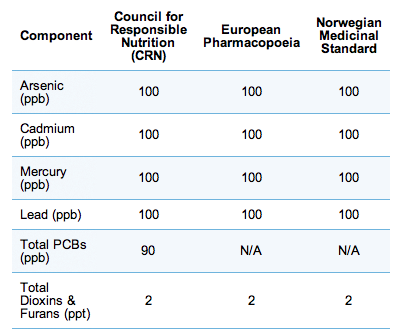
* ppt = parts per trillion
* ppb = parts per billion
The best fish oils will not only meet but exceed these international standards.
Freshness
I have written extensively about the dangers of oxidized, rancid oils. They promote oxidative damage and increase inflammation, both of which are risk factors for nearly every modern disease.
This is why it’s crucial to ensure that the fish oil you select is fresh and not rancid. Once it has gone rancid, it will have the exact opposite effect on your body than you want it to.
The first thing to do is to check something called the “peroxide value” on the COA. This is a measure of rancidity reactions in the oil that have occurred during storage. It should be less than 5 meq/kg.
If this checks out, and you decide to order that product, break open a capsule once you receive it. There should be no “fishy” odors. They should smell like the ocean, but not like rotten fish. They should also not have a strong lemon or lime scent, which could be an indicator that the manufacturer is trying to mask the rancidity.
The p-anisidine value measures secondary oxidation products. The IFOS and GOED standard is less than 20 units. However, it’s important to note that p-anisidine is not appropriate for measuring secondary oxidation in omega-3 oils that have a strong color or contain added flavorings.
For example, salmon oil contains carotenoids, which have a natural yellow/orange coloring. Bio-Avail Omega+ from Adapt Naturals contains curcumin, which also has a natural orange coloring. This throws off the p-anisidine values and makes it an irrelevant test.
TOTOX is the last way to measure oxidation. It’s simply a combination of the peroxide and p-anisidine values. (For this reason, it’s also not appropriate for products with a strong color.) The IFOS and GOED thresholds are 19.5 and 26 meq/kg, respectively. But the best products have TOTOX values below 15 meq/kg.
Finally, some studies have shown that adding antioxidants (e.g. curcumin or resveratrol) to fish oil can improve stability.
A common misconception is that you can determine the quality of fish oil by freezing it. The theory goes that if you freeze the oil and it is cloudy, it’s rancid. That is not the case. All fish contain saturated and monounsaturated fatty acids, albeit in small amounts. These fatty acids make the capsules appear cloudy when frozen in products that contain whole fish oil.
Potency
This is another area surrounded by significant controversy. Some argue the levels of individual constituents in fish oil aren’t paramount. Scientists discovered the healthful effects of omega-3s by studying people with fish-heavy diets, before supplemental fish oil even existed. Clinical trials using supplemental fish oils over the past few decades have contained widely variable levels of both long-chain omega-3 derivatives (EPA and DHA), and not super-high concentrations of either or both.
However, due to poor conversion of ALA to EPA and DHA, unless you are eating fish it is very likely you are deficient in long-chain omega-3s.
Following this line of reasoning, the DHA content in particular of fish and fish oils does seem important if we wish to obtain the best possible therapeutic effect. Many recent studies demonstrating the anti-inflammatory potential of fish oil used a daily dosage of DHA in the range of 1-3 grams. What’s more, foods like salmon roe that have been prized by traditional cultures for their nourishing and healing effects contain large amounts of DHA. A single 6 oz. serving of salmon roe contains 1 g of DHA. (In fact, this would be the best way by far of supplementing with DHA if money were no object. (Unfortunately, wild salmon roe goes for about $28/serving.)
Unfortunately, many fish oils do not have significant amounts of DHA. This means you’d have to take an impractically high number of capsules each day to obtain the therapeutic dose. This is not desirable, since all unsaturated oils (including fish oils) are subject to oxidative damage. We don’t want to take large quantities of them for this reason.
Remember to check the label and ensure that your product has approximately 200-300 mg of DHA per capsule. This will allow you to achieve the therapeutic dose by taking no more than 3 capsules twice a day.
Like what you’re reading? Get my free newsletter, recipes, eBooks, product recommendations, and more!
Bioavailability
The ability to absorb the beneficial components of fish oil is based on the molecular shape of the fatty acids. In short, the more natural the structure and the less it is chemically altered, the better.
This is true for any nutrient, of course, and it explains why I am always in favor of obtaining nutrients from food or food-based sources when possible. Each additional step in processing from the natural state of food to extract or isolate nutrients introduces the potential of damaging the nutrient or changing its chemical form so that it’s more difficult to absorb or affects the body in a different way.
When it comes to fish oils, there are three forms currently available on the market:
- Natural triglyercide oil. This is what you get when you “squeeze” the whole fish and extract the natural oil from it. It is the closest to eating fish oil in its natural form and is highly bioavailable. The drawback of this form is that, because it’s not concentrated, it usually has low levels of EPA and DHA. And because it isn’t purified, it can have high levels of contaminants such as heavy metals, PCBs, and dioxins.
- Ethyl ester oil. Occurs when natural triglyceride oil is concentrated and molecularly distilled to remove impurities. The ester form is still in a semi-natural state because it is the result of a process that naturally occurs in the body. The advantage of this form is that it can double or triple the levels of EPA and DHA.
- Synthetic triglyceride oil. This form occurs when natural triglycerides are converted to ethyl esters for concentration (as above) but then re-converted into synthetic triglycerides. The original position of the triglyceride’s carbon bonds changes, and the molecule’s overall structure is altered, which impacts the bioavailability of the oil.
Studies on absorption of the various types of fish oil suggest that, unsurprisingly, the natural triglyceride form is absorbed better than the ethyl ester form, which in turn is absorbed better than the synthetic triglyceride form.
One study by Lawson & Hughes in 1988 showed that 1 gram of EPA and 0.67 grams of DHA as natural triglycerides were absorbed 3.4 and 2.7 fold as well as the ethyl ester triglycerides.
In the previous article, we saw that fish oils were better absorbed when taken with a high-fat meal. In another study by Lawson & Hughes later the same year, they showed that the absorption of EPA & DHA from natural triglycerides improved from 69% with a low-fat meal (8g total fat) to 90% with a high-fat meal (44g total fat). Absorption of both EPA and DHA from ethyl ester oils was increased three-fold from 20% with a low-fat meal to 60% with a high-fat meal.
Sustainability
Our global fisheries are in dire straits, and fish oil is a big business. So, it’s crucial to choose a product that is manufactured with sustainability in mind and that has a fully transparent and traceable supply chain.
The easiest way to do this is to choose a product that is certified by organizations like Friend of the Sea or MarinTrust, two of the leading organizations for sustainable and responsible fishery management.
I would also choose a supplier/manufacturer with practices that minimize waste and its environmental impact.
For example, rather than catching fish that is only used to produce fish oil, some producers instead use fish meal to make the oil. This eliminates one of the main concerns about fish oil, which is that it will further deplete fisheries.
Recommendation
As a Functional Medicine clinician, author, and educator, I’ve been following the fish oil market closely for many years. I’ve used several different fish oils with my patients. I’ve read hundreds of studies on the purity, freshness, composition, and benefits of fish oil. I’ve spoken to industry experts and insiders, and I know what many companies do to cut corners and save money (at your expense).
When I started my own supplement company, Adapt Naturals, I knew that one of the first products we’d make would be fish oil. I wanted to create a product with the purest, freshest, and most sustainable fish oil available. And that’s exactly what we did with Bio-Avail Omega+.
I chose VivoOmega from GC Rieber as our fish oil. As the chart below illustrates, it significantly exceeds international standards for both purity and freshness.

Purity and freshness are critical. But I didn’t stop there. Most people who take fish oil are taking it to achieve certain outcomes, like better muscle and joint health, increased mental clarity, a more stable mood, clearer skin, and more balanced immune function.
So, when I formulated our fish oil product (Bio-Avail Omega+), I added the most bioavailable forms of two powerful nutrients that also support these goals: curcumin and black seed oil.
Now you can get the benefits of all three of these superfood nutrients in a single, two soft-gel daily serving.
Bio-Avail Omega+ contains an optimal composition of EPA and DHA (510 mg of EPA and 330 mg of DHA, a 3:2 ratio). It is made with triglyceride oils for optimal bioavailability and absorption. And it is produced with the most sustainable and traceable fish oil material in the industry. (See this page for more info.)
I’m proud of this product. It came directly out of my experience working with patients for 15 years and my extensive research into what is most important in a fish oil product. I hope it helps you to achieve your health goals!

Better supplementation. Fewer supplements.
Close the nutrient gap to feel and perform your best.
A daily stack of supplements designed to meet your most critical needs.

Chris, great work as always. I was wondering if you could comment on the products below. Skate Liver Oil vs. Cod Liver Oil with the Green Pastures product (I don’t like how hard it is to find the DHA/EPA amounts on their products)? Secondly, the Carlson’s product vs. the Green Pastures Cod Liver Oil? Thanks for all you do. I love the books and the podcast.
Green Pastures Fermented Skate Liver Oil Capsules – http://www.amazon.com/gp/product/B004PAP9E8?linkCode=xm2&tag=invihand-20
Carlson Labs Very Finest Liquid Fish Oil – http://www.amazon.com/gp/product/B001LF39RO?linkCode=xm2&tag=invihand-20
In similar vein to the last paragraph from Suzie Walker, but with respect to Cod Liver Oil:
I’m afraid most if not all of the over-the-counter CLO sold in Britain is heat-treated, and has synthetic vitamins A and D added back in. This alone would stop me buying it, in addition to what Suzie said.
I have used a CLO from Nordic Naturals in the past (expensive), but I’m liking more the sound of the GP FCLO, although I have yet to try it.
I’ve tended to minimise fish in the past because of a slight fear of toxins, but also the inconvenience factor of fresh fish, and a distrust of canned or packaged, but I think I’ll revisit that. I do eat Craster Kippers from time to time – no cleaning required, easy to cook, nice and oily, nice taste. Last one I had I managed to eat completely, including most of the head and some of the tail, a la Inuit 🙂
I do worry about toxins due to the smoking process though, or is that another unnecessary fear?
Excellent information here. I wish I would’ve found it like two weeks ago as I just bought some lemon flavored fish oil online. I prefer the oil to the capsules, the capsules seemed to cause me awful burps. Anyone else get that from the capsules? Also I’ve tried the orange flavor as well. I think I prefer the lemon in that case. I just put an article up that stated how basically everyone who can should be taking some sort of fish oil. Along with a multivitamin and creatine. All three of these have huge benefits, creatine helps build lean muscle mass. Thanks for putting this together.
Great post.
For those in the UNITED KINGDOM asking for suggestions, the best I have found available on the market are;
1. Nordic Naturals – don’t expect good quality to be cheap, these are expensive but are the most recommended by Nutritional therapists – http://www.nordicnaturals.com/uk/
2. Eskimo 3 – also highly recommended slightly cheaper than Nordic Naturals http://www.eskimo3.co.uk/Default.aspx?tabid=71
3. Lamberts Pure Fish Oil – high potency EPA and DHA oil, limited information on their website however the company are happy to answer any questions. Most affordable of the 3 and I have some clients on a low budget who also don’t eat any fish so this is the next best option.
Stay away from any fish oil (or any supplements for that matter) from Boots, Holland and Barratt, Tesco and the rest of supermarkets all extremely low quality with low doses and cheap fillers.
Suzie
Me gustaría saber su opinión sobre los suplementos de Life Extensión, en particular del O3. Son recomendables también?
Carlson’s makes a high vitamin D cod liver oil that I’ve been taking for the past three years “Super D — Omega 3”. It contains 2000mg of vitamin D per teaspoon. As far as I can tell Carlson’s is top quality although it is expensive.
Great article. Did you check out vectomega?
I buy Carlssons when I can. Good stuff, but expensive. Helpful tips for finding a quality fish oil: http://www.womentowomen.com/healthynutrition/omega3benefits.aspx (scroll towards the end). Thanks for the article!
Hi Chris,
Thanks to your high praise of Paul Jaminet, I have read his blog and book and am following his diet advice very closely. I have noticed a significant improvement in many aspects of my health. I am not overweight, but I do have rheumatoid arthritis (mostly in remission) and have had skin problems on and off. Lately my skin looks and feels very good, probably due to the increase in fat because the rest of the PHD is pretty much the way I have eaten for many years. Been working on getting my gut healthy for many years and on this diet, it feels better than ever. I think it is completely healed.
Because Paul recommends no fish oil supplementation and you do, I am torn. I also have several bottles of Jarrow Max brand on my shelf, you know, ordering in bulk to save a few bucks. I hold both you and Jaminet in high regard and realize, too, that you may not have all the answers. I eat plenty of salmon and sardines, have given up nuts and am cutting down slightly on chicken (only eat it every 4 days or so anyway). Eat the pastured beef, etc., all the best stuff. Do I need supplementation just because I have RA?
Just wondered if you might want to comment on what seems like a pretty big discrepancy. Do you still stand firmly on the advice you gave in this post?
Always appreciative of all you do.
HELP!!!!!! Please can you tell me the best fish oil to buy in the UK. I have spent hours and hours researching fish oils and nearly all of them state products from the USA, Canada and New Zealand! I tried contacting the IFOS unable to. Asked in BOOTS and after a long phonecall all they would say was that it met EU standards. Not good enough I presume?
what about Carlson fish oil? they alway seemed as the top mark but I know not of there certification.
Thanks to Maxalife Omega-3 Fish Oil, I’m experiencing less sleep deprivation now. I think I even gained energy because of it.
Where do you buy Maxalife fish oil supplement ?
Try Amazon
Hi,
In the comments above, some people living in Europe consider buying FCLO from Green Pasture. But doesn’t the oil get rancid during the shipping time? I live in Paris, and products from the US are usually delivered in three weeks, sometimes more. I’m worried about that. Does the oil only get rancid after you’ve opened the bottle?
Hi everyone
Great post here! I’m on Maxalife fish oil supplement now and i can really say that it helps and does a lot to our body. I rarely get sick now. I have more energy than before. I don’t get tired easily. It also worked as anti-inflammatory. For those who are thinking of buying fish oil supplements, just check the ingredients first before making your purchase. Make sure also that the process was cleanly done. It should also be high in EPA and DHA.
A last word on the subject, having read Chris Masterjohn’s piece on the WAPF website (http://www.westonaprice.org/know-your-fats/2021-precious-yet-perilous) I’m inclined to agree with you, Chris (Kresser) that it is not necessary to supplement with vast quantities of fish oil, even very pure, as it could throw everything else out of balance. A little FCLO, a good wholefoods diet, grass-fed meat and eggs, oily fish and very limited refined foods seems ok to me. And saves me a lot of money on pricey fish-oils too!
Hello, everyone.
Been minding my health for the longest time: effectively. Ditto, fish oil. When Barry Sears started to sell his (expensive) fish oil I wanted to make sure that Costo’s caplsules wre just as clear of toxins. At the time had an exchange with Costo’s CEO & head buyer. The Costo product has the same purity, according to them. There might be a better product, or, not. In OUR case we weekly consume enough salmon & sardines that sticking to the reasonably priced Costco capsules seems more than OK.
________________
PS. The mouth/gums are huge source of vascular inflamation. Thorough immediate oral hygiene upon getting out of bed in the morning is a HUGE inflamation deterrent. Cleanliness IS next to godliness.
Also, I just checked the Carlson bottle and it has purity guaranteed, tested using AOAC protocols etc written all over it but maybe this isn’t enough – I know I can Nordic Naturals but am not sure if any of their products are Vit D free which I want as I take the FCLO. And also some seem higher in DHA than EPA and I never know which is more important or what the ratio should be or if it doesn’t really matter. Confused as ever so any recommendations/advice appreciated!
Thanks, Marshall – glad the olive oil is ok. So should I supplement with fish oil after all in your opinion? And do you know of a UK available brand that you would recommend? I’ll check out the IFSA in the meantime as you suggest, thanks for the input.
Karen, Olive oil has no n-6, just the hormonally-neutral n-9. Carlson’s doesn’t publish regular test results of the contamination & oxidation of their fish oils. Your best bet is to check the International Fish Oil Standards program for the 5-star brands. With these, you can ensure optimal levels of purity & freshness. They test 4 different indicators of freshness (peroxide, total oxidation, anisidine leves and acid values) as opposed to the single indicator of freshness (peroxide) that this “definitive” guide suggests to check for. Furthermore, all high quality supplements will include a fat-soluble antioxidant to protect them from oxidation, but it’s worth taking more, such as Vitamin E.
Chris: grass fed beef has around 25mg of omega-3 per oz, FCLO has 270mg of omega-3. Are you saying less than half a gram per day of omega-3 is enough?
Thank you, Chris. I did think of trying canned but wasn’t sure if the level of n-3 etc was compromised by canning. We do eat grass fed meat and I’ll try and reduce the n-6 intake too – is olive oil v. high? Thank you so much for the fast, succinct answer!