

Update: I now recommend Bio-Avail Omega+ from Adapt Naturals. It’s a blend of ultra-pure fish oil and the most bioavailable forms of curcumin and black seed oil.
Summary
Sorry, folks. Another long one. It was unavoidable, though, because I really did want this to be a “definitive guide” that covers all (or at least most) of the relevant issues involved with choosing a fish oil. Here’s a summary for the time-challenged:
- There are five important factors to consider when choosing a fish oil: composition, purity, freshness, bioavailability, and sustainability.
- Not all fish oils are created equal. It’s essential to do your homework and make an informed choice. Many fish oils are oxidized or made with poor-quality ingredients and may cause health problems instead of solving them.
- The potency of various products depends not only upon the levels of EPA and DHA but also upon the molecular structure of the fats in the oil, which in turn affects absorption.
- Natural triglyceride fish oils are better absorbed than highly purified (i.e. ester) fish oils.
- Many fish oils are made from fish that are endangered. Choose products made from fish that are certified by organizations such as Friend of the Sea or MarinTrust.
Introduction
So far in this series we’ve looked at why fish is superior to plant-based sources of omega-3. We’ve examined the importance of reducing consumption of omega-6 fats. We’ve considered how much omega-3 is needed to support health and treat disease. We’ve revealed that concerns about the safety of fish consumption have been overblown, and that eating fish regularly is not only safe but incredibly beneficial. And in the previous article we compared the benefits of eating fish to taking fish oil.
In this final article of the series, we’re going to take a closer look at fish oil. Fish oil is one of the most popular supplements taken by consumers today. Most people who are at least relatively health conscious understand that they need omega-3 in their diet and are probably not getting enough from food (unless they eat a lot of fish).
But why should you consider taking fish oil in the first place? Which fish oils are best? How much should you take? And what should you look for in a good product?
In this article, I’ll focus more on dispelling common misconceptions about fish oil and helping you to choose the best product for your needs.
My current thoughts on fish oil
My view and recommendations for fish oil have evolved over time.
I’ll tell you what has remained constant first, then tell you what has changed.
I still recommend getting EPA/DHA from the diet whenever possible—either as your exclusive source or as a foundation to build upon.
And I still don’t recommend super-high doses of fish oil, like 10 grams per day. This isn’t common anymore, but there was a time when many health gurus were suggesting this as a way to reduce inflammation. But it’s not supported by research, and there’s no additional benefit beyond the 1-3 grams a day studies suggest is the best therapeutic target.
What has changed is my growing appreciation for the role fish oil can play in ensuring adequate EPA/DHA intake for many people. For all of the reasons I’ve mentioned in this series, many folks are just not getting enough EPA/DHA, and taking a fish oil supplement is probably the only way they’re going to get these critical fatty acids.
It’s also true that some people benefit from greater amounts of EPA/DHA than they can easily obtain in their diet.
My specific recommendations for EPA/DHA supplementation have also evolved. I have recommended cod liver oil for many years, and I still do today. It’s a good option because it contains vitamins A and D in addition to EPA/DHA.
However, the amounts of EPA and DHA are lower in cod liver oil than in most fish oil supplements. And if you’re already consuming organ meats like liver or an organ meat supplement, like Bio-Avail Organ from Adapt Naturals, you don’t really need (or even want) the additional A/D from cod liver oil.
This is why I now recommend a high-quality fish oil supplement for people who are either not getting enough EPA/DHA from their diet or who would benefit from additional EPA/DHA because of a chronic, inflammatory, or autoimmune condition.
But finding a high-quality fish oil is easier said than done. The global market for fish oil is north of $2 billion now. Whenever there’s that much money to be made, you can be sure all kinds of shenanigans will ensue!
So, let’s look at some of the most important factors to consider when buying fish oil.
Factors to consider when buying fish oil
There are five primary variables to be aware of when shopping for fish oil:
- Composition. In order to have the desired anti-inflammatory effect, fish oil must contain an adequate amount of the long-chain omega-3 derivatives EPA and DHA.
- Purity. The oil must meet or exceed international standards for heavy metals, PCBs, dioxins, and other contaminants. Many do not—even when they claim they do.
- Freshness. The oil should be fresh and not rancid. Rancid/oxidized oils promote oxidative damage and increase inflammation, both of which are risk factors for nearly every modern disease. Sadly, many fish oils on the market contain high levels of oxidative by-products.
- Bioavailability. The ability to absorb the beneficial components of fish oil is based on the molecular shape of the fatty acids. The more natural the structure, the better.
- Sustainability: The fish should be harvested in a sustainable manner, and species that are under threat should be avoided.
Composition
Composition refers to the overall concentration of EPA/DHA and the ratio of EPA to DHA. To some extent, this depends on the goal of taking fish oil. For example, some conditions may call for a higher proportion of DHA, while others benefit from more EPA.
Most studies suggest that a 3:2 ratio of EPA to DHA is optimal, with a total amount of omega-3 ranging between 500 mg and 2 g per day.
The optimal amount for each person will vary based on several factors, including how much fish/seafood you’re consuming in your diet. If you don’t eat any, and/or you have an inflammatory or autoimmune condition, you want to aim for the higher end. If you eat some fish/seafood, you can aim for the lower to mid-range.
Purity
Many species of fish are known to concentrate toxic chemicals like heavy metals, PCBs, and dioxins, which can cause serious diseases, especially in children and developing fetuses. In a previous article, I explained how these chemicals are typically not a concern when eating whole fish because fish also contains selenium. Selenium binds to mercury and makes it unavailable to tissues, thus protecting against any damage it may cause.
To address this, fish oil manufacturers use a process called molecular distillation to remove the toxins from the oil. When done correctly, molecular distillation is capable of reducing the toxins in fish oil to levels considered to be safe by the EPA and other agencies.
Although almost any fish oil manufacturer will tell you their product is free of these toxins, independent lab analyses tell a different story. In March of 2010, a lawsuit was filed in California court against the manufacturers of ten popular fish oils because they contained undisclosed and (possibly) unsafe levels of contaminants.
Unfortunately, this kind of deception is all too common in the supplement industry. The best companies will be able to provide a Certificate of Analysis (COA) from the manufacturer upon request. A COA is an analysis performed by an independent lab to measure the ingredients of a product and confirm whether it lives up to the claims made by the manufacturer.
If the manufacturer won’t provide a COA, I start to get suspicious. This is standard practice in the industry, and there’s no reason they shouldn’t be happy to show you theirs.
In general, fish that are lower on the food chain, like sardines and anchovies, naturally have a lower concentration of contaminants. For this reason, it may be wise to look for a product made from these fish.
So what levels of these toxins are safe? As you might imagine, there is some disagreement on this question since there is no single governing body that determines acceptable levels. However, the standards that are most often followed by fish oil manufacturers are summarized in the table below.
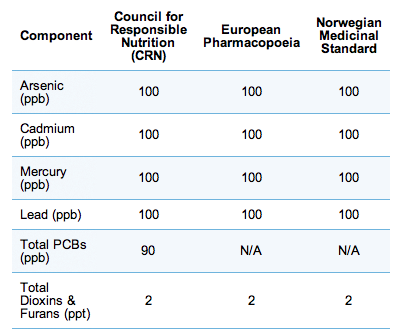
* ppt = parts per trillion
* ppb = parts per billion
The best fish oils will not only meet but exceed these international standards.
Freshness
I have written extensively about the dangers of oxidized, rancid oils. They promote oxidative damage and increase inflammation, both of which are risk factors for nearly every modern disease.
This is why it’s crucial to ensure that the fish oil you select is fresh and not rancid. Once it has gone rancid, it will have the exact opposite effect on your body than you want it to.
The first thing to do is to check something called the “peroxide value” on the COA. This is a measure of rancidity reactions in the oil that have occurred during storage. It should be less than 5 meq/kg.
If this checks out, and you decide to order that product, break open a capsule once you receive it. There should be no “fishy” odors. They should smell like the ocean, but not like rotten fish. They should also not have a strong lemon or lime scent, which could be an indicator that the manufacturer is trying to mask the rancidity.
The p-anisidine value measures secondary oxidation products. The IFOS and GOED standard is less than 20 units. However, it’s important to note that p-anisidine is not appropriate for measuring secondary oxidation in omega-3 oils that have a strong color or contain added flavorings.
For example, salmon oil contains carotenoids, which have a natural yellow/orange coloring. Bio-Avail Omega+ from Adapt Naturals contains curcumin, which also has a natural orange coloring. This throws off the p-anisidine values and makes it an irrelevant test.
TOTOX is the last way to measure oxidation. It’s simply a combination of the peroxide and p-anisidine values. (For this reason, it’s also not appropriate for products with a strong color.) The IFOS and GOED thresholds are 19.5 and 26 meq/kg, respectively. But the best products have TOTOX values below 15 meq/kg.
Finally, some studies have shown that adding antioxidants (e.g. curcumin or resveratrol) to fish oil can improve stability.
A common misconception is that you can determine the quality of fish oil by freezing it. The theory goes that if you freeze the oil and it is cloudy, it’s rancid. That is not the case. All fish contain saturated and monounsaturated fatty acids, albeit in small amounts. These fatty acids make the capsules appear cloudy when frozen in products that contain whole fish oil.
Potency
This is another area surrounded by significant controversy. Some argue the levels of individual constituents in fish oil aren’t paramount. Scientists discovered the healthful effects of omega-3s by studying people with fish-heavy diets, before supplemental fish oil even existed. Clinical trials using supplemental fish oils over the past few decades have contained widely variable levels of both long-chain omega-3 derivatives (EPA and DHA), and not super-high concentrations of either or both.
However, due to poor conversion of ALA to EPA and DHA, unless you are eating fish it is very likely you are deficient in long-chain omega-3s.
Following this line of reasoning, the DHA content in particular of fish and fish oils does seem important if we wish to obtain the best possible therapeutic effect. Many recent studies demonstrating the anti-inflammatory potential of fish oil used a daily dosage of DHA in the range of 1-3 grams. What’s more, foods like salmon roe that have been prized by traditional cultures for their nourishing and healing effects contain large amounts of DHA. A single 6 oz. serving of salmon roe contains 1 g of DHA. (In fact, this would be the best way by far of supplementing with DHA if money were no object. (Unfortunately, wild salmon roe goes for about $28/serving.)
Unfortunately, many fish oils do not have significant amounts of DHA. This means you’d have to take an impractically high number of capsules each day to obtain the therapeutic dose. This is not desirable, since all unsaturated oils (including fish oils) are subject to oxidative damage. We don’t want to take large quantities of them for this reason.
Remember to check the label and ensure that your product has approximately 200-300 mg of DHA per capsule. This will allow you to achieve the therapeutic dose by taking no more than 3 capsules twice a day.
Like what you’re reading? Get my free newsletter, recipes, eBooks, product recommendations, and more!
Bioavailability
The ability to absorb the beneficial components of fish oil is based on the molecular shape of the fatty acids. In short, the more natural the structure and the less it is chemically altered, the better.
This is true for any nutrient, of course, and it explains why I am always in favor of obtaining nutrients from food or food-based sources when possible. Each additional step in processing from the natural state of food to extract or isolate nutrients introduces the potential of damaging the nutrient or changing its chemical form so that it’s more difficult to absorb or affects the body in a different way.
When it comes to fish oils, there are three forms currently available on the market:
- Natural triglyercide oil. This is what you get when you “squeeze” the whole fish and extract the natural oil from it. It is the closest to eating fish oil in its natural form and is highly bioavailable. The drawback of this form is that, because it’s not concentrated, it usually has low levels of EPA and DHA. And because it isn’t purified, it can have high levels of contaminants such as heavy metals, PCBs, and dioxins.
- Ethyl ester oil. Occurs when natural triglyceride oil is concentrated and molecularly distilled to remove impurities. The ester form is still in a semi-natural state because it is the result of a process that naturally occurs in the body. The advantage of this form is that it can double or triple the levels of EPA and DHA.
- Synthetic triglyceride oil. This form occurs when natural triglycerides are converted to ethyl esters for concentration (as above) but then re-converted into synthetic triglycerides. The original position of the triglyceride’s carbon bonds changes, and the molecule’s overall structure is altered, which impacts the bioavailability of the oil.
Studies on absorption of the various types of fish oil suggest that, unsurprisingly, the natural triglyceride form is absorbed better than the ethyl ester form, which in turn is absorbed better than the synthetic triglyceride form.
One study by Lawson & Hughes in 1988 showed that 1 gram of EPA and 0.67 grams of DHA as natural triglycerides were absorbed 3.4 and 2.7 fold as well as the ethyl ester triglycerides.
In the previous article, we saw that fish oils were better absorbed when taken with a high-fat meal. In another study by Lawson & Hughes later the same year, they showed that the absorption of EPA & DHA from natural triglycerides improved from 69% with a low-fat meal (8g total fat) to 90% with a high-fat meal (44g total fat). Absorption of both EPA and DHA from ethyl ester oils was increased three-fold from 20% with a low-fat meal to 60% with a high-fat meal.
Sustainability
Our global fisheries are in dire straits, and fish oil is a big business. So, it’s crucial to choose a product that is manufactured with sustainability in mind and that has a fully transparent and traceable supply chain.
The easiest way to do this is to choose a product that is certified by organizations like Friend of the Sea or MarinTrust, two of the leading organizations for sustainable and responsible fishery management.
I would also choose a supplier/manufacturer with practices that minimize waste and its environmental impact.
For example, rather than catching fish that is only used to produce fish oil, some producers instead use fish meal to make the oil. This eliminates one of the main concerns about fish oil, which is that it will further deplete fisheries.
Recommendation
As a Functional Medicine clinician, author, and educator, I’ve been following the fish oil market closely for many years. I’ve used several different fish oils with my patients. I’ve read hundreds of studies on the purity, freshness, composition, and benefits of fish oil. I’ve spoken to industry experts and insiders, and I know what many companies do to cut corners and save money (at your expense).
When I started my own supplement company, Adapt Naturals, I knew that one of the first products we’d make would be fish oil. I wanted to create a product with the purest, freshest, and most sustainable fish oil available. And that’s exactly what we did with Bio-Avail Omega+.
I chose VivoOmega from GC Rieber as our fish oil. As the chart below illustrates, it significantly exceeds international standards for both purity and freshness.

Purity and freshness are critical. But I didn’t stop there. Most people who take fish oil are taking it to achieve certain outcomes, like better muscle and joint health, increased mental clarity, a more stable mood, clearer skin, and more balanced immune function.
So, when I formulated our fish oil product (Bio-Avail Omega+), I added the most bioavailable forms of two powerful nutrients that also support these goals: curcumin and black seed oil.
Now you can get the benefits of all three of these superfood nutrients in a single, two soft-gel daily serving.
Bio-Avail Omega+ contains an optimal composition of EPA and DHA (510 mg of EPA and 330 mg of DHA, a 3:2 ratio). It is made with triglyceride oils for optimal bioavailability and absorption. And it is produced with the most sustainable and traceable fish oil material in the industry. (See this page for more info.)
I’m proud of this product. It came directly out of my experience working with patients for 15 years and my extensive research into what is most important in a fish oil product. I hope it helps you to achieve your health goals!

Better supplementation. Fewer supplements.
Close the nutrient gap to feel and perform your best.
A daily stack of supplements designed to meet your most critical needs.

Hi Chris,
This is such an impressive article & clearly neededait was written 3 years ago. I learned the hard way that rancid fish oil is very bad for your body & I can not tell you the number if people I have talked to about the importance of their fish oil not being rancid. Most look at me like I’m crazy. Now I will direct them to this article.
My question for you is about fclo. I have tried taking it because I’m aware of its incredible benifits but it tastes and smells so horrible that I think it has to be rancid. Is it not? What exactly is the difference between fermented & rancid?
Chris:
Just want to inform the readers that many “fish oil” products on the market are incorrectly labeled as fish oil. In fact, many of the products are ethyl ester derivatives of the omega-3s. What is disturbing is that these products are really marine biodiesel and are flammable. Check the back of your labels and if is says as ethyl esters, it is flammable. Several companies are exploring using fish offal (fish byproducts) esterified using ethanol derived from corn to produce a renewable biofuel known as marine biodiesel. The composition of the fuel is very similar to what is being sold on the market that is incorrectly labeled as “fish oil”. These products are misbranded. See http://www.fishoildetective.com and the page burning fish oil for more information. So, many of you purchased what you thought was “fish oil” but actually got gelatin capsules filled with the flammable liquid marine biodiesel fuel. This liquid is probably the only chemical that is used as both as a dietary supplement and a fuel. Please use caution if you attempt to see if your misbranded “fish oil” burns. I am trying to contact the Federal Trade Commission to complain about false advertising.
Look for fish oil that sometimes will say “natural” but this is not 100% sure. Products that are natural fish oil are Berkley&Jensen Natural Extra Strength Fish Oil (1200 mg), Kirkland Natural Omega-3 Fish Oil, Nature Made Fish Oil 1000 mg 300 mg Omega-3, CVS Natural Fish Oil 1000 mg, Nordic Natural products, and Sundown Naturals Fish Oil 1200 mg. Check your labels. The Kirkland Enteric Coated Omega-3 Fish Oil 1200 mg, one per day is not “fish oil” and is the ethyl ester derivatives per fine print on the supplement facts label. Strangely, this product carries the USP seal of approval which is incorrect. USP defines what the definition of fish oil is in their fish oil monograph and this Kirkland product does not meet the definition and you can’t really trust the USP seal.
PIXE
PIXE,
Do you have any info on Prograde EFA Icon krill oil? Interested to hear your opinion. Thanks!
Now I’m really confused, PIXE. Are you saying fish oil containing ethyl esters is marine biodiesel fuel and should be rejected? (All oils are flammable.)
Would appreciate a response about the calamari oil in Jarrows Max DHA. (Also note: The content of DHA 500mg and EPA 72mg is in a “serving” of TWO capsules, which makes it weak fish oil in my book.)
Hi has anyone read this article?
http://www.drdavesbest.com/newarticles/the-truth-about-rancid-fish-oil/
it’s an article that states that there is no proof of any damage to human health by consuming oxidized Omega 3’s.
any comments?
Jarrows Max DHA has a soft gel made from clamari
Total Calamari Oil (source Omega-3)1200mg
DHA (Docosahexaenoic Acid) 500mg
EPA (Eicosapentaenoic Acid) 72mg
What do you think about this product. iHerb’s price $23.37
I’m confused with all the choices.
Tried to order the liquid Jarrow, it is no longer being produced. Picked up Nordic Naturals Arctic Cod Liver Oil from WFs today. Is this a good option?
EPA 410
DHA 600
Vit A 425-1500
Vit D 0-20 (seems low?)
Other Omega 3s 225
Oleic Acid 600
http://www.nordicnaturals.com/en/General_Public/Arctic_Cod_Liver_Oil/378
Hi Chris
I have just bought Jarrow Max DHA – it says in your post that it is made with anchovies and sardines, both of which are naturally low in contaminants – but it is actually made from Calamari so I am confused as I haven’t heard of Calamari being a good source.
Please can you let me know what you think about this?
Many thanks
I’ve been taking fish oil for about 8 years at dosages of 1,000mg to 3,600mg EPA+DHA per day. Most of that time, it’s been either Trader Joe’s or Natural Factors RxOmega-3 Factors. My criteria have been molecular distillation for purity and at least 600mg EPA+DHA per capsule with a cost somewhere around $.10 per capsule. I didn’t know about the synthetic triglyceride issues.
I’ve been taking these relatively high dosages to help relieve the symptoms of Paxil withdrawal syndrome. When I started taking fish oil, I could fairly immediately feel a relaxing effect. Many people find it relieves brain zaps, a very common (and not at all benign) withdrawal symptom, and other parasthesias.
Along the way, I’ve tried pure DHA (Pharmax and Metagenics) and didn’t find it any more effective than the EPA+DHA capsules.
Years later, at age 62, I don’t actually feel the fish oil any more, but my good cholesterol (HDL) to bad cholesterol (LDL) ratio is outstanding and my blood sugar went down. (I also minimize vegetable oil intake and eat lots of nuts.)
My understanding is that EPA and DHA can convert to each other http://ajcn.nutrition.org/content/83/6/S1467.long
As for EPA vs DHA, my understanding is that
Alto:
Your Trader Joe’s molecular distilled Omega-3 Fatty Acids dietary supplement is 60% EPA and DHA as the ethyl esters. My lot 3372 D2 Exp date of 02/2015. You need to be careful of these EE brands because they don’t absorb as well as triacyl-sn-glycerol (TAG) formerly referred to as triglyceride. Your Trader Joe’s has the same two active pharmaceutical ingredients (APIs) as the prescription pro-drugs Lovaza and Vascepa. Vascepa only has EPA-Ethyl ester. They must be take with a fatty meal in order for them to be absorbed. This is because the ethyl esters are poor substrates for pancreatic lipases that cut off fatty acyls from positions 1 and 3 from TAG. These lipases operate at the oil-water interface of the emulsions formed in the gut lumen. Also, although small, the metabolite of these EE is ethanol (ethyl alcohol). See the warning labels for Lorvaza and Vascepa.
You are better off taking the Pharmax Ultra EPA/DHA 395 mg EPA and 265 mg DHA per my bottle Lot BN 25435 Exp date 08/2013. The product is made by Seroyal and it is a re-esterified TAG to get you more EPA and DHA (66%) per TAG molecule than natural fish oil which is about 30% EPA=DHA which are the so called “18/12 TAG oils.” The Pharmax has more EPA/DHA per capsule than the Trader Joe’s in addition to being more bioavalilable. See my web site http://www.fishoildetective.com
PIXE
Thanks, PIXE.
Is there a list of the ~425 products you’ve analyzed on your site? I don’t see a link.
Alto:
The list is to long to post on my web site. However, if you have a brand that you are interested in, just let me know.
PIXE
Hi PIXE, Do you know anything about Prograde’s EFA Icon Krill oil? Just received and not sure if this was a good choice. Thanks!
I’m interested in seeing how your site develops at fishoildetective.com. You have good information relaying principals of nutritional biochemistry; however, I believe you over emphasize advantage of TG over EE. Consider this recent article from Vin Kutty: http://www.omegavia.com/fish-oil-ethyl-ester-vs-triglyceride-revisited/
Doug:
I am an analytical chemist only reporting scientific fact rather than marketing fiction.
Thanks for your constructive criticism of my web site http://www.fishoildetective.com. I read your link to OmegaVia’s web site, and that information is not entirely correct. The digestion and metabolism of chemical compounds are more complex than what was stated. First, your first meal on your birth date was fat and our digestive system has taken thousands of years to develop and become efficient. As a result, the digestive mechanism protects the transport of substances to the systemic blood system. That is why those in the drug design business use pro-drug development to get drugs into the blood stream. A favorite drug derivative is to attach an ethanol molecule to the drug via ester formation with the drug. There is an entire science on pro-drug development and a nice review article in Nature (Pg 248 MARCH 2007, VOLUME 6) on the subject of digesting prescription drugs and design.
I have nothing against ethyl ester omega-3 dietary supplements. They do have a place in managing medical conditions such as high blood fat. My problem is with the incorrect labeling of products with the term “fish oil” when they are not fish oil. The efficacy of ethyl ester omega-3s has a long history and has been studied extensively. However, these are prescription drugs that contain, for example, Lovaza, contains 345 mg DHA and 426 mg EPA per capsule of oil with a mass of 1,000 mg (77.1 %) and Vascepa (879 mg EPA only per 1,000 mg of oil) or 87.9% EPA. These prescription drugs have non-detectable saturated fatty acid ethyl esters and are of high purity per NDA (FDA New Drug Application). In addition, these highly concentrated ethyl esters of EPA and DHA have warning labels for pregnant and nursing moms. Here is what the Lovaza label says: “8.3 Nursing Mothers Studies with omega-3-acid ethyl esters have demonstrated excretion into human milk. The effect of this excretion on the infant of a nursing mother is unknown; caution should be exercised when LOVAZA is administered to a nursing mother.” Also, these ethyl esters have been shown to increase LDL cholesterol (bad cholesterol) in certain patients and that is why Vascepa was developed.
Additional information of using generic LOVAZA in the UK can be found at: http://www.mhra.gov.uk/home/groups/par/documents/websiteresources/con152800.pdf where they say: “The potential risk for humans is unknown and therefore Omega-3-acid-ethyl esters should not be used during pregnancy unless clearly necessary.” “Omega-3-acid-ethyl esters should not be used during lactation.” Many of the mislabeled “fish oil” dietary supplements you are taking are not pure and are not of the quality of prescription omega-3 ethyl esters. These mislabeled products have never gone through the Generally Recognized as Safe (GRAS) process by the FDA. Natural fish oil and re-esterified TAGs have all gone through the GRAS process and you can find a complete list of these types of oils at: http://www.accessdata.fda.gov/scripts/fcn/fcnNavigation.cfm?rpt=grasListing
Taking ethyl esters with food is critical because if you are taking prescription omega-3 ethyl esters such as Lovaza to reduce blood fat, you are also told to modify your diet so that you eat fewer fatty meals. If this is the case, then the UK application for Lovaza generic from Teva says: “An in-house study was conducted to compare the bioavailabilities of omega-3 fatty acids under fasted and fed states. The study demonstrated that (i) the fasted state is associated with a flat absorption curve for eicosapentaenoic acid and docosahexaenoic acid and that (ii) the bioavailabilities of eicosapentaenoic acid and docosahexaenoic acid are many-fold higher in the fed than the fasted state.” The fact that these ethyl esters are poor substrates for pancreatic lipase (enzyme that digest fat) shows that the absorption is dependent on what you eat. Natural fish oil (TAG) is already fat and is not affected as much by what you eat and you can take natural TAG or rTAG fish oils on an empty stomach. In addition, this is why Omthera Pharmaceuticals is developing pure EPA (no TAG or ethyl ester derivatives) as a prescription drug to lower blood fat that is independent of a high or low-fat diet. They completed Phase III of the clinical trials that met their endpoints, and they are trying to file an NDA for their drug this year.
My other point is that many of these mislabeled products do not list whether they are ethyl esters or TAG. The amount of ethanol produced during the metabolism of these ethyl esters is low and if I were pregnant or nursing, I would not take these ethyl esters per labeled prescription drugs. All I am doing is letting the consumer know which products are ethyl esters. As I said previously, many of these low-grade omega-3 ethyl esters mislabeled as “fish oil” is actually marine biodiesel. You might as well go to your local gas station that is selling biodiesel, fill up your coffee mug and drink this to get your supply of saturated fatty acid ethyl esters with a trace of omega-3s. In Japan, ethyl ester omega-3 “fish oil” is outlawed and the only fish oil that you can purchase in Japan is TAG fish oil unless this policy has changed. Ethyl ester omega-3s can only be purchased with a prescription.
If you are looking for a highly pure high-quality omega-3 ethyl ester product to replace Lovaza (provides 426 mg EPA and 345 mg DHA, mass 1.41807 g, L=24.11 mm, diameter=9.80 mm) that is selling in my region without a prescription-drug plan cost $217 for 120 capsules, then look at AlaskaOmega (mass 0.92748 g, L=20.12 mm, diameter=8.71 mm) selling for $20.79 for 180 “mini softgels” (provides 356 mg EPA and 144 mg DHA) on Amazon. This product is made in Alaska and is made from fish cuttings from Alaskan Pollock and Hake as a nice way to get rid of fish waste. This is one of a few products that actually list the source of the oil and the company (http://purealaskaomega.com/ ) is very forthcoming. OmegaVia is using this company to also provide oil for their product that is more expansive but comes in a larger capsule (mass 1.84915 g, L=27.07 mm, diameter=10.82 mm) and supplies 780 mg EPA and 260 mg DHA).
As I said previously, if you don’t need medical grade omega-3 ethyl esters, the best cost effective product is Costco’s Kirkland Natural Fish Oil (TAG, fat) that is selling for $8.00 ($5.99 when there is a sale) for 400 capsules that supply 180 mg EPA and 120 mg DHA. So, for 2 cents a capsule, take two or 4 cents a day will give you 600 mg EPA and DHA which is above the AHA recommended dose for those without heart disease. Four cents a day seems rather inexpensive to reduce a major health care expense in the US, i.e. heart disease.
Sorry for the long response.
PIXE
I’ve actually read a study (well, the abstract of one anyway) that found that DHA from algal oil was as readily absorbed as that in fresh fish. Can’t track it down for you right now because I’m in the middle of midterms, but I’ll try to remember to check back in with it when I have time.
DHA from algae oil is probably easily absorbed, but the body also needs EPA and DPA.
Neither of which fish have the metabolic pathways to synthesize themselves. They get it from algae or from the lower order marine life that subsists on algae. For example, I take a flax oil/algal oil supplement that labels itself as having ALA, DHA and EPA, so I know you can get EPA from commercial supplements. DPA you don’t find so much on nutritional information. I regret to say I don’t even know so much about why people need it.
Superficial Internet research seems indicate that fish oil isn’t always a great source of DPA, so I’d be curious to know how algae, krill, etc., stack up. Anyone know f the top of their heads?
Merry:
Here are several references to algal oil vs fish oil and eating salmon.
http://www.ncbi.nlm.nih.gov/pubmed/18589030 (Algal-oil capsules and cooked salmon: nutritionally equivalent sources of docosahexaenoic acid) and http://jn.nutrition.org/content/early/2011/11/22/jn.111.148973.full.pdf (A Meta-Analysis Shows That Docosahexaenoic Acid from Algal Oil Reduces Serum Triglycerides and Increases HDL-Cholesterol and LDL-Cholesterol in Persons without Coronary Heart Disease. Note that algal oil does not have DPA which may turn out to be any important omega-3. Remember that the Inuit’s diet contains marine organisms such as seal that contain a high amount of DPA. All fish oils that I have analyzed contain DPA. Also see http://www.sciencedirect.com/science/article/pii/S0952327813000264 (Postprandial metabolism of docosapentaenoic acid (DPA, 22:5n−3) and eicosapentaenoic acid (EPA, 20:5n−3) in humans) you need to purchase this if you don’t have subscription. At least you can read the abstract for free from the link above.
PIXE
Hi PIXE,
You seem to know your stuff re fish oils. I have chronic atopic eczema, multiple allergies and rhinitis/hayfever. Im currenyly taking antihistamines and evening primrose oil and i know i need to take fish oils too but with so many brands out there i dont know which one to go with! Which fish oil and dose would you recommend? 🙂
Hello Chris,
How much FCLO should someone take if they’re suffering from depression?
It has been over a year; i am not sure if you are subscribed to this thread. If so, see my comment above, to Tom Gossard(sp. ?), dated today. There is ton of other suggestions here, that are proven as statistically significant results of Omega3 – but it took much of my patience and perseverance to collect all the data, and study all the papers.
Hey cris,
I’m 10 week pregnant and taking Nordic Naturals DHA .I was first alittle worried about mercury levels in this product but also I didnt see it on your recomendation list. In your excellent opinion is this a safe and effective product for my unborn baby and myself. Thanks cris.laren
Chris,
Thank you for your great work! I’ve been trying to get some more specific info from Green Pastures regarding vitamin D levels and contaminants in their FCLO and have only gotten only vague pedantic responses. This is a red flag to me. It only makes sense that anyone producing a product which could potentially contain high levels of heavy metals or dioxins, and which is often given to children or other more susceptible/ at-risk populations has a responsibility to ensure the purity of their product if possible. Since we know it’s possible to have fish oil tested, I do not understand why they refuse to make this information available (by giving me vague answers instead of sending their COA directly). There is a graph on their website, but it’s not clear what the graph is supposed to be showing. My question is whether you have been able to gather more information than what’s on their website; and if so, if you’d be willing to share it. I want to believe that they really do have a great product, and your endorsement of it gives me confidence, but I’m still wondering if they’re really as good as they say if they are not willing to give up the information to back up their claim.
Again, thank you for your work!
SB
Chris,
Wondering how fish oil compares to algae such as this one being promoted now..so confusing.
THey say this is the ultimate because this is what the fish eat. Would it be like saying you should eat grass rather than raw milk because this is what the cows eat?
http://www.activationproducts.com/fohn-oceansalive?AFFID=111542&utm_source=tfohn&utm_medium=email&utm_campaign=fohn-OA-isabel
Are the Madre Labs fish oils suitable for vegetarians? I’m concerned over the source of the gelatin used in fish oils capsules.
C.K.
You didn’t seem to have much info on algae oil. Are you aware of the Martek Biosciences Corp. that manufactures NEUROMINS algae oil, and also has research as to its efficacy ?
Hi Cris,
I am living in Turkey and it is really hard to find qualified products.Even if you can find it ,it will be very very expencive.The best brand in Turkey with reasonable prices is Carlsons.Can we trust Carlson.I know they don’t declare their test results but how can we feel that we are in safe while using Carlsons products.I am using Carlsons pills and liquid form.Which one is better ?
Thanks in advance for your kind help.
Best Regards
mehmet
PIXIE:
What do you think of Eskimo-3? http://www.cardinova.com/
What I have been recommmended is that they are the highest quality, purity and stability.
Miriam:
I have ordered this brand and waiting for its arrival for testing. Funny that there are several products of fish oil with the name Eskimo-3. I know of three brands.
PIXE
Hi Chris,
I noticed that this article is a couple of years old and I know your views on certain aspects of nutrition have changed recently; are these still your recommendations?
I am a nursing mother and, sadly, I hate the taste of fish, especially very fatty fish like salmon. I take 10 ml of FCLO and eat eggs daily, but I wonder if that is enough EPA and DHA for a nursing mother. I would like to have another baby when I am done nursing my daughter, so I also want to prep for that. I purchased your Healthy Baby Code but it doesn’t address this issue much.
I would love your opinion on whether 10 ML of FCLO per day supplies a nursing/pregnant mother with enough EPA, DHA, and other beneficial nutrients found in fish. If not, what supplement(s) do you suggest to make up for this deficiency?
Thanks,
Angela
Angela:
I will add my 2 cents. For nursing mom’s you would want more DHA for the infant’s brain and eye development. Same is true if you are pregnant. However, be careful not to take those products that are ethyl esters (not fish oil). The reason being that these synthetic chemical compounds produce ethanol as one of the metabolites. Ethanol is hazardous for the fetus a.k.a. fetal alcohol syndrome. Although the amount of ethanol produced during the metabolism of these ethyl esters is small, there is still concern. That is why the FDA’s approval of Lovaza, a prescription omega-3, comes with a warning label for pregnant and nursing women. You can read the label warnings on Lovaza’s web site. The same API (active pharmaceutical ingredient) that is in Lovaza is also in many of the OTC “fish oil” dietary supplements. However, fish don’t produce ethyl esters and many of the labels on products called “fish oil” are not fish oil but instead are a synthetic chemical compound.
PIXE
Hey PIXE,
Would you consider a re-esterified triglyceride to be a synthetic compound? Technically it is, but it’s also a great candidate for pancreatic lipase while ethyl esters are *not*. Thus, it avoids the general problems with the synthetic EE. Furthermore, the only researching comparing TG, EE and rTG shows that rTG actually has the greatest absorption rates. So isn’t the bioavailability far more important than whether it’s synthetic or not?
Marshall:
Yes, re-esterified Triacylglycerol (rTAG) are very good even though they are synthetic. However, in natural fish, you will find these same TAGs but of lesser concentrations. The rTAGs are made by removing most of the saturated and mono-saturated fatty acids from glycerol molecule and replacing them with EPA and DHA. The ideal supplement would have TAGs where all there sn positions are occupied by either DHA or EPA. This means that during digestion to MAG (mono-acylglycerol), you will get two moles of DHA per mole of TAG or two moles of EPA per mole of TAG. This is necessary to go from the intestines to the bloodstream and provide the best absorption rates and are independent of co-ingestion of a fatty meal. There are several excellent products on the market that are rTAGs. They are Quell (Douglas Labs, very expensive) and Nordic Naturals Ultimate, also very expensive. There are others less expensive but they have less amounts of EPA and DHA. I will provide names when I return to my lab on Wednesday. However, they provide more EPA and DHA per capsule than the traditional “18/12” fish oils where one molecule of TAG will contain one molecule of esterified DHA or EPA. There have been several publications compairing the bioavaliability of rTAG vs TAG vs EE besides the one you mentioned.
PIXE
Marshall:
Here is the additional information.
r-Triacylglycerol (re-esterified Triacylglycerols) or rTAG sometimes referred to as structured triacylglycerols (sTAG) in the scientific literature.
Here are some products that we determined to be rTAGs.
Omegor Vitality
Ascenta Nutra Sea 2x Concentrated, Ascenta Health Inc
Ascenta Nutra Sea Omega-3, Ascenta Health Inc.
PurePharma Omega-3
Nordic Naturals Ultimate Omega
Paradise Omega-3
Jarrow Formulas Max DHA
Nutri Supreme Research Omega-3
Optimal Health Bridge True Omega-3
EPA/DHA Blend Distributed by George Elvore (IFOS certified on bottle)
Parmax Ultra EPA/DHA
Ortho Molecular Products Orthomega
Lahana Naturals Omega-3
Quell Products (EPA/DHA, EPA, DHA) Douglas Labs
I am sure there are others but you will not be able to determine if they are rTAGs unless you perform some complex analytical analyses. These products are excellent choices but our analysis shows that Nordic, Vitality, and Omegor are among the best. Other issues about these highly re-esterified products is that some have DAGs (di-acylglycerols, two fatty acids and one hydroxyl group on the glycerol backbone) and MAGs (mono-acylglycerols, one fatty acid and two hydroxyl groups on the glycerol backbone). What is interesting about the MAGs is that this is the product of the pancreatic lipase in the digestion step of fat (TAGs) and this molecule is the one that crosses the intestines and is re-esterified into TAGs to circulate in the blood stream. Just think that if you took a MAG with DHA or EPA in the sn-2 position, there is no need for the digestion step in the intestines. TAGs and DAGs have to be broken down by lipases into MAGs for absorption.
Sorry for the details.
PIXE
Marshall, when we click on Jessica’s name it takes us to a website where every article is written by…wait for it…Marshall!
Go peddle your snake oil (fish oil) elsewhere please.
Marshall, If you sell a product then you stand to benefit financially from recommending it. You are no longer impartial. If you recommend a supplement without stating that you also sell it, you yourself undermine your trustworthyness. If you made it clear each time you recommend it that you rate it so highly you also import and sell it, I would be OK with that. But you didn’t. Not here and not when I emailed you asking for your advice. I find that lack of transparency off-putting.
*Shrug* I just do what I always have done: I share information so that people can decide for themselves. I point them to IFOS to pick a brand. And if they really want to save themselves the time and energy, I recommend a brand that I also sell because it’s easier than ordering from Italy. I don’t worry about whether people trust me or not. I only concern myself with putting out high quality information. And regarding being impartial, I never was — I’m extremely partial to a few brands, and I tell people exactly why so they can decide for themselves.
Jessica, until this morning, your name was nowhere to be found on that blog post – it displayed “written by: Marshall Sontag. I’m happy for you that your skin looks awesome..
Marshall, it is not necessary to show your father’s obituary to prove a point. I respect that you’ve done your research and you know your stuff. The first postings you wrote on this page were to express your skepticism of Chris Kresser’s knowledge which then later on turned a bit argumentative towards him. So maybe you don’t have reason to accuse other’s of being cynical just because they feel “skeptical” towards you.
I’m sure Chris Kresser put this post out to help others, not turn it into a debate class (which is why he probably grew tired of responding to the argumentative comments being put out). People who spend time debating with others waste good time, energy and relationships – I will not be one of those and will now go enjoy my life, enjoy those around me and continue to learn about fish oil.. the original reason for reading this! 🙂
I wasn’t expressing “skepticism.” I was pointing out a pretty gross error. Chris quoted marketing text, word for word, from a fish oil manufacturer, as if it were scientific fact. It turned out that the marketing text he lifted wasn’t even true, and had no scientific support. When I pointed this out, did he change it? No. Why? I have no clue. He won’t say. Debate is not just an academic exercise for children. It has a place in real life, particularly when it comes to holding public authorities accountable for the veracity of their information. Thankfully, many others have benefitted from this information, so it’s far from a waste of energy.
And @Taylor… my skin still looks awesome 🙂