

Update: I now recommend Bio-Avail Omega+ from Adapt Naturals. It’s a blend of ultra-pure fish oil and the most bioavailable forms of curcumin and black seed oil.
Summary
Sorry, folks. Another long one. It was unavoidable, though, because I really did want this to be a “definitive guide” that covers all (or at least most) of the relevant issues involved with choosing a fish oil. Here’s a summary for the time-challenged:
- There are five important factors to consider when choosing a fish oil: composition, purity, freshness, bioavailability, and sustainability.
- Not all fish oils are created equal. It’s essential to do your homework and make an informed choice. Many fish oils are oxidized or made with poor-quality ingredients and may cause health problems instead of solving them.
- The potency of various products depends not only upon the levels of EPA and DHA but also upon the molecular structure of the fats in the oil, which in turn affects absorption.
- Natural triglyceride fish oils are better absorbed than highly purified (i.e. ester) fish oils.
- Many fish oils are made from fish that are endangered. Choose products made from fish that are certified by organizations such as Friend of the Sea or MarinTrust.
Introduction
So far in this series we’ve looked at why fish is superior to plant-based sources of omega-3. We’ve examined the importance of reducing consumption of omega-6 fats. We’ve considered how much omega-3 is needed to support health and treat disease. We’ve revealed that concerns about the safety of fish consumption have been overblown, and that eating fish regularly is not only safe but incredibly beneficial. And in the previous article we compared the benefits of eating fish to taking fish oil.
In this final article of the series, we’re going to take a closer look at fish oil. Fish oil is one of the most popular supplements taken by consumers today. Most people who are at least relatively health conscious understand that they need omega-3 in their diet and are probably not getting enough from food (unless they eat a lot of fish).
But why should you consider taking fish oil in the first place? Which fish oils are best? How much should you take? And what should you look for in a good product?
In this article, I’ll focus more on dispelling common misconceptions about fish oil and helping you to choose the best product for your needs.
My current thoughts on fish oil
My view and recommendations for fish oil have evolved over time.
I’ll tell you what has remained constant first, then tell you what has changed.
I still recommend getting EPA/DHA from the diet whenever possible—either as your exclusive source or as a foundation to build upon.
And I still don’t recommend super-high doses of fish oil, like 10 grams per day. This isn’t common anymore, but there was a time when many health gurus were suggesting this as a way to reduce inflammation. But it’s not supported by research, and there’s no additional benefit beyond the 1-3 grams a day studies suggest is the best therapeutic target.
What has changed is my growing appreciation for the role fish oil can play in ensuring adequate EPA/DHA intake for many people. For all of the reasons I’ve mentioned in this series, many folks are just not getting enough EPA/DHA, and taking a fish oil supplement is probably the only way they’re going to get these critical fatty acids.
It’s also true that some people benefit from greater amounts of EPA/DHA than they can easily obtain in their diet.
My specific recommendations for EPA/DHA supplementation have also evolved. I have recommended cod liver oil for many years, and I still do today. It’s a good option because it contains vitamins A and D in addition to EPA/DHA.
However, the amounts of EPA and DHA are lower in cod liver oil than in most fish oil supplements. And if you’re already consuming organ meats like liver or an organ meat supplement, like Bio-Avail Organ from Adapt Naturals, you don’t really need (or even want) the additional A/D from cod liver oil.
This is why I now recommend a high-quality fish oil supplement for people who are either not getting enough EPA/DHA from their diet or who would benefit from additional EPA/DHA because of a chronic, inflammatory, or autoimmune condition.
But finding a high-quality fish oil is easier said than done. The global market for fish oil is north of $2 billion now. Whenever there’s that much money to be made, you can be sure all kinds of shenanigans will ensue!
So, let’s look at some of the most important factors to consider when buying fish oil.
Factors to consider when buying fish oil
There are five primary variables to be aware of when shopping for fish oil:
- Composition. In order to have the desired anti-inflammatory effect, fish oil must contain an adequate amount of the long-chain omega-3 derivatives EPA and DHA.
- Purity. The oil must meet or exceed international standards for heavy metals, PCBs, dioxins, and other contaminants. Many do not—even when they claim they do.
- Freshness. The oil should be fresh and not rancid. Rancid/oxidized oils promote oxidative damage and increase inflammation, both of which are risk factors for nearly every modern disease. Sadly, many fish oils on the market contain high levels of oxidative by-products.
- Bioavailability. The ability to absorb the beneficial components of fish oil is based on the molecular shape of the fatty acids. The more natural the structure, the better.
- Sustainability: The fish should be harvested in a sustainable manner, and species that are under threat should be avoided.
Composition
Composition refers to the overall concentration of EPA/DHA and the ratio of EPA to DHA. To some extent, this depends on the goal of taking fish oil. For example, some conditions may call for a higher proportion of DHA, while others benefit from more EPA.
Most studies suggest that a 3:2 ratio of EPA to DHA is optimal, with a total amount of omega-3 ranging between 500 mg and 2 g per day.
The optimal amount for each person will vary based on several factors, including how much fish/seafood you’re consuming in your diet. If you don’t eat any, and/or you have an inflammatory or autoimmune condition, you want to aim for the higher end. If you eat some fish/seafood, you can aim for the lower to mid-range.
Purity
Many species of fish are known to concentrate toxic chemicals like heavy metals, PCBs, and dioxins, which can cause serious diseases, especially in children and developing fetuses. In a previous article, I explained how these chemicals are typically not a concern when eating whole fish because fish also contains selenium. Selenium binds to mercury and makes it unavailable to tissues, thus protecting against any damage it may cause.
To address this, fish oil manufacturers use a process called molecular distillation to remove the toxins from the oil. When done correctly, molecular distillation is capable of reducing the toxins in fish oil to levels considered to be safe by the EPA and other agencies.
Although almost any fish oil manufacturer will tell you their product is free of these toxins, independent lab analyses tell a different story. In March of 2010, a lawsuit was filed in California court against the manufacturers of ten popular fish oils because they contained undisclosed and (possibly) unsafe levels of contaminants.
Unfortunately, this kind of deception is all too common in the supplement industry. The best companies will be able to provide a Certificate of Analysis (COA) from the manufacturer upon request. A COA is an analysis performed by an independent lab to measure the ingredients of a product and confirm whether it lives up to the claims made by the manufacturer.
If the manufacturer won’t provide a COA, I start to get suspicious. This is standard practice in the industry, and there’s no reason they shouldn’t be happy to show you theirs.
In general, fish that are lower on the food chain, like sardines and anchovies, naturally have a lower concentration of contaminants. For this reason, it may be wise to look for a product made from these fish.
So what levels of these toxins are safe? As you might imagine, there is some disagreement on this question since there is no single governing body that determines acceptable levels. However, the standards that are most often followed by fish oil manufacturers are summarized in the table below.
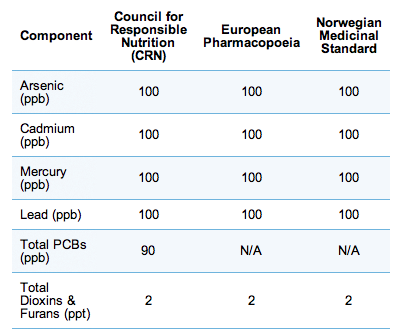
* ppt = parts per trillion
* ppb = parts per billion
The best fish oils will not only meet but exceed these international standards.
Freshness
I have written extensively about the dangers of oxidized, rancid oils. They promote oxidative damage and increase inflammation, both of which are risk factors for nearly every modern disease.
This is why it’s crucial to ensure that the fish oil you select is fresh and not rancid. Once it has gone rancid, it will have the exact opposite effect on your body than you want it to.
The first thing to do is to check something called the “peroxide value” on the COA. This is a measure of rancidity reactions in the oil that have occurred during storage. It should be less than 5 meq/kg.
If this checks out, and you decide to order that product, break open a capsule once you receive it. There should be no “fishy” odors. They should smell like the ocean, but not like rotten fish. They should also not have a strong lemon or lime scent, which could be an indicator that the manufacturer is trying to mask the rancidity.
The p-anisidine value measures secondary oxidation products. The IFOS and GOED standard is less than 20 units. However, it’s important to note that p-anisidine is not appropriate for measuring secondary oxidation in omega-3 oils that have a strong color or contain added flavorings.
For example, salmon oil contains carotenoids, which have a natural yellow/orange coloring. Bio-Avail Omega+ from Adapt Naturals contains curcumin, which also has a natural orange coloring. This throws off the p-anisidine values and makes it an irrelevant test.
TOTOX is the last way to measure oxidation. It’s simply a combination of the peroxide and p-anisidine values. (For this reason, it’s also not appropriate for products with a strong color.) The IFOS and GOED thresholds are 19.5 and 26 meq/kg, respectively. But the best products have TOTOX values below 15 meq/kg.
Finally, some studies have shown that adding antioxidants (e.g. curcumin or resveratrol) to fish oil can improve stability.
A common misconception is that you can determine the quality of fish oil by freezing it. The theory goes that if you freeze the oil and it is cloudy, it’s rancid. That is not the case. All fish contain saturated and monounsaturated fatty acids, albeit in small amounts. These fatty acids make the capsules appear cloudy when frozen in products that contain whole fish oil.
Potency
This is another area surrounded by significant controversy. Some argue the levels of individual constituents in fish oil aren’t paramount. Scientists discovered the healthful effects of omega-3s by studying people with fish-heavy diets, before supplemental fish oil even existed. Clinical trials using supplemental fish oils over the past few decades have contained widely variable levels of both long-chain omega-3 derivatives (EPA and DHA), and not super-high concentrations of either or both.
However, due to poor conversion of ALA to EPA and DHA, unless you are eating fish it is very likely you are deficient in long-chain omega-3s.
Following this line of reasoning, the DHA content in particular of fish and fish oils does seem important if we wish to obtain the best possible therapeutic effect. Many recent studies demonstrating the anti-inflammatory potential of fish oil used a daily dosage of DHA in the range of 1-3 grams. What’s more, foods like salmon roe that have been prized by traditional cultures for their nourishing and healing effects contain large amounts of DHA. A single 6 oz. serving of salmon roe contains 1 g of DHA. (In fact, this would be the best way by far of supplementing with DHA if money were no object. (Unfortunately, wild salmon roe goes for about $28/serving.)
Unfortunately, many fish oils do not have significant amounts of DHA. This means you’d have to take an impractically high number of capsules each day to obtain the therapeutic dose. This is not desirable, since all unsaturated oils (including fish oils) are subject to oxidative damage. We don’t want to take large quantities of them for this reason.
Remember to check the label and ensure that your product has approximately 200-300 mg of DHA per capsule. This will allow you to achieve the therapeutic dose by taking no more than 3 capsules twice a day.
Like what you’re reading? Get my free newsletter, recipes, eBooks, product recommendations, and more!
Bioavailability
The ability to absorb the beneficial components of fish oil is based on the molecular shape of the fatty acids. In short, the more natural the structure and the less it is chemically altered, the better.
This is true for any nutrient, of course, and it explains why I am always in favor of obtaining nutrients from food or food-based sources when possible. Each additional step in processing from the natural state of food to extract or isolate nutrients introduces the potential of damaging the nutrient or changing its chemical form so that it’s more difficult to absorb or affects the body in a different way.
When it comes to fish oils, there are three forms currently available on the market:
- Natural triglyercide oil. This is what you get when you “squeeze” the whole fish and extract the natural oil from it. It is the closest to eating fish oil in its natural form and is highly bioavailable. The drawback of this form is that, because it’s not concentrated, it usually has low levels of EPA and DHA. And because it isn’t purified, it can have high levels of contaminants such as heavy metals, PCBs, and dioxins.
- Ethyl ester oil. Occurs when natural triglyceride oil is concentrated and molecularly distilled to remove impurities. The ester form is still in a semi-natural state because it is the result of a process that naturally occurs in the body. The advantage of this form is that it can double or triple the levels of EPA and DHA.
- Synthetic triglyceride oil. This form occurs when natural triglycerides are converted to ethyl esters for concentration (as above) but then re-converted into synthetic triglycerides. The original position of the triglyceride’s carbon bonds changes, and the molecule’s overall structure is altered, which impacts the bioavailability of the oil.
Studies on absorption of the various types of fish oil suggest that, unsurprisingly, the natural triglyceride form is absorbed better than the ethyl ester form, which in turn is absorbed better than the synthetic triglyceride form.
One study by Lawson & Hughes in 1988 showed that 1 gram of EPA and 0.67 grams of DHA as natural triglycerides were absorbed 3.4 and 2.7 fold as well as the ethyl ester triglycerides.
In the previous article, we saw that fish oils were better absorbed when taken with a high-fat meal. In another study by Lawson & Hughes later the same year, they showed that the absorption of EPA & DHA from natural triglycerides improved from 69% with a low-fat meal (8g total fat) to 90% with a high-fat meal (44g total fat). Absorption of both EPA and DHA from ethyl ester oils was increased three-fold from 20% with a low-fat meal to 60% with a high-fat meal.
Sustainability
Our global fisheries are in dire straits, and fish oil is a big business. So, it’s crucial to choose a product that is manufactured with sustainability in mind and that has a fully transparent and traceable supply chain.
The easiest way to do this is to choose a product that is certified by organizations like Friend of the Sea or MarinTrust, two of the leading organizations for sustainable and responsible fishery management.
I would also choose a supplier/manufacturer with practices that minimize waste and its environmental impact.
For example, rather than catching fish that is only used to produce fish oil, some producers instead use fish meal to make the oil. This eliminates one of the main concerns about fish oil, which is that it will further deplete fisheries.
Recommendation
As a Functional Medicine clinician, author, and educator, I’ve been following the fish oil market closely for many years. I’ve used several different fish oils with my patients. I’ve read hundreds of studies on the purity, freshness, composition, and benefits of fish oil. I’ve spoken to industry experts and insiders, and I know what many companies do to cut corners and save money (at your expense).
When I started my own supplement company, Adapt Naturals, I knew that one of the first products we’d make would be fish oil. I wanted to create a product with the purest, freshest, and most sustainable fish oil available. And that’s exactly what we did with Bio-Avail Omega+.
I chose VivoOmega from GC Rieber as our fish oil. As the chart below illustrates, it significantly exceeds international standards for both purity and freshness.

Purity and freshness are critical. But I didn’t stop there. Most people who take fish oil are taking it to achieve certain outcomes, like better muscle and joint health, increased mental clarity, a more stable mood, clearer skin, and more balanced immune function.
So, when I formulated our fish oil product (Bio-Avail Omega+), I added the most bioavailable forms of two powerful nutrients that also support these goals: curcumin and black seed oil.
Now you can get the benefits of all three of these superfood nutrients in a single, two soft-gel daily serving.
Bio-Avail Omega+ contains an optimal composition of EPA and DHA (510 mg of EPA and 330 mg of DHA, a 3:2 ratio). It is made with triglyceride oils for optimal bioavailability and absorption. And it is produced with the most sustainable and traceable fish oil material in the industry. (See this page for more info.)
I’m proud of this product. It came directly out of my experience working with patients for 15 years and my extensive research into what is most important in a fish oil product. I hope it helps you to achieve your health goals!

Better supplementation. Fewer supplements.
Close the nutrient gap to feel and perform your best.
A daily stack of supplements designed to meet your most critical needs.

hi Im currently pregnant wanted to switch from a prenatal dha that was fish oil I was afraid of the mercury or toxin possibility. I did take this with my son he is amazing and bright and it is prenatal but at the time I didn’t realize there are options to fish supplied dha. I started taking a vegan dha epa Ovega-3 however I have very sensitive skin, I have now noticed after one bottle my skin is a mess my hands are so sore eczema red spots burning itching, winter itch on legs etc. my nursing son even has a little rash on his bottom and this is not normal for him. I ordered Naturewise Krill oil. I get nervous starting a new product. I have anxiety and worry about silly things. From what I read this is a quality supplement and company. Has anyone else taken this during pregnancy? My midwife told me I do need to stop taking a month before my due date . I assume this has to do with blood clotting, what if something were to happen early is this unsafe? if not pregnant- What happens if you have an accident and need surgery? I sure hope this is a good one. https://www.amazon.com/NatureWise-OmegaWise-Superba-Traceability-Softgels/dp/B00EFVQ3OC/ref=sr_1_1?ie=UTF8&qid=1387417319&sr=8-1&keywords=naturewise+krill
Great info, thank you! Unless I have missed it, could you please explain why ever since I have started taking omega-3s- Nordic Naturals, my back has been breaking out with severe acne including cystic acne. The skin on my back was flawless before this. Please help!! Thank you!
I like Krill because of the pill size and all you mentioned above. Can you take BOTH fish oil and krill? Is it too much?? Also Vital Choice has a Krill….not sure what to do and what about the Liquid DHA?
I am curious about Nordic Naturals brand? Any thoughts?
I know as working with a producer that Nordic Naturals are very careful about selecting their quality oil that they use in their products. They are very quality minded and one of the best in my opinion. Also “Omega-cure” is a tremendous pure quality product of CLO. If you don’t want to take the oil, I would at least bite the soft-gel to test the quality. Tasting is the way to know if your product is rancid (oxidated or not)
Hi! I am interested in starting to take fish oil daily. I was wondering what you thoughts are on Beachbody’s Core Omega-3? Thank you
Can anyone recommend a good fish oil in liquid form? My understanding is that for one it works out cheaper and secondly it doesn’t contain any additives that you would find in capsules. I’m also interested in Krill oil. Perhaps a combination of a fish oil and krill oil product.
Also, is there a good source for reviews? Sorry if this has been asked before.
Thanks!
Dan, the Vital Choice Salmon oil that Chris recommends comes in a liquid form (or gel cap). The liquid is cheaper.
Good to know! thx
Hello, at this moment I take Xtend-Life Omega 3 / QH Ultra. I was a little tired and simple I want to try someone else’s product, and when I entered into a search engine then I get scared when I just saw how much of the product on the market
Is there something equal or better that you can recommend as best-buy based on your experience for daily use.
Regards
Ivan
I was curious. I am looking for a product to use daily for my acne. Should I be take a fish oil from BOTH the baseline and supplemental level daily?
I’m looking for recommendations for pregnant vegetarians who eat no fish whatsoever. I also have high cholestrol.
Dee:
The product that you are looking for will have the logo or trademark of “LifesDHA”. This is a DHA only product derived from single cell organisms. LifesDHA contains the product DocosaHexaenoic Acid Single Cell Organism (DHASCO) made by DSM (formally Martek) and is extracted from the unicellular alga Crypthecodinium cohnii. Deva Vegan Vitamins has both DHA (LifesDHA) and added EPA (non-fish sourced). Amerifit Nutrition Ovega-3 DHA EPA Vegetarian is another product containing both. You need to have EPA to reduce cholesterol. However, the doses in these dietary supplements may not be the strength you need unless you take several of the capsules.
You need to be careful of these dietary supplements and make sure that the label says “LifesDHA”. This product containing DHASCO has generally recognized as safe (GRAS # 41) status and is approved for use in infant formula. I am quoting from New Zealand A Safety Assessment TECHNICAL REPORT SERIES NO. 22 “DHASCO is produced from C. cohnii using fermentation techniques. Cultures of the organism are grown up in liquid medium in shaker flasks and are transferred to progressively larger vessels. When the culture reaches a specified cell density and fatty acid content, the cells are harvested by centrifugation and spray dried. The process for extraction of the oil is basically the same as that used in conventional vegetable oil processing plants. The oil is extracted from the biomass by blending the biomass with hexane in a continuous extraction process.”
Here are some products that are marketed towards pregnant and nursing moms that have the “LifesDHA” trademark: Expecta Lipil DHA. See https://www.lifesdha.com/find-lifes-dha/products.aspx for more products. I am sure there are others but the price is high due to marketing to these groups. Also, many of these products only contain 30 supplements per bottle. You are better off purchasing a LifesDHA product that is not marketed towards women and you will get a much better price for the same ingredients.
For pregnancy outcome, 600 mg DHA/d has been recommended. Here is an excerpt from a publication: “A supplement of 600 mg DHA/d in the last half of
gestation resulted in overall greater gestation duration and infant
size. A reduction in early preterm and very-low birth weight could
be important clinical and public health outcomes of DHA supplementation.
This trial was registered at clinicaltrials.gov as NCT00266825.” From “DHA supplementation and pregnancy outcomes” in Am J Clin Nutr 2013;97:808–15.
Good luck on your pregnancy,
PIXE
Pixie, the email on fishoil detective is not active.do you have an email I can reach you at? Thanks for your time,
Kelly,
I very much appreciate PIXE taking the time to share his knowledge here. From him I have learned the important differences between TAG, EE and rTag supplements. My only complaint is that sometimes his links don’t work. This one does https://www.pharmamarine.com . (The Jarrow site does not state that Max DHA is made with Calamarine. Perhaps the website has not been updated to reflect the reformulation.)
PIXE has not hijacked Chris’ blog. He is posting on what would otherwise be a dead thread. I would suggest that no one try to imagine how Chris feels about it.
Thanks, PIXE.
Kelly:
Sorry about the link. Perhaps this will work: https://www.pharmamarine.com/default.aspx?menu=22
There is a table of the contents of the different types of oils TAG vs. EE. Just compare the label on any product with the listing. Pharmamarine is suppose to be the only supplier of Calamari oil but that does not mean that someone else could be selling it unregistered. Although Jarrow’s formulae does not match the currently listing on Pharmarine does not concern me since the content of the oil changes and they could perhaps be selling a different formula. In addition, Jarrow could of purshased the raw oil and then re-esterified it to get the formula that is not listed. My data shows that my bottle has rTAG. I will check to see why the trademark Calamarine is not on Jarrow’s MaxDHA.
I am only reporting the chemical forms of these oils since this is the major concern of an effective product for various disease. I apologize if I have not provided any mercury or other toxin data since this is also of concern. These products are purified to reduce these contaminants to accepted standards. Calamari are low in contaminants because of low lifespan. In addition, the part of the calamari that is used for producing the oil is from the cuttings.
PIXE
Hi Chris,
Add me to the list of people who would like to know what you think of the new Jarrow Max DHA formula, which is made from “calamari oil” (Marketing-speak for squid?). It’s still a great price, so I’d like to know what you think.
Thanks,
Ben
Ben:
Jarrow’s revised formula Max DHA is a high quality product and it is TAG oil from the waste cuttings of wild squid. To learn more about the product visit the producer’s web site https://www.pharmamarine.com. My bottle Lot# 48269k 12 Ex. 11/14 was purchased from Amazon at $22.37 for 180 softgels. Each softgel supplies 250 mg DHA and 65 mg EPA. Researchers are recommending higher DHA intakes for pregnancy and lactating moms. High DHA is suspected of decreasing symptoms of Alzheimer’s and may result in a reduction of Attention Deficit Hyperactivity Disorder (ADHD).
The company makes both the ethyl ester and TAG derivatives of the product and you must be careful of which one you select. See my post early on in regards to Dr.’s Best DHA 500 which is an ethyl ester.
PIXE
Pixe,
I don’t understand why you keep posting, basically hijacking poor Chris’ blog. You’re clearly passionate about certain types of fish oils, but the fact that you’re not interested in the mercury or other heavy metal content of oils, almost negates your obsession with a particular form of oil. If the brands (with high DHA, which I’ve read over and over are not the type to get) are contaminated with heavy metals, why would they be preferable over others that have been purified?
Sigh…
I am iodine sensitive…….one of three doctors says hashemotos…… considering this….. which product would you recommend… thank u!!
In all honesty, I’m somewhat skeptical of fermented cod liver oil.
Have there been independent lab tests on the benefits of fermented cod liver oil? I’m emailed Green Pastures to ask them questions about their products. Their responses are usually evasive. I wonder why?
I would love too see more hardcore evidence before jumping the gun.
Hi….I am sensitive to iodine in fish (hashimotos ). I’ve just recently realized that the flushing i have ( poss hashiimotos reaction) ,is attributed to using cod liver oil… I didn’t see any warning in ur article concerning iodine in the fish oil, for hashimotos… Could you plz give ur opinion on this…..I’ve been taking Carlsons Norwegian Cod Liver Oil. Could you plz make a suggestion for me… THANK YOU !
In May of 2010 Chris Kresser recommended Vital Choice Wild Salmon Oil. I would really like to purchase a natural triglyceride fish supplement. What I don’t understand is that the EPA is greater than the DHA. I thought it was more beneficial for the DHA to be greater. Please explain.
Danny:
With all do respect to the moderator Chris.
For VitalChoice “Wild Alaskan” Sockeye Salmon Oil, they forgot to tell their salmon to make the oil with a different DHA/EPA ratio than they naturally produce. My bottle with Lot # uc100411 that expired 8/2012 has 90 softgels. Each softgel supplies 80 mg EPA (8%) and 73 mg DHA (7.3%) for which I paid $22.00. Today, the formulae has not changed and you get 90 softgels for $24.00. The supplement facts is misleading as well as their website because you need to take three softgels to get 240 mg EPA and 220 mg DHA. Again, read your labels before you purchase your dietary supplements. In salmon, the DHA content is greater than EPA. The VitalChoice salmon oil is a low quality product with low concentrations of DHA and EPA. If the EPA is greater than DHA in products that claim to be “salmon oil”, I would not purchase it. It is widely known that there are many fake salmon oil supplements on the market that are just regular fish oil with the red pigment astaxanthin. A more cost effective purchase for high concentrations of DHA would be Jarrow Formulas Max DHA that each softgel provides 250 mg DHA (42%) and 65 mg EPA (11%) in TAG from calamari. My bottle of 180 softgels cost me $16.49 from Vitacost: https://www.vitacost.com/jarrow-formulas-max-dha or $22.37 from Amazon. Price does not include shipping. Wow, that is a tremendous difference in price for the VitalChoice (90 softgels for $22.00, 80 mg EPA, 73 mg DHA) vs. Jarrow Max DHA (250 mg DHA, 65 mg EPA).
DHA is important for pregnant and nursing women and also has promise for improving cognitive functions. In Canada, they allow the following health claims on DHA rich fish oil: “DHA, an omega-3 fatty acid, supports the normal development of the brain, eyes and nerves.”
Before purchasing salmon oil, see the article: “Supplementing long-chain n-3 polyunsaturated fatty acids in canned wild Pacific pink salmon with Alaska salmon oil” at https://onlinelibrary.wiley.com/doi/10.1002/fsn3.4/pdf (open access, i.e. free). This article will give you the background information on where salmon oil comes from. In addition, before purchasing salmon oil or any other marine oils, read the USDA detailed database: https://www.ars.usda.gov/SP2UserFiles/Place/12354500/Data/SR25/reports/sr25fg15.pdf. This massive data base will give you information on trace elements as well as fatty acid content of cooked, canned, and different types of raw fish.
I used this database to calculate how much EPA and DHA you can get from a cooked 100 grams (about 3.5 oz) of a salmon steak I purchased for $5.99 for a 4 oz portion. See my photo at http://www.fishoildetective.com to get a perspective of this cooked salmon steak in relation to a bottle of Kirkland’s Natural fish-oil capsules that can be purchased for $7.99 from Costco for 400 capsules. You can also purchase the almost identical Natural fish oil from B.Js. to get their “Berkley & Jensen Natural Extra Strength Fish Oil 1200 Mg” for $8.99, but you only get 300 capsules of the same product as the Kirkland. Both have the USP seal of approval since they are both “fish oil” in TAG as defined by USP.
PIXE
Hello
I just looked up Xtendlife Omega3/DHA Fish Oil (on their website) and found this info, “Our Omega3 / DHA Fish Oil is a 50/50 blend of hoki oil in its natural triglyceride form and a concentrated molecularly distilled tuna oil in an ethyl ester form. Both are exceptionally pure.” Would a 50/50 blend be to keep the cost down and how effective would this type of fish oil be?
Thank you
Hello
Does anyone have any information regarding Standard Process brand Tuna Omega-3 Oil. I asked about their processing/extraction methods and they stated, “The only additional information I can provide at this time is that it is filtered. Our vendors feel their filtration process is proprietary.” They also stated, “During manufacturing, our marine oils are processed to retain their natural triglyceride structure.” What bothers me is that the information sheet and the packaging doesn’t state anything about ethyl ester or triglycerides. Has anyone on this site found out any more info regarding this brand?
Danny:
My bottle of Standard Process Tuna Omega-3 oil was purchased from Amazon and now the cost is $33.00 for 120 capsules that are pearls that weigh 0.97271 g. Each capsule supplies 150 mg DHA and 30 mg EPA from refined tuna oil, TAG. Refined tuna has GRAS (generally recognized as safe) status via three GRAS applications. GRAS numbers 94, 109, and 379 (from Ocean Nutrition Canada) cover tuna oil. Find all GRAS applications at: https://www.accessdata.fda.gov/scripts/fcn/fcnNavigation.cfm?rpt=grasListing. GRAS 379 will give you details on how the oil is extracted from tuna byproducts. Also, there are no ethyl ester incorrectly labeled “fish oil” GRAS products. Only TAG oils have GRAS status such as menhaden, salmon, and re-esterified oils. This should tell you something about the safety of TAG oil dietary supplements.
A better buy would be Jarrow Formulas MaxDHA from Vitacost $16.49 for 180 capsules each supplying 180 mg DHA and 65 mg EPA from Calamari oil that is TAG. Notice that these two dietary supplements have DHA > EPA. In this case, DHA is suppose to be better for retina and brain development. The reason why tuna oil got GRAS was because it is used in baby formula to promote healthy brain and retina development.
So, the choice is cost effective to get your DHA > EPA from Calamari rather than the more expensive tuna oil. Both will also have DPA omega-3 fatty acid. I have no information on heavy metals and organic toxins for these two products. However, the GRAS application for the tuna oil discusses how they remove these toxins. Similar description is also on https://www.calamarine.com/default.aspx?menu=42 for calamari oil.
PIXE
PIXE
Thank you for the information and please excuse my ignorance on the subject of ‘fish oils’. Is TAG the same as TG (natural triglycerides) when being used in the comment section?
Also, right now I am taking 3000mg (3 soft gels) of Xtendlife Omega3/DHA Fish Oil – 50%EE (Tuna )/50% TG (Hoki) 60 soft gels to a bottle ($17.95), so 1 bottle lasts me 20 days. I would really like to switch to something healthier, no EE, without further damaging my pocketbook. If Standard Process is a good TG/TAG product I wouldn’t mind taking that. I can get that through my chiropractor for an even better price than on Amazon (go figure!). I had no idea about ethyl ester, and thought I was purchasing a totally healthy product. I don’t think of 50% EE as healthy. And one more question… what do you think about Barlean’s Wild and Whole Alaskan Salmon Oil, listed as “Natural Triglyceride Form”?
Again, thank you for any information you might be able to give me,
Danelle
Danny:
Here is more references to GRAS fish oils. This is from GRAS Notice GRN 193:
“Eupoly-EPA and Eupoly-DHA are substantially similar to other fish oils that are already
regarded as GRAS for addition to foods, including menhaden oil (21 CFR 184.1472),
small planktivorous pelagic fish body oil (GRAS Notice GRN 102), salmon oil (GRAS
Notice GRN 146), anchovy-sardine 18/12 TG fish oil (GRAS Notice GRN 138), Marinol
Omega-3 fish oil derived from anchovy, sardine and mackerel (GRAS Notice GRN 105),
and tuna oil (GRAS Notice GRN 109).”
PIXE
Hi,
I’m in the process of taking fish oil from livers, seperated mechanically after being cooked for a short period at 70C, and trying to design an oil for capsules (or bottling) from this. My untouched oil is 100(ish)mg DHA and 60(ish)mg EPA, and I am waiting of vitamin results from the lab unfortunately. From here I am planning to use a solvent based process to partially concentrate some oil and blend it back in to the raw oil to improve the DHA/EPA content (after total removal of the solvent of course!!). By doing so I expect that I will be able to retain all the natural good stuff in the oil (phospholipids, marine DNA, any other good stuff there is) and produce a better product.
What concentration would be best to bring the DHA/EPA up to?
Any other advice?
Thanks. JB
A university student.
The only problem on doing this would be the contaminants, that is mainly why all raw oils have to go through a refining process
what about Rescue 1250… it’s pretty expensive…do you know anything about it?
ro:
My bottle of Res-Q Power of the Sea Omega-3 supplement 1250, lot # 77341 Exp 03 2016 contains 200 softgels for which I paid $41.00 on Amazon in June 2013. Each softgel supplies 390-425 mg EPA and 300-325 mg DHA. It appears that they don’t know what the real concentration is, and they give a range perhaps due to variability from batch-to-batch. This is one of the few products that I see where they give a range. I gather this is being honest since probably those values on other bottle labels are incorrect and really are ranges. Hard to imagine that all those labels on products can have the same identical absolute amount of EPA and DHA per capsule since the concentration of omega-3s varies season-to-season, location-to-location, and species-to-species in fish. A range is probably more realistic and gets around misleading advertising since many fish oil products that are tested do not have the concentrations stated on the bottles. Most of them are lower than what is on the label.
This product Res-Q 1250 enjoys marketing fiction by stating, “is the purest, most potent form omega-3, EPA and DHA, available.” This product is a low-grade ethyl ester omega-3 market with several saturated fatty acid ethyl ester impurities and is not the “purest, most potent form.” What is disturbing is that they have fallen to the same tactics as many products by listing “Omega-3 Fatty Acids” content instead of listing the total amount of oil concentrate or “fish oil concentrate.” This misleading listing of the amount of EPA and DHA per total omega-3 content is misleading and gives a higher percentage of EPA+DHA than is actually in the product. For Res-Q 1250, each capsule weighs 1.83932 g but the oil weighs 1.29852 g versus the “omega-3 fatty acids” of 750-850 mg. When I calculate the relative amount of EPA and DHA content to the mass of the liquid (oil concentrate) I get 32% EPA and 25% DHA. If you use the “omega-3 fatty acids” as the relative amounts you get 50% EPA and 38% DHA, which is misleading. So, (32+25) gives 57% EPA+DHA content. You have to ask yourself what is the remaining 43%. Well, this is those infamous saturated fatty acid ethyl esters that you find in marine biodiesel.
This brings me to the point that you really have to read those labels carefully. Also, in error is the total fat content of “1.5 g” when the mass of the oil is only ~1.3 grams, unless they calculate that the capsule is fat which it is not. Most of the omega-3 dietary supplements on the market do not have up-to-date labels. Back in 2004, the FDA allowed Qualified Health Claims for Omega-3 Fatty Acids to say, “Supportive but not conclusive research shows that consumption of EPA and DHA omega-3 fatty acids may reduce the risk of coronary heart disease.” However, many products on the market do not have this statement on their products and shows that these products are not up to date with labeling.
Finally, $41.00 is very expensive to pay for a product that is less pure than other products on the market. I gather the high cost goes towards marketing “is the purest, most potent form omega-3, EPA and DHA, available” fiction. It is not how much you take, but how much gets absorbed that counts. You are better off with natural TAG and a lower price, but you will have to take more capsules. For $41.00, I can buy 5 bottles (2,000 softgels) of Kirkland Natural (not the enteric, ethyl ester Kirkland) that will give me 600 grams total of EPA+DHA versus 150 grams (1 bottle of 200 softgels) for the Res-Q 1250.
PIXE
Hi,
I was hoping for an answer to the question about Green Pastures Fermented Cod Liver Oil and whether or not it is rancid. It smells and tastes absolutely vile and gives me stomach cramps so I just cant bring myself to take it. I figure our natural instincts should be trusted and if your senses are telling you not to take it then you probably shouldn’t?! Is it supposed to taste like this?
Also, on their Product Test Data page it shows that a lot of the vitamin D in the FCLO is D2 rather than D3 and the Vitamin A is palmitate rather than retinol. Does this have implications and is it still the brand you most highly recommend Chris?
Rancidity is oxidation which is known to be bad for you cells . When your body is repeating the oil, it is your body telling you that this is not good for your body. It is a natural reaction. I have test results from a lab on Green Pastures Fermented Cod Liver Oil, showing that the oxidation level is probably already at stage 2. Not within pharmacopeia standards nor in the USA or EU in other words. If not refined I can only imagine how the contaminant parameters would be!