

Update: I now recommend Bio-Avail Omega+ from Adapt Naturals. It’s a blend of ultra-pure fish oil and the most bioavailable forms of curcumin and black seed oil.
Summary
Sorry, folks. Another long one. It was unavoidable, though, because I really did want this to be a “definitive guide” that covers all (or at least most) of the relevant issues involved with choosing a fish oil. Here’s a summary for the time-challenged:
- There are five important factors to consider when choosing a fish oil: composition, purity, freshness, bioavailability, and sustainability.
- Not all fish oils are created equal. It’s essential to do your homework and make an informed choice. Many fish oils are oxidized or made with poor-quality ingredients and may cause health problems instead of solving them.
- The potency of various products depends not only upon the levels of EPA and DHA but also upon the molecular structure of the fats in the oil, which in turn affects absorption.
- Natural triglyceride fish oils are better absorbed than highly purified (i.e. ester) fish oils.
- Many fish oils are made from fish that are endangered. Choose products made from fish that are certified by organizations such as Friend of the Sea or MarinTrust.
Introduction
So far in this series we’ve looked at why fish is superior to plant-based sources of omega-3. We’ve examined the importance of reducing consumption of omega-6 fats. We’ve considered how much omega-3 is needed to support health and treat disease. We’ve revealed that concerns about the safety of fish consumption have been overblown, and that eating fish regularly is not only safe but incredibly beneficial. And in the previous article we compared the benefits of eating fish to taking fish oil.
In this final article of the series, we’re going to take a closer look at fish oil. Fish oil is one of the most popular supplements taken by consumers today. Most people who are at least relatively health conscious understand that they need omega-3 in their diet and are probably not getting enough from food (unless they eat a lot of fish).
But why should you consider taking fish oil in the first place? Which fish oils are best? How much should you take? And what should you look for in a good product?
In this article, I’ll focus more on dispelling common misconceptions about fish oil and helping you to choose the best product for your needs.
My current thoughts on fish oil
My view and recommendations for fish oil have evolved over time.
I’ll tell you what has remained constant first, then tell you what has changed.
I still recommend getting EPA/DHA from the diet whenever possible—either as your exclusive source or as a foundation to build upon.
And I still don’t recommend super-high doses of fish oil, like 10 grams per day. This isn’t common anymore, but there was a time when many health gurus were suggesting this as a way to reduce inflammation. But it’s not supported by research, and there’s no additional benefit beyond the 1-3 grams a day studies suggest is the best therapeutic target.
What has changed is my growing appreciation for the role fish oil can play in ensuring adequate EPA/DHA intake for many people. For all of the reasons I’ve mentioned in this series, many folks are just not getting enough EPA/DHA, and taking a fish oil supplement is probably the only way they’re going to get these critical fatty acids.
It’s also true that some people benefit from greater amounts of EPA/DHA than they can easily obtain in their diet.
My specific recommendations for EPA/DHA supplementation have also evolved. I have recommended cod liver oil for many years, and I still do today. It’s a good option because it contains vitamins A and D in addition to EPA/DHA.
However, the amounts of EPA and DHA are lower in cod liver oil than in most fish oil supplements. And if you’re already consuming organ meats like liver or an organ meat supplement, like Bio-Avail Organ from Adapt Naturals, you don’t really need (or even want) the additional A/D from cod liver oil.
This is why I now recommend a high-quality fish oil supplement for people who are either not getting enough EPA/DHA from their diet or who would benefit from additional EPA/DHA because of a chronic, inflammatory, or autoimmune condition.
But finding a high-quality fish oil is easier said than done. The global market for fish oil is north of $2 billion now. Whenever there’s that much money to be made, you can be sure all kinds of shenanigans will ensue!
So, let’s look at some of the most important factors to consider when buying fish oil.
Factors to consider when buying fish oil
There are five primary variables to be aware of when shopping for fish oil:
- Composition. In order to have the desired anti-inflammatory effect, fish oil must contain an adequate amount of the long-chain omega-3 derivatives EPA and DHA.
- Purity. The oil must meet or exceed international standards for heavy metals, PCBs, dioxins, and other contaminants. Many do not—even when they claim they do.
- Freshness. The oil should be fresh and not rancid. Rancid/oxidized oils promote oxidative damage and increase inflammation, both of which are risk factors for nearly every modern disease. Sadly, many fish oils on the market contain high levels of oxidative by-products.
- Bioavailability. The ability to absorb the beneficial components of fish oil is based on the molecular shape of the fatty acids. The more natural the structure, the better.
- Sustainability: The fish should be harvested in a sustainable manner, and species that are under threat should be avoided.
Composition
Composition refers to the overall concentration of EPA/DHA and the ratio of EPA to DHA. To some extent, this depends on the goal of taking fish oil. For example, some conditions may call for a higher proportion of DHA, while others benefit from more EPA.
Most studies suggest that a 3:2 ratio of EPA to DHA is optimal, with a total amount of omega-3 ranging between 500 mg and 2 g per day.
The optimal amount for each person will vary based on several factors, including how much fish/seafood you’re consuming in your diet. If you don’t eat any, and/or you have an inflammatory or autoimmune condition, you want to aim for the higher end. If you eat some fish/seafood, you can aim for the lower to mid-range.
Purity
Many species of fish are known to concentrate toxic chemicals like heavy metals, PCBs, and dioxins, which can cause serious diseases, especially in children and developing fetuses. In a previous article, I explained how these chemicals are typically not a concern when eating whole fish because fish also contains selenium. Selenium binds to mercury and makes it unavailable to tissues, thus protecting against any damage it may cause.
To address this, fish oil manufacturers use a process called molecular distillation to remove the toxins from the oil. When done correctly, molecular distillation is capable of reducing the toxins in fish oil to levels considered to be safe by the EPA and other agencies.
Although almost any fish oil manufacturer will tell you their product is free of these toxins, independent lab analyses tell a different story. In March of 2010, a lawsuit was filed in California court against the manufacturers of ten popular fish oils because they contained undisclosed and (possibly) unsafe levels of contaminants.
Unfortunately, this kind of deception is all too common in the supplement industry. The best companies will be able to provide a Certificate of Analysis (COA) from the manufacturer upon request. A COA is an analysis performed by an independent lab to measure the ingredients of a product and confirm whether it lives up to the claims made by the manufacturer.
If the manufacturer won’t provide a COA, I start to get suspicious. This is standard practice in the industry, and there’s no reason they shouldn’t be happy to show you theirs.
In general, fish that are lower on the food chain, like sardines and anchovies, naturally have a lower concentration of contaminants. For this reason, it may be wise to look for a product made from these fish.
So what levels of these toxins are safe? As you might imagine, there is some disagreement on this question since there is no single governing body that determines acceptable levels. However, the standards that are most often followed by fish oil manufacturers are summarized in the table below.
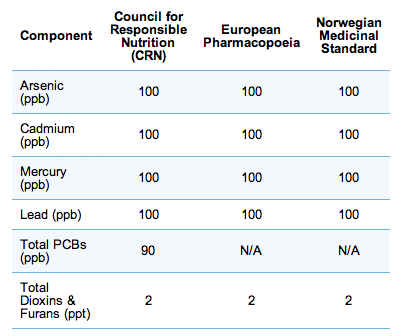
* ppt = parts per trillion
* ppb = parts per billion
The best fish oils will not only meet but exceed these international standards.
Freshness
I have written extensively about the dangers of oxidized, rancid oils. They promote oxidative damage and increase inflammation, both of which are risk factors for nearly every modern disease.
This is why it’s crucial to ensure that the fish oil you select is fresh and not rancid. Once it has gone rancid, it will have the exact opposite effect on your body than you want it to.
The first thing to do is to check something called the “peroxide value” on the COA. This is a measure of rancidity reactions in the oil that have occurred during storage. It should be less than 5 meq/kg.
If this checks out, and you decide to order that product, break open a capsule once you receive it. There should be no “fishy” odors. They should smell like the ocean, but not like rotten fish. They should also not have a strong lemon or lime scent, which could be an indicator that the manufacturer is trying to mask the rancidity.
The p-anisidine value measures secondary oxidation products. The IFOS and GOED standard is less than 20 units. However, it’s important to note that p-anisidine is not appropriate for measuring secondary oxidation in omega-3 oils that have a strong color or contain added flavorings.
For example, salmon oil contains carotenoids, which have a natural yellow/orange coloring. Bio-Avail Omega+ from Adapt Naturals contains curcumin, which also has a natural orange coloring. This throws off the p-anisidine values and makes it an irrelevant test.
TOTOX is the last way to measure oxidation. It’s simply a combination of the peroxide and p-anisidine values. (For this reason, it’s also not appropriate for products with a strong color.) The IFOS and GOED thresholds are 19.5 and 26 meq/kg, respectively. But the best products have TOTOX values below 15 meq/kg.
Finally, some studies have shown that adding antioxidants (e.g. curcumin or resveratrol) to fish oil can improve stability.
A common misconception is that you can determine the quality of fish oil by freezing it. The theory goes that if you freeze the oil and it is cloudy, it’s rancid. That is not the case. All fish contain saturated and monounsaturated fatty acids, albeit in small amounts. These fatty acids make the capsules appear cloudy when frozen in products that contain whole fish oil.
Potency
This is another area surrounded by significant controversy. Some argue the levels of individual constituents in fish oil aren’t paramount. Scientists discovered the healthful effects of omega-3s by studying people with fish-heavy diets, before supplemental fish oil even existed. Clinical trials using supplemental fish oils over the past few decades have contained widely variable levels of both long-chain omega-3 derivatives (EPA and DHA), and not super-high concentrations of either or both.
However, due to poor conversion of ALA to EPA and DHA, unless you are eating fish it is very likely you are deficient in long-chain omega-3s.
Following this line of reasoning, the DHA content in particular of fish and fish oils does seem important if we wish to obtain the best possible therapeutic effect. Many recent studies demonstrating the anti-inflammatory potential of fish oil used a daily dosage of DHA in the range of 1-3 grams. What’s more, foods like salmon roe that have been prized by traditional cultures for their nourishing and healing effects contain large amounts of DHA. A single 6 oz. serving of salmon roe contains 1 g of DHA. (In fact, this would be the best way by far of supplementing with DHA if money were no object. (Unfortunately, wild salmon roe goes for about $28/serving.)
Unfortunately, many fish oils do not have significant amounts of DHA. This means you’d have to take an impractically high number of capsules each day to obtain the therapeutic dose. This is not desirable, since all unsaturated oils (including fish oils) are subject to oxidative damage. We don’t want to take large quantities of them for this reason.
Remember to check the label and ensure that your product has approximately 200-300 mg of DHA per capsule. This will allow you to achieve the therapeutic dose by taking no more than 3 capsules twice a day.
Like what you’re reading? Get my free newsletter, recipes, eBooks, product recommendations, and more!
Bioavailability
The ability to absorb the beneficial components of fish oil is based on the molecular shape of the fatty acids. In short, the more natural the structure and the less it is chemically altered, the better.
This is true for any nutrient, of course, and it explains why I am always in favor of obtaining nutrients from food or food-based sources when possible. Each additional step in processing from the natural state of food to extract or isolate nutrients introduces the potential of damaging the nutrient or changing its chemical form so that it’s more difficult to absorb or affects the body in a different way.
When it comes to fish oils, there are three forms currently available on the market:
- Natural triglyercide oil. This is what you get when you “squeeze” the whole fish and extract the natural oil from it. It is the closest to eating fish oil in its natural form and is highly bioavailable. The drawback of this form is that, because it’s not concentrated, it usually has low levels of EPA and DHA. And because it isn’t purified, it can have high levels of contaminants such as heavy metals, PCBs, and dioxins.
- Ethyl ester oil. Occurs when natural triglyceride oil is concentrated and molecularly distilled to remove impurities. The ester form is still in a semi-natural state because it is the result of a process that naturally occurs in the body. The advantage of this form is that it can double or triple the levels of EPA and DHA.
- Synthetic triglyceride oil. This form occurs when natural triglycerides are converted to ethyl esters for concentration (as above) but then re-converted into synthetic triglycerides. The original position of the triglyceride’s carbon bonds changes, and the molecule’s overall structure is altered, which impacts the bioavailability of the oil.
Studies on absorption of the various types of fish oil suggest that, unsurprisingly, the natural triglyceride form is absorbed better than the ethyl ester form, which in turn is absorbed better than the synthetic triglyceride form.
One study by Lawson & Hughes in 1988 showed that 1 gram of EPA and 0.67 grams of DHA as natural triglycerides were absorbed 3.4 and 2.7 fold as well as the ethyl ester triglycerides.
In the previous article, we saw that fish oils were better absorbed when taken with a high-fat meal. In another study by Lawson & Hughes later the same year, they showed that the absorption of EPA & DHA from natural triglycerides improved from 69% with a low-fat meal (8g total fat) to 90% with a high-fat meal (44g total fat). Absorption of both EPA and DHA from ethyl ester oils was increased three-fold from 20% with a low-fat meal to 60% with a high-fat meal.
Sustainability
Our global fisheries are in dire straits, and fish oil is a big business. So, it’s crucial to choose a product that is manufactured with sustainability in mind and that has a fully transparent and traceable supply chain.
The easiest way to do this is to choose a product that is certified by organizations like Friend of the Sea or MarinTrust, two of the leading organizations for sustainable and responsible fishery management.
I would also choose a supplier/manufacturer with practices that minimize waste and its environmental impact.
For example, rather than catching fish that is only used to produce fish oil, some producers instead use fish meal to make the oil. This eliminates one of the main concerns about fish oil, which is that it will further deplete fisheries.
Recommendation
As a Functional Medicine clinician, author, and educator, I’ve been following the fish oil market closely for many years. I’ve used several different fish oils with my patients. I’ve read hundreds of studies on the purity, freshness, composition, and benefits of fish oil. I’ve spoken to industry experts and insiders, and I know what many companies do to cut corners and save money (at your expense).
When I started my own supplement company, Adapt Naturals, I knew that one of the first products we’d make would be fish oil. I wanted to create a product with the purest, freshest, and most sustainable fish oil available. And that’s exactly what we did with Bio-Avail Omega+.
I chose VivoOmega from GC Rieber as our fish oil. As the chart below illustrates, it significantly exceeds international standards for both purity and freshness.

Purity and freshness are critical. But I didn’t stop there. Most people who take fish oil are taking it to achieve certain outcomes, like better muscle and joint health, increased mental clarity, a more stable mood, clearer skin, and more balanced immune function.
So, when I formulated our fish oil product (Bio-Avail Omega+), I added the most bioavailable forms of two powerful nutrients that also support these goals: curcumin and black seed oil.
Now you can get the benefits of all three of these superfood nutrients in a single, two soft-gel daily serving.
Bio-Avail Omega+ contains an optimal composition of EPA and DHA (510 mg of EPA and 330 mg of DHA, a 3:2 ratio). It is made with triglyceride oils for optimal bioavailability and absorption. And it is produced with the most sustainable and traceable fish oil material in the industry. (See this page for more info.)
I’m proud of this product. It came directly out of my experience working with patients for 15 years and my extensive research into what is most important in a fish oil product. I hope it helps you to achieve your health goals!

Better supplementation. Fewer supplements.
Close the nutrient gap to feel and perform your best.
A daily stack of supplements designed to meet your most critical needs.

I currently take 3 teaspoons daily of Carlson’s Omega 3 fish oil. I’m looking to switch to a krill oil product but it needs to be a liquid as I have trouble swallowing pills. I’ve found this product on the web and would like to know if you’ve ever heard of this company or have an opinion of their product. My goal is to lower my cholesterol and triglycerides.
Thank You
Joe
hi pixe hoping we can see what you found regarding the Biotrust Omega 3 5x new supplement soon .. thanks for all this input /testing info … are you still taking the Triglyceride Omega 3 Gold? or something else … thank you !!
Jay:
I am in the process of putting together a brief report on this dietary supplement. See “Enhanced increase of omega-3 index in healthy individuals with response to 4-week n-3 fatty acid supplementation from krill oil versus fish oil” https://www.lipidworld.com/content/pdf/1476-511X-12-178.pdf
to prep for the information that I will be posting.
Also see the back and forth between the authors and letters to the editor.
Pixe
Jay:
Grab these two important reports before they disappear. They are in relation to krill oil and I will comment on the misleading information for the Biotrust product shortly.
https://novagenex.com/wp-content/uploads/2011/11/Krill-oil.pdf
and
https://www.vladozlatos.com/project/files/pages/1794/detska-vyziva-report-bench-marking-dec-2010.pdf
Very interesting reading that contradicts the current bogus information that krill oil has 75-90% of omega-3 attached to phospholipids.
Pixe
Pixe,
The 3 krill oil comparison study, sponsored by Enzymotec, has always bugged me because of an apples/oranges issue. Product A is Neptune krill oil (NKO), product B is Aker (Superba) krill oil, and product C is Enzymotec krill/fish oil blend. Enzymotec makes a pure krill oil and yet they chose to compare their blend to the other two companies’ pure krill oils. And guess what, the blend (with a ton of added astaxanthin) outperforms the pure products.
Of the three, only Superba is not a construct. As I remember, the astaxanthin in Neptune is concentrated from krill oil and added back in to the product (see the patent). The astaxanthin in the Enzymotec blend comes from algae, and some of the omega-3s come from fish oil.
If you look at various U.S. brands of krill oil, you will see many that state as the source NKO or Superba, but you will not find the name Enzymotec on any. I think Mercola krill oil is based on Enzymotec’s pure product with added astaxanthin and with slightly jacked-up specs. Several companies sell the Enzymotec blend including Source Naturals and Olympic.
A/the U.S. distributor for Enzymotec is Azantis. Neptune and Enzymotec have been in a long-running patent infringement lawsuit. If Enzymotec loses, their products might disappear from the U.S. market.
rocks2stocks:
Thanks for the update. Yes, I already knew that information and I have analyzed more than 75 different brands of krill oil products.
See my sister site: http://www.krilloildetective.com
We discovered that about 25% of the “krill oil” products on the market are not krill oil and do not contain the oil from krill. I do have products with Cyvex and Azantis (Enzymotec) as suppliers of the oil.
What is disturbing about these 75+ products, many do not list the source of the oil as if to hide something.
If you want to read interesting drama, get the briefs and paperwork submitted to USPTO about the krill oil patent dispute. These patents also reveal that DHA and EPA are not predominately bond to phospholipids as several of the clinical trials claim. Seems these “peer reviewed” articles don’t check or even read the current references. They all quote the misleading article in Alternative Medicine Review “Krill Oil Monograph”, Vol. 15, Number 1, Page 84, 2007. Figures 3 and 4. However, the article does have good background information and references on krill oil.
See Nils (from AkerBioMarine) nice description of their Superba Krill oil at https://prod.dfox.com/public/images/0000438021/000/059/0000595589.pdf
Pixe
Pixe,
Thanks for the very informative Nils/Aker report.
Too bad ConsumerLab didn’t test Superba. Has anyone tested Superba for spoilage other than the study sponsored by Enzymotec?
Rocks2stocks:
Here is the slide presentation from the AOCS Newcastle Australia November 2013 conference by Nils from AkerBiomarine.
“Composition of Antarctic krill oil and methods for its harvesting, production and qualitative and quantitative
analysis.”
Link: https://aocs.files.cms-plus.com/Meetings/Affliated/N.Holem_%20CompositionofAntarcticKrillOil.pdf
Seems that krill oil is not just phospholipids but also contains TAGs and free fatty acids. It also depends on how the oil is extracted from krill. Neptune and Aker use two different methods to get the oil.
See the pages 28 to 31 that show that the TAG part of the oil contains lots of DHA and EPA esterified to TAGs. The PL LC-MS data is not shown. These slides contradict what the bogus clinical trials stating that most of EPA and DHA are on the PL.
Probably should download the link before Aker removes it.
Pixe
Tom:
I would disagree with the choice Nature’s Bounty Maximum Strength Fish Oil 1,400 mg – 980 mg Omega-3 in the enteric form. This is an ethyl ester and what makes it less effective is the fact that it is in enteric coated capsule. Ethyl esters are already less absorbed going the normal route with digestion starting in the stomach. By using an enteric coating, you are bypassing this crucial step for digestion and hence absorption. To the best of my knowledge, there is no efficacy for ethyl esters in enteric coating capsules. My personal opinion would be a TAG of similar strength without enteric coating. For example, try Nutrigold Triglyceride 1,200 mg supplying 200 mg EPA and 120 mg DHA per capsule. I take these and my Omega-3 index is 13.4% taking two of these daily and eating salmon or sardines once a week. These will outperform ethyl esters of higher strength because it is a TAG (rTAG) for which the digestion system will recognize.
P
Hi Pixe,
Thanks for the tip re: enteric coated OM-3 being less efficacious than w/o enteric coating.
Perhaps, in addition, you could suggest a moderate-priced alternative to the more expensive Nordic Naturals, for those of us who, like myself, need to spend as little as possible while also supporting our health and medical requirements. To date I haven’t found any rTag OM-3 that meets your exacting criteria, and which costs any less than the Nordic Naturals, which costs me at least $40 per month, or higher, which is a real financial sacrifice.
As always, thank you very much for sharing your expert knowledge and experience!
rocks2stocks:
What is your knowledge of KriaXanthin by Cyvex? It appears that this so called “100 % Krill Oil” is missing the phospholipids per many labels such as Vitacost. Our analyses shows very little phosphorous and could be just fish oil (low quality) with added astaxanthin. Many products with great reviews but the consumers don’t realize that they are taking perhaps fish oil. That is why some of the lowest priced krill oil supplements contain unlabeled source KriaXanthin from Cyvex.
P
Has any research been done to find out if DHA might be a better choice for ADHD than, say, Wellbutrin, Ritalin… etc.? I have a reason for asking which is I have been diagnosed having Adult Attention Deficit Disorder (ADD, AADD), and, for which I take Wellbutrin SR (also for depression). I recently tried a brand of EPA/DHA fish oil pills. I had to stop taking them soon after starting them, because they were very over-stimulating. I guess you could say I couldn’t tolerate them, but I wonder if that same effect would suggest DHA could be helpful for ADD/ADHD.
Note I started this comment with a question concerning using Wellbutrin because it treats both my depression and to an extent the ADD (though I can’t say I’ve seen much difference with Wellbutrin re: ADD). So in a sense I’m asking, since Wellbutrin does help some with ADHD/ADD evidently, might DHA work as well or better than the prescription Wellbutrin.
Tom:
See the article: https://www.prweb.com/releases/prweb2012/7/prweb9689296.htm
Here is copy of the introduction: “Vegepa Pure EPA Shows Potential as Non-Medical Co-Therapy Treatment for ADHD
Methylphenidate prescriptions have increased fourfold in the last decade, and yet estimates as to its effectiveness suggest a sizeable ‘gap’ where children do not respond to such drug-based treatment. A recent double-blind pilot trial shows a potential natural treatment breakthrough that may help fill this gap for children resistant to medication.”
Here is the link from medline to get to the article:
https://www.ncbi.nlm.nih.gov/pubmed/22596014
Please note that I am just passing on what is in the public domain and my comments are not meant to treat, diagnose, or cure any medical problems or disease. Consult with your health care practitioner before taking any dietary supplements.
I have purchased and analyzed more than 1,000 dietary supplements that supply the bioactive molecules EPA and DHA. I purchased my Vegepa from England but I believe you can get it on Amazon.
Pixe
I believe the product you are referring to is sold as “Pharmepa STEP 1 RESTORE E-EPA 90 – pure EPA fish oil for omega-3 deficiency – 60 capsules” and is available in the USA from http://www.pharmepa.com.
The only Vegepa EPA product I could locate is intended for children, and is a lower dose EPA. Orange flavored chewables. It is purchasable from Igennus in the UK, and can be shipped to the USA.
Does anyone have an opinion on “Genuine Health” fish oil capsules? Any input will be greatly appreciated.
https://www.genuinehealth.com/store/productlist?family=264
Yes, I would love to know opinions on Genuine Health Omega 3s too
Hi!
Maybe somebody asked already, but are Möller’s omega 3 capsules worth buying?
Anna
Thanks to Chris and all the following contributors. It’s taken a while to get to the bottom of the page but I’ve learned so much!
I currently use oils (fish and krill) from a company called Thorne Research. https://www.thorne.com/
Does anyone have thoughts about the quality of their products, esp the fish and krill oils? Their website says that they have TGA certification and in-house lab testing, which sounds suspicious to me but I have had many people recommend their products.
Here is info about one of their products:
Super EPA
concentrated omega-3 fatty acids from cold-water fish
•to help maintain healthy heart and brain function*
•425 mg EPA and 270 mg DHA per softgel
•molecular distillation removes heavy metals and other potential contaminants
•enhances mood and memory*
EPA (Eicosapentaenoic Acid) (from Fish Oil) 425 mg.
DHA (Docosahexaenoic Acid) (from Fish Oil) 270 mg.
Other Ingredients: Gelatin (bovine), Purified Water and Glycerin (vegetable source) gelcap, Vitamin E (mixed tocopherols).
Contains ingredient derived from fish (fish oil = anchovy, sardine, mackerel).
Based on recommendations on this site, I’m thinking of switching to Nordic Naturals, which seems like a better product in terms of formula and certification. And it is more affordable than the Thorne Research, though still plenty expensive.
Any thoughts would be greatly appreciated!
Panda:
Which to you want first, the good news or the bad news?
Pixe
hi, just wondering what is the bad and good news here regarding the thorne Super EPA ?? .. thanks so much pixe
Jay:
The good news is that you can share this product with your pet because it is the same product sold as Thorne Research SuperEPA Vet. Bottle says, “Warnings: For animal use only.” Here is what consumers who purchased the same product you are taking for their pets are saying on Amazon:
—————————————————————————————————————-
Amazon Verified Purchase(What’s this?)
Amazon: “5.0 out of 5 stars Great product, March 11, 2014
This review is from: Thorne Research Veterinary – Super EPA VET 90gc [Health and Beauty] (Health and Beauty)
Bought this for my dog who has back issues. Rap it in a piece of white bread for him to ingest. He eats it with no problems. He’s very active and not showing any signs of back related issues. Is part of a regime with food that has glucosimine and chondrotin.
Amazon Verified Purchase(What’s this?)
After using it for a couple months, the dog’s coat became smooth and shiny. Boxer fur is usually prickly, but the Thorne’s made it soft.
Help other customers find the most helpful reviews
Amazon Verified Purchase(What’s this?)
This review is from: Thorne Research Veterinary – Super EPA VET 90gc [Health and Beauty] (Health and Beauty)
This is an excellent, palatable product for dogs. It must be tasty, as the dog eats it up without disguising it in cheese or a meatball. His skin is shinier and he seems calmer when taking it.
————————————————————————————————————-
Maybe they made a mistake in the manufacture of the product. Here are the details of my two bottles:
Thorne Research Super EPA with lot #305032 Exp. 01-2014, capsule mass = 1.67367 g, L=25.67 mm, D=10.44 mm and supplies 1.29956 g of marine fatty acid ethyl esters of which 425 mg are EPA-EE and 270 mg DHA-EE.
Thorne Research Super EPAVet “Supports Dermatological, cognitive, & Cardiovascular health” (for animal use only) with lot #313613 Exp. 09-2015, capsule mass = 1.79117 g, L=26.48 mm, D=10.34 mm and supplies 1.29185 g of marine fatty acid ethyl esters of which 425 mg are EPA-EE and 270 mg DHA-EE. Has the NASC seal National Animal Supplement Council “The Benchmark of Quality.” Wow, no statement of quality on the same product for humans. See the photos at http://www.fishoildetective.com under Thorne research to see if this is the same product as yours.
The bad news is that you have to share with your dog or other pets. However, don’t worry because if your pet’s supply runs out or your supply runs out, you can use the others and vice versa.
My analysis shows that the gelatin capsule and the omega-3 ethyl esters in the capsules are identical. Don’t jump to conclusions because my bottle expired 01-2014 and the newer batch you purchased maybe a better match in size and mass with the new lot that has the same identical label contents as my expired bottle.
According to the Dietary Supplement Health and Education Act of 1994, this product is illegal. Don’t worry, it is only a dietary supplement and does not need pre-market approval by the FDA. No one will know (violation of cGMP) or care if I filled the human dietary supplement bottle with the same capsules that I used to fill the “animal use only” bottle because they both cost the same on Amazon. My company is just following the status quo as most nutraceutical companies are doing the same thing because FDA does not have the resources to police us.
One consolation on the SuperEPAVet product label that you can use is this statement: “If animal’s condition worsens or does not improve, stop product administration and consult your veterinarian.”
Wishing you and your pet happy fish oiling.
Pixe
The only omega3 fish oil I could find that is made up of Halal gelatins was by noorvitamins . However having read all the information and compare it with the label of noorvitamins I found the EPA is 180 and DHA is 120. My Dr prescribed this for me because if my triglycerides readings in my last physical. Please advice am I doing more harm than good?
Nuzkiya:
See Nutrition Enhancement Halal Fish Oil https://www.nutritionenhancement.com/index.php/products/halal-omega-3-fish-oil.
My bottle is TAG (natural fat) with 180 mg EPA and 120 mg DHA per label which I have not verified. This is just your standard fish oil formulation and because it is fat, your digestion system will recognize it.
My capsule weighs 1.56858 g with length 25.58 mm and diameter 9.40 mm. Mass of oil is 1.01286 g which translates into 17.8% EPA and 11.8 % DHA expressed as free fatty acid equivalents per CRN, USP, and GOED protocols.
Capsule is enteric. There is no difference between absorption from enteric vs non-enteric capsule according to a clinical trial with TAG oil.
Diet first then supplement if need be with consultation with your health care provider.
Pixe
Great stuff throughout this page. Thanks to all that have contributed!
Pixe,
have you analyzed Ascenta Healths NutraSea products? I have been taking this one for a while but am always keeping an eye open for a higher quality and less expensive products. https://www.ascentahealth.com/products/human/nutrasea-original-500-ml
Also, do you have any information on green-lipped mussel oil? I saw an article a while back on them but have not dove into the research papers yet.
Thank for your time.
Chris:
A good source of reading in regards to the what’s trending in EPA for the treatment of various health issues can be found at:
https://epadruginitiative.com/ then see all the sections within:
https://epadruginitiative.com/press/fda-puts-patients-at-risk
Read the reports and slide lectures so that you can be informed about the biology and chemistry of the health affects of omega-3s. Information is particularly of help for those obtaining OM3 naturally from the diet.
If you are a consumer and don’t care about your rights when purchasing a diet supplement and buyers beware, disregard this post.
Enjoy,
Pixe
Pixe, I am completely confused ..
I need help to find a product that will help me ..
My overall Cholesterol level is borderline high, and my Triglyceride levels are borderline high ..
I need to know which Reputable Omega 3 do you recommend for me, to address these issues .
Do I need the EE form, or the Tryg form ?
And which brand do you suggest please ..
Thank you for any thoughts.
Pixe, I would appreciate your citing references to back up your alleged statements of fact. I know it can be cumbersome but I for one would greatly appreciate it. I do my own research and such references are of immense value to me, since I read a lot of erroneous information and flawed interpretations all over the health advice and guidance sites on the internet. Also, myself, I am very cautious about making categorical statements when I haven’t done due diligence from reputable, highest quality information sources. Thanks.
On an unrelated topic, I have just had an bad reaction to a specific popular brand Omega-3 supplement. It was my first experience with the brand, and, since I have not taken any other brand Omega-3 supplements other than the one I have been taking for years, I don’t want to cite the brand name because I’m not sure what caused me to have such a surprising and unusual reaction. It might be an interaction between the formulation of the supplement and one or other of the several differing types of medications I take for bipolar depression.
Which brings me to the point I want to make, that one should exercise caution when starting a new or different Omega-3 supplement, and check with your doctor before starting to take an Omega-3 supplement. (As it happens, I did, but my Psychiatrist didn’t recommend a specific brand to take, which could be part of the problem.) Further, as with myself, if you take a combination of several drugs for this or that condition, it warrants extreme caution, including stopping taking the particular supplement. Omega-3 supplements are powerful medicines in addition to being good for overall health, or for a particular health issue.
Tom
Paul:
Sorry to hear of your problem fish oil. Send me the name via my website and out of the 1,000+ different omega-3 products, I may have analyzed your brand. What details about “buyer beware” do you need specifics?
A good source of information about EPA and treating high blood fat (triacylglycerols) is: https://epadruginitiative.com/
Great reading for all the links and trials on diabetics and how the FDA dealt with the approval of Vascepa (prescription EPA ethyl ester). It also describes how the FDA turned down Vascepa sNDA (supplemental new drug application) for lower blood fat levels. Provides details on basic good health and the diet.
Enjoy,
Pixe
Tom:
The first place to start is https://www.fda.gov/RegulatoryInformation/Legislation/FederalFoodDrugandCosmeticActFDCAct/SignificantAmendmentstotheFDCAct/ucm148003.htm#sec3
Then see section 7 about labeling. The consumer will perhaps drive the marketplace driving out those who do not follow the rules. Read the law then pick up any fish oil dietary supplement bottle and read the supplement facts label. I have more 1,000 bottles of dietary supplements and analyzed them all.
First observation is that the US is a dumping ground for products that can’t get approved in other countries and because of the standard American diet (SAD) they prey upon naive citizens wanting the Inuit affect.
Second observation is that many say “natural” but are far from that. I noticed that companies whose product is TAG will proudly display the correct information in the supplement facts panel about the true identity of the active nutraceutical ingredient (ANI). Others who are ashamed of the identity of their ANI do not list the true identity but instead hide behind the good name “fish oil.” For example, Now Foods Fish Oil supplements with higher 18/12 TAG oil and then compare with the labels say from Mason MaxEPA. MaxEPA was the first prescription drug (https://www.seven-seas.com/seven-seas-timeline) real “fish oil” that was marketed by Seven Seas in the UK.
Buyer beware that EPA only supplements are trending because of the greater awareness of EPA to assist in perhaps improving those who have mental health issues. Do a search of EPA only fish oils and see what you get. Again, diet first then supplement under the supervision of a health care provider. Do your due diligence. Verify, then trust.
Pixe
Very important comment. However what about the source of the 18/12 TAG oil, raw material and production conditions in Peru. Also lack of sustainability branding is a problem. Most 18/12 oils with origin Peru cannot get MSC branding.
Chris:
Can you change this in your introduction?
“Ethyl ester oil. Occurs when natural triglyceride oil is concentrated and molecularly distilled to remove impurities. The ester form is still in a semi-natural state because it is the result of a process that naturally occurs in the body. The advantage to this form is that it can double or triple the levels of EPA and DHA.”
This is incorrect. Should read something like this:
“Marine fatty acid ethyl esters (FAEE) are produced by reacting ethanol and a catalyst with fish body oils or fish offal oils that have been extracted from fish. The resulting FAEEs are purified (molecular distillation, super critical CO2, or chromatography) to separate the polyunsaturated omega-3s from the other lower molecular weight compounds.”
This is important because it should be noted that the original molecular structure of the oil in the fish has been changed and both physical and chemical properties are different than the starting oil original in the marine source.
Ethyl esters have saved thousands of lives and will continue. If you do not need excessive amounts of omega-3s, why take an ethyl ester. These ethyl ester were made from natural TAG based molecules in the fish. The body has to convert them back to some of the original TAG molecules in the fish for the body to use them. Consumers don’t realize that this process is inefficient because pancreatic lipase evolved to digest fat. Ethyl esters are a poor substrate for this enzyme and are digested by another less efficient enzyme.
The body has a natural mechanism to prevent chemicals from gaining access to the systemic circulation. That is why drug companies spend billions of dollars developing drugs (pro-drugs) to gain access to your blood. One popular compound used to derivatize these bioactive compounds is ethanol to make an active pharmaceutical ingredient (API) to provide the bioactive molecule (examples EPA, DHA, DPA, ARA).
If you are eating a healthy diet of good fats, you may need just an extra dose of OM3s if there are no medical issues. However, those on fixed incomes, homeless, etc. who can’t afford an affluent diet of eating oily fish (salmon) that are expensive , a low cost natural omega-3 dietary supplement (5 cents day) may reduce many health issues.
If you must take a dietary supplement, especial “fish oil”, do your due diligence and verify before you trust.
This is my opinion.
Pixe
I noticed that nobody has really talked about AdvoCare OmegaPlex.
Everyone should see the report by ConsumerLab on the Dr. Oz show… Of the products tested only TWO passed there test and the results may surprise most… https://www.doctoroz.com/videos/smart-guide-buying-supplements?page=2
For more info on OmegaPlex see:
https://bit.ly/AdvoCare-OmegaPlex
Hi. Great site and thread. I have now spent three hours on it. I kind of got lost:-) my late father suffered from sever arthritis. Over the past three years I have removed as much omega 6 from my diet as possible and that takes effort since corn is in every food stuff produced in this country. I am 60 and I want to avoid that arthritis road map. Can you point me toward an omega 3 practice that would be optimum for reducing or postponing this nasty desease?
Also, as to buyer beware…there is no such thing…it’s a fallacy in today’s world. We’re not buying horses any more. I want FDA over site.
Thanx again for such a super site
Paul:
Do you want me to tell you horror studies of “buyer beware” with mislabeling, fake labels, failure to disclose the true identity of products, and the most outrageous of them all is the famous “bait and switch” practices in the omega-3 dietary supplement industry? There are good companies out there selling honest product and truthful labels. The fad now is “super critical” omega-3s that is the buzz word.
Perhaps the consumer will determine the marketplace and weed out those “snake oil” products.
Pixe
Look for sub critical as it allows for a natural ratio of nutrients to be delivered.
New to the fish oil scene.Am 51 with Rheumatoid for 4-5yrs now.Thoughts on Carlson products esp MedOmega 2800.
Also ive read that taking a fish oil supplement with glucosamine sulfate is beneficial for the joints.The fish oil is suppose to help in the uptake of the glucosamine.Is this true?
Ernie:
Here is a comment on fish oil and arthritis:
https://www.google.com/url?sa=t&rct=j&q=&esrc=s&source=web&cd=5&cad=rja&uact=8&ved=0CE8QFjAE&url=http%3A%2F%2Farthritisnsw.org.au%2Fwp-content%2Fuploads%2F2013%2F01%2FFish_Oils.pdf&ei=nH8YU5quPMK80gHngYHoCQ&usg=AFQjCNELp8Xv6AuswUUcOZuAUjGu6lLeNA&sig2=HtqragYWS6qdK6u6NoespQ&bvm=bv.62577051,d.dmQ
I know this is a long link. Here is the title and reference if the above link is a trouble for the browser:
Fish Oil: What the Prescriber Needs to Know
Arthritis Research & Therapy Volume 8, Issue 1, 2006, pp. 402
Leslie G Cleland, Michael J James and Susanna M Proudman
Diet first. To supplement however, do your due diligence.
Pixe
I take 2 fish oil softgels a day…one in the morning, one at night…It is Puritan Pride Triple Omega 3-6-9-(fish,flax,borage oils)
There has been news lately that says fish oil really has no benefit, so my question is, should I continue taking this product or not…because in the long run, is it doing this 65 year old woman any good???
Any product having a combination at Omega-3,6,9 is a waste of money. Most people get more than enough omega-6 in there diets that they only need to supplement with Omega-3. You need to have a balance of omega-3 to omega-6 for your body to properly function in harmony. Omega-3s are anti-inflammatory and omega-6s are pro-inflammatory. Your body needs both, but in balanced ratio. Most people are 20:1 Omega-6 to omega-3, but we should be striving to be 2:1. Also, know that flax seed/oils omega-3 is predominately ALA which does not convert very well into EPA or DHA in the body so you are not getting the correct beneficial PUFA’s such as EPA and DHA.
How do I unsubscribe from this blog?
unsubscribe
HELP!! How do I unsubscribe to this blog?
Hi Khris,
great info you are sharing and thanks for that .
would like to check with you that the product southpose oceank (omega 3 6 9 ) 1000 mg / causule .
I just started to take this one .
hope to hear from you soon, thanks.
rgds.
May
Hey
I need your help
I would like to know, what do you think about Myprotein’s Omega 3
https://www.myprotein.com/sports-nutrition/omega-3/10529329.html
which is reaaaaly cheap, but the (wellknown) website doesn’t provide much informations.
Could it be dangerous?
Even though the absobtion of the oméga 3 is bad, the price is really hot.
Do you advice me to purchase it (1000 capsules).
Im aiming for intellectual improvement.
Thanks a lot and sorry if there is any mistakes (as english isn’t my first language)