

Update: I now recommend Bio-Avail Omega+ from Adapt Naturals. It’s a blend of ultra-pure fish oil and the most bioavailable forms of curcumin and black seed oil.
Summary
Sorry, folks. Another long one. It was unavoidable, though, because I really did want this to be a “definitive guide” that covers all (or at least most) of the relevant issues involved with choosing a fish oil. Here’s a summary for the time-challenged:
- There are five important factors to consider when choosing a fish oil: composition, purity, freshness, bioavailability, and sustainability.
- Not all fish oils are created equal. It’s essential to do your homework and make an informed choice. Many fish oils are oxidized or made with poor-quality ingredients and may cause health problems instead of solving them.
- The potency of various products depends not only upon the levels of EPA and DHA but also upon the molecular structure of the fats in the oil, which in turn affects absorption.
- Natural triglyceride fish oils are better absorbed than highly purified (i.e. ester) fish oils.
- Many fish oils are made from fish that are endangered. Choose products made from fish that are certified by organizations such as Friend of the Sea or MarinTrust.
Introduction
So far in this series we’ve looked at why fish is superior to plant-based sources of omega-3. We’ve examined the importance of reducing consumption of omega-6 fats. We’ve considered how much omega-3 is needed to support health and treat disease. We’ve revealed that concerns about the safety of fish consumption have been overblown, and that eating fish regularly is not only safe but incredibly beneficial. And in the previous article we compared the benefits of eating fish to taking fish oil.
In this final article of the series, we’re going to take a closer look at fish oil. Fish oil is one of the most popular supplements taken by consumers today. Most people who are at least relatively health conscious understand that they need omega-3 in their diet and are probably not getting enough from food (unless they eat a lot of fish).
But why should you consider taking fish oil in the first place? Which fish oils are best? How much should you take? And what should you look for in a good product?
In this article, I’ll focus more on dispelling common misconceptions about fish oil and helping you to choose the best product for your needs.
My current thoughts on fish oil
My view and recommendations for fish oil have evolved over time.
I’ll tell you what has remained constant first, then tell you what has changed.
I still recommend getting EPA/DHA from the diet whenever possible—either as your exclusive source or as a foundation to build upon.
And I still don’t recommend super-high doses of fish oil, like 10 grams per day. This isn’t common anymore, but there was a time when many health gurus were suggesting this as a way to reduce inflammation. But it’s not supported by research, and there’s no additional benefit beyond the 1-3 grams a day studies suggest is the best therapeutic target.
What has changed is my growing appreciation for the role fish oil can play in ensuring adequate EPA/DHA intake for many people. For all of the reasons I’ve mentioned in this series, many folks are just not getting enough EPA/DHA, and taking a fish oil supplement is probably the only way they’re going to get these critical fatty acids.
It’s also true that some people benefit from greater amounts of EPA/DHA than they can easily obtain in their diet.
My specific recommendations for EPA/DHA supplementation have also evolved. I have recommended cod liver oil for many years, and I still do today. It’s a good option because it contains vitamins A and D in addition to EPA/DHA.
However, the amounts of EPA and DHA are lower in cod liver oil than in most fish oil supplements. And if you’re already consuming organ meats like liver or an organ meat supplement, like Bio-Avail Organ from Adapt Naturals, you don’t really need (or even want) the additional A/D from cod liver oil.
This is why I now recommend a high-quality fish oil supplement for people who are either not getting enough EPA/DHA from their diet or who would benefit from additional EPA/DHA because of a chronic, inflammatory, or autoimmune condition.
But finding a high-quality fish oil is easier said than done. The global market for fish oil is north of $2 billion now. Whenever there’s that much money to be made, you can be sure all kinds of shenanigans will ensue!
So, let’s look at some of the most important factors to consider when buying fish oil.
Factors to consider when buying fish oil
There are five primary variables to be aware of when shopping for fish oil:
- Composition. In order to have the desired anti-inflammatory effect, fish oil must contain an adequate amount of the long-chain omega-3 derivatives EPA and DHA.
- Purity. The oil must meet or exceed international standards for heavy metals, PCBs, dioxins, and other contaminants. Many do not—even when they claim they do.
- Freshness. The oil should be fresh and not rancid. Rancid/oxidized oils promote oxidative damage and increase inflammation, both of which are risk factors for nearly every modern disease. Sadly, many fish oils on the market contain high levels of oxidative by-products.
- Bioavailability. The ability to absorb the beneficial components of fish oil is based on the molecular shape of the fatty acids. The more natural the structure, the better.
- Sustainability: The fish should be harvested in a sustainable manner, and species that are under threat should be avoided.
Composition
Composition refers to the overall concentration of EPA/DHA and the ratio of EPA to DHA. To some extent, this depends on the goal of taking fish oil. For example, some conditions may call for a higher proportion of DHA, while others benefit from more EPA.
Most studies suggest that a 3:2 ratio of EPA to DHA is optimal, with a total amount of omega-3 ranging between 500 mg and 2 g per day.
The optimal amount for each person will vary based on several factors, including how much fish/seafood you’re consuming in your diet. If you don’t eat any, and/or you have an inflammatory or autoimmune condition, you want to aim for the higher end. If you eat some fish/seafood, you can aim for the lower to mid-range.
Purity
Many species of fish are known to concentrate toxic chemicals like heavy metals, PCBs, and dioxins, which can cause serious diseases, especially in children and developing fetuses. In a previous article, I explained how these chemicals are typically not a concern when eating whole fish because fish also contains selenium. Selenium binds to mercury and makes it unavailable to tissues, thus protecting against any damage it may cause.
To address this, fish oil manufacturers use a process called molecular distillation to remove the toxins from the oil. When done correctly, molecular distillation is capable of reducing the toxins in fish oil to levels considered to be safe by the EPA and other agencies.
Although almost any fish oil manufacturer will tell you their product is free of these toxins, independent lab analyses tell a different story. In March of 2010, a lawsuit was filed in California court against the manufacturers of ten popular fish oils because they contained undisclosed and (possibly) unsafe levels of contaminants.
Unfortunately, this kind of deception is all too common in the supplement industry. The best companies will be able to provide a Certificate of Analysis (COA) from the manufacturer upon request. A COA is an analysis performed by an independent lab to measure the ingredients of a product and confirm whether it lives up to the claims made by the manufacturer.
If the manufacturer won’t provide a COA, I start to get suspicious. This is standard practice in the industry, and there’s no reason they shouldn’t be happy to show you theirs.
In general, fish that are lower on the food chain, like sardines and anchovies, naturally have a lower concentration of contaminants. For this reason, it may be wise to look for a product made from these fish.
So what levels of these toxins are safe? As you might imagine, there is some disagreement on this question since there is no single governing body that determines acceptable levels. However, the standards that are most often followed by fish oil manufacturers are summarized in the table below.
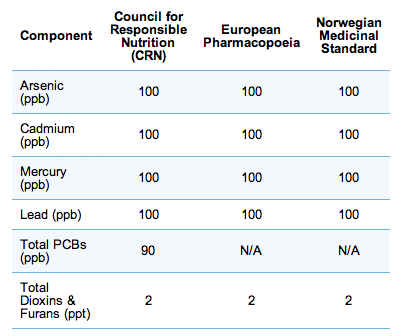
* ppt = parts per trillion
* ppb = parts per billion
The best fish oils will not only meet but exceed these international standards.
Freshness
I have written extensively about the dangers of oxidized, rancid oils. They promote oxidative damage and increase inflammation, both of which are risk factors for nearly every modern disease.
This is why it’s crucial to ensure that the fish oil you select is fresh and not rancid. Once it has gone rancid, it will have the exact opposite effect on your body than you want it to.
The first thing to do is to check something called the “peroxide value” on the COA. This is a measure of rancidity reactions in the oil that have occurred during storage. It should be less than 5 meq/kg.
If this checks out, and you decide to order that product, break open a capsule once you receive it. There should be no “fishy” odors. They should smell like the ocean, but not like rotten fish. They should also not have a strong lemon or lime scent, which could be an indicator that the manufacturer is trying to mask the rancidity.
The p-anisidine value measures secondary oxidation products. The IFOS and GOED standard is less than 20 units. However, it’s important to note that p-anisidine is not appropriate for measuring secondary oxidation in omega-3 oils that have a strong color or contain added flavorings.
For example, salmon oil contains carotenoids, which have a natural yellow/orange coloring. Bio-Avail Omega+ from Adapt Naturals contains curcumin, which also has a natural orange coloring. This throws off the p-anisidine values and makes it an irrelevant test.
TOTOX is the last way to measure oxidation. It’s simply a combination of the peroxide and p-anisidine values. (For this reason, it’s also not appropriate for products with a strong color.) The IFOS and GOED thresholds are 19.5 and 26 meq/kg, respectively. But the best products have TOTOX values below 15 meq/kg.
Finally, some studies have shown that adding antioxidants (e.g. curcumin or resveratrol) to fish oil can improve stability.
A common misconception is that you can determine the quality of fish oil by freezing it. The theory goes that if you freeze the oil and it is cloudy, it’s rancid. That is not the case. All fish contain saturated and monounsaturated fatty acids, albeit in small amounts. These fatty acids make the capsules appear cloudy when frozen in products that contain whole fish oil.
Potency
This is another area surrounded by significant controversy. Some argue the levels of individual constituents in fish oil aren’t paramount. Scientists discovered the healthful effects of omega-3s by studying people with fish-heavy diets, before supplemental fish oil even existed. Clinical trials using supplemental fish oils over the past few decades have contained widely variable levels of both long-chain omega-3 derivatives (EPA and DHA), and not super-high concentrations of either or both.
However, due to poor conversion of ALA to EPA and DHA, unless you are eating fish it is very likely you are deficient in long-chain omega-3s.
Following this line of reasoning, the DHA content in particular of fish and fish oils does seem important if we wish to obtain the best possible therapeutic effect. Many recent studies demonstrating the anti-inflammatory potential of fish oil used a daily dosage of DHA in the range of 1-3 grams. What’s more, foods like salmon roe that have been prized by traditional cultures for their nourishing and healing effects contain large amounts of DHA. A single 6 oz. serving of salmon roe contains 1 g of DHA. (In fact, this would be the best way by far of supplementing with DHA if money were no object. (Unfortunately, wild salmon roe goes for about $28/serving.)
Unfortunately, many fish oils do not have significant amounts of DHA. This means you’d have to take an impractically high number of capsules each day to obtain the therapeutic dose. This is not desirable, since all unsaturated oils (including fish oils) are subject to oxidative damage. We don’t want to take large quantities of them for this reason.
Remember to check the label and ensure that your product has approximately 200-300 mg of DHA per capsule. This will allow you to achieve the therapeutic dose by taking no more than 3 capsules twice a day.
Like what you’re reading? Get my free newsletter, recipes, eBooks, product recommendations, and more!
Bioavailability
The ability to absorb the beneficial components of fish oil is based on the molecular shape of the fatty acids. In short, the more natural the structure and the less it is chemically altered, the better.
This is true for any nutrient, of course, and it explains why I am always in favor of obtaining nutrients from food or food-based sources when possible. Each additional step in processing from the natural state of food to extract or isolate nutrients introduces the potential of damaging the nutrient or changing its chemical form so that it’s more difficult to absorb or affects the body in a different way.
When it comes to fish oils, there are three forms currently available on the market:
- Natural triglyercide oil. This is what you get when you “squeeze” the whole fish and extract the natural oil from it. It is the closest to eating fish oil in its natural form and is highly bioavailable. The drawback of this form is that, because it’s not concentrated, it usually has low levels of EPA and DHA. And because it isn’t purified, it can have high levels of contaminants such as heavy metals, PCBs, and dioxins.
- Ethyl ester oil. Occurs when natural triglyceride oil is concentrated and molecularly distilled to remove impurities. The ester form is still in a semi-natural state because it is the result of a process that naturally occurs in the body. The advantage of this form is that it can double or triple the levels of EPA and DHA.
- Synthetic triglyceride oil. This form occurs when natural triglycerides are converted to ethyl esters for concentration (as above) but then re-converted into synthetic triglycerides. The original position of the triglyceride’s carbon bonds changes, and the molecule’s overall structure is altered, which impacts the bioavailability of the oil.
Studies on absorption of the various types of fish oil suggest that, unsurprisingly, the natural triglyceride form is absorbed better than the ethyl ester form, which in turn is absorbed better than the synthetic triglyceride form.
One study by Lawson & Hughes in 1988 showed that 1 gram of EPA and 0.67 grams of DHA as natural triglycerides were absorbed 3.4 and 2.7 fold as well as the ethyl ester triglycerides.
In the previous article, we saw that fish oils were better absorbed when taken with a high-fat meal. In another study by Lawson & Hughes later the same year, they showed that the absorption of EPA & DHA from natural triglycerides improved from 69% with a low-fat meal (8g total fat) to 90% with a high-fat meal (44g total fat). Absorption of both EPA and DHA from ethyl ester oils was increased three-fold from 20% with a low-fat meal to 60% with a high-fat meal.
Sustainability
Our global fisheries are in dire straits, and fish oil is a big business. So, it’s crucial to choose a product that is manufactured with sustainability in mind and that has a fully transparent and traceable supply chain.
The easiest way to do this is to choose a product that is certified by organizations like Friend of the Sea or MarinTrust, two of the leading organizations for sustainable and responsible fishery management.
I would also choose a supplier/manufacturer with practices that minimize waste and its environmental impact.
For example, rather than catching fish that is only used to produce fish oil, some producers instead use fish meal to make the oil. This eliminates one of the main concerns about fish oil, which is that it will further deplete fisheries.
Recommendation
As a Functional Medicine clinician, author, and educator, I’ve been following the fish oil market closely for many years. I’ve used several different fish oils with my patients. I’ve read hundreds of studies on the purity, freshness, composition, and benefits of fish oil. I’ve spoken to industry experts and insiders, and I know what many companies do to cut corners and save money (at your expense).
When I started my own supplement company, Adapt Naturals, I knew that one of the first products we’d make would be fish oil. I wanted to create a product with the purest, freshest, and most sustainable fish oil available. And that’s exactly what we did with Bio-Avail Omega+.
I chose VivoOmega from GC Rieber as our fish oil. As the chart below illustrates, it significantly exceeds international standards for both purity and freshness.

Purity and freshness are critical. But I didn’t stop there. Most people who take fish oil are taking it to achieve certain outcomes, like better muscle and joint health, increased mental clarity, a more stable mood, clearer skin, and more balanced immune function.
So, when I formulated our fish oil product (Bio-Avail Omega+), I added the most bioavailable forms of two powerful nutrients that also support these goals: curcumin and black seed oil.
Now you can get the benefits of all three of these superfood nutrients in a single, two soft-gel daily serving.
Bio-Avail Omega+ contains an optimal composition of EPA and DHA (510 mg of EPA and 330 mg of DHA, a 3:2 ratio). It is made with triglyceride oils for optimal bioavailability and absorption. And it is produced with the most sustainable and traceable fish oil material in the industry. (See this page for more info.)
I’m proud of this product. It came directly out of my experience working with patients for 15 years and my extensive research into what is most important in a fish oil product. I hope it helps you to achieve your health goals!

Better supplementation. Fewer supplements.
Close the nutrient gap to feel and perform your best.
A daily stack of supplements designed to meet your most critical needs.

Hi Chris,
I was hoping you might be able to recommend a good EPA supplement for a patient suffering from cachexia due to end stage renal disease as well as being the recipient of an allogenic stem cell transplant for AML. I have read sever studies citing 1.4-2g of EPA/day can help with Protein Energy-Wasting which is what they call cachexia in ERD patients. She is on peritoneal dialysis so she needs to avoid Vitamin A and K, ironically the ones you spoke about in the recommendations you made above. Any advice would be appreciated! Thank you!
hi very grateful for all postings here !! just wondering am i right in thinking that both fermented CLO and also krill are not ok cause of potential rancidity and toxicity ??
also eagerly awaiting what PixE thinks of the Biotrust Omega 3 5x product .. using both krill and fish oil and also in something called Verisorb?? that is supposed to protect it from going rancid….
I do not have good enough data on krill, but expect some rancidity/oxidation as this is usually upconcentrated. Upconcentrated fish oils are known to have of the highest totox values. Toxins is a separate issue, and has nothing to do with rancidity. “Fermented” fish oil is also a highly rancid/oxidated product.
Do not have information about verisorb, but the only way to stop oxidation development is to neutrilize the product at enzyme level and seal the product with nitrogen against exposure to oxigen and light. An already developed oxidation process can not be reversed. Only camouflaged with for instance flavouring.
Jay:
I placed my order for Biotrust Omega 3 5x on Wednesday February 19, 2014 and I am awaiting the product and will analyze the softgel contents and the softgel material to determine what is actually in the supplement. Marketing looks interesting.
Here is a quote from their website:
“The Problem…
Most consumers of nutrition products are often surprised to learn that the FDA (the Food and Drug Administration) does not test, monitor or approve dietary supplements.
Just think about that for a second. This means that all the hundreds of thousands of fat burners, performance boosters, vitamins, minerals, herbs and protein powders you see online and on store shelves everywhere are completely unregulated. It’s difficult to know what you’re really getting.
You see, the FDA leaves it up to the individual supplement companies to formulate, test and monitor their own products. As you can imagine, many supplement companies cut all kinds of corners when it comes to quality control in order to boost their profit margins.
Buyer Beware: What Are You Swallowing?”
Sounds familiar, “the fox guarding the hen house” doctrine.
I have discovered that some krill oil products masquerading as “krill oil” are actually a mixture of fish oil with astaxanthin and have very little if any krill oil in the capsule. See my sister website: https://www.krilloildetective.com
I pointed this out to ConsumerLabs.com but they did not act on the information probably because these companies did not pay the fee to have their product evaluated. I am skeptical of these companies “independent testing” publishing data on “approved” or “third party” tested results. I would rather do my own testing which I fund my own research and if anyone wants to challenge my results, I will give them the data. My philosophy on dietary supplements is not to trust, but to verify.
Some of these companies offering “independent testing” ratings are for profit and some will redirect your inquiry about the product to a web site selling the product. To me, this is a conflict of interest. However, some of these rating sites “independent testing” do provide a service to weed out products that are mislabeled and report that the label contents do not match rating companies “independent testing” values.
I guest you have to start somewhere.
Pixe
Chris, Marshall, Randi, Pixe and Altostrata, and everyone else who pitched in here, thank you for such an illuminating discussion. I greatly appreciate you all sharing what you know, and good questions to ask, as we seek to take advantage of the choices that we have, and make intelligent decisions based on our own priorities.
Grace:
Here is an excellent article tracing the development of the human brain. Article is open access (free to download).
Nutrients 2011, 3, 529-554; doi:10.3390/nu3050529
Title: “Docosahexaenoic Acid (DHA): An Ancient Nutrient for the Modern Human Brain”
Here is a segment of the abstract in case others don’t want to waste their time reading the entire article.
“Abstract: Modern humans have evolved with a staple source of preformed
docosahexaenoic acid (DHA) in the diet. An important turning point in human evolution was the discovery of high-quality, easily digested nutrients from coastal seafood and inland freshwater sources. Multi-generational exploitation of seafood by shore-based dwellers coincided with the rapid expansion of grey matter in the cerebral cortex, which characterizes the modern human brain.”
“The excessive consumption of omega-6 fatty acids in the modern Western diet further displaces DHA from membrane phospholipids. An emerging body of research is exploring a unique role for DHA in neurodevelopment and the prevention of neuropsychiatric and neurodegenerative disorders. DHA is increasingly being added back into the food supply as fish oil or algal oil supplementation.”
Enjoy,
Pixe
Dear Pixe, I greatly appreciate all of the information you have been sharing. I just finished studying the entire comments here, and taking notes, and following the links. Fascinating! Thank you for helping me to understand fish oil processing, EFA synthesis and digestion, and the comparison between flax/fish/krill oils. You taught me to see through claims of purified Omega-3s, and distinguish between the EFAs .
I’m thinking that I want to use a fish oil that is as close to eating the real food as possible, for when I don’t eat as much fish as usual. I believe that the real food likely has properties that we haven’t discovered and encapsulated yet.
I narrowed my choices down to include a few that I didn’t see you mention:
Pure Alaska Salmon Oil (I like their story)
Barlean’s Wild & Whole Salmon Oil (I used to think that they were a reputable brand)
Nature’s Bounty Fish Oil, Salmon Oil, Norwegian Cod LIver Oil, and Calamari Oil (I used to think that they were a low-quality brand)
Will you share what you know about these products? Are they the real thing?
Congrats on your Omega-3 test result! 🙂 Unfortunately, it is illegal where I live 🙁 but I’m sure my dr. will do one at my next appt. 🙂
This is very important information about dietary supplements. It falls in between regulations. It is not food, and it is not medicine, and regulations are few. All consumers should therefore pay attention to content and quality of their dietary supplements.
Pending US Senate bill S. 1310.
If you are for or against more government regulations to protect the consumer from tainted dietary supplements, false advertising, label errors, and dangerous impurities, contact your senator about pending Senate bill S-1310. A bill to: “To improve the safety of dietary supplements by amending the Federal Food, Drug, and Cosmetic Act to require manufacturers of dietary supplements to register dietary supplement products with the Food and Drug Administration and to amend labeling requirements with respect to dietary supplements.” You can read the bill at:
https://www.gpo.gov/fdsys/pkg/BILLS-112s1310is/pdf/BILLS-112s1310is.pdf .
Pixe
This bill would effectively allow the “Government” to restrict and punish companies who produce supplements of any kind. At which point the “Government” decides something in that supplement is harmful. So no, this is a very bad idea to support this bill. It may make supplement companies more liable to share exactly what is in their product. But at the same time, the abuses of this bill and the removal of ingredients that some board deems as harmful far out weight its helpfulness. Why make more laws? Why not let the consumer independently find out what is the best? Isn’t that in fact the point of this blog? Weak and bad products will get weeded out naturally by us discerning people. Like you Pixe.
I am diagnosed Bipolar and Adult ADD. I have a meds regimen which works well for me but dosages are high for each med, hence to avert a depressive episode I found it necessary to add fish oil. It is best to avoid any depression, or return to stable as soon as possible, otherwise I may need to increase dosage of my regular meds, but not a good option because I already take high doses. Should I need to increase it might be better for me to begin ECT treatments.
I use OmegaBrite fish oil gelcaps at a set dosage of 4 softgels daily, I can take more if I start to become depressed, but then the issue becomes cost per day. So I am considering trying another brand. Problem is I don’t know enough to make a dosage comparison between one brand and another, nor can I determine which other brands would come closest to OmegaBrite comparing doses.
Btw, I am extremely grateful that fish oil has been so successful, consistent, while being flexible to change. It’s like my quality of life given my disorders, depends on fish oil, acting as a natural med.
Tom:
Reference to OM3 and depression.
https://jn.nutrition.org/content/143/11/1743.full.pdf+html
“n-3 Fatty Acid Intakes Are Inversely Related to
Elevated Depressive Symptoms among United
States Women”
Here is the summary of the article: “In sum, among United States women, higher intakes of n–3 fatty acids [absolute (n–3) and relative to n–6 fatty acids (n–3:n–6)] were associated with lower risk of elevated depressive symptoms, specifically in domains of somatic complaints (mainly n–3 PUFAs) and positive affect mainly n–3 HUFAs).” Please not that I am not a physician and this information is in the public domain along with numerous other publications showing the correlation with increased consumption of omega-3s EPA+DHA supplied by the diet and alternatively by dietary supplements.
OmegaBrite is not fish oil and it is the ethyl ester and may not provide optimum support for cognitive decline.
There are other OM3 supplements that are in TAG with higher DHA than EPA that perhaps will be more appropriate for cognitive support. However, I am not trying to sway your choice one way or the other about whether you choose to EE or TAG supplement. I take the common sense approach that fish contain TAG and dietary supplements based on what is in the fish is better for you if you must supplement your diet. The one of the most abundant fatty acids in the brain is DHA esterified to phospholipids. Current debate is whether krill oil is best at providing DHA to the brain and the mechanism of transport across the blood brain barrier is from non-esterified (free) DHA in the plasma bound to albumin.
There is extensive research being conducted using re-esterified TAG omega-3s for treating cognitive decline and depression.
As always, check with your health care provider before you take any dietary supplements.
Pixe
Hi Pixie,
Thank you for your very informative reply to my question.
Per fish oil, from the Omega-Brite website:
“Scientifically formulated by Carol Locke, MD, while on the faculty of Harvard Medical School, OmegaBrite® is a concentrated high EPA, pharmaceutical-quality omega-3 fatty acid supplement from fish oil promoting positive mood, cardiac and joint health, and overall well being.”
“OmegaBrite®’s total omega-3 concentration is 90%, making it 3X more potent than most common fish oil brands on the market. Only OmegaBrite® contains 70% EPA (eicosapentaenoic acid), the highest concentration available of this natural, anti-inflammatory molecule. One OmegaBrite® 500mg softgel capsule supplies you with 350mg of EPA and 50mg of DHA (docosahexaenoic acid). Many healthcare professionals recommend this 7:1 ratio, which is the highest in the industry.”
I’d be interested to know from what information source you learned that OmegaBrite isn’t made from fish oil.
As an aside, I’ve taken OmegaBrite for over 20 years, such that by now my body digests it with only occasional “fishy” burps, but when I do have burps now they’re still fishy tasting. Anyway, it’s a minor point.
I will follow up the study which you quoted from, and find other peer reviewed studies. I hope at least one will be double-blind and have a large enough cohort to obtain more significant results. Thanks for posting the excerpt.
I will continue to investigate to find a Omega 3 supplement which is both effective and safe, and easily tolerated by me, at a lower price, if obtainable.
Meanwhile, Omega-Brite has been consistently helpful. My own concern is that at some point in the future I may need to take <3 grams EPA Omega-Brite, or 7 gelcaps daily, which on my present income is expensive indeed.
Thanks again! If you have further comments, info to pass along I will be most grateful to receive.
Tom
As I have commented before on this site. “Fishy burps” is not a sign of a good quality oil. It is rather a sign of oxidated oil which your body is trying to get rid of. That’s why the burping. Please search the internet for what oxidation does to your cells. Just a little reminder
I need to clarify: I have no fishy burps, not even slight ones, with OmegaBrite, nor have I ever had them as best I can remember. My memory isn’t reliable enough, specifically to recall which brands of fish oil caps did produce fishy burps twenty years ago, but I can say I definitely haven’t experienced any since 1999, which is when I resumed taking OmegaBrite 4 caps per day specifically for symptoms of bipolar disorder, on the recommendation of my psychiatrist.
Sorry you were mislead by my initial comment, to which I didn’t pay close enough attention.
and, I well know what oxidation does to cells. Believe me when I say I have done my own exhaustive research of all available literature, and I have further studied to discover how each peer reviewed and published research study was designed, in addition to spending 5+ years professional work for a mental health research center, where I was paid to analyze in-house studies which then were later published in the top tier medical and mental health journals.
I know that in no way qualifies me as having *any degree of professional authority* — I’m no doubt not an “expert”— to do anything but comment mental health, mental health related and/or specific psychiatric or behavioral disorders in any authority. I’m a science writer and a mental health patient for 15 years.
sorry for all my sub-comments.
Since I did little else in this section than ask my question, read other comments with their corresponding replies; then cranked at length about something that actually was my fault.
My experience thus far of your blog is a positive one, and I really appreciate and respect your perspective on health matters generally, given your extensive apparently high quality education and training, including alternative and Oriental medicine. You write very well and you seem to me careful and cautious in your suggestions and recommendations not to overstate your expertise. And you aren’t or don’t seem to be dogmatic or ideological. I will enjoy keeping up with your blog. I need all the help I can get with my bipolar disorder, a need which never has stopped and I doubt ever will.
Sincerely,
Tom
Tom,
Check out Ocean Blue Omega Power soft gel capsules or Ocean Blue professional 2100 product. It has 975 mg of EPA & DHA per capsule. Highest amount out there without a prescription.
http://www.oceanblueprofessional.com
Will you be reviewing (or maybe you already have) the much hyped BioTrust Omega Krill 5X ?
I always rely on Nordic Naturals because they are number one in all the important areas when it comes to deciding how to choose a quality fish oil. First, they surpass all international pharmaceutical standards, they offer their oils in the true triglyceride form, they have exceptional purity and freshness, they have control over the manufacturing from boat to bottle, there are 25 published studies on their products and more than 30 in progress and their corporate social responsibility is unmatched. They will offer anyone a certificate of analysis if you call or email them and ask. They have every certification imaginable and they have won many many awards. Perhaps this is why they are the number one selling fish oil brand in the USA. To learn more, see https://www.nordicnaturals.com/en/About_Us_portal/Why_Nordic_Naturals/626. I trust this company because they have invested in this industry and they are transparent in what they do. I have yet to see a purer, fresher, great tasting oil.
Chris Keller,
I’m appreciative of this extensive review of fish oil, very informative and helps me decide on what to buy.
I’m just wondering why you didn’t include the fact that Krill Oil is contaminated and that Krill Oil cannot be purified of toxins, pcb’s etc. like fish oil can?
Here’s a link that further explains:
What do you think about OmegaVia Pharma-Grade Fish Oil??
PIXE,
From your previous posts, I understand that “Quell Fish Oil EPA/DHA Plus D 60 Softgels” are very high quality supplies. It also has VitaminD3 which is great for me since I am almost getting zero amount of direct sunlight here in one of the coldest cities in Canada. Unfortunately, it’s so hard to find Quells in Canada. What other brands would you advice equal to that one and easy to find in Canada?
PS: I would like to have 1 pills instead of 2 so I eliminated “Nordic Naturals Ultimates”.
Thank you for some great research. I stumbled across your site today after having just sat through a 30 minute video extolling the virtues of a ‘new’ Krill Oil product.
It was very convincing to the average person on the street and obviously highly sales driven to sell the product. The presenters appear to be well credentialed having medical and research backgrounds which also makes the claims about the product quite plausible.
This is the reason I decided to do some further research as I find so many conflicting views about the benefits of Omega Oils in general.
I would be very interested to hear your comments on this particular product. It is called Omega Krill 5X from Bio Trust Nutrition or biotrust.com.
Thank you – John F
One of the ingredients in Biotrust fish oil is nonionic surfactant. No thanks.
Hi rocks2stocks..what is wrong withnonionic surfactant ? Thanks
That non-ionic surfactant is polysorbate 80. Some people have had an allergic reaction to this compound. Do a search to see what you come up with. I am not sure why the company did not list the true identity of this compound. Perhaps they don’t know what it is.
Pixe
I would like to know your opinion on Carlson Labs Very Finest Fish Oil (liquid)
Thought this might be of general interest … Fish Oil Reports (www.fishoilreports.com) is an independent ranking of the best fish oil supplements by cost per gram of EPA and DHA. It also includes IFOS quality ratings. I found it very useful in my search for a good (but cheap) fish oil supplement.
This is the sort of information that consumers need, rather than PIXE’s more abstract approach, though I wonder about the inclusion of Nature Made. I bought some and it smelled awful. Returned!
Altostrata:
The http://www.fishoilreports.com does not tell the whole story. It is only for price which does not equal quality, source, accuracy of the labels, and the identity of the liquid in the softgels. My comments are based on science and has nothing to do with price.
However, many consumers are taking more fish oil than is necessary because your body will reach a steady-state concentration of omega-3s. Spend the money to get an omega-3 index report rather than investing in perhaps useless brands of omega-3 dietary supplements. Depending on your goal, you will perhaps need a targeted health outcome approach. Do you need cognitive support, then you will need more DHA than EPA. For cardio, you may need EPA only.
In the end, the best approach to omega-3 deficiencies is from the diet if the source of the marine organisms are low in toxins.
Pixe
I agree, PIXE, your site contains much extremely valuable information, and you are much more concerned about quality, which I appreciate very much. But — the formats you use to present the data make retrieving and interpreting your information difficult to someone who is a consumer rather than a biochem researcher.
There was also a comment about how it may be good for the fish oil that it is heated during the process of removing toxins and PCBs. My respond to that is that the oil is of course “stressed” in a way, going through such a process. However if the crude oil is low oxidized and of very good quality, the process itself is quick in a sence that it will reach a very high temperature during a very short time. After all it is important also not to take an oil with toxins and PCBs. Therefore this process is important.
What are your thoughts on Advocare’s Omega Plex? One serving contains 600mg EHA and 400mg DHA with 6 IU of Vitamin E. Recommended dosage is 2 capsules twice daily. Do you have an opinion on this dosage or on this particular brand? My husband needs to improve his lipids (he is currently walking & eating healthy). With those two changes he was able to bring his Triglycerides down 125 points but still has work to do. I want to make sure I get informed opinions before I make my final choice on brands.
Thank you for your article; there is a lot of information!
Carlson EcoSmart Omega-3 is another calamari oil product like Jarrow Max DHA. They are about the same price per gram of DHA, but Carlson’s has more EPA. Nowhere does Carlson say they are using Pharma Marine’s Calamarine product, but the Carlson product details line up perfectly with the Calamarine 140/360 ethyl ester formulation. Each gelcap has 1000 mg of calamari oil, of which 140 mg is EPA and 360 mg is DHA.
The flavor is mild – barely fishy at all. If I take them without food, worst case I just get lemon burps. Look for Carlson’s in a 180-count bottle, or in a 90-count bottle with 30-count bonus for the best price.
Also, i forgot to add, isn’t heat extraction used in all fish oil supplement production? (except for the cold pressed green pastures fermented product) and if so, then the chances are that the fragile PUFS will be damaged and turn rancid in the capsule. I’m not sure if the heat used in extraction is ‘gentle? but if not then surely ALL omega 3 fish oil supplements should be avoided as you are consuming rancid PUFS? Also, if the heat used is not ‘gentle’ then does this also apply to all non cold pressed/fermented cod liver oil products??? Surely HEAT is the important factor here?
I live in the UK and after spending over an hour reading this thread (and getting mightily confused along the way) i want to ask if i can just eat oily fish 3 times a week and eat Kerrygold butter (which is grass fed) for my omega 3’s???!!!
Seems a lot easier and even pixe says it is best to get nutrients from whole foods first and supplement secondly. Maybe oily fish is the best/safest way to go re omega 3’s? Selenium in the fish should protect from the heavy metals and eating oily fish low in the food chain should also help.
Just a thought
Mark:
Here is a link from the Australian National Heart Association “Omega-3 meal planner The Heart Foundation recommends that healthy adults have at least 500 mg
of omega-3 (EPA and DHA) per day.” to get your daily dose of omega-3s from the diet see:
https://www.heartfoundation.org.au/SiteCollectionDocuments/Meal-Planner-Omega3.pdf
Enjoy your meal.
Pixe
Independent evaluation of 30 fish oil supplements just released https://labdoor.com/c/fish-oil
Suprisingly no comments about Anicidine and Peroxide value. Oxidated supplements still don’t have focus in the industry. This is in my opinion the most important feature besides toxins and PCB. Oxidation produces free radicals which again is known to be bad for your cells. I focus less on EPA /DHA as the difference and effect is minimal. I focus more on oxidation and toxins. I don’t want to take anything that may help me get cancer.
Here was I looking for information as to the best fish oil obtainable, from someone who had studied the subject. I looked at the beginning comments that were posted A W A Y back in May, 2011 and stared taking notes as to what should be taken or avoided.
The more I read, the more confused I became, then to add to my misery, it would appear that on January, 2012, Chris Kresser donned a cape and became ‘Mighty Pixie’, a man of few words, and the color of the mud deepened.
Sigh … I guess I’ll just continue buying what I’ve been purchasing for the past several years
Alexander:
Sorry if I offended you with my post because I thought I was just trying to be helpful by supplying additional information. If you were to ask a question about the product you have been taking “for the past several years” and I discovered that it was marine biodiesel, I would let you know so that your health is not compromised. Do you care to share with us the product you have been taking “for the past several years”? I take Triglyceride Omega-3 Gold that supplies 400 mg EPA and 200 mg DHA per capsule that gives a total of 600 mg/day. This is approximately what the American Heart Association is recommending for those with out heart disease. This product is what is known as re-esterified fish oil. The fish oil “is sourced from certified sustainable wild-caught Pacific fish (Cod, Pollack) found in deep, cold, pure Alaskan Ocean waters.”
Hope you continue to enjoy your product that you have been taking for the past several years and I hope it is not marine biodiesel.
Pixe
Hi, I am totally confused as to what I should or should not be taking as far as Fish Oil goes. I have been taking Blackmores and recently purchased Natures Own Omega Platinum. Are either of these good or bad for me. Do I even need to take Fish Oil? My husband and I are 56 years old and thought we were doing the right thing but it appears we may not be 🙁
Rhonda:
I am just jumping in here to add some additional information to the discussion even though the question was addressed to Chris.
Since I believe you are from Australia, which has the TGA, which is protecting the citizens of your country, the two products you mentioned are good and are approved. See https://www.tga.gov.au/hp/msu-2010-02.htm#.UtwinhAo671 which gives some info on intake. In the US, the AHA recommends about 600 mg/day EPA+DHA for those without heart disease. Check to see if Australia has a DRI (dietary reference intake) for omega-3s. Many foods are fortified with omega-3s such as eggs, breads, etc so that everyone is getting some of these omega-3s. The question is, how much additional omega-3s do you need will depend on your diet and how much oil fish you eat. Normally, get the nutrient from your diet first, then supplement on a need-to-basis. Other issues consumers face are pollutants in the fish and the cost and time for preparation not to mention access to this food source.
Here is the reference to your Omega Platinum https://www.naturesown.com.au/omega-platinum/. This product contains a combination of both real fish oil and krill oil. Therefore, you get the benefits of both EPA+DHA bound to TAG and PL (Phospholipids).
Pixe
Thanks Pixe…you are a legend!
I really appreciate the info and that you took the time to reply.
Cheers! 🙂