

This article is part of a special report on Thyroid Disorders. To see the other articles in this series, click here.
In the last post I explained that, for the vast majority of patients, hypothyroidism is an autoimmune disease. This isn’t just an academic distinction. It’s the reason both conventional and alternative treatments are so often ineffective.
Want to learn more about thyroid disorders?
Download This Free eBook
Find out how a thyroid imbalance could be causing your biggest health problems.
"*" indicates required fields
I hate spam, too. Your email is safe with me. By signing up, you agree to our privacy policy.
In this post I’m going to show you why taking replacement thyroid hormones without addressing the underlying immune imbalance is doomed to fail.
On the surface it seems like a reasonable approach. Patient doesn’t have enough hormones? Give more hormones. Simple, right?
Not so much.
Once again the conventional approach falls short because it ignores the underlying cause of the problem. It’s like taking Advil when you’ve got a pebble stuck in your shoe. It might work for a little while, and might even be necessary to dull the pain. But you’d be a lot better off if you took the pebble out of your shoe. Right?
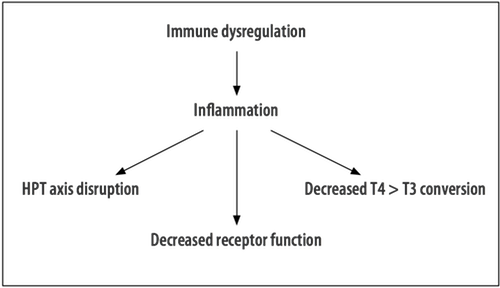
Let’s take a closer look at why thyroid hormones often don’t work, or stop working over time. The following diagram illustrates how autoimmunity affects thyroid metabolism (please note, “HPT” stands for “hypothalamus-pituitary-thyroid axis”):
Immune dysregulation is another term for autoimmune disease. We still don’t know exactly what causes it, but most researchers agree it’s a mixture of genetic susceptibility and environmental factors such as iodine (excess), infection, pregnancy, diet and intestinal permeability.
In autoimmune disease the body attacks itself. It does this the same way it attacks foreign invaders like bacteria and viruses: with T-cells, B-cells, natural killer cells, and cytotoxic T cells. The immune response also involves proteins called cytokines, chemical messengers that pass messages between cells.
This self-attack by the immune system increases inflammation. And inflammation has a profound effect on all aspects of thyroid metabolism and physiology.
First, inflammation suppresses the HPT axis. (1) One study showed a single injection of the inflammatory cytokine TNF-alpha reduced blood levels of TSH, T3, free T4, free T3 and TRH for 5 days. (2) This shows inflammation disrupts the production and regulatory mechanisms of thyroid hormones. Thyroid medication will increase the levels of T4 (and possibly T3), but it doesn’t address the other effects of HPT axis suppression.
Like what you’re reading? Get my free newsletter, recipes, eBooks, product recommendations, and more!
Second, inflammation decreases both the number and sensitivity of thyroid hormone receptors. (3) If there aren’t enough receptors, or they aren’t sensitive enough, it doesn’t matter how much thyroid medication we take. The cells won’t be able to use it. It’s like when my grandpa used to turn down his hearing aids while he was watching the football game. It didn’t matter how much my grandma yelled at him – he couldn’t hear a word she said.
Third, inflammation decreases the conversion of T4 to T3. (4) T4 is the inactive form of thyroid hormone. The body has to convert it to the active T3 form before it can be used. Most synthetic hormone medications on the market are T4. If you give a T4 medication (like Synthroid, Levoxyl, Unithroid, etc.) to someone with inflammation, it’s not going to work because they can’t convert the T4 to T3.
Patients who don’t convert T4 to T3 well do better on bio-identical hormones like Armour, because it contains both T4 and T3 (in a 4.22:1 ratio).
Inflammation disrupts thyroid metabolism in several other ways, but I think these three examples make the point.
Now let’s review.
The only way to do that is to address the problem at its root by regulating the immune system and decreasing inflammation. (For more on how to address underlying inflammation, check out this episode of Revolution Health Radio with Izabella Wentz.) Unfortunately, this is rarely done in either conventional or alternative treatment of thyroid disorders.
Before I sign off, I just want to make one thing clear. I’m not saying thyroid medication isn’t necessary or useful. In fact, I think it’s an important part of treating Hashimoto’s—especially when TSH is consistently elevated and T4 and T3 are consistently low. My point is thyroid medication is only one piece of the puzzle, and it won’t be effective on its own unless the autoimmunity and inflammation are addressed.
If thyroid medication is the fantasy magic bullet of conventional medicine, iodine is the equivalent in alternative medicine. In the next post I’m going to explain why supplemental iodine may cause more harm than good in Hashimoto’s patients.

Better supplementation. Fewer supplements.
Close the nutrient gap to feel and perform your best.
A daily stack of supplements designed to meet your most critical needs.

Hope my comment will help some of you. I had posted a while back asking how we determine where the inflammation is coming from – I knew I was inflamed due to feeling inflamed and having ferritin that was above the range and increasing (and no genetics for hemochromatosis). After a lot of searching and testing, we think we have found my source of inflammation: LYME. I now know a lot of Lyme patients who also have thyroid problems and have been down the same path as me (told they have Hashis without testing positive for it, told they have AID without testing positive, told they have fibromyalgia, and so on and so on and so on). I kept pushing doctors because we weren’t finding answers and I felt as if my body was invaded by some kind of bacteria or parasite. If you have a thyroid problem and you can’t identify the source, it’s worth looking into Lyme as a cause.
I have had problems with my thyroid for over 30 yrs, last year I started loosing weight for the first time and I wasn’t hungry all the time either. I ended up loosing 40lbs in about 3 months and then I had a doctor’s appointment and she checked my TSH level and changed my thyroid med, and the weight just started piling on.
I went to my doctor today after I have been fighting with myself and taking the synthyoid medicine all these years and ask my doctor if there was another way to trip my thyroid so I could loose the weight, She is a family doctor and not a specialist on this matter but I hope with the above info I can get a little more in-depth help for my thyroid. I have been to a specialist and he gave me the same medicine but he use to do biopics of my thyroid every 3 mths but I never lost the weight like I did last yr.
I wish there was a way to find out what triggered it? One small little part of the body by your throat that does so much harm.
Debra
I forgot to mention that I have Lymphedema also and when I had lost the 40lbs last year my Lymphedema had also gotten better. The swelling in my legs and arms went down and I hadn’t felt better in years.
So for some reason I believe the Thyroid and the Lymphedema have something in common. If anyone has any information on this please let me know.
Thanks Debra
I had my thyroid removed in 2009 . Up until then I have felt fine. This past yr I started gaining weight20 lbs and was having severe pain in left arm have lost a lot of range of motion. In Jan 2014 I woke up one morning extremely dizzy and threw up. I went to hospital and was diagnosed with vertigo. That same day I went to my DR and had blood work done. The next day she called and said my thyroid levels were off ( to high)and moved me from 100 to 125. Now roughly 6 weeks later more blood work and my levels are low,moving me to 112.5 I have felt slightly dizzy every day for the past 6 weeks. What caused my levels to change in the first place
I’ve been told that stopping it will cause a heart attack or stroke is this true?
My husband was diagnosed with hypothyroidism about 4 months ago he is on levothyroxin but it is ruining our lives. Before he was diagnosed he was just a little more tired than usual, now that he has been diagnosed and on meds he is constipated, more tired, depressed, no sex drive, anxious at times needs to move around, I don’t see him smile or laugh, we were always a couple that was close held hands, emotional he has just lost all of that. We have an appt now with an endocrinologist and I just found your blog and just feel I need help. I want my husband back I almost want to tell him to stop taking the medicine but I know thats not the thing to do. What questions should I ask the doc when we go if you can help at all. Thank You.
Hi, i can understand the situation you and your husband are going through sounds very similar to my condition. Me and my wife have been going through this from 6 months and all the problem started since i started 100 mg levothyroxine, i remember those days like a very bad dream. then i finally decided to change my doctor someone who would listen to me and consider my feelings rather than dumping me with medicines. My endo took me off the meds and started with 25mg levo for 2 weeks then increased 12.5 mg every week slowly reaching to a target range of 125 mg. I lost the excess weight that i gained, started feeling better, came out of depression, started spending time with my lovely wife and kids. Though i am not 100% and i even dont expect that i will be since meds cannot replace something which God has designed as he is the best of all desingers and free of errors.
I suggest you review your husbands condition with another doctor anr also watch out for his cholestrol levels as they may get elevated due to hypothyroid, take the meds on empty stomach first thing in the morning do not eat/drink anything until 30-45 mins to allow absorbtion avoid coffee and caffeine products. Slowly get him to excercise for atleast 30 mins. Again he may feel hyper at times due to high levels of t4 but should stabalised gradually insha allah (god willing).
All the above is based on my personal experience and knowledge gained through reading. I pray that Allah provides your husband and family with good health and well being insha allah. Apart from the above changes i used to take 3 glasses of fresh orange juice daily, 1 teaspoon honey and half teaspoon black seed oil in 1 cup warm water this really helped me. Black seed has a lot of health benefits you can google it. I hope i have tried to be of help to you and your husband, i feel that its my duty to share my experience and help people benefit from it i just request you to remember me in your prayers.
How do you address the inflammation? I agree with your assessment but I find it extremely difficult to reduce inflammation. Thanks.
hey chris i have hypothyroid and been taking synthroid and then later levothyroxine but have been dealing with under eye bags and dark circles for about a year since ive been on medication and tsh is in normal range
I would like to know what do I have to do to obtain Chris,s answers to all the great questions, I have went on all the links shown but still can not find the right place. Thanks Jane
Since both thyroid and parathyroid disease co-exists in many patients, and in light of mention of multiple endocrine glands (i.e. pituitary, adrenals, etc.) which can be simultaneously affected, hopefully each will also keep PHPT (Primary Hyperparathyroidism) in mind. It is very often misdiagnosed as “Fibromyalgia” / “CFS”.
Thoughts, Dr. Chris?
Hello! Nice article. I have Graves Disease , and a radiated thyroid. The doctor that (finally) diagnosed me many years ago, commented that my hyperthyroid was probably brought on by family history of auto-immune illness, and by a doctor who was giving me massive doses of iodine in many multiple supplements in an attempt to relieve extreme fatigue.
Now that I am “treated”, am I still considered to have auto-immune issues? They now call me hypo thyroid. Surprise. I would conclude that just because my thyroid is now low without medication, that the auto immune thing is ongoing. Am I correct?
Would love a comment.
Thanks, Patricia
In my early 30’s I was diagnosed with Grave’s disease and took radioactive iodine twice. I’ve also tried every thyroid rx known to man since then.
In 2007 I was diagnosed with thyroid cancer after feeling a lump in my neck and having very swollen lymph nodes in my collar bone. It was papillary carcinoma. My thyroid was removed at that time and I’m cancer free. I’m now 54 and have osteo arthritis, joint inflammation, insomnia, complex migraines, high blood pressure, anxiety and depression. I take t3 and t4. I started 100 mcg of tirosint about 8 months ago and also take generec cytomel .5 mcg twice a day. My anxiety and depression have never been worse. I started bioidentical hormone therapy and 5 mg dhea a few months ago and thought I was better for a month or so. Now I feel worse than ever.
I have regular blood work done and my levels started fluctuating. I’m thinking I’m getting too much of something. I don’t feel like eating and have lost about 15 lbs. I’ve been crying for 2 days. What do you know about hormone replacement therapy with thyroid medicine combined? I’m tired of feeling this way.
Thank you
I found this interesting and notice that it is quite like what I have went through. I suffer from Chronic Urticaria and Angioedema so it explains why it was so increasingly worse when I was on Synthroid. My inflammation started after I suffered a traumatic injury from a MVA. I was given about 8 different new medications that had obviously interfered with my Synthroid, my Dr just kept increasing the dose and I just kept getting worse to the point I was continuously swelling and felt like ending my life due to the severity of pain from swelling, heart attack type of symptoms also. Then I started to develop a new Liver condition, Primary Biliary Cirrhosis.. I decided to quit all the medications at once since they were not working in any way, only making me worse. I had to seek out an alternative Dr. to prescribe me Natural Desiccated Thyroid because no Dr would Prescribe it for me. I then saw my Liver clear up completely and slowly my Thyroid got back to normal but still swayed back and forth to Hypo and Hyper, I also still had Thyroid Anti bodies but they were more than half what they were prior to the Natural Thyroid. I now have been given HIGH doses of PABA to decrease my Thyroid Anti-Bodies and I went through a Chelation iv and urine test to find out my Metals were way out. Lead, Mercury and Cesium and a few others were very very high, lead and Mercury were the highest, Lead was right off the chart. I am now at this point and in need for Metals detoxing. I am currently taking Natural Thyroid extract, PABA, selenium, ThyroSense and I can already feel the difference, I am glad I learned about the Metals and also about the Paba.. I will post more when I find out what I improve from
Hope someone will read this and help:
What kinds of inflammation cause this and How does one determine the cause of inflammation?
I’ve been going through this for a while and can’t figure out where the inflammation is coming from. I’m not looking for medical advice about my condition but rather some ideas to research with my doctor.
I had my thyroid removed at age 36 due to micro carcinoma. After two pregnancies and now age 43 my doctors are at a loss. General practitioner can do no more than check T3 levels and Endochronologist thinks I should be on depression meds.
Frustration is stetting in! I tried going carb-free, then gluten free. I tried to take 4000mg vitamin D supplements (as per OBgyn), iodine, kelp, etc.
I am bloated, tired, irritable, spacey. I have insomnia, constipation and waves of depression from these things.
I switched from CVS prescriptions to a local compound pharmacist. From Levothyroxine to Synthroid.
I could go on. I’ve done a lot of research, talked to a lot of people. What to I do now?
Try NDT. Armour works the best for me. Split the dose morning I take. 60mg evening at 5 I take 30mg with food. If still feel foggy will take 30mg more later. I take Adrenal Complex and extra Vit B Complex. Multivitamin. Calcium Chewable with zinc and magnesium in it. Extra Vit D3. Vit C and Vit E. Fish oil. Iron at bedtime. If headachey I take ibiprophen. Dhea 10mg compounded time release. Relieves headache and lifts mood. Selenium lifts mood too and helps with conversion of T4 to T3. Pregnenolone helps with brain fog. Also from compounding pharmacy 100mg. Find a holistic MD hope this helps. Karen.
Dear sir, i am 37 yr male weight 104 kg was diagonised with subacute thyroiditis in august 2013 my t4 was slightly elevated and tsh was low. My esr was high and i had pain in the neck area, later after 6 weeks i started feeling better then after a few days started feeling symptoms of hypo my first hypo testcame tsh 30 and low t4. I was given 100 mg levothyroxine immediately but i was unable to tolerate it and within a week i had all sort of hyper symptoms, later my cardio checked my cholestrol and found it was very high and put me on 40 mg lipitor and asked me to continue 100 mg levo however i statred developing myalgias and could not tolerate the pain my cpk came up high as well. I met an endo who t3sted the tsh and t3 t4 again and said that my thyroid was not functioning and my tsh was > 100 and t4 t3 was low too he then reduced my levo dose to 25 mg and gradually asked me to increase tp 75 for 6 weeks with ezithrol 10 mg with lipitor 10 mg i started feeling better last tests came as tsh 70 and t4 was 14 he has now increased the dosage to 125 mg since 3 weeks now and i can see most of the symptoms have improved since then i will be doing the tests again in march end. I used to take approvel 150 mg and novarsac 5 mg to reduce my bp but now i have limited it since most of the tine my bp is normal and sometimes low like 100/70. I am experiencing myalgias and pains from time to time. Is there any hope of my thyroid getting normal i have done the tests for antibodies and it came back negative. Whats ur advice for me on this doctor.
Read all the info on this post- have thyroid problems, after radiation in neck area for breast cancer.\Been on thyroid since radiation(1992) At 72 have weight problems, it is nearly impossible to loose weight.
so how do we regulate the immune system and reduce inflammation?
One article I read suggests zinc and maca?
This article does nothing to explain how to reduce inflammation. Isnt that the main point here?
Hi Chris! Love your articles and find them very educating. I was concerned when I read about birth control pills and Hashimoto’s. Both of my daughters are on the pill for very heavy/prolonged periods. I was put on it at age 20 for same reason. I have Hashimoto’s and my oldest daughter is showing signs of hypothyroidism. When tested her TSH was 2.8, but I think I want them to test her for antibodies. If there is any additional information you have regarding birth control pills and thyroid disease, I would love the hear it.
I am tryng to get help and more information as my doctor has not been very helpful.
I was diagnosed with Hypothyroidism and for a week and 3 days ive been taking Levothyroxin 25mcg
Before i got diagnosed i had all he symptoms. The one symptom that concerns me the most is the weight gain.
Mydoctor said that aslong as i eat right when the medication starts working it will start helping with stablelizing my weight. How true is that? Is it also tru that Hypothyroidism also can cause your hair to fall out, Skin to be dry and flaky and to retain water?
If i can get some information it will help me a great deal. Thank you all!!