

This article is part of a special report on Thyroid Disorders. To see the other articles in this series, click here.
In the last post I explained that, for the vast majority of patients, hypothyroidism is an autoimmune disease. This isn’t just an academic distinction. It’s the reason both conventional and alternative treatments are so often ineffective.
Want to learn more about thyroid disorders?
Download This Free eBook
Find out how a thyroid imbalance could be causing your biggest health problems.
"*" indicates required fields
I hate spam, too. Your email is safe with me. By signing up, you agree to our privacy policy.
In this post I’m going to show you why taking replacement thyroid hormones without addressing the underlying immune imbalance is doomed to fail.
On the surface it seems like a reasonable approach. Patient doesn’t have enough hormones? Give more hormones. Simple, right?
Not so much.
Once again the conventional approach falls short because it ignores the underlying cause of the problem. It’s like taking Advil when you’ve got a pebble stuck in your shoe. It might work for a little while, and might even be necessary to dull the pain. But you’d be a lot better off if you took the pebble out of your shoe. Right?
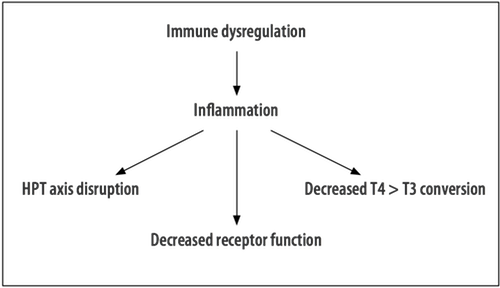
Let’s take a closer look at why thyroid hormones often don’t work, or stop working over time. The following diagram illustrates how autoimmunity affects thyroid metabolism (please note, “HPT” stands for “hypothalamus-pituitary-thyroid axis”):
Immune dysregulation is another term for autoimmune disease. We still don’t know exactly what causes it, but most researchers agree it’s a mixture of genetic susceptibility and environmental factors such as iodine (excess), infection, pregnancy, diet and intestinal permeability.
In autoimmune disease the body attacks itself. It does this the same way it attacks foreign invaders like bacteria and viruses: with T-cells, B-cells, natural killer cells, and cytotoxic T cells. The immune response also involves proteins called cytokines, chemical messengers that pass messages between cells.
This self-attack by the immune system increases inflammation. And inflammation has a profound effect on all aspects of thyroid metabolism and physiology.
First, inflammation suppresses the HPT axis. (1) One study showed a single injection of the inflammatory cytokine TNF-alpha reduced blood levels of TSH, T3, free T4, free T3 and TRH for 5 days. (2) This shows inflammation disrupts the production and regulatory mechanisms of thyroid hormones. Thyroid medication will increase the levels of T4 (and possibly T3), but it doesn’t address the other effects of HPT axis suppression.
Like what you’re reading? Get my free newsletter, recipes, eBooks, product recommendations, and more!
Second, inflammation decreases both the number and sensitivity of thyroid hormone receptors. (3) If there aren’t enough receptors, or they aren’t sensitive enough, it doesn’t matter how much thyroid medication we take. The cells won’t be able to use it. It’s like when my grandpa used to turn down his hearing aids while he was watching the football game. It didn’t matter how much my grandma yelled at him – he couldn’t hear a word she said.
Third, inflammation decreases the conversion of T4 to T3. (4) T4 is the inactive form of thyroid hormone. The body has to convert it to the active T3 form before it can be used. Most synthetic hormone medications on the market are T4. If you give a T4 medication (like Synthroid, Levoxyl, Unithroid, etc.) to someone with inflammation, it’s not going to work because they can’t convert the T4 to T3.
Patients who don’t convert T4 to T3 well do better on bio-identical hormones like Armour, because it contains both T4 and T3 (in a 4.22:1 ratio).
Inflammation disrupts thyroid metabolism in several other ways, but I think these three examples make the point.
Now let’s review.
The only way to do that is to address the problem at its root by regulating the immune system and decreasing inflammation. (For more on how to address underlying inflammation, check out this episode of Revolution Health Radio with Izabella Wentz.) Unfortunately, this is rarely done in either conventional or alternative treatment of thyroid disorders.
Before I sign off, I just want to make one thing clear. I’m not saying thyroid medication isn’t necessary or useful. In fact, I think it’s an important part of treating Hashimoto’s—especially when TSH is consistently elevated and T4 and T3 are consistently low. My point is thyroid medication is only one piece of the puzzle, and it won’t be effective on its own unless the autoimmunity and inflammation are addressed.
If thyroid medication is the fantasy magic bullet of conventional medicine, iodine is the equivalent in alternative medicine. In the next post I’m going to explain why supplemental iodine may cause more harm than good in Hashimoto’s patients.

Better supplementation. Fewer supplements.
Close the nutrient gap to feel and perform your best.
A daily stack of supplements designed to meet your most critical needs.

I suffer with hyperthyroidism, I was taking 100mcg. Started feeling very strange, anxious, stressed, tired etc. Dr. then lowered it to 75 mcg. Still feeling the same, does this need to be lowered again and how long do I wait before another blood test.
hello…
14 years ago i was diagnosed with Hashimoto with thyroid antibodies 500 and still suffering with horrific symptoms.
I was denied any meds untill this year. This year antibody were lowered to 200 and I got syndroid which adjusted my appetite and stopped cravings. But my face started looking horrible. hanging eyelids, extremely dry, peeling red skin with severe acne, still no energy, overweight, and severe bloating indigestion and constipation. Than I was given T3 and i could not take it as my joints and body pain increased to the point I could not walk. So I switched to dessicated thyroid, which was gentle but with no any good effect.
So i stopped it all.
I started eat a lot of veggies for breakfast with some protein and one raw onion daily. For few days I felt as my immune system switched off and I felt no pain, a lots of energy, perfect digestion and I felt great like never before.
After a week I am still with this way of eating but my symptoms and pain of joints and ancylosis spons.is back.
It seams to mi that anything that supports thyroid function and good health including diet is overpowered by immune system after few days and I am back to my sickness and big body pain. Is this the end for me ? I know if my Immune System would be switched off my body function would be restored. But how I can achieve this ? any insight Chris ?
Thank you in advance
This so sounds like me. Hope you have found some answers.
Hello Dr. Kresser,
This is a very informative website on a much misunderstood subject. I was diagnosed with hypothyroidism in 08 and have been on a small dosage of Synthroid/levothyroxine ever since. It helped with the breathing trouble at night, blood pressure swings and numerous other problems but I still struggle with hives when getting hot mainly but also getting cold (large temperature swings). Every doctor I’ve been to just wants me to throw large amounts of allergy meds at it. I take Zyrtec daily and that helps lessen the severity but not by much. Benadryl works some to alleviate the horrible welts all over I get from just going to the gym. Any suggestions?
i am taking thyroid medication i am always really tired why??
I have made blood analysis. TSH was 3,9 mlU/ml (referance range 0,5-4,1) and TG-ab 296,8 (referance range small 100AU/ml) and the doctor recommended to drink L-Thyroxin 50. After two monthes the blood anaysis show the following results: TSH is 1,32mlU/ml; TG-ab now is 471,8. Two days ago (29.07.14) the doctor recommended to continue drink L-Thyroxin 50 each day and Metypred one drug each 2 days. Today (31.07.14) I am feeling some lump in my throat. I am not sure is it nervious one or something going wrong. She suggeted to make blood analysis after a month and make thyroid ultrasound. I am afraid if I am in right way. What will be your suggetion. I dont want to miss the time. I am 42 years old. Never have serious problems before and my relatives never have such diagnose.
I suggest you go to a cancer doctor and have testing done on it. This does not hurt but you can rule out cancer. I noticed a small bumb on my neck in my 20’s. in my 40’s it was bigger. i always said something to the doctors and they never thought anything about it. Finally 20 yrs later a doctor sent me to a throat, nose and ear doc.. they found out i had cancer. Dont get scared yet, my pators wife also had a lump on her throat. she was tested and she did not have cancer. you just need to get it checked to make sure. If you catch it soon enough you may be able to remove it without removing all your thyroid like i had to do.
I am currently taking .5 synthroid (for 5 years or so) and iron supplements. My ferritin was 9 a month ago before the iron. I am still so tired all the time. Doc wants me to go back on BC pills. I have ringing in my ears, frequent candida /sore tongue, hair loss Lately my stomach has felt very bloated and full. I am not over weight. I live a very stressful life. Any ideas suggestions
You need ferritin to go up by taking iron . Have your b 12 checked too and adrenal glands (cortisol saliva test). YOu might want to join the thyroid adrenal group in yahoo.
I was diagnosed with a overactive thyroid when I was 21, I have had the surgery and radio iodine treatment and became underactive. I had no problem for 10+ years on 200 mcg of levo but last august became overmedicated and was cut down to 175mcg, I was still ill and in April this year was told I was still overmedicated and was cut down to 150mcg, my blood test results came back last week as normal but yesterday I started feeling unwell again, could I be undermedicated this time and why at 45 years old is it all of a sudden playing up?
I was diagnosed with hyperthyroidism when I was 12 yrs old now I took the radio active iodine!have been on levothroxin ever since! I am now 45 years of age and is no longer working body is slowly shutting down! doctor wants me to try synthroid! will that actually make a difference?
isn’t that the same medication? what good will that do?
Chris,
In case you didn’t know, this person completely plagiarized sections of this article.
https://healthimpactnews.com/2013/get-off-your-thyroid-medication-and-start-consuming-coconut-oil/
Actually it’s the other way around. The article by: NATASHA LONGO, https://healthimpactnews.com/2013/get-off-your-thyroid-medication-and-start-consuming-coconut-oil/ was written in March 2013.
I was found to have HashiMoto’s a year and a half ago after my thyroid was damaged during spinal surgery. I started at 88 mg, then 100. In February (this year and a year later), I felt like I looked dead, felt dead; my wife took my body temperature and it was 95.2. I was having the most massive headaches you could imagine and felt lifeless. My voice was as if my vocal cords had been damaged, it was very scratchy. She read articles and it suggested I needed to take more thyroid medication. So I doubled it from the 100 to the 200 and my body temperature came up to 98. I felt like a flower that hadn’t been watered for a week and looked dead, and then sprung back to life with water again. Lab work supported that I was on the right track, and my endocrinologist was in shock that I could need that much so quickly but put me at 175.
A month ago I started to feel the same, took my body temperature and it had slipped to 96.9. So I split one in half and am now taking basically 260. It brought up my body temperature to 97.6. I still have massive headaches that come and go all the time, lack energy, am fatigued, the list goes on. I am very hesitant to take more, and after reading your article think my issue is T4 to T3 conversion isn’t taking place, so no matter how much Levothyroxin I take, the T4 isn’t being converted to T3, so my body temperature isn’t going up proportionally.
My question is: I assume that the T3 working correctly is what corrects the body temperature, that T4 has no impact on it until it is converted to T3. Is that correct?
Thanks!
I have tried 3 hypothyroid meds. Synthroid never worked and I actually gained weight. I used Armour for about 2-3 years and it became ineffective and now after 8 monhts of Naturethroid it is becoming less effective.
Why would this happen? What else can I do? I feel bad.
I was recently diagnosed (3 months ago) with Hashimotos. My question is has anyone experienced the medicine working and then all the sudden stopping, I started out on the 50 microgram dose and now am on 75 microgram dose. It seemed to work great within the first week and continued until it was time for a refill then it seemed to slow down and the symptoms returned, then the next round of labs and they up’ed the dose to 75 micrograms. Now it’s time for another round of labs and I feel that the symptoms returned.
Hello. While searching for answers about my Thyroid issue/was removed by radiation
, I came across this site. Have truly been more educated and share everyone’s concern. Currently I take a Synthroid and had blood work by an Endocrinologist.
Triglycer…130mg/DL
TSH. 0.109 uIU
thyroxine T4. 9.4ug/DL
T3. Uptake. 28%
Free Thyroidine index. 2.6
TPO. >6 IU/ml
Hemoglobin. 12.4g/DL
Hematocrit. 38.1%
I am trying to understand everything
Doctors havent (well) anyway. Could med be increased. etc. Thanks
[email protected]-I lost most of my thyroid back in 1983 due to surgery. I’ve been taking Synthroid ever since, now its 2014, I moved up to a higher dose of 175 as of May 20th, it is now June 16th and it doesn’t seem to be working. How can I tell if my thyroid has stopped working? Tests done on 4/14/14
TSH-0.03
4T- 1.20
Cholesterol-172
HDL-63
LDL-92.0
TRIG-85
Cindy
I have same exact problem with vibration/internal shaking! Do you still have this problem?
Sorry…meant to say Dianne
I had the same problem with the internal shaking/vibration. This started at age 38. I found that my progesterone was low. Progesterone cream relieved this feeling. Susan
I had vibrating/internal shaking and it was caused by low progesterone. I was 38 at the time. Susan
I have hypothyroid and am taking bio identical hormones and am not seeing any results. I would love to try seeing if any inflammation is the problem however when I look anything up it’s either to eat an anti inflammatory diet or the natural way by taking tummeric. How would you recommend combating inflammation?
hi my name is aurora an I had my hole thyroid remove and ben taking levothyroxine for 2 years and I don’t know what is wrong with me becase I take a 200 ml and I feel very sick no energy and allways cold and I have gain about 80 pounds mostly on my lower belly and down to my legs very ugly and I don’t understand why because I go 2 the gym every day 2 hours and eat very healthy food I don’t even eat meat or breads r pastas and they test me every 6 months and it doent change im always so sleepy an very tayer
I too had my thyroid removed due to cancer and i have been on levo 400mcg for a long time. it is not working at all and now i am having problems with my kidneys. i need help going to talk to my doctor and see if i need a specialist or what. please any info would be appreciated. thank you.
Hi Chris
Thanks for the great information. I had a total thyroidectomy two years ago (diagnosed with thyroid cancer, but once it was removed the labs came back clear). And as usual I was placed on levothyroxine. After about 6 months, I was still very hypothyroid, even though my TSH was finally back in the normal range. After a lot of research, I changed to liothyronine sodium (T3 only) meds. I improved a lot, and I am now able to work full time again, but I still have many hypothyroid symptoms. I am taking a lot of supplements to support my adrenals, but I still think there’s another underlying issue. Do you have any suggestions? And just to add, where I am living atm, there are no facilities for fancy tests like RT3, or adrenal saliva tests. Many thanks.
Thanks for the great article Chris! Any tips on the kind of tests we should do to diagnose maybe alternative causes of Hyopthyroidism.. My naturopath put me on naturthroid and now im on levothyroxine , about ten years ago…..would love to know if taking iodine or anything else would be of benefit or if you recommend naturthroid over levothyroixine..?
Thank you!!
Hi Chris..Great Article!
I have been on levothyroxine for hypothyroidism for about 7 years..However, whenever I drink warm liquids, eat cooked warm foods, etc, My body gets really really hot..My husband says my thyroid is out of whack..Anyways, yesterday I checked my oxygen because I also have COPD and my pulse was only 47.
I am somewhat active 54 year old but am by no means athletic..this came as a shock to me as my pulse is usually between 90 and 120 all the time..
So I was able to get right in to see the doctor and combined with the dizziness, weakness, low heart beat he says “acute onset symptomatic brady cardia”
Of course, since Ive never had heart problems I raced home (well not really) but see through researching it that hypothyroidism can cause this to happen.
Im hoping thats what it is. You talk about inflammation? should I be taking the ibuprofen regularly?
Also, I think it strange that I am also diabetic but have never been overweight, in fact weigh only 130 pounds and am 5’10.
Doesnt hypothyroidism and diabetes affect mostly persons who are overweight? better yet, don’t both of these cause weight gain?
I know you are probably thinking “Lady, save it for the doctor” but I do appreciate your taking the time to read my inquisitive post..