

Update: I now recommend Extra Virgin Cod Liver Oil from Rosita as my preferred cod liver oil product. For more information, read this article. You can purchase EVCLO here.
Article summary
- The benefits of fish oil supplementation have been grossly overstated
- Most of the studies showing fish oil benefits are short-term, lasting less than one year
- The only fish oil study lasting more than four years showed an increase in heart disease and sudden death
- Fish oil is highly unstable and vulnerable to oxidative damage
- There’s no evidence that healthy people benefit from fish oil supplementation
- Taking several grams of fish oil per day may be hazardous to your health
A new study was recently published showing that 3g/d of fish oil in patients with metabolic syndrome increased LDL levels and insulin resistance.
Unfortunately, I don’t read Portuguese so I can’t review the full-text. But this study isn’t alone in highlighting the potential risks of high-dose fish oil supplementation. Chris Masterjohn’s latest article on essential fatty acids, Precious yet Perilous, makes a compelling argument that fish oil supplementation – especially over the long-term – is not only not beneficial, but may be harmful.
This may come as a surprise to you, with all of the current media hoopla about the benefits of fish oil supplementation. Yet the vast majority of the studies done that have shown a benefit have been short-term, lasting less than one year. The only trial lasting more than four years, the DART 2 trial, showed that fish oil capsules actually increase the risk of heart disease and sudden death.
A 2004 Cochrane meta-analysis of trials lasting longer than six months suggests that the cardiovascular benefits of fish oil have been dramatically over-stated. They analyzed 79 trials overall, and pooled data from 48 trials that met their criteria. The only effect that could be distinguished from chance was a reduced risk of heart failure. Fish oil provided no reduction in total or cardiovascular mortality.
Too much fish oil can wreak havoc in your body
A study by Mata et al demonstrated that oxidative damage increases as intake of omega-3 fat increases. The results of this study were summarized in the Perfect Health Diet, by Paul and Shou-Ching Jaminet:
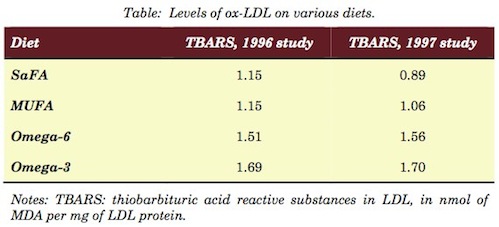
Notice the clear increase in TBARS (a measure of oxidative damage of the LDL particle) with omega-3 fat. It’s important to note that this was only a 5-week trial. If it had gone on for longer than that, it’s likely the oxidative damage caused by omega-3 fats would have been even worse. This isn’t surprising if you understand the chemical composition of fats. Polyunsaturated fats (PUFA) are highly vulnerable to oxidative damage because they’re the only fatty acids that have two or more double bonds, and it’s the carbon that lies between the double bonds that is vulnerable to oxidation (as shown in the figure below):
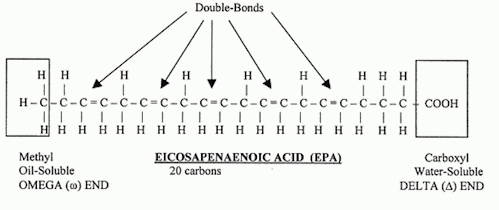
Another thing worth noting, if you haven’t already, is that intake of saturated and monounsaturated fats does not increase oxidative damage by a significant amount. This is illustrated in both the table and the diagram above: saturated fats have no double bonds, which means they are well protected against oxidation. MUFA is slightly more vulnerable, since it does have one double bond, but not nearly as much as PUFA which has several double-bonds.
A randomized, double blind, placebo-controlled trial likewise showed that 6 grams per day of fish oil increased lipid peroxides and MDA in healthy men, regardless of whether they were supplemented with 900 IU of vitamin E. And consumption of fresh, non-oxidized DHA and EPA has been shown to increase markers of oxidative stress in rats.
Like what you’re reading? Get my free newsletter, recipes, eBooks, product recommendations, and more!
Fish oil not as beneficial as commonly believed
To be fair, at least one review suggests that fish oil supplementation is beneficial in the short and even intermediate term. A recent meta-analysis of 11 trials lasting more than one year found that fish oil reduced the relative risk of cardiovascular death by 13 percent and the relative risk of death from any cause by 8 percent.
But the effect seen in this review was mostly due to the GISSI and DART-1 trials. They found that fish oil may prevent arrhythmia in patients with chronic heart failure and patients who have recently survived a heart attack.
However, there is no evidence that people other than those with arrhythmia and chronic heart failure benefit from taking fish oil or that doses higher than one gram of omega-3 fatty acids per day provide any benefit over smaller doses. And then there’s the rather disturbing result of the DART-2 trial, the only fish oil study lasting more than four years, showing an increase in heart disease and sudden death.
It’s logical to assume the effects of oxidative damage would take a while to manifest, and would increase as time goes on. That’s likely the reason we see some benefit in short- and intermediate-term studies (as n-3 displace n-6 in the tissues), but a declining and even opposite effect in the longer-term DART-2 trial (as increased total PUFA intake causes more oxidative damage).
The danger of reductionist thinking in nutritional research
The current fish oil craze highlights the danger of isolated nutrient studies, which unfortunately is the focus of nutritional research today. Kuipers et al. eloquently described the risks of this approach in a recent paper:
The fish oil fatty acids EPA and DHA (and their derivatives), vitamin D (1,25-dihydroxyvitamin D) and vitamin A (retinoic acid) are examples of nutrients that act in concert, while each of these has multiple actions(7,8).
Consequently, the criteria for establishing optimum nutrient intakes via randomised controlled trials (RCT) with single nutrients at a given dose and with a single end point have serious limitations. They are usually based upon poorly researched dose–response relationships, and typically ignore many possible nutrient interactions and metabolic interrelationships.
For instance, the adequate intake of linoleic acid (LA) to prevent LA deficiency depends on the concurrent intakes of α-linolenic acid (ALA), γ-LA and arachidonic acid (AA). Consequently, the nutritional balance on which our genome evolved is virtually impossible to determine using the reigning paradigm of ‘evidence-based medicine’ with RCT.
Interest in fish oil supplementation started with observations that the Inuit had almost no heart disease. It was assumed their high intake of marine oils produced this benefit. While this may be true, at least in part, what was overlooked is that the Inuit don’t consume marine oils in isolation. They eat them as part of a whole-food diet that also includes other nutrients which may help prevent the oxidative damage that otherwise occurs with such a high intake of fragile, n-3 PUFA.
It’s also important to note that there are many other traditional peoples, such as the Masai, the Tokelau, and the Kitavans, that are virtually free of heart disease but do not consume high amounts of marine oils. What these diets all share in common is not a large intake of omega-3 fats, but instead a complete absence of modern, refined foods.
Eat fish, not fish oil – cod liver oil excepted
That is why the best approach is to dramatically reduce intake of omega-6 fat, found in industrial seed oils and processed and refined foods, and then eat a nutrient-dense, whole-foods based diet that includes fatty fish, shellfish and organ meats. This mimics our ancestral diet and is the safest and most sane approach to meeting our omega-3 needs – which as Chris Masterjohn points out, are much lower than commonly assumed.
Some may ask why I continue to recommend fermented cod liver oil (FCLO), in light of everything I’ve shared in this article. There are a few reasons. First, I view FCLO as primarily a source of fat-soluble vitamins (A, D, K2 and E) – not EPA and DHA. Second, in the context of a nutrient-dense diet that excludes industrial seed oils and refined sugar, and is adequate in vitamin B6, biotin, calcium, magnesium and arachidonic acid, the risk of oxidative damage that may occur with 1g/d of cod liver oils is outweighed by the benefits of the fat-soluble vitamins.
So I still recommend eating fatty fish a couple times per week, and taking cod liver oil daily, presuming your diet is as I described above. What I don’t endorse is taking several grams per day of fish oil, especially for an extended period of time. Unfortunately this advice is becoming more and more common in the nutrition world.
More is not always better, despite our tendency to believe it is.
Note: As always, I’m open to dissenting views, but I’m not convinced by short-term studies on the efficacy of fish oil. As I’ve explained in this article, it’s the long-term effects that we’re primarily concerned with. I’d be interested in seeing any studies longer than 2 years showing that 1) fish oil benefits extend beyond reducing arrhythmia in patients with chronic heart failure and patients who have recently survived a heart attack, 2) doses higher than 1g/d produce a larger benefit than doses of 1g/d, and (most importantly) 3) doses of >1g/d or higher do not increase the risk of heart disease or death.

Better supplementation. Fewer supplements.
Close the nutrient gap to feel and perform your best.
A daily stack of supplements designed to meet your most critical needs.

OmegaRx is the purest fish oil product you can buy with or without a prescription. It is free of heavy metals, such as mercury, and Zone Labs analyzes every lot to make sure the PCB levels meet the strict standards of Dr. Barry Sears. If you want purity and potency at the lowest possible price, then OmegaRx® should be your only choice.
OmegaRx? I wouldn’t trust any product brand that resorts to lurking around public forums trying to squeeze badly disguised self-promotion as part of the discussion
Omerga RX is absolute garbage and this has been proven.
By whom?
I do agree generally with your article, however the recent results showing a fairly, actually very significant positive affect of fish oil on Alzheimer’s disease may trump everything.
Urgent: I’m having a real problem with conflicting information on this site. The article “The definitive fish oil buyer’s guide” strongly endorses quality fish oil as a supplement. But the article “When it comes to fish oil, more is not better” contains dire warnings about the dangers of fish oil (except fermented cod liver oil). To have two drastically conflicting “expert recommendations” there for everyone to read seems like a real disservice at best & negligent at worst. Mr. Kresser, PLEASE clarify.
Yes, same here. I started taking 3g of Omega 3 from Nutrigold and Jarrows’s based on Chris’s previous recommendations (he used to say that it’s all about the ratio of 3 to 6, and take more 3 if you want a better ratio). Now he is stating almost the opposite – all of a sudden we are supposed to consume 3 and 6 (as in the FSLO supplements, which also comes with high dosage of proinflammatory vitamin A). What do we do??
I will stop coming here. It seems nothing is consistent in nutrition…
What makes you think Vitamin A is pro-inflammatory? Traditional diets ate it in very high concentrations.
I’ve made this request twice – for clarification on the fact that one posted article here tells us fish oil is highly beneficial and a second article that says it just might kill you. Several other people have echoed this. I’m astounded that there has been no response & the drastically conflicting information is still posted. I am ceasing to come to this site as of today & am recommending to all my all online contacts interested in nutrition that they do the same. A real disservice, Mr. Kresser – shame on you.
David,
After re-reading Chris’s alarmist post and then looking over the studies he references, I am in full agreement with what you have posted. I, too, will continue to look to more trusted sources which are not replete with contradictory, inconsistent and incomplete information. I have taken issue overall with some of Chris’s prior advice/recommendations based on, for example, conflicting yet concurring information among other reputable health researchers.
The studies Chris cites raise more questions than confidence in their conclusions. It’s not simply their conclusions that seem questionable but also their methods and implementation. I was particularly bothered by the study which surrounded its analysis based on cholesterol values. It is becoming increasingly recognized that years of warnings surrounding the “dangers” of particular cholesterol levels are unfounded and, to a great degree, amount to little more than myth. In fact, one excellent eye-opening expose which I have just completed and recommend is The Great Cholesterol Myth: Why Lowering Your Cholesterol Won’t Prevent Heart Disease-and the Statin-Free Plan That Will by Drs. Jonny Bowden and Stephen Sinatra, highly known and respected in their fields (nutrition and cardiology respectively).
We Americans need to “take back” our health!
Agree. I’ll bet the website that sells his services and products are kept up to date. It’s a shame that he nor any of his administrative staff have responded to your questions.
Chris has become famous and has forgotten the people who got him there. I quit my email subscription and will no longer visit his site.
To leave conflicting undated and not updated information on the web, is pretty sad, given the whole purpose is of these articles is to promote health. Shameful.
Yup! I’m outta here too–far more reliable sources out there! Too bad, yet all of us should exercise doubt, practice skepticism when we feel it in our gut, take the word of “experts” as perhaps fleeting (always Question Authority)–and most importantly, do our own thorough research and then do some more. One life…
Thanks Chris for an eye opening post.
DO you have any specific recommendation products for Cod-liver oil (amazon link)?
Hi Dr Chris,
I have read many articles in the recent couple years that agreed with you on not taking fish oils. I have looked into another source and would like your thoughts please… How do you feel about “Nordic Naturals Algae Omega”? Personally I would prefer NOT to take any fish oils regardless of the FCLO you suggest.
Also, do you have a recommendation for a DHEA supplement that you particularly like?
Hear from you soon,
Thanks so much.
I am trying to figure out why I have had constant, and I do mean constant diarrhea for the past several months. Have spend thousands of dollars (insurance has anyway) and still no answers. I came across an article that to much fish oil can cause it. I started taking the LLV from doTerra several months ago and never put it together. Do you think this could be the cause?
Pam,
I feel for you, having had severe diarrhea for about two years before someone thought to give me a blood test for Celiac disease. It was positive to the extreme. By this time I was so weak and had lost all muscle tone. Back to you – until you get a diagnosis, consider getting a blood test for Celiac disease, and after you have that, please give the gluten-free diet a trial with no cheating, for a good three months at least to see if that helps. Meanwhile, are you drinking electrolytes to replenish those lost with d.? And keep eating enough high quality protein, as you are losing so many nutrients every day. You can certainly eliminate anything you suspect as a cause, and just keep searching – parasites, gluten and severe food allergies seem the most logical places to start. Don’t just wait for your doctor to suggest something, as his interest in your case has human limitations. Do your research and definitely try the gluten-free diet only after the Ttg test (you have to be on gluten for it to work).
Jeanne
Yes indeed. Fish oil gave me diarrhea. The combination of my capsules plus my daily magnesium was a recipe for disaster. The gluten police will tell you to go gluten free but try eliminating supplements before cutting out entire food groups.
Nofish it’s the magnesium that is probably given you diarrhea. If you ate taking citrate or oxide version that’s why you have problem
Switch to Chelated magnesium
Can you name a chelated magnesium brand? I’ve been taking Natural Calm, not sure what that is.
Hi No Fish – Just jumping in here to help you in case you didn’t get a reply. Natural Calm reacts with water to create magnesium citrate is that is highly stimulating to bowels. I only recommend that form to my clients who have constipation. I agree it’s highly likely that the mag is a key component of your loose stools. I recommend magnesium glycinate or malate for those with normal/loose stools. However, it is also true that you may have fat malabsorption in your intestines. I have seen this often when there is a parasite or an imbalance (dysbiosis) in the bacterial balance in the intestines. However, in this latter situation, it wouldn’t be only the fish oil giving you loose stools but rather any intense intake of fat at once. Thus you can easily experiment to find your true root cause. But certainly I agree: the Natural Calm is probably the larger culprit. Hope that helps!
What is the cure for this fat absorption problem?
That’s the combination I’m on magnesium and just introduced fish oil. I feel dreadful!! Diarrhoea, nausea and feel very lousy!
I’m confused. The article “The definitive fish oil buyer’s guide,” seems to strongly endorse quality fish oil as a supplement. But the article “When it comes to fish oil, more is not better,” contains dire warnings about the dangers of fish oil (except forced liver oil). Can anyone clarify this for me?
Sorry – meant “fermented” not “forced” fish oil.”
ditto here – absolute confusion now
I have the same question as David. I just read the Definitive Fish Oil Buyer’s Guide a few days ago and this seems to contradict that info. Chris, can you clarify. Is this the latest? How old is the Fish Oil Buyer’s Guide on your website?
I use quality fish oil products for my son with epilepsy and for his Service Dog as well.
The quality of the fish oil supplements used in research could vary considerably, was that controlled? If researchers got their fish oil supplements off the drugstore shelf, I’m not surprised that rancid, oxidized fish oil that wasn’t molecularly distilled would show an increase in risk of disease.
Granted you’re saying it oxidizes in the body, hence the risk, but do we know if a high quality fish oil supplement poses the same risks as an oxidized, rancid oil?
Only use liquid fish oil , not softgel capsules
Fish becomes rancid when it is heated in the softgel. That’s why they add lemon to mask burps.
Best is Carlson Fish Oil or Carlson Cod Liver but only in liquid form
what about some high quality supplements – such as Jarrow’s or Nutrigold? Do those get heated, too? I doubt that…
Hi Chris,
Just started taking fish oil. Have a pretty significant depression going and trying different means to help myself. Taking EPA, about 4000mg /day split into two times each day and taking it with 12 g of extra v olive oil each time. Do I have this wrong? I know your preference is the fish, not the fish oil. I intend to do that as well. Thank you very much
Hi, for depression personally i recommend a combined approach. Eliminate grains and sugar, increase protein and increase fat (eggs for breakfast every day is a great start ) also look at a paleo low carb approach. There is some evidence that a ketogenic diet has a positive effect on depression (as long as it meets your nutrient needs and is well planned ) i have used this approach for several people and it seems to work quite well. Individual results and reasons for depression vary a lot though!
Cheers, Tim
For significant depression, you must see a doctor first and foremost to get treated so that you are stable. and only then try nutrition to augment your meds. Mild and moderate depression can respond to amino acids like 5-HTP or tryptophan, but it sounds like yours is real suffering and can cause one to be suicidal. Brain imbalances must be treated by a professional. Even then, it can take several different prescriptions till one feels normal and happy again.
All the fish oil in the world won’t balance brain chemicals. Going off all gluten grains is a good idea, as Celiac disease can cause depression, but please see a doctor.
Jeanne has no clue. Just bad advice
The gluten police are everywhere …
Listen to Jeanne’s advice only if you want to prolong your suffering or make it multitudes worse. Take it from someone who’s been on multiple prescription depression meds as well as plenty of other prescriptions. These prescribed meds generally lead to greater mood swings than you would have ever seen normally. A natural dietary option is your best bet for leading to a sustained improvement in overall cognitive functioning. Something else that nobody seems to ever mention (because the pharmaceutical company buries the information) is Neurofeedback. Check out Low Energy Neural Stimulation (LENS) treatment, as it has an extremely high rate of success of eliminating (or at least limiting) cognitive deficiencies. Also, if you’ve had a concussion throughout your life, that may have brought on the issues you’re experiencing now and neurofeedback can also work with the brain to repair neural pathways. Hope this helps, and wishing you a swift recovery! Best, Parker S.
I’m happy for anyone that can treat their depression naturally. After trying this route first with one friend, who was severely depressed, I had to make an emergency appointment for her to a doctor so that she wouldn’t harm herself. This same young woman before her episode had spent three weeks with her own friend who was so unstable she was trying to commit suicide and needed someone to stay with her night and day for three weeks while she worked with a specialist to get balanced again. She had tried everything before this, self-medicating. Some people need help to become stable. The suicidal woman is now happily married and still needs meds, but the other woman doesn’t need anything anymore and weened herself off everything. Don’t think I want people to take drugs if they can possibly manage without. Most people don’t need them.
I agree with Jeanne. Being a person who had been through prenatal depression myself, best bet would be to get a proper diagnosis from a doctor, stabilize the situation before having any other self medications. Please do not treat depression lightly as it can be life threatening.
Thank you for putting together an eloquent summary of a controversial, yet an important subject matter.
The first rule in medicine is “first do no harm”. Unfortunately, our peers in natural medicine have supported the (potentially dangerous) use of fish oil with no rel debate.
Interesting article by Prof. Brian Peskin,
Why fish oils fails.
https://www.ncbi.nlm.nih.gov/pmc/articles/PMC3914521/
You mean, the article that got retracted for being complete BS? That article? I guess that’s one way to support your argument. LOL
“The article titled “Why Fish Oil Fails: A Comprehensive 21st Century Lipids-Based Physiologic Analysis” [1], published in Journal of Lipids has been retracted as a result of an undeclared competing interest on the part of the manuscript’s author.”
What does this mean?
I suspect that Professor Peskin was selling or linking to sales, on his site, of PEOs which he is no longer doing.
That does not discrete his work but it is against the regulations of the publishing site.
I could be wrong on this but the description is not terribly detailed to the problem.
Your addition “LOL” shows your bias and very possibly closed mind.
Namaste and care (and keep safe in your beliefs)
mhikl
I’m a vegetarian and I don’t eat fish. I made an exception for fish oil capsules because I believe Omega 3s are important. However I have found that I cannot tolerate the capsules as they give me bowel issues. Is there another way to get Omega 3s? I can’t take flaxseed oil because of breast cancer concerns.
Avocado, tree nuts, spirulina, hemp seed oil are all vegetarian sources of omega 3s.
Mr/Ms Sharp: the foods you named are such miniscule soures of omega 3 you’d have to eat bushels of them to even get the lowest dose any doctor recommends. This is one of those vegan fallacies, that the foods you named provide any more than a slight trace of omega 3s.
Use Carlson liquid
Capsules don’t work and they can cause stomach issues
Chris,
Your solution and direction is for all people to eat 2-3 servings of fatty fish a week? O.k.~ Where are we going to get all these fish from? If “everyone” did this… we’d have no fish left. The oceans and reefs are in a dire state now. How can you recommend something that, even though it may seem like good advice, is not really practical or sustainable?
Hi Jen,
I don’t think it’s sustainable for human beings to have to limit essential nutrition either, nor do I think it’s necessary to solve the problem. Polluting waters and not fishing in a way that allows for populations to thrive is what limits their numbers. Solutions don’t manifest from a place of scarcity consciousness. There’s tremendous intelligence in the world, take Allen Savory, for instance. He challenges conventional ideas about the cause of global warming and understands how to create a thriving ecosystem where every living organism, including people, can thrive.
Not everyone is going to rush out and start eating fish every day. Most people are very content to continue eating their processed and fast foods.
I read that fish oil helps people with salicylate sensitivity. Will the fermented cod liver oil help with that? If so how much per day? Thanks!
Hi Chris,,
Very late to the discussion but I wanted to comment on your conclusions from the Saito journal article re peroxidation in rats fed high doses of DHA, EPA, ALA. Their conclusions were, “the extent of lipid peroxidation in the EPA and
DHA groups fed diets with adequate level of vitamin E was
far less than expected from the relative peroxidizability
indices of the total liver lipids.” That seems counter to what you concluded from the article, yes?
I was very interested to read what you have written about fish oil supplements. Normally I take a 1000mg Fish Oil capsule daily and recently upped that dose to two per day (taken together). I have recently also noticed a few joint sensitivities in a couple of fingers which I have never had problems with before. I have just started cutting out the fish oil so will be interested to see if the problem goes away. In my diet I have oily fish about twice a week plus chia seeds every day (I believe they have a good dose of Omega 3), so hopefully that is all I need as I am normally very healthy. I hope this is of interest to you. Thanks, Janice
I am sticking with fresh caught salmon for now. I just discovered camelina oil sold by a Washington company that grows and cold presses it. It is 33 to 40% omega 3, 20% omega 6, with olive oil at 10% omega 6 and 3% omega 3. I am wondering about the DHA percentage content. Burn point 475 F.
Link on some testing of this plant and its seed for omega 3 content:
https://www.ncbi.nlm.nih.gov/pmc/articles/PMC3942731/
Thanks for the article Chris, I had been taking 1000mg krill oil per day for the past year and everything was fine with my health, however in May 2014 i changed to fish oil and started taking 3000 mg per day, In June i started noticing a big decline in my haelth with the following symptoms.
mood swings, nervousness, irritability, and severe anxiety
insomnia,
headache,
abnormal sensations,
muscle twitching,
tremors,
weakness,
muscle atrophy, and
decreased cognitive functions.
at one stage i actually thought i was going insane,
I visited my doctor who prescribed antibiotics as she believed it was sinus related, however no joy. She ordered blood tests and my results came back High Cholesterol and an abnormal liver function test result.
I then retraced my steps as to when all the symptoms above started, and then it dawned on me that they had started when i had commenced the larger amount of oil supplement as recommended on the packaging. I searched the Internet in relation to fish oil intake and came across this article and others which related to mercury poisoning on anxiety forums( as i thought i was suffering from an anxiety disorder) . I stopped the fish oil immediately and within 2 days my symptoms subsided, A week later they virtually left me. I am awaiting further blood tests as a follow up and have arranged an appointment again with my doctor to discuss this. It goes without saying in my case and as you have explained too much is not better. I would never take these supplements again and i am even apphrehensive about taking fish now.
Wow – Reading your story just blew me away.
I have virtually EXACTLY the same story.
I’m stopping Fish Oil supps today and see how I go for the next few weeks and if the following goes away:
mood swings, nervousness, irritability, and severe anxiety
insomnia,
muscle atrophy
decreased cognitive functions.
at one stage i actually thought i was going insane,
unexplained high cholesterol for somebody who has a brilliant diet otherwise and runs 70 kilometers per week and is extremely healthy and fit otherwise, pretty well a health and fitness junkie………………………..
except I take a high dose around 4,000-4,500 mg of fish oil daily to try and combat high cholesterol without using statin drugs.
I will report back in a few weeks.
Regards James
Yes James its true, actually taken me until now to eventually get rid off all symtoms ( I highly recommend renew life heavy metal cleanse you can google it) I really thought i was having some king of break down. But thankfully now im great. Would never touch fish oil/ omega supplement again.
My friend, brother and I all suffered from anxiety when taking fish oil supplements. I know that I am particularly sensitive to oxidative damage due to autoimmune and gut issues (I respond very well to vitamin C, a great anti-oxidant). I would suggest that it was not mecury at all but the fish oil processing that was the problem. Since researching about the fish oil process, I’ve learnt that when companies ‘molecularly distil’ the oil, they produce an ‘ethyl ester’ form of omega 3. This is apparently difficult for lipase to clever (breakdown) and requires our body to donate the necessary triglyceride backbone before the omega 3 is accepted by the body. Perhaps this causes oxidative damage? I know there is a link between inflammation and depression/anxiety, so it wouldn’t be surprising. Eat whole fish such as salmon, I get zero issues no matter how much I eat. I don’t think higher doses of the triglyceride form of fish oil would be a problem, this article doesn’t seem to address that complication.
I’m curious whether you’ve tried Green Pasture’s fermented cod liver oil? It seems like it should work for you.
“The only fish oil study lasting more than four years showed an increase in heart disease and sudden death”
This is NOT true. The mean supplementation and follow-up in JELIS lasted 4.6 years (Lancet 2007; 369:1090-98). The addition of EPA to low-dose statin therapy resulted in a statistically significant 19% reduction in the risk of major coronary events, defined as sudden cardiac death, fatal or nonfatal MI, unstable angina, or the need for revascularization.
https://www.medscape.com/viewarticle/789191?t=1
I suggest that everyone interested in the role of fish oil in CVD read the excellent article by prof. Clemens
von Schacky: Omega-3 Index and Cardiovascular Health. Review. Nutrients 2014, 6(2), 799-814.
https://www.mdpi.com/2072-6643/6/2/799/pdf
Dear Dr. Tolonen, MD:
Might you, perchance, write me at [email protected]?
I do thank you most kindly, Dr. Tolonen.
Most appreciatively,
Jim
Is about 5grams of omega 3 from sardines too much? It is my cheapest protein source. should i limit sardines?
This is an interesting study but I haven’t checked it out properly yet:
Dietary supplementation with Lovaza and krill oil shortens the life span of long-lived F1 mice
https://link.springer.com/article/10.1007/s11357-014-9659-7
Re:
1)
kevin
May 14, 2014 at 11:01 am
Just eat the whole fish…
https://www.ncbi.nlm.nih.gov/pmc/articles/PMC3914521/
and your
2)
Dietary supplementation with Lovaza and krill oil shortens the life span of long-lived F1 mice
https://link.springer.com/article/10.1007/s11357-014-9659-7
(and does “administration of krill oil (1.17 g oil/kg diet)” [ibid.]
mean g/kg of body weight or
g/kg of food weight)
and
3)
Recommended Daily Omega 6 Intake
Last Updated: Jan 14, 2014 | By Bridget Coila
–https://www.livestrong.com/article/335622-recommended-daily-omega-6-intake/
of 17 g/d. for adults
vs.
4)
The paleo <2% of kC
and the unclearness to me in the n-6 articles as to using the EPA + DHA total gms. vs. the weight of the whole fish oil (or in my case, krill oil) cap to calculate n-6/3 ratios,
which would require a lot of n-3 regardless, to = the 1:1 a 2000 CE study found best
("Keep in mind from the last article that the optimal ratio of omega-6 to omega-3 is estimated to be between 1:1 and 2.3:1" Kresser ibid.)
[© 2000 American Society for Clinical Nutrition
Polyunsaturated fatty acids in the food chain in the United States1,2])
or even the 2.3:1 mentioned:
thus, elaboration thereon for me, please?