

Update: I now recommend Extra Virgin Cod Liver Oil from Rosita as my preferred cod liver oil product. For more information, read this article. You can purchase EVCLO here.
Article summary
- The benefits of fish oil supplementation have been grossly overstated
- Most of the studies showing fish oil benefits are short-term, lasting less than one year
- The only fish oil study lasting more than four years showed an increase in heart disease and sudden death
- Fish oil is highly unstable and vulnerable to oxidative damage
- There’s no evidence that healthy people benefit from fish oil supplementation
- Taking several grams of fish oil per day may be hazardous to your health
A new study was recently published showing that 3g/d of fish oil in patients with metabolic syndrome increased LDL levels and insulin resistance.
Unfortunately, I don’t read Portuguese so I can’t review the full-text. But this study isn’t alone in highlighting the potential risks of high-dose fish oil supplementation. Chris Masterjohn’s latest article on essential fatty acids, Precious yet Perilous, makes a compelling argument that fish oil supplementation – especially over the long-term – is not only not beneficial, but may be harmful.
This may come as a surprise to you, with all of the current media hoopla about the benefits of fish oil supplementation. Yet the vast majority of the studies done that have shown a benefit have been short-term, lasting less than one year. The only trial lasting more than four years, the DART 2 trial, showed that fish oil capsules actually increase the risk of heart disease and sudden death.
A 2004 Cochrane meta-analysis of trials lasting longer than six months suggests that the cardiovascular benefits of fish oil have been dramatically over-stated. They analyzed 79 trials overall, and pooled data from 48 trials that met their criteria. The only effect that could be distinguished from chance was a reduced risk of heart failure. Fish oil provided no reduction in total or cardiovascular mortality.
Too much fish oil can wreak havoc in your body
A study by Mata et al demonstrated that oxidative damage increases as intake of omega-3 fat increases. The results of this study were summarized in the Perfect Health Diet, by Paul and Shou-Ching Jaminet:
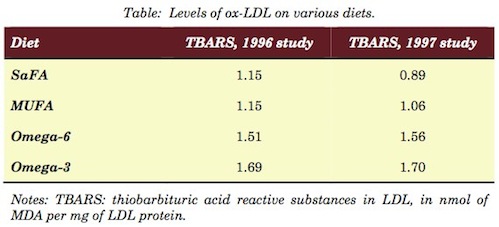
Notice the clear increase in TBARS (a measure of oxidative damage of the LDL particle) with omega-3 fat. It’s important to note that this was only a 5-week trial. If it had gone on for longer than that, it’s likely the oxidative damage caused by omega-3 fats would have been even worse. This isn’t surprising if you understand the chemical composition of fats. Polyunsaturated fats (PUFA) are highly vulnerable to oxidative damage because they’re the only fatty acids that have two or more double bonds, and it’s the carbon that lies between the double bonds that is vulnerable to oxidation (as shown in the figure below):
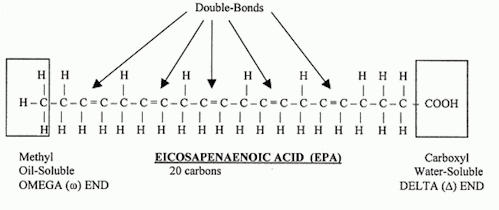
Another thing worth noting, if you haven’t already, is that intake of saturated and monounsaturated fats does not increase oxidative damage by a significant amount. This is illustrated in both the table and the diagram above: saturated fats have no double bonds, which means they are well protected against oxidation. MUFA is slightly more vulnerable, since it does have one double bond, but not nearly as much as PUFA which has several double-bonds.
A randomized, double blind, placebo-controlled trial likewise showed that 6 grams per day of fish oil increased lipid peroxides and MDA in healthy men, regardless of whether they were supplemented with 900 IU of vitamin E. And consumption of fresh, non-oxidized DHA and EPA has been shown to increase markers of oxidative stress in rats.
Like what you’re reading? Get my free newsletter, recipes, eBooks, product recommendations, and more!
Fish oil not as beneficial as commonly believed
To be fair, at least one review suggests that fish oil supplementation is beneficial in the short and even intermediate term. A recent meta-analysis of 11 trials lasting more than one year found that fish oil reduced the relative risk of cardiovascular death by 13 percent and the relative risk of death from any cause by 8 percent.
But the effect seen in this review was mostly due to the GISSI and DART-1 trials. They found that fish oil may prevent arrhythmia in patients with chronic heart failure and patients who have recently survived a heart attack.
However, there is no evidence that people other than those with arrhythmia and chronic heart failure benefit from taking fish oil or that doses higher than one gram of omega-3 fatty acids per day provide any benefit over smaller doses. And then there’s the rather disturbing result of the DART-2 trial, the only fish oil study lasting more than four years, showing an increase in heart disease and sudden death.
It’s logical to assume the effects of oxidative damage would take a while to manifest, and would increase as time goes on. That’s likely the reason we see some benefit in short- and intermediate-term studies (as n-3 displace n-6 in the tissues), but a declining and even opposite effect in the longer-term DART-2 trial (as increased total PUFA intake causes more oxidative damage).
The danger of reductionist thinking in nutritional research
The current fish oil craze highlights the danger of isolated nutrient studies, which unfortunately is the focus of nutritional research today. Kuipers et al. eloquently described the risks of this approach in a recent paper:
The fish oil fatty acids EPA and DHA (and their derivatives), vitamin D (1,25-dihydroxyvitamin D) and vitamin A (retinoic acid) are examples of nutrients that act in concert, while each of these has multiple actions(7,8).
Consequently, the criteria for establishing optimum nutrient intakes via randomised controlled trials (RCT) with single nutrients at a given dose and with a single end point have serious limitations. They are usually based upon poorly researched dose–response relationships, and typically ignore many possible nutrient interactions and metabolic interrelationships.
For instance, the adequate intake of linoleic acid (LA) to prevent LA deficiency depends on the concurrent intakes of α-linolenic acid (ALA), γ-LA and arachidonic acid (AA). Consequently, the nutritional balance on which our genome evolved is virtually impossible to determine using the reigning paradigm of ‘evidence-based medicine’ with RCT.
Interest in fish oil supplementation started with observations that the Inuit had almost no heart disease. It was assumed their high intake of marine oils produced this benefit. While this may be true, at least in part, what was overlooked is that the Inuit don’t consume marine oils in isolation. They eat them as part of a whole-food diet that also includes other nutrients which may help prevent the oxidative damage that otherwise occurs with such a high intake of fragile, n-3 PUFA.
It’s also important to note that there are many other traditional peoples, such as the Masai, the Tokelau, and the Kitavans, that are virtually free of heart disease but do not consume high amounts of marine oils. What these diets all share in common is not a large intake of omega-3 fats, but instead a complete absence of modern, refined foods.
Eat fish, not fish oil – cod liver oil excepted
That is why the best approach is to dramatically reduce intake of omega-6 fat, found in industrial seed oils and processed and refined foods, and then eat a nutrient-dense, whole-foods based diet that includes fatty fish, shellfish and organ meats. This mimics our ancestral diet and is the safest and most sane approach to meeting our omega-3 needs – which as Chris Masterjohn points out, are much lower than commonly assumed.
Some may ask why I continue to recommend fermented cod liver oil (FCLO), in light of everything I’ve shared in this article. There are a few reasons. First, I view FCLO as primarily a source of fat-soluble vitamins (A, D, K2 and E) – not EPA and DHA. Second, in the context of a nutrient-dense diet that excludes industrial seed oils and refined sugar, and is adequate in vitamin B6, biotin, calcium, magnesium and arachidonic acid, the risk of oxidative damage that may occur with 1g/d of cod liver oils is outweighed by the benefits of the fat-soluble vitamins.
So I still recommend eating fatty fish a couple times per week, and taking cod liver oil daily, presuming your diet is as I described above. What I don’t endorse is taking several grams per day of fish oil, especially for an extended period of time. Unfortunately this advice is becoming more and more common in the nutrition world.
More is not always better, despite our tendency to believe it is.
Note: As always, I’m open to dissenting views, but I’m not convinced by short-term studies on the efficacy of fish oil. As I’ve explained in this article, it’s the long-term effects that we’re primarily concerned with. I’d be interested in seeing any studies longer than 2 years showing that 1) fish oil benefits extend beyond reducing arrhythmia in patients with chronic heart failure and patients who have recently survived a heart attack, 2) doses higher than 1g/d produce a larger benefit than doses of 1g/d, and (most importantly) 3) doses of >1g/d or higher do not increase the risk of heart disease or death.

Better supplementation. Fewer supplements.
Close the nutrient gap to feel and perform your best.
A daily stack of supplements designed to meet your most critical needs.

Hi Chris,
Have you seen this study?
‘Oxidised fish oil does not influence established markers of oxidative stress in healthy human subjects: a randomised controlled trial’.
https://www.ncbi.nlm.nih.gov/pubmed/22136711
Yea – he won’t respond to this one, because it counters his position. I see what you’re talking about, and am with you here.
Hi Chris,
Really curious about taking fish oil (vital choice wild alaskan) during pregnancy and especially while nursing. I’ve been following Nina Planck’s recommendations of 3,000mg. In your opinion, does this fall into the beneficial short term use category? I have been supplementing and planned to until my daughters could consume fish on their own. They do take CLO. Thanks very much!
If you eat 1 lb. of fatty fish (salmon, mackerel, herring) in addition to both you and they taking FCLO, that should be enough. No need to take additional fish oil above and beyond that.
It has been common knowledge that the actor, Cary Grant, died from an unusual addiction to fish oil capsules. The coroner indicated it was due to cardiac problems; however, these problems was caused by an overconsumption of fish oil capsules.
He died at age 86, at which point he had most likely been taking the capsules for about 40 years, and that is well beyond current life expectancy.
If Cod Liver Oil is good (at least fermented CLO), then one would think that eating fresh whole cod, including its liver (and maybe other organs) would be even better, assuming one can get hold of a good quality fresh cod.
I assume this is what traditional Inuit actually did, anyway (cod, or whatever fish they caught).
Is there anything inside a fresh cod that we shouldn’t be eating?
I guess people might find eating the guts distasteful, but would it actually do us any harm?
If so, then presumably, if one was skilled with a knife and knew what to leave in and cut out, should do the trick. Then cook at eat whole. Does this sound plausible?
After all, some of us eat mammal organs with equanimity, so why not fish organs?
Chris I wonder if I am missing something obvious as I read all the comments (plus googled) and will be the first one to ask this: Where do I gather the info off of the Green Pasture FCLO to fulfill your daily recommendations of 10,000- 15,000iu? Thanks
Chris,
I don’t know if this is the best place to post this. Thank you so so much for everything you’ve done to help us reach optimal health. I just purchased Healthy Baby Code, and I’m very impressed by how well you’ve distilled a ton of information. It was worth every penny.
You’re welcome Alexandra! I’m glad you’re enjoying the course, and thank you for the feedback.
I agree largely about the reduction of Omega6 being more important.
You said in a previous comment “We know less than we think about how all of the various constituents of vitamin and mineral complexes behave.”
I couldn’t agree more. Why is an apple healthier for you than if we took water, sugar, fiber, and a vitamin complex and took those instead? There are probably many more types of the vitamins we know of that we are generalizing too much. There’s most likely small amounts of nutrients in whole foods that effect our bodies, that we don’t even know about.
Here is an idea for salad dressing: sour cream. I grew up in former Soviet Union, and the only choices I had for salad dressing were sunflower oil, vinegar and sour cream. I always went with the latter. It tastes better in a salad with lots of tomato. When salted, tomatoes release juice that thins sour cream. Uh, taste of childhood.
Sour cream is very low in PUFA and tastes great. I am surprised it not widely eaten in America. Fear of saturated fat, I guess?
Thanks for your work Chris.
As you mention, fish oils are notoriously unstable. It’s widely recognized that fish oil supplementation lowers blood concentrations of vitamin E. One reason may be that the Vitamin E is being used up to combat its immediate oxidation in our system. Krill oil will follow the same pattern – though my experience is that it is slightly more stable – so has to be “fresh”.
My question follows: A damaged oil or fat will often have the opposite effects in the system of its fresh counterpart?
The quality average omega 6 in the diet is low, low, low. So lumping all O-6 together may be misleading.
Take beef as an example… you’ve referenced studies that show that the O-6/O-3 ratio in grain beef is 10 times that of grass fed beef. I think most readers can agree that this is imbalanced/unhealthy – for the steer and the steer eater. But if we dig down one notch, how does the grain fed steer reach these inflamed heights? Well it’s dollars we know – and we know naturally grazing animals won’t thrive on grain long-term (or even short-term) but to compound the problem the grain they get is the worst possible omega 6 source – cheap, GMO, round-up laced, rancid grain… not a recipe for healthy tissues. So the beef most of us eat is (of course) way high on Omega-6 – but is this fair to call this “real omega 6”. Similarly is the Omega 6 in eggs, processed food, etc – really omega 6? or some stale and toxic oil-like residue – that just gives omega 6 a bad name?
What is the normal smell of Krill oil? The brand I bought on Amazon smells horrible. I suspect it is rancid.
Hi Chris,
3 months ago when I started taking Spironolactone/Aldactone for my PCOS to lower my androgen levels. I started to see the lbs start to come off almost immediately and my energy levels return. Hence my exercise levels have increased because of my over all sense of well being. In the past three months I have gone down 30 lbs and my doctor is still concerned about my cholesterol. Mainly the triglyceride levels. Which comes as no surprise to me because the high triglycerides runs in my family. I told my doctor I do not want to take statins. He recommended 4000mg of fish oil per day. He also recommended freezing them so it won’t dissolve until it has gotten into my stomach. I bought some capsules and have been taking them for about a week and I noticed that my weight loss has slowed down. You said fish oil doesn’t help healthy people, but what about obese people with PCOS trying to lower triglycerides?
Would be interesting to see what these peoples other nutrient intake was like…
We know fats with double bonds are easily oxidized. Did these people have adequate fat soluble vitmains and antioxidants to avoid oxidaiton?
Like anything we cant draw too many conclusions from such little infomation and such a little picture. Health isnt 1 nutrient or pill. Its a lifestyle, and when that lifestyle can be studied would be interesting to see the results.
Would be interesting to see what these peoples other nutrient intake was like…
We know fats with double bonds are easily oxidized. Did these people have adequate fat soluble vitmains and antioxidants to avoid oxidaiton?
Like anything we cant draw too many conclusions from such little infomation and such a little picture. Health isnt 1 nutrient or pill. Its a lifestyle, and when that lifestyle can be studied would be interesting to see the results.
Would be interesting to see what these peoples other nutrient intake was like…
We know fats with double bonds are easily oxidized. Did these people have adequate fat soluble vitmains and antioxidants to avoid oxidaiton?
Like anything we cant draw too many conclusions from such little infomation and such a little picture. Health isnt 1 nutrient or pill. Its a lifestyle, and when that lifestyle can be studied would be interesting to see the results.
Hi,
I had a heart attack 5 years ago and have taken Omacor (1 * 1000mg per day) since. I’m not sure if this is a good or bad thing now. Could you tell me?
Thanks,
Iain
MFA are perfectly safe. However, both almonds and avocados contain a fair amount of omega-6 so consumption of these should be moderated.
Hi,
I had a heart attack 5 years ago and have taken Omacor (1 * 1000mg per day) since. I’m not sure if this is a good or bad thing now. Could you tell me?
Thanks,
Iain
Chris: Excellent discussion! Where do monounsaturated fats fit into the picture? Myself and many of my Paleo friends have been consuming quite a bit of almond butter and avocados. Do you see any problems arising from this. To my knowledge almonds are much higher in mono than poly unsaturated fats and assuming that we are not eating processed foods and the dangerous seed oils would this be OK provided we are balancing with FCLO and fatty fish a couple x a week?
Hi Chris, this article is interesting, but worrying! I have hashimotos thyroiditis and am avoiding iodine containing food as it definitely worsens the auto-immune attacks – they rocketed after I went on Summer holidays and overdosed on fresh fish and shellfish. I have been taking krill oil tablets on the basis that they don’t contain iodine? Does FCLO contain Iodine? would this be a safe option for hashimoto’s?
Would appreciate your thoughts!
Lex: I don’t think food goitrogens play a significant role in suppressing thyroid function. I prefer FCLO to krill oil because it also has fat-soluble vitamins A & D.
Cotd…
So, is “So I still recommend eating fatty fish a couple times per week…” overly restrictive?
Hi Chris,
1 small can (213g) of Alaskan Wild Red Salmon contains ~20g of oil, of which ~6g is EPA & DHA. I can easily eat that in one meal!
Eskimos eat both oily fish and marine mammals. Marine mammals run at a higher temperature than oily fish, so they have a lower percentage of pufas in their fat. Even so, Eskimos are eating a diet high in long-chain omega-3 pufas but they aren’t dropping like flies from CHD & cancer (although they may age prematurely).
Therefore, is it reasonable to conclude that the omega-3 pufas naturally present in foods = O.K. so don’t worry about them?
Cheers, Nige.
This is interesting stuff. I have a peculiar condition of longitudinal grooves in each thumb nail. Various MDs have suggested there is an infection or damage to my nails, But I don’t agree as there are no other signs. but when nails are placed end to end, the groove is in precisely the same position on both nails and they are quite deep. This has been developing over the last 20 years.
I have been using fish oils for several years together with other supplements. Three months ago I started taking 4000mcg of fish oil daily and now it is obvious that my new nail growth is almost smooth and normal. This indicates that the fish oil is promoting good nail growth. I don’t know what it is doing to other aspects of my health.
I will have a full blood analysis soon, so it will be interesting to see if my usually high LDL is reduced. I eat fish twice a week and otherwise a nutritious omniverous diet. I am 69 and maintain an excellent BMI.