

Update: I now recommend Extra Virgin Cod Liver Oil from Rosita as my preferred cod liver oil product. For more information, read this article. You can purchase EVCLO here.
Article summary
- The benefits of fish oil supplementation have been grossly overstated
- Most of the studies showing fish oil benefits are short-term, lasting less than one year
- The only fish oil study lasting more than four years showed an increase in heart disease and sudden death
- Fish oil is highly unstable and vulnerable to oxidative damage
- There’s no evidence that healthy people benefit from fish oil supplementation
- Taking several grams of fish oil per day may be hazardous to your health
A new study was recently published showing that 3g/d of fish oil in patients with metabolic syndrome increased LDL levels and insulin resistance.
Unfortunately, I don’t read Portuguese so I can’t review the full-text. But this study isn’t alone in highlighting the potential risks of high-dose fish oil supplementation. Chris Masterjohn’s latest article on essential fatty acids, Precious yet Perilous, makes a compelling argument that fish oil supplementation – especially over the long-term – is not only not beneficial, but may be harmful.
This may come as a surprise to you, with all of the current media hoopla about the benefits of fish oil supplementation. Yet the vast majority of the studies done that have shown a benefit have been short-term, lasting less than one year. The only trial lasting more than four years, the DART 2 trial, showed that fish oil capsules actually increase the risk of heart disease and sudden death.
A 2004 Cochrane meta-analysis of trials lasting longer than six months suggests that the cardiovascular benefits of fish oil have been dramatically over-stated. They analyzed 79 trials overall, and pooled data from 48 trials that met their criteria. The only effect that could be distinguished from chance was a reduced risk of heart failure. Fish oil provided no reduction in total or cardiovascular mortality.
Too much fish oil can wreak havoc in your body
A study by Mata et al demonstrated that oxidative damage increases as intake of omega-3 fat increases. The results of this study were summarized in the Perfect Health Diet, by Paul and Shou-Ching Jaminet:
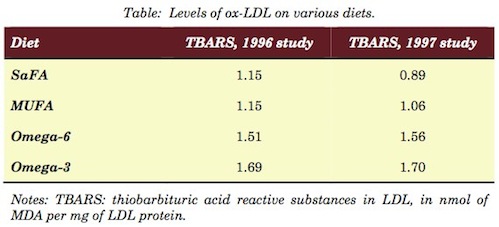
Notice the clear increase in TBARS (a measure of oxidative damage of the LDL particle) with omega-3 fat. It’s important to note that this was only a 5-week trial. If it had gone on for longer than that, it’s likely the oxidative damage caused by omega-3 fats would have been even worse. This isn’t surprising if you understand the chemical composition of fats. Polyunsaturated fats (PUFA) are highly vulnerable to oxidative damage because they’re the only fatty acids that have two or more double bonds, and it’s the carbon that lies between the double bonds that is vulnerable to oxidation (as shown in the figure below):
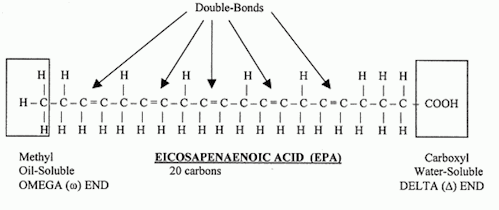
Another thing worth noting, if you haven’t already, is that intake of saturated and monounsaturated fats does not increase oxidative damage by a significant amount. This is illustrated in both the table and the diagram above: saturated fats have no double bonds, which means they are well protected against oxidation. MUFA is slightly more vulnerable, since it does have one double bond, but not nearly as much as PUFA which has several double-bonds.
A randomized, double blind, placebo-controlled trial likewise showed that 6 grams per day of fish oil increased lipid peroxides and MDA in healthy men, regardless of whether they were supplemented with 900 IU of vitamin E. And consumption of fresh, non-oxidized DHA and EPA has been shown to increase markers of oxidative stress in rats.
Like what you’re reading? Get my free newsletter, recipes, eBooks, product recommendations, and more!
Fish oil not as beneficial as commonly believed
To be fair, at least one review suggests that fish oil supplementation is beneficial in the short and even intermediate term. A recent meta-analysis of 11 trials lasting more than one year found that fish oil reduced the relative risk of cardiovascular death by 13 percent and the relative risk of death from any cause by 8 percent.
But the effect seen in this review was mostly due to the GISSI and DART-1 trials. They found that fish oil may prevent arrhythmia in patients with chronic heart failure and patients who have recently survived a heart attack.
However, there is no evidence that people other than those with arrhythmia and chronic heart failure benefit from taking fish oil or that doses higher than one gram of omega-3 fatty acids per day provide any benefit over smaller doses. And then there’s the rather disturbing result of the DART-2 trial, the only fish oil study lasting more than four years, showing an increase in heart disease and sudden death.
It’s logical to assume the effects of oxidative damage would take a while to manifest, and would increase as time goes on. That’s likely the reason we see some benefit in short- and intermediate-term studies (as n-3 displace n-6 in the tissues), but a declining and even opposite effect in the longer-term DART-2 trial (as increased total PUFA intake causes more oxidative damage).
The danger of reductionist thinking in nutritional research
The current fish oil craze highlights the danger of isolated nutrient studies, which unfortunately is the focus of nutritional research today. Kuipers et al. eloquently described the risks of this approach in a recent paper:
The fish oil fatty acids EPA and DHA (and their derivatives), vitamin D (1,25-dihydroxyvitamin D) and vitamin A (retinoic acid) are examples of nutrients that act in concert, while each of these has multiple actions(7,8).
Consequently, the criteria for establishing optimum nutrient intakes via randomised controlled trials (RCT) with single nutrients at a given dose and with a single end point have serious limitations. They are usually based upon poorly researched dose–response relationships, and typically ignore many possible nutrient interactions and metabolic interrelationships.
For instance, the adequate intake of linoleic acid (LA) to prevent LA deficiency depends on the concurrent intakes of α-linolenic acid (ALA), γ-LA and arachidonic acid (AA). Consequently, the nutritional balance on which our genome evolved is virtually impossible to determine using the reigning paradigm of ‘evidence-based medicine’ with RCT.
Interest in fish oil supplementation started with observations that the Inuit had almost no heart disease. It was assumed their high intake of marine oils produced this benefit. While this may be true, at least in part, what was overlooked is that the Inuit don’t consume marine oils in isolation. They eat them as part of a whole-food diet that also includes other nutrients which may help prevent the oxidative damage that otherwise occurs with such a high intake of fragile, n-3 PUFA.
It’s also important to note that there are many other traditional peoples, such as the Masai, the Tokelau, and the Kitavans, that are virtually free of heart disease but do not consume high amounts of marine oils. What these diets all share in common is not a large intake of omega-3 fats, but instead a complete absence of modern, refined foods.
Eat fish, not fish oil – cod liver oil excepted
That is why the best approach is to dramatically reduce intake of omega-6 fat, found in industrial seed oils and processed and refined foods, and then eat a nutrient-dense, whole-foods based diet that includes fatty fish, shellfish and organ meats. This mimics our ancestral diet and is the safest and most sane approach to meeting our omega-3 needs – which as Chris Masterjohn points out, are much lower than commonly assumed.
Some may ask why I continue to recommend fermented cod liver oil (FCLO), in light of everything I’ve shared in this article. There are a few reasons. First, I view FCLO as primarily a source of fat-soluble vitamins (A, D, K2 and E) – not EPA and DHA. Second, in the context of a nutrient-dense diet that excludes industrial seed oils and refined sugar, and is adequate in vitamin B6, biotin, calcium, magnesium and arachidonic acid, the risk of oxidative damage that may occur with 1g/d of cod liver oils is outweighed by the benefits of the fat-soluble vitamins.
So I still recommend eating fatty fish a couple times per week, and taking cod liver oil daily, presuming your diet is as I described above. What I don’t endorse is taking several grams per day of fish oil, especially for an extended period of time. Unfortunately this advice is becoming more and more common in the nutrition world.
More is not always better, despite our tendency to believe it is.
Note: As always, I’m open to dissenting views, but I’m not convinced by short-term studies on the efficacy of fish oil. As I’ve explained in this article, it’s the long-term effects that we’re primarily concerned with. I’d be interested in seeing any studies longer than 2 years showing that 1) fish oil benefits extend beyond reducing arrhythmia in patients with chronic heart failure and patients who have recently survived a heart attack, 2) doses higher than 1g/d produce a larger benefit than doses of 1g/d, and (most importantly) 3) doses of >1g/d or higher do not increase the risk of heart disease or death.

Better supplementation. Fewer supplements.
Close the nutrient gap to feel and perform your best.
A daily stack of supplements designed to meet your most critical needs.

Thank for the info Chris. I love that you are open enough to question what “everybody” else is doing. I have wondered about fish oil for some time. I am curious if you have any thoughts per Michael’s July 25, 2012 post about oxidation of FCLO. I know fermentation is an ancient practice, but it seems that the long process would create more oxidation.
I wonder what Dr Barry Sears would have to say about this? I know he has recommended 3-4g a day of Omega 3’s for my RA accompanied with his anti-oxidant formula (capsules) which he believes helps reduce that oxidative stress. He recommended I take 2 per day.
I’ve been taking fish oil — Nordic Naturals actual oil, not the supplements, in order to avoid a daily aspirin because the aspirin was killing my stomach. I know fish oil has a blood thinning effect, so I was thinking I was doing a good thing by switching. I take a daily aspirin as a preventative measure because I had a DVT while pregnant. I also have a family history of blood clots, so it’s imperative that I find natural ways to keep my blood thin. Fish oil is the most tested natural product for this purpose. I know other herbs and things thin the blood, but I wouldn’t know how much to take or when I’ve gone too far. Any advice on what kind of doctor I can talk to about this or where to find information that will help?
Best bet is to clean up your diet/lifestyle an for added assurance you cau use Nattokinase to “thin” your blood and ward of blood clots..Cayenne pepper , Serrapepase also do the same but Natto is likely your best choice..
Article summary–My comments to the right.
The benefits of fish oil supplementation have been grossly overstated–Yes, especially at low doses.
Most of the studies showing fish oil benefits are short-term, lasting less than one year–except for Aleutian natives and South Pacific Islanders who eat a lot of raw fish.
The only fish oil study lasting more than four years showed an increase in heart disease and sudden death–except for the epidemiological studies on South Pacific Islanders and Aleutian natives who eat a predominantly fish diet most of their lives.
Fish oil is highly unstable and vulnerable to oxidative damage–until it it eaten. At which time peroxides and hydroperoxides a a normal part of essential fatty acid and prostaglandin metabolism which includes immune system function and just about every process in the body.
There’s no evidence that healthy people benefit from fish oil supplementation–See above.
Taking several grams of fish oil per day may be hazardous to your health–Yes, but because of increased risk of strokes and colon cancer, not heart attacks.
And the fish oil industry is responsible, it is now becoming apparent, for the increasing numbers of deaths of seabirds from starvation, and failing to raise any young, again from lack of food. As we vacuum up the contents of the oceans for our own precious diets, we might spare a thought for the other species condemned to live on the same planet as the greedy hominid.
Fish oil increases intestinal permeability so I join your recommendation that eating whole fish is OK, supplementing large quantities of fish oil is not.
Fish oil increases intestinal permeability, what is also does is increase CELLULAR permeability , which is a GREAT thing..All in all getting your nourishment from whole clean food sources is what we should strive for and supplementing temporarily when one’s diet is less than optimal or when fighting dise eases..The other thing to note and this has baffled many health professionals, is how one metabolises their sustenence..Hippocrates said it over 2500 years ago “one man’s food is another poison.” This held true back then and it STILL does TODAY…Just look at all the conficting data you see on many of the studies done, even the gold standard,double blind placebo studies.Then look at ALL of the diets out there see how many people fare well and how many do very poorly..We all need to find out what is best for US … Not because something works well for some means it wold work well for EVERYONE..This is a giant mistake…
It think this article sets it straight.
https://www.lef.org/magazine/mag2012/sep2012_Fish-Oils-Health-Benefits_02.htm
lef is hardly an unbiased source of information. Their fish oil is one of their top sellers.
And where exactly in the article do they promote any brand of supplement?
Valid information, Chris. When I read the title of the article, I immediately thought “ I think I know where he is going with this.” The intake of EPA/DHA can decrease amounts of other beneficial fatty acids, as well as have some deleterious effects if other nutrients are not used in concert.
For example, an increase in consumption of EPA will decrease GLA which has anti-inflammatory and anti-cancer benefits, as well as decreasing oleic acid which is a known cardioprotectant.
An increase in DHA will have the same effect on GLA and oleic acid that EPA does.
As well, an increase in GLA will decrease EPA, and an increase in ALA and EPA will decrease oleic acid.
To optimize clinical benefits, fatty acids must be administered in combination. Doctors NEED to stop thinking in terms of “either…..or”. They need to use health promoting fatty acids IN COMBINATION to optimize biochemical status and thereby maximize clinical effectiveness.
Lastly, Chris, I recently came across a paper by Ottestad and Vogt, et.al. in the British Journal of Nutrition, 2012, 108, 315-326, in which it states that oxidized fish oil DOES NOT influence markers of oxidative stress in healthy subjects.”
However, this was a very short term study in already healthy individuals. This paper concluded that a daily intake of 8 grams of oxidized fish oil did not influence a variety “in vivo” markers of oxidative stress, lipid peroxidation and inflammation in healthy subject after 3 or 7 weeks of intervention.
Have you seen any studies similar to this?
I am on the look for long-term studies since, as you pointed out, almost all fish oil studies are done on the short term.
Thanks again for everything you do.
Dear Chris
I stumbled upon your podcast a few weeks back because of the word “skeptic”. Subsequently, I have listened to a number of your podcasts and read a number of articles. I had never heard of the Paleo Diet before, but your version makes a lot of sense.
I have just read the above article on fish oil supplementing and I am sad about this although it makes sense. The reason I am sad is that I have a serious problem with lack of focus, boredom and procrastination. I previously used to eat a “healthy diet” of lots of fruits and veg, some meat, wholewheat bread and virtually no fat – you know, the previously healthy diet.
I also used to use coffee to get me through the day, but after months of two to three cups a day I would get exhausted so would give it up for a few weeks. The symptoms appeared to be adrenal fatigue. The problem is that I would eventually get back onto coffee again and repeat, repeat, repeat for twenty years. Last year I was really desperate and discovered Ritalin.
Initially I thought I had found the Wonder Drug. I could focus, I had enthusiasm for the most mundane chores, I plowed through task lists in days that normally took months or years because of my procrastination issues. But everything that seems too good to be true always comes to an end. After about six months I got nasal cold symptons that just would not clear up, I needed sleeping tablets to fall asleep at night and the dose of Ritalin was not helping so I had to increase it. Round about then I found your website and decided to quit Ritalin and try your theories.
I cut all grain products except soaked rolled oats for breakfast, cut all industrial seed oils, started eating much more fat/oils with every meal and feel much better. I find that if I eat only fats, protein and veggies for breakfast I struggle big time with exhaustion during the morning hence the oats. I guess my body is still carb dependant and not used to getting energy from fats yet.
My questions are thus:
1. Can I eat my way out of procrastination and will I ever get the “Ritalin Enthusiasm” by eating? I assume it has something to do with not having enough of the right fats in my brain?
2. What can I eat, how much and how often to get my life back?
Thank you for your research. You have already made a difference in my life
Kind regards
Murray (South Africa)
Thanks for the article; very informative. One thing I don’t understand about achieving a healthy omega 6/3 ratio: Omega 6 is essential to health. Apparently the RDA is about 10 or 11 grams per day. Granted, most Americans consume more. I use no cooking oils, or any other pure oil, for that matter, consume no processed food, and consume nuts or seeds infrequently and only in very small quantities (e.g., less than 1/4 oz serving). My daily intake of omega 6 is probably about 5-8 grams/day, which means, if the RDA is accurate, I’m deficient in omega 6’s. However, even with this low consumption of omega 6, to achieve the desired ration of 3/1 or less, I would still need to take 2 or more grams of fish oil a day, which you point out, might be unhealthy. I would never be able to get enough omega 3’s from natural foods, as I’ve heard that conversion from flax or chia is only about 5%, and, I can eat only so much fish (maybe about 6 oz/week, max). And especially for someone consuming the RDA of omega 6 (actually 13 g/day for men), how could they ever achieve the desired ratio of 6/3 without taking quite a lot of fish oil supplements? Thanks for any light you can shed on this!
Chris – I have taken FCLO for many years and did not get the amazing inflammatory affects I would have liked to have seen until I started eating a high quality blend of chia. I am hoping some fresh studies arise soon showing that ALA does convert to EPA and DHA because in many anecdotal stories, people are having great results from this chia blend. I do believe that FCLO is important as you mentioned to attain vitamins A, D, K2, E. My actual question is about Krill oil. As I understand it, Krill oil does not go rancid like fish oil but you state above that your thoughts on Krill oil are the same as fish oil. What do you know about the rancidity of Krill oil?
Thanks!
Here is one study showing that chia seeds (25g/d) increase plasma ALA ansd EPA, but not DHA.
https://www.ncbi.nlm.nih.gov/pubmed/22538527
Here is one study showing that chia seeds (25g/d) increases plasma ALA and EPA levels but not DHA
Supplementation of milled chia seeds increases plasma ALA and EPA in postmenopausal women
Chris:
Thank you for the article regarding the negative health consequences of fish oil. There is a lot of information in your fish oil articles. I would like to take the oils; however, I don’t want to have negative health consequences. Would you mind simplifying some things for me? Thank you!
1. How much FISH OIL would you recommend as the safest upper limit for someone eating the average American diet (please specify is that measuring the total oil, or the EPA and DHA, and what type, such as ethyl ester or what?)?
2. How much KRILL OIL would you recommend as the safest upper limit for someone eating the average American diet (please specify is that measuring the total oil, or the EPA and DHA, and what type, such as ethyl ester or what?)?
3. I have heard that ALA promotes good prostaglandins. Is it okay to take ALA such as PRIMROSE OIL? If it is, should I cut back on the amount of FISH OIL or KRILL OIL (whichever I am taking), while I am taking ALA , since some ALA is converted?
Great article doctor. I am wondering, though, if there has been any testing of the oxidation level in the fermented CLO you recommend (if this test is actually possible). I have actually been taking green pastures for some time but literally a week before stumbling onto your article I switched back to regular CLO as I could not reconcile how a delicate oil left in a vat to ferment wouldn’t get super oxidized. You said in this and a previous post that green pastures is “cold processed” so it’s not subject to high levels of oxidation. However, from what I understand, ‘cold’ in this context really means ‘not heated to pasturization levels (like ~160+)’, not actually cold as in ‘refrigerated cold’ (or else fermentation wouldn’t happen). Plus, from what I know about fermentation is it requires access to oxygen and room temperature for many days, ideal conditions to oxidize any oil, whereas the ‘regular’ clo’s are only heated for seconds and presumably under oxygen free conditions. In fact, Green Pastures says you don’t even need to refrigerate their product, and this jumps out at me because it sounds like the oil must be completely oxidized on delivery if further refrigeration isn’t even a concern of theirs anymore.
It seems to me that your biggest concern with fish oil is oxidation and you did really in depth research on it for regular fish oils. But I feel like the ‘cold fermented’ process that blue pastures needs more analysis since you ultimately recommend it so highly, especially in comparison to regular CLO. I have not seen anyone question their oxidation levels with their process and that makes me concerned. It seems like everyone is taking it for granted that with the word ‘cold’ before processed that oxidation is not a concern, but it seems to me that it’s a huge concern if it is left out to ferment for days. I understand it has more vitamins, but does that really offset the possibly rancid oil left exposed to oxygen for days? ie Would you take a spoonful of almond oil (or other polyunsaturated fat) that was left out for a week to oxidize at room temp (defined as cold processing) if it had those vitamins at the end of the process? Additionally, if k2 is the only extra vitamin you could get that from butter. I’m genuinely curious and would like to hear your thoughts before deciding which way to go with my CLO/FCLO. Thanks!
I once bought an expensive Norwegian Fish Oil (not in capsules). A message on a bottle was saying, they replaced air in the bottle with azote to prevent oxidation and suggested to keep it in a refrigerator after opening and to consume in less than 100 days.
I too, would be curious to know if there is any test data on the FCLO finished product as it realtes to oxidation They seem to evade the issue when questioned because it is a whole food. I think it is fair of someone who is shelling out the money for green pastures product to ask.
Here is the only information on rancidity I could find on greenpastures site:
https://www.greenpasture.org/fermented-cod-liver-oil-butter-oil-vitamin-d-vitamin-a/peroxide-value/?back=javascript:history.back();
To summarize, they tested in 2009 and came back with a peroxide value of 0.4. They are claiming a great oil tests below peroxide value of 1, and a good oil below 10. I cannot validate the claim.
From that link “The fermented clo achieves a 50% better number than the best readings of other clo’s and without the use of heavy industrial processing. Plus the fermented clo will not rapidly increase it’s peroxide value when exposed to air as it has not been extracted with heat/industrial processing methods.”
And here is the Green Pastures discussion on why they stopped adding antioxidants to the fermented cod liver oil:
https://www.greenpasture.org/fermented-cod-liver-oil-butter-oil-vitamin-d-vitamin-a/why-do-we-not-add-anti-oxidantsrosemary-oilpreservatives/?back=javascript:history.back();
I wonder how helpful or potentially dangerous are no-fish sources of Omega 3, like Flaxseed Oil, etc.
Also, I second that question by Jeremy above about “fish oil supplementation for athletes who frequently train at high intensity?”
Hi
I’ve been taking fish oil for a very long time at quite a high dose (7.5g a day of EPA/DHA). Obviously your article has me concerned.
However, I’m not completely convinced that its the fish oil itself that’s causing the increases in oxidative stress. Nowadays fish are horribly contaminated with the myriad of pollutants we’ve dumped into the ocean. Particularly concerning are the mercury, pcb, and dioxin levels in large top-of-the-food chain fish like tuna and halibut. These pollutants become highly concentrated in “crude” fish oils. Cod liver oil is especially contaminated because of the fact that toxins are stored in large part in the liver of the fish.
As far as I can tell, none of the studies demonstrating the oxidative risk of fish oil control for toxins which may be present.
Also, assuming you’re right that high levels of fish oil supplementation increase oxidative stress, it makes sense to adjust the omega 3/omega 6 ratio primarily by reducing omega 6 consumption, but in this context your recommendation to eat fish instead of taking fish oil supplements has the problem of increasing dietary intake pcbs, mercury, and dioxins. The correct move would be to supplement with a highly purified fish oil at the minimum dose necessary to achieve the ideal omega 3/omega 6 ratio, and then to avoid fish entirely.
ALL fish oil must achieve FDA mandated safety standards.
So called ‘highly purified’ fish oils are nothing more than an expensive marketing scam that relies on fear not facts.
Fish oils contain negligible heavy metals because these metal are not oil soluble.
Humans (unlike rodents) are not significantly affected by dioxins.except in extremely high dosages.
PCBs are not highly toxic. https://blogs.mcgill.ca/oss/2013/08/30/pcbs-are-not-toxic-time-bombs/
I’ve been taking fish oil for the last few years, and all the sudden I can’t tallorate proteins either meat or milk products,, I’ve seen all doctors and there’s nothing wrong with me according to the doctors, it is possible for this to be related with the intake of fish oil?
Chris,
Very interesting study that supports your notion of long term oxidative damage as well as lifespan on mice. What do you think??
https://extremelongevity.net/wp-content/uploads/fish-oil-death.pdf
Very recent RCT on fish oil and oxidation.
“Oxidised fish oil does not influence established markers of oxidative stress in healthy human subjects: a randomised controlled trial”
– https://www.ncbi.nlm.nih.gov/pubmed/22136711
Worth commenting on Chris?
As Mat LaLonde has discussed, lipid peroxides break down into alcohol functional groups during digestion. While consuming oxidized lipids may not increase cellular oxidative damage, the by-product of their conversion into alcohol functional groups is aldehyde – which is very toxic to the liver. Consuming fresh (unoxidized) PUFA, however, does increase the risk of oxidative damage because those PUFA are incorporated into cell membranes and phospholipids, which makes those cells more vulnerabile to oxidation.
It’s very complex, but this explains why studies of people consuming oxidized lipids don’t show an increase in markers for oxidative stress.
Thanks for all your work Dr. Kresser.
I have two questions, however:
Would increasing your antioxidants from sources such as fruits (oranges, berries) and vegetables (kale, broccoli, etc.) reduce or even eliminate all potential damage from fish oil?
Also, how does krill oil compare to fish oil?
What are your thoughts about fish oil supplementation for athletes who frequently train at high intensity? This type of training usually causes an increase in inflammation and it has been said high-quality fish oils are potent antiinflammatories that can assist in recovery and maximize training efficacy. Are there any studies out there that shed light on whether athletes should be supplementing with fish oil?