

Update: I now recommend Extra Virgin Cod Liver Oil from Rosita as my preferred cod liver oil product. For more information, read this article. You can purchase EVCLO here.
Article summary
- The benefits of fish oil supplementation have been grossly overstated
- Most of the studies showing fish oil benefits are short-term, lasting less than one year
- The only fish oil study lasting more than four years showed an increase in heart disease and sudden death
- Fish oil is highly unstable and vulnerable to oxidative damage
- There’s no evidence that healthy people benefit from fish oil supplementation
- Taking several grams of fish oil per day may be hazardous to your health
A new study was recently published showing that 3g/d of fish oil in patients with metabolic syndrome increased LDL levels and insulin resistance.
Unfortunately, I don’t read Portuguese so I can’t review the full-text. But this study isn’t alone in highlighting the potential risks of high-dose fish oil supplementation. Chris Masterjohn’s latest article on essential fatty acids, Precious yet Perilous, makes a compelling argument that fish oil supplementation – especially over the long-term – is not only not beneficial, but may be harmful.
This may come as a surprise to you, with all of the current media hoopla about the benefits of fish oil supplementation. Yet the vast majority of the studies done that have shown a benefit have been short-term, lasting less than one year. The only trial lasting more than four years, the DART 2 trial, showed that fish oil capsules actually increase the risk of heart disease and sudden death.
A 2004 Cochrane meta-analysis of trials lasting longer than six months suggests that the cardiovascular benefits of fish oil have been dramatically over-stated. They analyzed 79 trials overall, and pooled data from 48 trials that met their criteria. The only effect that could be distinguished from chance was a reduced risk of heart failure. Fish oil provided no reduction in total or cardiovascular mortality.
Too much fish oil can wreak havoc in your body
A study by Mata et al demonstrated that oxidative damage increases as intake of omega-3 fat increases. The results of this study were summarized in the Perfect Health Diet, by Paul and Shou-Ching Jaminet:
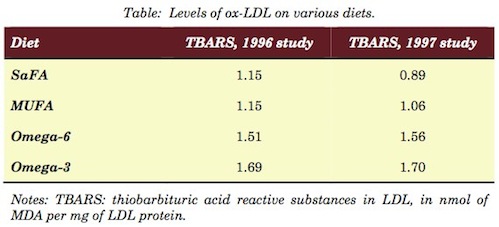
Notice the clear increase in TBARS (a measure of oxidative damage of the LDL particle) with omega-3 fat. It’s important to note that this was only a 5-week trial. If it had gone on for longer than that, it’s likely the oxidative damage caused by omega-3 fats would have been even worse. This isn’t surprising if you understand the chemical composition of fats. Polyunsaturated fats (PUFA) are highly vulnerable to oxidative damage because they’re the only fatty acids that have two or more double bonds, and it’s the carbon that lies between the double bonds that is vulnerable to oxidation (as shown in the figure below):
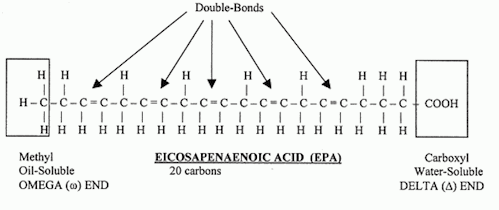
Another thing worth noting, if you haven’t already, is that intake of saturated and monounsaturated fats does not increase oxidative damage by a significant amount. This is illustrated in both the table and the diagram above: saturated fats have no double bonds, which means they are well protected against oxidation. MUFA is slightly more vulnerable, since it does have one double bond, but not nearly as much as PUFA which has several double-bonds.
A randomized, double blind, placebo-controlled trial likewise showed that 6 grams per day of fish oil increased lipid peroxides and MDA in healthy men, regardless of whether they were supplemented with 900 IU of vitamin E. And consumption of fresh, non-oxidized DHA and EPA has been shown to increase markers of oxidative stress in rats.
Like what you’re reading? Get my free newsletter, recipes, eBooks, product recommendations, and more!
Fish oil not as beneficial as commonly believed
To be fair, at least one review suggests that fish oil supplementation is beneficial in the short and even intermediate term. A recent meta-analysis of 11 trials lasting more than one year found that fish oil reduced the relative risk of cardiovascular death by 13 percent and the relative risk of death from any cause by 8 percent.
But the effect seen in this review was mostly due to the GISSI and DART-1 trials. They found that fish oil may prevent arrhythmia in patients with chronic heart failure and patients who have recently survived a heart attack.
However, there is no evidence that people other than those with arrhythmia and chronic heart failure benefit from taking fish oil or that doses higher than one gram of omega-3 fatty acids per day provide any benefit over smaller doses. And then there’s the rather disturbing result of the DART-2 trial, the only fish oil study lasting more than four years, showing an increase in heart disease and sudden death.
It’s logical to assume the effects of oxidative damage would take a while to manifest, and would increase as time goes on. That’s likely the reason we see some benefit in short- and intermediate-term studies (as n-3 displace n-6 in the tissues), but a declining and even opposite effect in the longer-term DART-2 trial (as increased total PUFA intake causes more oxidative damage).
The danger of reductionist thinking in nutritional research
The current fish oil craze highlights the danger of isolated nutrient studies, which unfortunately is the focus of nutritional research today. Kuipers et al. eloquently described the risks of this approach in a recent paper:
The fish oil fatty acids EPA and DHA (and their derivatives), vitamin D (1,25-dihydroxyvitamin D) and vitamin A (retinoic acid) are examples of nutrients that act in concert, while each of these has multiple actions(7,8).
Consequently, the criteria for establishing optimum nutrient intakes via randomised controlled trials (RCT) with single nutrients at a given dose and with a single end point have serious limitations. They are usually based upon poorly researched dose–response relationships, and typically ignore many possible nutrient interactions and metabolic interrelationships.
For instance, the adequate intake of linoleic acid (LA) to prevent LA deficiency depends on the concurrent intakes of α-linolenic acid (ALA), γ-LA and arachidonic acid (AA). Consequently, the nutritional balance on which our genome evolved is virtually impossible to determine using the reigning paradigm of ‘evidence-based medicine’ with RCT.
Interest in fish oil supplementation started with observations that the Inuit had almost no heart disease. It was assumed their high intake of marine oils produced this benefit. While this may be true, at least in part, what was overlooked is that the Inuit don’t consume marine oils in isolation. They eat them as part of a whole-food diet that also includes other nutrients which may help prevent the oxidative damage that otherwise occurs with such a high intake of fragile, n-3 PUFA.
It’s also important to note that there are many other traditional peoples, such as the Masai, the Tokelau, and the Kitavans, that are virtually free of heart disease but do not consume high amounts of marine oils. What these diets all share in common is not a large intake of omega-3 fats, but instead a complete absence of modern, refined foods.
Eat fish, not fish oil – cod liver oil excepted
That is why the best approach is to dramatically reduce intake of omega-6 fat, found in industrial seed oils and processed and refined foods, and then eat a nutrient-dense, whole-foods based diet that includes fatty fish, shellfish and organ meats. This mimics our ancestral diet and is the safest and most sane approach to meeting our omega-3 needs – which as Chris Masterjohn points out, are much lower than commonly assumed.
Some may ask why I continue to recommend fermented cod liver oil (FCLO), in light of everything I’ve shared in this article. There are a few reasons. First, I view FCLO as primarily a source of fat-soluble vitamins (A, D, K2 and E) – not EPA and DHA. Second, in the context of a nutrient-dense diet that excludes industrial seed oils and refined sugar, and is adequate in vitamin B6, biotin, calcium, magnesium and arachidonic acid, the risk of oxidative damage that may occur with 1g/d of cod liver oils is outweighed by the benefits of the fat-soluble vitamins.
So I still recommend eating fatty fish a couple times per week, and taking cod liver oil daily, presuming your diet is as I described above. What I don’t endorse is taking several grams per day of fish oil, especially for an extended period of time. Unfortunately this advice is becoming more and more common in the nutrition world.
More is not always better, despite our tendency to believe it is.
Note: As always, I’m open to dissenting views, but I’m not convinced by short-term studies on the efficacy of fish oil. As I’ve explained in this article, it’s the long-term effects that we’re primarily concerned with. I’d be interested in seeing any studies longer than 2 years showing that 1) fish oil benefits extend beyond reducing arrhythmia in patients with chronic heart failure and patients who have recently survived a heart attack, 2) doses higher than 1g/d produce a larger benefit than doses of 1g/d, and (most importantly) 3) doses of >1g/d or higher do not increase the risk of heart disease or death.

Better supplementation. Fewer supplements.
Close the nutrient gap to feel and perform your best.
A daily stack of supplements designed to meet your most critical needs.

The 2004 Cochrane link in the article is no longer working. It moved to here:
https://summaries.cochrane.org/CD003177/
The other takeaway from all of this is that real objective for us should be to eliminate nearly all polyunsaturated fats from the diet. What little we do get should be in a better balance of Omega-3 to Omega-6. But I get the feeling reading some of your sources that our actual biological need for Omega-3 and Omega-6 are really very trivial, and we should not try to supplement either source through oils.
The main problem I see here is that we don’t know if the bad long-term results of taking commercial omega-3 fish oil products stems from the fact it is omega-3 or from the fact that the oil was rancid at the time it was ingested. Presumably it is the rancidity of these commercial products that is causing the most harm?
What about this study that tracked patients over several years? There were numerous positive results related to the consumption of fish oil?
Dietary supplementation with n-3 polyunsaturated fatty acids and vitamin E after myocardial infarction: results of the GISSI-Prevenzione trial
https://www.thelancet.com/journals/lancet/article/PIIS0140-6736(99)07072-5/fulltext
Thanks Chris for the good article.
If you do not mind my question please..
You said that Whole fish is a good source of omega-3 instead of taking fish oil capsule because Omega3 is easily to be oxidize so how to cook the Whole-fish to not produce the oxidation in its oil?
Thx
Hi,
I am considering taking FCLO – but I am confused by this statement:
Some may ask why I continue to recommend fermented cod liver oil (FCLO), in light of everything I’ve shared in this article. There are a few reasons. First, I view FCLO as primarily a source of fat-soluble vitamins (A, D, K2 and E) – not EPA and DHA. Second, in the context of a nutrient-dense diet that excludes industrial seed oils and refined sugar, and is adequate in vitamin B6, biotin, calcium, magnesium and arachidonic acid, the risk of oxidative damage that may occur with 1g/d of cod liver oils is outweighed by the benefits of the fat-soluble vitamins. So I still recommend eating fatty fish a couple times per week, and taking cod liver oil daily, presuming your diet is as I described above.
My question is this – if my diet isn’t nutrient-dense are you saying taking FCLO is not recommended? I am working on having a nutrient dense diet, but it’s been difficult with work and travel. I was considering taking Green Pastures FCLO. Please advise. Thank you!
I recall coming across a forum months back in which people were discussing how their inflammation and pain increased when they began fish oil. This was about when I started taking it at a high dosage as prescribed by my naturopath. I have chronic fatigue, so I am no stranger to pain and experience it regularly, but particularly in the past few months. My paleo diet has helped me in so many ways, but these aches don’t want to give. Anyways, I noticed this week that my pain was subsiding. I was about to open my new fish oil and paused in thought. Oh my gosh. I have been off of it for a week and I have been feeling stronger and less tender. Could that forum be correct ? I immediately checked your thoughts and well apparently you don’t recommend it. I will stop the supplement. Have any thoughts on this, have you seen this reaction to fish oil or read about it ?
I can report one thing that fish oil definitely does do (at least for me) – improves skin appearance, texture and reduces oiliness, and as a result improves the condition I suffer with – Sebhorreic dermatitis. Interestingly, I have noticed that taking too much (1-2 capsules daily is optimal for me) makes my skin worse and makes me feel fatigued.
What do you feel about krill oil? Dr Mercola advocates it over fish oil because it has antioxidants and its in phospholipid form . . .
1) Mercola is a nut. I’d look to Andrew Weil when it comes to alternative medicaine.
2) Fish Oil taken with mixed tocopherols is just as good as Krill Oil. The prblem iwth Krill is that it’s just not environmentally sustainable at the moment.
Let me add that Weil isn’t right about everything. His outdated view of saturated fat being a killer is a glaring example of him being dead wrong. That said, his writings on vitamins and supplements are spot-on from what I’ve seen.
I’ve been taking 6 grams of fish oil (3,600 mg of Omega 3s) for the past 8 months and now I have high glucose. Could there be a correlation?
No. It’s definitely something else.
I find it odd that I’ve suddenly become diabetic. I don’t have the risk factors or the symptoms (weight loss, thirst, frequent urination). I’m physically fit. Just have high glucose over the past few months around the time I started megadosing.
You should look into this if you haven’t figured it out already. I recall reading something about this on Chris Masterjohn’s site. You could be on to something. That’s a lot of omega-3.
There are studies that correlate insulin intolerance with intakes of saturated fats. I doubt small quantities of fish oil could do it, but I imagine there is biological diversity and some people hyper respond with insulin resistance to particular foods. Have you thought about buying a glucometer and starting to check before-meal and 1 and 2 hours after meals? That lets you start to associate glucose surges with particular foods.
Yes, I have a glucose meter, that’s how I know I have high glucose. But I think my high glucose is related to cortisol.
hi! I was just reading thru some very interesting articles by Prof. Brian peskin, stating that fish oils actually worsens diabetes; and again, that diabetes is caused by the lack of parent essential oils, which make all the necessary PG1, PG11, EPA’s,-3,6,9.; DHA; AA etc. without supplementing on adulterated, highly oxidizing ‘derivatives’, no matter their processing…! I’ve been scouring thru his findings, and feel fairly secure he could be onto something!-so I’ve just gone out and bought organic flax, black-seed [nigella sativa], sunflower, walnuts, sunflower- seeds [pepitas]; raw almonds, organic, cold-pressed coconut oil.[just by squeezing a capsule of astaxanthin into Extra virgin olive oil, will keep it from oxidizing]-heating oils, cause the loss of oxygen transference capacity, which again, is another reason why fish-oil supplements are unrecommended. There is much more to his research findings, and since being on a high dosage of fish oils from a ‘trusted’ brand that has a higher % of DHA to EPA, it appears my health has declined, and my arteries are clogging up, i’ve gained weight, despite care- so I also bought Nattokinase and Serrapeptase, to clean my arteries, and re started a regime for this ailment- I wish you every success- may I also recommend Clayton nolte’s Water re-structurer- i’m about to purchase the portable and home units ! I was speaking with some naturopaths today, who all recommend eating grass-fed meats, and organic chicken, with their respective fats, to cook with Ghee and coconut-oil but to really cut down on carbs and sugars, and hype up the veges, esp. leafy greens[collards, kale, swiss chards, gotu kola, spinaches-such a variety.. brassicas[broccoli, brussels, cauliflower, cabbage..] and do look into trying a standardized Curcumin[turmeric] supplement biocurcumin has 4, 300 or so mg. of curcumin, which is potently good for so many things..i could go on…x
The safety of fish oil really just comes down to the quality of the product. Get high quality fish oil.
How can we possibly know if the oil is high quality, when:
1) Manufacturers are often bleaching and deodorizing rancid oils
2) A given manufacturer can source oil from different places, thus changing key parameters
3) There is no published guideline for determining rancidity, and metrics around this concept are not required to be on the label.
etc…..
I am still trying to decide whether or not to continue with my liquid fish oil supplement after reading all the pro’s and con’s. I have a hard time putting anything into my body that may have poisons in it ie, pcb’s, mercury, etc, however I have been taking one particular fish oil for 2 years daily now at 1205mg per day with a meal and notice that my arthritis pain is reduced dramatically, but only with this one particular brand. Other brands claim to have a bit more mg but do not work for me. I had been on NSAIDS for years and have been off of them since taking this fish oil. I have tried to go off of the fish oil only to have my symptoms return within 2 days. Do not think I could possibly eat the amount of fish to get the same effect! Hmmmmmm.
Hi Chris,
I’ve recently being doing some research on Omega-3’s and fish oil supplementing for speech delay in toddlers as well as benefits for children with autism. Some studies and many parents claim to see a dramatic improvement in their children when supplementing with fish oils or Omega-3’s. Any thoughts?
Hi Chris,
I believe I have EFA deficiency. I won’t go into full details but the main reason is because I get really bad dry eyes on a daily basis. Now I noticed this completely gone when I started eating 2 tins (90 grams) of tuna in olive oil each day.
So I was wanting to see what your thoughts are on:
– EFA deficiency and best way to beat this
– eating too much tuna or particularly tuna in olive oil
– hempseed oil
Much appreciated.
p.s. love you articles and site!
“The risk of heart attacks is more dependent on the number of LDL particles than on the amount of cholesterol they contain. Fish oil can slightly increase the amount of cholesterol in LDL, but it also significantly lowers the number of LDL particles. The end result is beneficial. There’s no reason to worry that taking fish oil will sabotage your cholesterol control and every reason to believe that it will benefit your heart and general health.” – Integrative cardiologist Stephen DeVries, M.D. of Northwestern University’s Center for Integrative Medicine and Division of Cardiology in Chicago
Hi Chris and viewers,
I was taking A Lot of fish oil caps & liquid, nordic naturals brand to combat a certain neuralgia, after the neuralgia was subsiding, i notice the joints around my knees started to feel weak. After quitting fish oil for a few days, 4 days at least, i’ve been having difficulty in waking, while the knees start to have some burning pain. Was wondering if you can recommend foods or supplements, kale spinach, broccoli carrots cucumber i know of…I Just dont need sugar and anything omega-related like fish…I have slight burning pain when sitting as well…Everything else in my body is fine, im a young adult.
I dont expect an answer quickly, but i constantly check my email & will view the site. Thanks for reading….
hello 🙂 there is a unlimited range of possibilities to what you are describing. it sounds a bit auto immune related (autoimmune complexes lodge all over the body a trigger localised inflammation) go back to basics with diet , not too much intervention with supplements and allow the body to communicate. The body often goes back in time when healing so it might be an old injury coming good
long term 15 year study correlates n3 acid intake with lower body fat https://www.ncbi.nlm.nih.gov/m/pubmed/23887855/?i=1&from=fish%20oil%20long%20term. Good info fyi. As always, without excersize you are done. Eat green vegetables too. Drink water. I take 4 G of EPA/DHA a day and as a physically fit 24 year old, I feel it helps with my recovery time, and my memory and my stress level. I also take it with other oils to help absorb (usually olive) and dark leafy greens, so they can use the oils to help vitamin absorbtion.
Hi Chris, I really appreciate your work. I have a question that so far nobody in the nutrition world has been able to answer for me. I agree with you that omega-3 oils are highly unstable and eating oily fish is a much better idea. But what happens when we cook fish? Aren’t the polyunsaturated fatty acids also being damaged and creating free radicals? It would seem that only raw preparations such as sashimi or ceviche are beneficial. Am I missing something? Thanks!
Hmmm…wonder how cold smoking would affect salmon.
Hello – i would like you to answer what you think – and if anyone else wants to answer it can be nice
i started giving my dog oil fish reading about it in this link :
https://www.examiner.com/article/what-you-don-t-know-about-fish-oil-could-hurt-your-pet
they say my dog needs 1000 epa a day and that epa is better – so i looked and found an expensive fish oil that say he has this ratio – 400epa : 200dha and i thought this was good do you think its actually bad that it has this amount of epa ? the company making it says its better the more epa there is i have a cheaper fish oil and it has 200:200 ratio should i switch to it ? is 1000 epa to much maybe i should just give 1 pill a day of 400 ?
would be intersted to hear what you think
Just wanted to say I have primary sjogren’s syndrome (autoimmune disease) and when I take fish oil I get exponentially worse…all my symptoms skyrocket. Then I stop and it gets BETTER. I have read over and over how fish oil is supposed to help with autoimmunity but it makes me worse. I thought I was a freak of nature….not I am not so sure. Taking curcumin…another natural anti-inflammatory…makes the symptoms of my autoimmune disease way, way worse as well. I want to try sea buckthorn oil…supposed to be great for sjogren’s….but I am too scared at this point. Have you ever heard of these things making autoimmune disease worse? Thanks for this info you posted. I think there is definitely something to this.
not surprised that fish oil would worsen auto immune conditions , the right oils improve the integrity of all cells including the ones that attack organs in auto immune conditions.