

Update: I now recommend Extra Virgin Cod Liver Oil from Rosita as my preferred cod liver oil product. For more information, read this article. You can purchase EVCLO here.
Article summary
- The benefits of fish oil supplementation have been grossly overstated
- Most of the studies showing fish oil benefits are short-term, lasting less than one year
- The only fish oil study lasting more than four years showed an increase in heart disease and sudden death
- Fish oil is highly unstable and vulnerable to oxidative damage
- There’s no evidence that healthy people benefit from fish oil supplementation
- Taking several grams of fish oil per day may be hazardous to your health
A new study was recently published showing that 3g/d of fish oil in patients with metabolic syndrome increased LDL levels and insulin resistance.
Unfortunately, I don’t read Portuguese so I can’t review the full-text. But this study isn’t alone in highlighting the potential risks of high-dose fish oil supplementation. Chris Masterjohn’s latest article on essential fatty acids, Precious yet Perilous, makes a compelling argument that fish oil supplementation – especially over the long-term – is not only not beneficial, but may be harmful.
This may come as a surprise to you, with all of the current media hoopla about the benefits of fish oil supplementation. Yet the vast majority of the studies done that have shown a benefit have been short-term, lasting less than one year. The only trial lasting more than four years, the DART 2 trial, showed that fish oil capsules actually increase the risk of heart disease and sudden death.
A 2004 Cochrane meta-analysis of trials lasting longer than six months suggests that the cardiovascular benefits of fish oil have been dramatically over-stated. They analyzed 79 trials overall, and pooled data from 48 trials that met their criteria. The only effect that could be distinguished from chance was a reduced risk of heart failure. Fish oil provided no reduction in total or cardiovascular mortality.
Too much fish oil can wreak havoc in your body
A study by Mata et al demonstrated that oxidative damage increases as intake of omega-3 fat increases. The results of this study were summarized in the Perfect Health Diet, by Paul and Shou-Ching Jaminet:
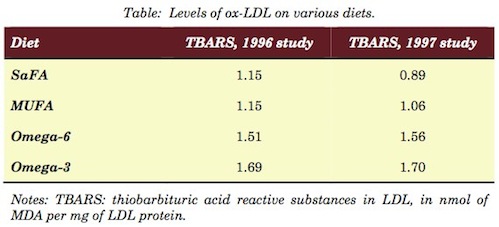
Notice the clear increase in TBARS (a measure of oxidative damage of the LDL particle) with omega-3 fat. It’s important to note that this was only a 5-week trial. If it had gone on for longer than that, it’s likely the oxidative damage caused by omega-3 fats would have been even worse. This isn’t surprising if you understand the chemical composition of fats. Polyunsaturated fats (PUFA) are highly vulnerable to oxidative damage because they’re the only fatty acids that have two or more double bonds, and it’s the carbon that lies between the double bonds that is vulnerable to oxidation (as shown in the figure below):
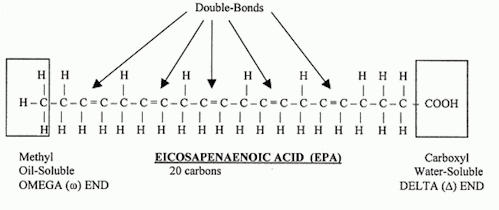
Another thing worth noting, if you haven’t already, is that intake of saturated and monounsaturated fats does not increase oxidative damage by a significant amount. This is illustrated in both the table and the diagram above: saturated fats have no double bonds, which means they are well protected against oxidation. MUFA is slightly more vulnerable, since it does have one double bond, but not nearly as much as PUFA which has several double-bonds.
A randomized, double blind, placebo-controlled trial likewise showed that 6 grams per day of fish oil increased lipid peroxides and MDA in healthy men, regardless of whether they were supplemented with 900 IU of vitamin E. And consumption of fresh, non-oxidized DHA and EPA has been shown to increase markers of oxidative stress in rats.
Like what you’re reading? Get my free newsletter, recipes, eBooks, product recommendations, and more!
Fish oil not as beneficial as commonly believed
To be fair, at least one review suggests that fish oil supplementation is beneficial in the short and even intermediate term. A recent meta-analysis of 11 trials lasting more than one year found that fish oil reduced the relative risk of cardiovascular death by 13 percent and the relative risk of death from any cause by 8 percent.
But the effect seen in this review was mostly due to the GISSI and DART-1 trials. They found that fish oil may prevent arrhythmia in patients with chronic heart failure and patients who have recently survived a heart attack.
However, there is no evidence that people other than those with arrhythmia and chronic heart failure benefit from taking fish oil or that doses higher than one gram of omega-3 fatty acids per day provide any benefit over smaller doses. And then there’s the rather disturbing result of the DART-2 trial, the only fish oil study lasting more than four years, showing an increase in heart disease and sudden death.
It’s logical to assume the effects of oxidative damage would take a while to manifest, and would increase as time goes on. That’s likely the reason we see some benefit in short- and intermediate-term studies (as n-3 displace n-6 in the tissues), but a declining and even opposite effect in the longer-term DART-2 trial (as increased total PUFA intake causes more oxidative damage).
The danger of reductionist thinking in nutritional research
The current fish oil craze highlights the danger of isolated nutrient studies, which unfortunately is the focus of nutritional research today. Kuipers et al. eloquently described the risks of this approach in a recent paper:
The fish oil fatty acids EPA and DHA (and their derivatives), vitamin D (1,25-dihydroxyvitamin D) and vitamin A (retinoic acid) are examples of nutrients that act in concert, while each of these has multiple actions(7,8).
Consequently, the criteria for establishing optimum nutrient intakes via randomised controlled trials (RCT) with single nutrients at a given dose and with a single end point have serious limitations. They are usually based upon poorly researched dose–response relationships, and typically ignore many possible nutrient interactions and metabolic interrelationships.
For instance, the adequate intake of linoleic acid (LA) to prevent LA deficiency depends on the concurrent intakes of α-linolenic acid (ALA), γ-LA and arachidonic acid (AA). Consequently, the nutritional balance on which our genome evolved is virtually impossible to determine using the reigning paradigm of ‘evidence-based medicine’ with RCT.
Interest in fish oil supplementation started with observations that the Inuit had almost no heart disease. It was assumed their high intake of marine oils produced this benefit. While this may be true, at least in part, what was overlooked is that the Inuit don’t consume marine oils in isolation. They eat them as part of a whole-food diet that also includes other nutrients which may help prevent the oxidative damage that otherwise occurs with such a high intake of fragile, n-3 PUFA.
It’s also important to note that there are many other traditional peoples, such as the Masai, the Tokelau, and the Kitavans, that are virtually free of heart disease but do not consume high amounts of marine oils. What these diets all share in common is not a large intake of omega-3 fats, but instead a complete absence of modern, refined foods.
Eat fish, not fish oil – cod liver oil excepted
That is why the best approach is to dramatically reduce intake of omega-6 fat, found in industrial seed oils and processed and refined foods, and then eat a nutrient-dense, whole-foods based diet that includes fatty fish, shellfish and organ meats. This mimics our ancestral diet and is the safest and most sane approach to meeting our omega-3 needs – which as Chris Masterjohn points out, are much lower than commonly assumed.
Some may ask why I continue to recommend fermented cod liver oil (FCLO), in light of everything I’ve shared in this article. There are a few reasons. First, I view FCLO as primarily a source of fat-soluble vitamins (A, D, K2 and E) – not EPA and DHA. Second, in the context of a nutrient-dense diet that excludes industrial seed oils and refined sugar, and is adequate in vitamin B6, biotin, calcium, magnesium and arachidonic acid, the risk of oxidative damage that may occur with 1g/d of cod liver oils is outweighed by the benefits of the fat-soluble vitamins.
So I still recommend eating fatty fish a couple times per week, and taking cod liver oil daily, presuming your diet is as I described above. What I don’t endorse is taking several grams per day of fish oil, especially for an extended period of time. Unfortunately this advice is becoming more and more common in the nutrition world.
More is not always better, despite our tendency to believe it is.
Note: As always, I’m open to dissenting views, but I’m not convinced by short-term studies on the efficacy of fish oil. As I’ve explained in this article, it’s the long-term effects that we’re primarily concerned with. I’d be interested in seeing any studies longer than 2 years showing that 1) fish oil benefits extend beyond reducing arrhythmia in patients with chronic heart failure and patients who have recently survived a heart attack, 2) doses higher than 1g/d produce a larger benefit than doses of 1g/d, and (most importantly) 3) doses of >1g/d or higher do not increase the risk of heart disease or death.

Better supplementation. Fewer supplements.
Close the nutrient gap to feel and perform your best.
A daily stack of supplements designed to meet your most critical needs.

my cod liver oil dosage recommendation is up to 5ml a day for adult – how many grams is that?
Kevin, being labeled as a quack on a quackwatch.org does not mean you are really quack and your promoted healing/teaching is wrong. Gary Null and many others are on quackwatch.org but does not mean they dont know anything about health.
Just eat the whole fish…
http://www.ncbi.nlm.nih.gov/pmc/articles/PMC3914521/
cancel that last post… turns out the author is a quack
http://www.quackwatch.com/11Ind/Peskin/peskin.html
months ago I had a blood teat and my cholesterol was 240. hdl-56, trigl.-193, ldl-140. My Doctor prescribed fish oil. After 3 months my choleserol was 290. hdl-67, trigl.-127, ldl-198. My doctor then prescribed a stain. I refused to take it and instead took plant sterols daily before meals and 1 teaspoon of fiber. After 3 months, my cholesterol was 289. hdl-59, trigl. 195(back up) and ldl-191. My Doctor insists that I take the statin. Instead, I have opted to run 30 minutes daily, limit my choleserol intake, and cut out all refined sugar. Do you have any other suggestions, should I take low levels of fish oil?? Thank you!
I would heavily caution against the statin which you are rightfully questioning since they have severe and sometimes irreversible side effects of muscle atrophy and other things. Your cholesterol levels are not bad, and the high hdl says you are body is working fine with them. The best way to reduce triglycerides imo is to reduce carb / sugar consumption, starting with all refined flour. If you did that for a few months the triglyceride would probably drop considerably.
Dr. Perlmutter in Grain Brain, which I strongly suggest reading, cites Dutch studies actually showing that cholesterol levels higher than yours are associated with the best overall levels of health and well being; your levels are not detrimental, and a statin would imo not help the triglyceride level but only potentially lower the cholesterol to unhealthy levels; your body needs it for all sorts of reasons. Continue to question the doc and maybe look for another one.
Try Niacin, and make sure it’s NIACIN, not niacinamide (flush free niacin). Cut out the fish oil and each whole fish instead. Keep up the plant sterols and exercise, that sounds perfect. Also, as you’re obviously aware, fiber can help lower cholesterol (psyllium husk is good). Fructose seems to be a contributor for higher TG’s, so as well as cutting the sugar, don’t get stuck into fruit juices (e.g. ditch the OJ in the morning). Good luck and good health to you.
Folks,
Why are you continuing to ask questions here, despite the fact no one ever answers?
Chris Kresser ignores questions and perhaps totally forgot about his article already.
does all this apply to krill oil?
I’ve recently started taking fish oil and have been feeling good until last week Friday when I felt my heart rate change. Out of nowhere I felt like it was fluttering or skipping a beat. So last night I looked up what was wrong with me and I was having palpitations. I had a feeling it was the fish oil. So I stopped taking it and can feel my heart rate going back to normal. But I was nervous at first. Then I found this article. And im glad I did. Hopefully i wont feel that flutter again. Not cool. It was like my heart was struggling to pump blood through my vessels.
It sucks when all you’re trying to do is be healthy and we as people get so mimisled on things.
It’s critical to verify which fish oil brands the studies used. The bulk of fish oil supplements use soy bean oil as the base oil, rendering them almost totally useless. Soy bean oil is toxic in small doses, let alone taken daily in such a large amount as several caps a day. Long term, the inflammatory effects of this toxic oil which, just to add to the inflammatory effects, is also very high in omega 6, would no doubt cause disease.
is this true of krill oil? just curious….
i bought the FCLO and my kids took it once and i am having a heck of time getting this to be a daily routine. i don’t even want it. made a pot of elderberry syrup…going to try it mixed in that tomorrow. i was actually going to start buying the barleans omega swirl in a fancy flavor and squirt it in that but came on here first to see what you had to say. soooo, that idea is out the door:(
thanks!!
Hi Chris
When ever I take high strength fish oil or take recommended dosage on bottle, after a few days I have blurred vision,feel depressed and as if almost drugged.
I am curious if anyone one knows what causes this. I am OK if I just eat fresh salmond or tuna.
Thanks.
Might be some liver congestion. Try lecithin with vitamine c.
I heard someone say canned Alaskan salmon. Is there no concern of BPA from having the canned fish?
Good read. If use of fish oil supplements or high doses are not good for you in the long term, does that apply also to krill oil where a much lower dose is needed?
Chris this article is right on the money. My experience confirmed your conclusions a year or so ago after I upped my intake of fish oil to try and counter night-time arrhythmia and noticed a disturbing affect on my heart rhythm. I consulted my cardiologist who confirmed that fish oil wasn’t necessarily beneficial. Then I read about the study indicating it can cause prostate cancer. Although I still have some reservations about that study, I cut it out supplementing with fish oil entirely at that point. I like your recommendation of the fermented cod liver oil but still think eating salmon and/or sardines a few times a week is best unless you have a particular health issue you are trying to overcome with supplementation.
Fish Oil Supplement Research Remains Murky
Polyunsaturated omega-3 fatty acids are important parts of a healthy diet, but supplement studies have numerous sampling problems
Melinda Wenner Moyer
25 September 2012
http://www.nature.com/news/fish-oil-supplement-research-remains-murky-1.11484
I just found out that my tryglicerides have gone to about 220. My dr suggested exercise,diet and taking 3 fish oil supplements a day. What do you think?
Chris-Have you read the study that fish oil decreases the resistance to influenza? I wonder if that is true also for Cod Liver Oil.
http://www.ncbi.nlm.nih.gov/pmc/articles/PMC2709305/
Fish Oil-Fed Mice Have Impaired Resistance to Influenza Infection1
I’m a 35-year old male and a budding long distance runner.
I started taking fish oil weeks ago and this is the ingredients list:
(per 1 soft gel)
Fish Oil: 995.0 mg
Providing EPA: 180.0 mg
Providing DHA: 120.0 mg
Vitamin E: 0.50 mg
Other ingredients: Gelatin, Glycerine, Purified water.
It recommends 2-3 soft gel capsules per day.
My question is – is it safe? Will it improve my long distance running in any way? – or will I be ill in the long run?
Thanks!
Watch this video sieries, and do some of the exercise. You dont have to start running barefoot straightawy.
Lydia,
Your knee pain may have nothing to do with a lack of fish oils. It could be purely due to incorrect running technique, wrong shoes, or overpronation. Perhaps your are running with shoes that have big, thick heal, which puts extra stress on your knees. However, if you move to minimalist shoes do it slowly as it could lead to injuries.
What this video http://www.theguardian.com/lifeandstyle/the-running-blog/video/2013/apr/17/how-run-barefoot-video
Also watch some other of Ben Le Vesconte’s videos on YT.
Knee probs can be due to tight IT band, so do stretches, there are a few good videos on YT how to do IT band stretch.
If you have money get your running analysed by profesionals and see if there is anything you need to correct.
^^ Helpful, thanks.
Chris, I am a vegetarian and I don’t eat meat or fish.
I’m a 50-year-old female. I lift weights and run and I have recently been having problems with me knees. I take about 1200 mg of Omega 3s a day in 2 capsules. Do you think I should take extra capsules because I’m a vegetarian?
Please don’t tell me to eat fish 3 x a week because I won’t do it!