

This is the second article in a series on heartburn and GERD. If you haven’t read the first one, I’d suggest doing that first.
The idea that heartburn is caused by too much stomach acid is still popular in the media and the public. But as Daniel pointed out in the comments section of the last post, anyone familiar with the scientific literature could tell you that heartburn and GERD are not considered to be diseases of excess stomach acid.
Instead, the prevailing scientific theory is that GERD is caused by a dysfunction of the muscular valve (sphincter) that separates the lower end of the esophagus and the stomach. This is known as the lower esophageal valve, or LES. The LES normally opens wide to permit swallowed food and liquids to pass easily into the stomach. Except for belching, this is the only time the LES should open.
Here’s the key point. It doesn’t matter how much acid there is in the stomach. Even a small amount can cause serious damage. Unlike the stomach, the lining of the esophagus has no protection against acid.
Free eBook
Learn More about Heartburn and GERD
Download this free eBook to discover the little-known causes of heartburn and GERD, and find out how to get rid of the problem forever.
"*" indicates required fields
I hate spam, too. Your email is safe with me. By signing up, you agree to our privacy policy.
We’ve Been Asking the Wrong Question
In an editorial published in the journal Gastroenterology, the author remarked: (1)
Treating gastroesophageal reflux disease with profound acid inhibition will never be ideal because acid secretion is not the primary underlying defect.
I couldn’t agree more. For decades the medical establishment has been directing its attention at how to reduce stomach acid secretion in people suffering from heartburn and GERD, even though it’s well-known that these conditions are not caused by excess stomach acid. Instead, the question researchers should have been asking is, “what is causing the LES to malfunction?” Since it is universally agreed upon that this is the underlying mechanism producing the symptoms of GERD, wouldn’t it make sense to focus our efforts here? That’s exactly what we’re going to do in this article.
GERD Is Caused by Increased Intra-Abdominal Pressure
It is well accepted in the literature that GERD is caused by an increase in intra-abdominal pressure (IAP).
For example, several studies have indicated an association between obesity and GERD, and one paper in Gastroenterology concluded that increased intra-abdominal pressure was the causative mechanism. (2, 3) But while I agree that all of the currently accepted factors play a role, I do not think they are the primary causes of the increased IAP seen in GERD.
The Two Primary Causes of Increased Intra-Abdominal Pressure
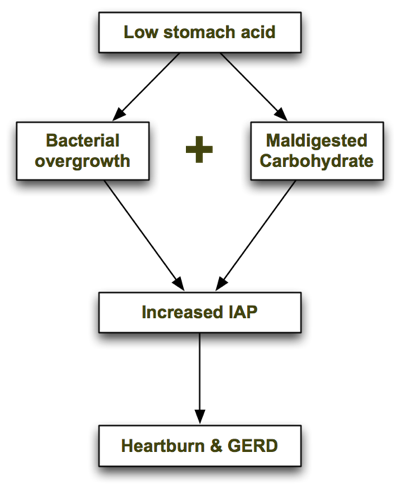
In his excellent book, Heartburn Cured, microbiologist Dr. Norm Robillard argues that carbohydrate malabsorption leads to bacterial overgrowth, resulting in IAP which drives reflux. Dr. Robillard makes a strong case that carbohydrate malabsorption plays a significant role in IAP, and I agree. But as I researched this issue I couldn’t help asking: what might be causing the carbohydrate malabsorption in the first place, and are there any other causes of bacterial overgrowth that may precede carbohydrate malabsorption? I believe the one answer to both of those questions is low stomach acid. Low stomach acid can contribute to both bacterial overgrowth (independently of carbohydrate intake) and carbohydrate malabsorption, as I describe below. In a nutshell, the process looks like this: Let’s look at each step in turn.
1. Low Stomach Acid Causes Bacterial Overgrowth
As I explain in the next article, one of the chief roles of stomach acid is to inhibit bacterial overgrowth. At a pH of 3 or less (the normal pH of the stomach), most bacteria can’t survive for more than 15 minutes. But when stomach acid is insufficient and the pH of the stomach rises above 5, bacteria begin to thrive. The gastrin knockout mouse, which is incapable of producing stomach acid, suffers from bacterial overgrowth—as well as inflammation, damage and precancerous polyps in its intestines. (4) It is also well documented that acid-suppressing drugs promote bacterial overgrowth. Long-term use of Prilosec, one of the most potent acid suppressing drugs, reduces the secretion of hydrochloric acid (HCL) in the stomach to near zero. In one trial, 30 people with GERD were treated with a high dose of Prilosec (40g/day) for at least 3 months. (5) Eleven of the 30 Prilosec-treated people had developed significant bacterial overgrowth, compared with only one of the 10 people in the control group.
2. Low Stomach Acid Causes Maldigestion of Carbohydrates
Stomach acid (HCL) supports the digestion and absorption of carbohydrates by stimulating the release of pancreatic enzymes into the small intestine. If the pH of the stomach is too high (due to insufficient stomach acid), the pancreatic enzymes will not be secreted and the carbohydrates will not be broken down properly.
Like what you’re reading? Get my free newsletter, recipes, eBooks, product recommendations, and more!
Bacterial Overgrowth + Maldigested Carbohydrates = GAS!
In Hearburn Cured, Dr. Robillard points out that though microbes are able to metabolize proteins and even fats, their preferred energy source is carbohydrate. The fermentation of carbohydrates that haven’t been digested properly produces gas. The resulting gas increases intra-abdominal pressure, which is the driving force behind acid reflux and GERD. From Dr. Robillard’s book:
According to Suarez and Levitt (17), 30 g of carbohydrate that escapes absorption in a day could produce more than 10,000 mL (ten liters) of hydrogen gas. That is a huge amount of gas!
When stomach acid is sufficient and carbohydrates are consumed in moderation, they are properly broken down into glucose and rapidly absorbed in the small intestine before they can be fermented by microbes. However, if stomach acid is insufficient and/or carbohydrates are consumed in excess, some of the carbs will escape absorption and become available for intestinal microbes to ferment.
Other Supporting Evidence
Dr. Robillard also argues that if gas produced by microbial fermentation of carbohydrates causes acid reflux, we might expect that reflux could be treated by either:
- Reducing bacterial overgrowth, or
- Reducing carbohydrate intake.
He points to two studies which demonstrate this. In a study by Pehl, administration of erythromycin (an antibiotic) significantly decreased esophageal reflux. (6)
In another study by Pennathur, erythromycin strengthened the defective lower esophageal sphincter in patients with acid reflux. (7) To my knowledge, there have only been two small trials performed to test the effects of carbohydrate restriction on GERD. Both had positive results. A small case series showed a significant, almost immediate resolution of GERD symptoms in obese individuals initiating a very-low-carb diet. (8) A more recent study found that a very low-carb diet decreased distal esophagus acid exposure and improved the symptoms of GERD. (9) Perhaps most importantly, the magnitude of the improvement was similar to what has been reported with treatment with proton-pump inhibitors (acid suppressing drugs).
Some researchers now believe that Irritable Bowel Syndrome (IBS) is caused by small intestinal bacterial overgrowth (SIBO). (10) A study performed at the GI Motility Center in Los Angeles in 2002 found that 71 percent of GERD patients tested positive for IBS—double the percentage seen in non-GERD patients being examined. (11) The high prevalence of IBS in GERD patients combined with the recognition that bacterial overgrowth causes IBS is yet another line of evidence suggesting that bacterial overgrowth is also a causative factor in GERD.
Final Comments
To summarize, low stomach acid contributes to bacterial overgrowth in the bowel which in turn can lead to carbohydrate malabsorption (due to decreased pancreatic enzyme secretion). Malabsorption of carbohydrates, as Dr. Robillard has pointed out, increases intra-abdominal pressure and causes GERD.
Where Dr. Robillard and I differ is that I believe low stomach acid is the primary problem with GERD, with carbohydrate malabsorption playing a secondary role. I do think that improper digestion of proteins can, in fact, lead to GERD, whereas Dr. Robillard states in his book that putrefaction of proteins is more likely to cause flatulence. This may be so in most cases, but I’ve seen several patients in my practice on very-low-carbohydrate diets who still experience heartburn, which improves upon restoring proper stomach acid secretion (which we covered in another article in this series). In the Part III of the series I discuss the connection between GERD and H. pylori, and further evidence supporting the theory that GERD is caused by bacterial overgrowth. Read on!

Better supplementation. Fewer supplements.
Close the nutrient gap to feel and perform your best.
A daily stack of supplements designed to meet your most critical needs.

Thank you for the article. I have been dealing with increasingly worse GERD, burning, choking and laryngospasms which cause me not to be able to breathe for seconds at a time. I was sick over the summer with food poisoning and never recovered fully until two months later when my doctor put me on Nexium, which stopped the vomiting. I developed the laryngospasms a few months later when I stopped the Nexium. I believe I may have too much stomach acid and a faulty LES sphincter from the vomiting and from longterm stress and anxiety issues. My diet in the past has always been protein/chicken dense. I started distilled aloe vera, Manuka honey, calcium/magnesium citrate powder in Papaya/Apple juice, alkaline foods such as spinach and almond butter, and DGL and powdered digestive plant enzymes. It has helped me to feel a bit better but I still have a burning throat and stomach at times. Aside from a gastroenterologist, I’m wondering if time will help this or if there is something else I could be doing. I was tested negative for hpylori over the summer when my symptoms began. Any ideas for a next step?
Chris – I was looking for information on whether probiotics can actually cause heartburn because I have recently (about 10 days ago) started taking them and I have had heartburn way too often to be a coincidence. Even though I am obese, I have been eating healthy for a few years now. At first I started on a raw diet and I had wonderful bowel movements (prior to that I struggled to be “normal” and went only 2-3x per week) every day. In my life I have never had as much heartburn as I have had in these past 10 days. I am following a Paleo diet right now but sometimes I fall off the beaten track into SNHAA (something not healthy at all!) I don’t believe that the heartburn has been happening only when I fall off because then it would’ve only been a couple of times in the past 10 days… I will now document the measurable heartburn and check it against the food … but I have to say… even when I ate UNhealth ALL the time I never had heartburn when I wake up in the morning – this is hard to deal with!
What type of probiotics are you taking? I’m not sure if I have this completely correct, but I think certain types of probiotics (D-lactate producing ones) can exacerbate SIBO (which many people unknowingly have), and I’m pretty sure SIBO can cause heartburn. So if you’re taking something like acidophilus, you might try switching to a probiotic (like PrescriptAssist) that’s ‘safe’ for people with SIBO, just to see if you get better results?
There’s a bit more info in this podcast: https://chriskresser.com/treating-sibo-cold-thermogenisis-and-when-to-take-probiotics
I already have the scaring in my lower esophagus as I was being tested for celiac disease [but do not have it] scaring was discovered. My doctor may have me swallow a camera to check further down in my small intestines for celiac. When in my esophagus, doctor discovered that I had candida esophagitis half way down and scaring at the base of my esophagus. Presently the only thing that really helps me is eating very little at each setting. If I eat spicy foods or have any alcohol I can feel the burning and discomfort all the way down and stomach bloating. Any suggestions on how to handle? I have a high intolerance to gluten [not eating it now], I’m allergic to yeast [not eating that either] and until I found this out my asthma was out of control. Asthma is calmer unless I cheat even with very small amounts. Thanks, GREAT article and series. John Kelley
Hello Chris,
Can you take the HCL while you are still taking PPIs? Also, how do you time the DGL, probiotics and the HCL? Thanks for the great info! I have Betaine HCL with Pepsin and I-chol at home-prescribed by a naturopath, but was afraid to take them as I am told to stay on the PPI…I have laxity of the LES and advanced GERD. I suffer bloating, belching, right upper quadrant and epigastric pain radiating to the back. My doctors are not able to help me….
Apparently, I have acid that creeps into my mouth that I don’t realize. it is eating the enamel off my teeth. I been prescribed Nexium 40mg. and have been taking it, but I don’t like what I’m reading. Could this be causing my teeth problems?
Re: “To summarize, low stomach acid contributes to bacterial overgrowth in the bowel which in turn can lead to carbohydrate malabsorption.”
Then why do proton pump inhibitors, which only function to further reduce stomache acid, aleviate acid reflux. Your logic is faulty.
Hi, I have been plagued by ibs since I was a kid. And recently had very very bad acid reflux, that warranted a strong dose of nexium and panic attacks.
I would like to share that I now no longer have ibs nor acid reflux.
I have been taking chlorophyll everyday and I have cut down on carbohydrates.
My diet consists of fruit / veg juices daily, protein, vegetables and very very little carbohydrates.
Please try this and tell me if it works for you. Spread the word if it does!
thank you for info.
im really struggling at mo. dr/gp (uk) have been useless.
def gonna try low carb, no high density carbs.
good luck
I was on Nexium for for three months and now I am currently on high dose pantoprazole – 40mg morning and 40mg at night due to LPR. After 4 weeks of this high dosing I still have the symptoms. Should I try taking HCL tablets even while on PPI ?
UPDATE! After months on INEFFECTIVE double doses of PPI for LPR ( post nasal problems, hoarness, chest and back pain) my G.I. put me on 10mg of amitriptyline and after 2 weeks all my symptoms were gone. That was almost three months ago. Apparently you can have a condition where damaged or sensitive nerves can mimic LPR and gerd- ( or ‘gord’ as we call it here in Australia) or gerd-like symtoms. Worth looking into.
Marvellous! This is the first reference I’ve found to amitryptelene helping with acid reflux! I was prescribed this drug many years ago by my GP, who explained the positive effect it had on acid reflux by its calming effect on IBS symptoms in the gut – he said he believed the abnormal spasms of the gut caused by IBS led to acid being released into the esophagus. Do you take it all of the time, or just in 2 week spells?
I’ve been taking it for almost 3 months straight, no breaks. I intend giving up soon but if my discomfort returns I’ll get back on it and have occasional breaks. The only side effect I get is morning drowsiness which clears in a few minutes.
I still avoid eating really big meals ( especially fried fatty food ) and hitting the sack too early after eating …But I can drink a beer every day, coffee and eat spicy foods without a problem. Other than that I tend to lean toward alkaline based food like yogurt, watermelon, ginger and plenty of fresh fruit and vegetables. Also since giving up the Pantoprazale I don’t feel full and do tiny belches as much. Maybe low acid does cause bacteria that produces gas and the belching of tiny bits of acid or pepsin.
Anyway, to sum it up, I had awful LPR symptoms and the Amitripyline made them disappear. Its not a cure and may not work for everybody but it did for me and I’m happy to be off the PPIs. Cheers.
Who is your doctor please Kevin? I am in Australia too
Dr Martin Weltman , Sydney
Hi i looked up that drug and it states its a antidpressant ?
Small doses ( 10mg) can control a sensitive larynx and nerve pain.
I’m confused. If small amounts of acid still can still cause acid reflux, then how do pump inhibitors stop heartburn? If more acid is better, then wouldn’t acidic tomatoes help, not cause, heartburn?
I started a strict Paleo diet about 6 weeks ago. More recently I stopped taking Prevacid, after over a year of daily use, because I’d rather not take it, but I’m suffering from acid discomfort symptoms as a result. The symptoms are more or less the same as before: constant burping after eating or drinking anything followed by acid burning feeling in my abdomen and sometimes upper chest area. What is different now is that I don’t have the symptoms at night so much, but maybe it’s just a matter of time before that returns — perhaps the acid needs more time to damage my repaired LES? In any respect I was wondering if you think I would be a good HCL candidate and, if so, what the dosage should be. Before every meal, etc.? Also, is a low carb diet appropriate for my condition? For instance, I eat lots of fruit — good, bad, indifferent?
Scott: Have you heard of Norman Robilliard? Here is his website. He has some interesting things to say about the cause of heartburn. https://digestivehealthinstitute.org/
As for HCL, your symptoms, from your description sound similar to mine. For me, the dose depends on how much I eat and what I eat. Today, I had scrambled eggs for breakfast and took two 650 mg tablets. At lunch time, I had some veggie thai curry with jasmine rice and I took one more. Last night, I took four with dinner (Indian chicken korma and naan bread), but also had some red wine 🙂 When I take the HCL with pepsin, the burping and the heartburn go away — totally. Haven’t totally figured it out yet, but the HCL and the Norman Robilliard book are helping me to do that.
Good luck!
Any information here about hiatal hernia?
After having a lump in my throat for a few weeks I visited the specialist who said I had mild acid reflux which was burning my throat. He gave me nexium for 2 weeks which I duly took for 4 days before I quit. It was making me feel unwell and I lost my appetite. After the 4 days of nexium I ended up having real heart-burn as well as a lump in my throat. Basically it got worse. That led me on an information hunt and this site was definitely the key in understanding the issue. I also have an IBS so I understand the bane of faulty bacteria. I ended up making sure I didn’t lie down to sleep/rest within 4 hours of eating. I also looked for some enzymes to help but none were available for purchase locally. I would have to wait for a shipment to arrive from Amazon (I live in HK).
As a stop-gap I decided to experiment. 100mg of caffeine causes acid stimulation similar to the enzyme tablet. However it also causes the sphincter to soften allowing acid to escape. A small cup of black coffee has 185mg of caffeine which, when I drank, gave me heartburn. However having a half/half brew of decaf with caffeinated coffee allowed me to just hit the 100mg number with little to no side effects. After a week of doing this the heartburn disappeared and though I sometimes get a mild “frog in my throat” feeling its nowhere near as intense. I can drink full coffee again and don’t have to be so strict with my bedtime.
The logic of this process is that if the root cause of bacteria than you need acid to kill it. Caffeine has negative side-effects but they can been managed with a mix of decaf beans + water if a burning sensation occurs. Any acid production is a good thing because it will kill off the rogue bacteria. I plan on taking the enzymes once they arrive though. As I said this was a “quick fix” only.
Necessity is the mother of innovation 🙂
Linda,
I too have excessive phlegm every single day. I have to clear my throat for at least 2 hours after every meal. It is really annoying. I was diagnosed with GERD in 2010 and for 6 months used Prilosec as the doctor prescribed. I had to immediately quit using them because my problems got worse and worse. I couldn’t digest food at all. So I thought I had low acid. I took HCL supplements for a while and it helped a little but I still get persistent heartburn. I have had all kinds of tests done. So I went to nutritionist and did an elimination diet. Cut out dairy and wheat/gluten. ALL of my problems went away completely! I did this elimination for a full 12 weeks. It was hard, but I needed to get better. Well, I slowly added dairy back first. I immediately got phlegm. Then I added back wheat/gluten. OMG! I thought it was going to be the death of me. Gastro distress, gas, pain. Just plain awful. I have had tests done for celiac and it came back negative. But I do know for a fact that I am sensitive to dairy and wheat/gluten. I have no problems when I eat rice or cereals like rice chex. Rice contains no wheat/gluten. I highly recommend you try an elimination diet. You have to be patient and follow through in order to truly know.
Tonya
Hi Tonya
This is great (that you’ve found a cure for your gerd) – would you come over to my site and tell your story there as a guest?
I would be happy to share my story as a guest.
This GERD thing sounds like an epidemic of major proportions. I want to know why all these americans are having so much of a problem with this including myself.
My issue is constant, constant belching whether I eat food or not or even drink water.
My throat feels swollen and lumpy everyday with constant phlegm that is stuck in my throat. I know, all very abnoxious. 3 months ago I was diagnosed with H Pylori, I know making since now…too much bacteria. I did the western doc regime(omeprazole/antiobiotics) I had total relief of symtoms.
All my symptoms came back, of course and now nothing works, including acupuncture.
Why does my throat feel lumpy and its difficult to swollow and what would be the cause of the phlegm?
Linda
Great article and food for thought! I’m working on a different model, however. I have a Zenker’s Diverticulum (a hernia in my throat) and when I viewed the fluoroscopy results it was obvious I have a ‘retrograde’ movement of liquids on swallowing. My background in physics tells me that this retrograde swallowing is due to 1) turbulent flow in the region of the hernia which 2) leads to deposition of food particles and 3) a reverse flow that provides some clearing of the debris. Like putting a boulder in a flowing stream: look at the downstream side behind the boulder and you will find a buildup of fine grained sand. I further believe a consequence of this reverse flow is that it can be a driver of reflux by creating a limited but upward flow of stomach contents. While it’s possible I do have low stomach acid (I will now have it checked), it’s also possible that my GERD is aggravated by the hernia.
I’m desperate…
I’m so glad I found your articles, very informing but I don’t know which direction to go first.
I have been on “Lo-sec” for more than 15 years…maybe 20 I can’t remember when I started.
The acid gets so bad I can’t eat anything or even drink water, or go with an empty stomach when I don’t take the pills. It appears to have worsened from long term use of the pills. The scope results always come back “nothing significant” which drives me crazy! I do have a Hiatus Hernia.
Recently I went to a special clinic (I’m part of a data collection program in exchange for reduced clinic costs) they did extensive blood and urine work which came up with interesting results. I show sensitivity to egg whites, legumes (unless sprouted), Casein and almonds. (have been eating large amounts of almonds) I have an excess of lead and need chelation, they also suggest having all my silver coloured fillings removed. They said I was heading towards Hypothyroidism and diabetes. The doctor told me to stop eating grains, except occasionally brown rice and Quinoa, because she thought there was fermentation in my stomach. I want to stop taking the pills and turn this around, but the agony has me in fear of the best way to do this….Any suggestions? How do I go off the pills and change the flora in my gut. One Doctor who did a scope said he thought I had “leaky gut syndrome” but didn’t tell me what to do about it.
I am also developing a fatty liver, from foods turning to sugars and building fat on my liver. I stopped drinking any alcohol beverages a few years ago because of the acid reflux.
Hi I’m Nessa from Philippines. I am currently a Masters student in Nursing and will be reporting all about GERD. Your article really is of great help. I hope you can send me a documented video, any video, that talks about GERD. Thank you very much!!
Hi,
Very interesting article. Thank you for writing it. For those of us on Nexium, what should we do? Stop taking it and reduce our carbs and take probiotics? When I stop taking Nexium, I’m in physical pain. Thoughts? recommendations? Thanks.
An excellent article.
May I add something which I feel is of vital importance. I am a physical therapist, and it should be noted that there are at least two structural factors which, in some people, can cause or greatly aggravate GERD.
Firstly, it is possible to develop a “trigger point” (irritable, spasmed area) in the upper rectus abdominis muscle – usually on the left side, just below the ribcage. This irritable focus can produce all the symptoms of GERD, as was noted by Dr. Janet Travell & Dr. David Simons in their classic text “Myofascial Pain and Dysfunction”.
Deep but gentle massage to this area can deactivate the trigger point and reduce, or eliminate, the symptoms of GERD. I have treated several patients who have had enormous improvement from this simple technique.
Secondly, prolonged spasm and stiffness around the 5th thoracic vertebra (origin of nerve supply to the stomach) can cause or aggravate GERD via a “viscerosomatic reflex”. Again, massage and mobilisation of this area can often give great relief. (In the “old days” before so-called “wonder drugs”, osteopaths had enormous success in treating stomach ulcers via this method.)
Usually I treat the dorsal spine together with the upper abdomen to “cover all bases”. It does take several treatments to get good results – although occasionally a patient can be much better after just one session.
This treatment can be given by any competent physical therapist – osteopath, chiropractor, physiotherapist or remedial massage therapist.
This of course is another reason why GERD can be triggered by bending forward over one’s work, or by heavy lifting – the abs and dorsal muscles are strained and irritated, and the relevant contracture develop.
Obviously this will not work for everyone, because in some people the biochemical factors are predominant. But these methods may be of great help for those who have tried the dietary and HCl supplement route without success.
Spike,
I pulled muscle on my left side below chest in last October and then when I sit on a couch or sleeping, sometimes, it hurts there. My GERD symptoms started around January 2013.
Should I consult PT or chiropractor ? Please let me know what exactly I tell them so they know what I want.
thanks in advance,
Hi Sudesh,
The type of therapist you see is less important than their knowledge of the physical concomitants of GERD. In other words, it doesn’t matter whether you consult a chiropractor, PT, licensed massage therapist or osteopath, as long as the person concerned is familiar with this type of treatment.
Firstly, ask around for recommendations of a good therapist. When you’ve got two or three of these, check if they’ve got a website – they might specifically mention that they treat digestive issues.
Otherwise, phone and speak to the therapist concerned. Ask if they are familiar with helping GERD by working on abdominal trigger points. The person you see should hopefully work on both the spine and the abdomen to increase the chances of a successful outcome.
The fact that you’ve strained a muscle in the exact area that triggers GERD symptoms, just prior to the onset of your symptoms, suggests that manual therapy would be very helpful for you. But you may have to give it time – I find most of my patients need 3 to 6 treatments at weekly intervals before significant improvement has been obtained, although a few people do get “miraculous” relief after one session (I’ve recently treated an elderly lady who fell into this category.
Best wishes.
Spike, I just came across your fascinating post written in 2013, it is now 2015!, regarding abdominal trigger points, and you are the first and only person I have come across to suggest this treatment and it may just be the answer to my prayers. My mother has been suffering from GERD symptoms for about 2 years, heart burn, gnawing hunger, sensation of lump in throat, abdominal pain, all varying in degrees of pain and discomfort, however she kept mentioning pains in her side and under her ribs that seemed to cause her great distress. Despite being a homoeopath she just didn’t seem able to help herself and I watched her go from an outgoing, active person to someone who lived in pain and discomfort with little hope of ever getting better. So after doing the rounds with doctors and hospital investigations, all utterly useless/clueless about causation and only interested in pushing drugs eg PPI’s etc all making her much worse, I have taken it upon myself to try and get to the bottom of this, and when I sent her your post it all made sense to her. Anyway I hope you see this as what I really wanted to say was ‘thank you’ for your contribution to this tread as you might have just thrown us a life line. Ps do you have a website or have you written any more on this subject?
Thank you so much for writing this and publishing this article. I have recently been diagnosed with GERD and my doctor placed me on a low-fat diet and prescribed Zantac. After being on Zantac and not being able to digest protein or fat, my doctor suggested that I stop eating animal eat and my other sources of protein. If I had not read this article (and many others on your website) then I think I would have even more serious complications than I do now. Everyday is a struggle for me, but I feel so much better than the last day. Thank you again for providing this wonderful information!