

In the last article we discussed the problems humans have converting omega-3 (n-3) fats from plant sources, such as flax seeds and walnuts, to the longer chain derivatives EPA and DHA. Since EPA and DHA (especially DHA) are responsible for the benefits omega-3 fats provide, and since EPA and DHA are only available in significant amounts in seafood, it follows that we should be consuming seafood on a regular basis.
But how much is enough? What does the research literature tell us about the levels of EPA and DHA needed to prevent disease and ensure proper physiological function?
I’m going to answer this question in detail in the next article. But before I do that, I need to make a crucial point: the question of how much omega-3 to eat depends in large part on how much omega-6 we eat.
The historical ratio of omega-6 to omega-3
Throughout 4-5 million years of hominid evolution, diets were abundant in seafood and other sources of omega-3 long chain fatty acids (EPA & DHA), but relatively low in omega-6 seed oils.
Anthropological research suggests that our hunter-gatherer ancestors consumed omega-6 and omega-3 fats in a ratio of roughly 1:1. It also indicates that both ancient and modern hunter-gatherers were free of the modern inflammatory diseases, like heart disease, cancer, and diabetes, that are the primary causes of death and morbidity today.
At the onset of the industrial revolution (about 140 years ago), there was a marked shift in the ratio of n-6 to n-3 fatty acids in the diet. Consumption of n-6 fats increased at the expense of n-3 fats. This change was due to both the advent of the modern vegetable oil industry and the increased use of cereal grains as feed for domestic livestock (which in turn altered the fatty acid profile of meat that humans consumed).
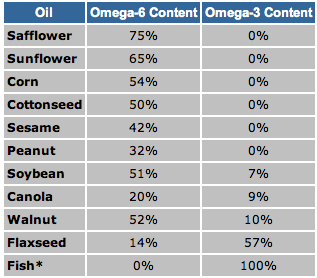
The following chart lists the omega-6 and omega-3 content of various vegetable oils and foods:
Vegetable oil consumption rose dramatically between the beginning and end of the 20th century, and this had an entirely predictable effect on the ratio of omega-6 to omega-3 fats in the American diet. Between 1935 and 1939, the ratio of n-6 to n-3 fatty acids was reported to be 8.4:1. From 1935 to 1985, this ratio increased to 10.3:1 (a 23% increase). Other calculations put the ratio as high as 12.4:1 in 1985. Today, estimates of the ratio range from an average of 10:1 to 20:1, with a ratio as high as 25:1 in some individuals.
In fact, Americans now get almost 20% of their calories from a single food source – soybean oil – with almost 9% of all calories from the omega-6 fat linoleic acid (LA) alone! (PDF)
This reveals that our average intake of n-6 fatty acids is between 10 and 25 times higher than evolutionary norms. The consequences of this dramatic shift cannot be overestimated.
Omega-6 competes with omega-3, and vice versa
As you may recall from the last article, n-6 and n-3 fatty acids compete for the same conversion enzymes. This means that the quantity of n-6 in the diet directly affects the conversion of n-3 ALA, found in plant foods, to long-chain n-3 EPA and DHA, which protect us from disease.
Several studies have shown that the biological availability and activity of n-6 fatty acids are inversely related to the concentration of of n-3 fatty acids in tissue. Studies have also shown that greater composition of EPA & DHA in membranes reduces the availability of AA for eicosanoid production. This is illustrated on the following graph, from a 1992 paper by Dr. William Landis:
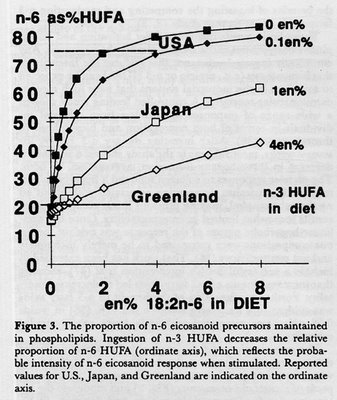
The graph shows the predicted concentration of n-6 in the tissue based on dietary intake of n-3. In the U.S. the average person’s tissue concentration of highly unsaturated n-6 fat is 75%.
Like what you’re reading? Get my free newsletter, recipes, eBooks, product recommendations, and more!
(Note: the ratio of omega-6 to omega-3 matters, but so does the total amount of each.)
In plain english, what this means is that the more omega-3 fat you eat, the less omega-6 will be available to the tissues to produce inflammation. Omega-6 is pro-inflammatory, while omega-3 is neutral. A diet with a lot of omega-6 and not much omega-3 will increase inflammation. A diet of a lot of omega-3 and not much omega-6 will reduce inflammation.
Big Pharma is well aware of the effect of n-6 on inflammation. In fact, the way over-the-counter and prescription NSAIDs (ibuprofen, aspirin, Celebres, etc.) work is by reducing the formation of inflammatory compounds derived from n-6 fatty acids. (The same effect could be achieved by simply limiting dietary intake of n-6, as we will discuss below, but of course the drug companies don’t want you to know that. Less profit for them.)
As we discussed in the previous article, conversion of the short-chain n-3 alpha-linolenic acid (ALA), found in plant foods like flax and walnut, to DHA is extremely poor in most people. Part of the reason for that is that diets high in n-6 LA inhibit conversion of ALA to DHA. For example, one study demonstrated that an increase of LA consumption from 15g/d to 30g/d decreases ALA to DHA conversion by 40%.
Death by vegetable oil
So what are the consequences to human health of an n-6:n-3 ratio that is up to 25 times higher than it should be?
The short answer is that elevated n-6 intakes are associated with an increase in all inflammatory diseases – which is to say virtually all diseases. The list includes (but isn’t limited to):
- cardiovascular disease
- type 2 diabetes
- obesity
- metabolic syndrome
- irritable bowel syndrome & inflammatory bowel disease
- macular degeneration
- rheumatoid arthritis
- asthma
- cancer
- psychiatric disorders
- autoimmune diseases
The relationship between intake n-6 fats and cardiovascular mortality is particularly striking. The following chart, from an article entitled Eicosanoids and Ischemic Heart Disease by Stephan Guyenet, clearly illustrates the correlation between a rising intake of n-6 and increased mortality from heart disease:
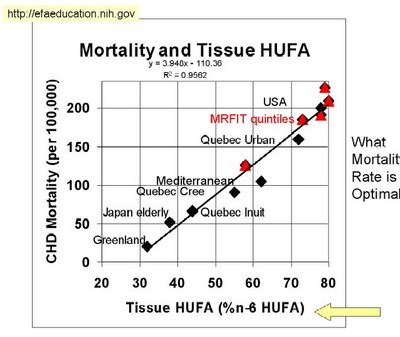
As you can see, the USA is right up there at the top with the highest intake of n-6 fat and the greatest risk of death from heart disease.
On the other hand, several clinical studies have shown that decreasing the n-6:n-3 ratio protects against chronic, degenerative diseases. One study showed that replacing corn oil with olive oil and canola oil to reach an n-6:n-3 ratio of 4:1 led to a 70% decrease in total mortality. That is no small difference.
Joseph Hibbeln, a researcher at the National Institute of Health (NIH) who has published several papers on n-3 and n-6 intakes, didn’t mince words when he commented on the rising intake of n-6 in a recent paper:
The increases in world LA consumption over the past century may be considered a very large uncontrolled experiment that may have contributed to increased societal burdens of aggression, depression and cardiovascular mortality.
And those are just the conditions we have the strongest evidence for. It’s likely that the increase in n-6 consumption has played an equally significant role in the rise of nearly every inflammatory disease. Since it is now known that inflammation is involved in nearly all diseases, including obesity and metabolic syndrome, it’s hard to overstate the negative effects of too much omega-6 fat.
In the next article, we’ll discuss three different methods for determining healthy intakes of n-3 that take background intake of n-6 into account.

Better supplementation. Fewer supplements.
Close the nutrient gap to feel and perform your best.
A daily stack of supplements designed to meet your most critical needs.

Does this imbalance include what we put on our skin? If my body oil is high in omega 6, will it absorb into my body and give me the same problems as eating foods that are very high in omega 6 and low in omega 3?
I am using a lot of body oil every day. All the good massage oils I know of are high in omega 6 and low in omega 3, but perhaps there are other options I can look into if this is a problem.
Hi there! I do believe so… it is most likely! The skin is the largest organ we have… what your skin is exposed to will enter the bloodstream. How interesting that I came across your comment, as I had been wondering the same thing myself! Have been using a lotion this last month or two made from sunflower/safflower. Just stopped a few days ago… I have some health problems/symptoms that have been worse lately and I think my lotion (everywhere on my body) is likely to blame. Trying to figure out why I’ve been reacting more to certain foods (when previously no or little reaction), it’s like my baseline level of inflammation has increased so now when my body comes into contact with said food substances, it doesn’t take much to push it over its limit. So sensitive lately! We’ll see if my symptoms improve. However, I’m starting a new diet here like NOW because everything has just become too much… gotta heal my gut. Anyway, hope this helps. I’m back to using coconut oil (organic unrefined) for lotion…
Linoleic acid is elongated to GLA in the presence of insulin, though the process is blocked by alcohol and diabetes. GLA is elongated to DGLA, which is acted upon by COX enzymes to become the anti-inflammatory series 1 prostaglandins. Simultaneously, DGLA is influenced by delta-5 desaturase to become arachidonic acid, a pro-inflammatory molecule that initiates healing, as in the activation of platelets and leukocytes following a laceration. Without some inflammation there is no healing. The conversion enzymes preferentially process n-3 fats, a plethora of which will inhibit immune responses. Maligning n-6 fats as outright pro-inflammatory is, well, inflammatory.
Thank you for this explanation.
I need someone’s help……my baby who is 8 years old decided that she would be vegetarian. She is now 21 in December 2016 and still she is vegetarian…..therefore will not consider taking krill oil. Is flaxseed a viable alternative or what would u suggest please? Thanking you in anticipation for your help.
Flax is a great source. It is BEST when we get it from our food as opposed to a pill. Some other good sources can be found at: https://www.onegreenplanet.org/natural-health/plant-based-foods-with-the-highest-amount-of-omega-3-fatty-acids/
Michael
I started taking Krill oil. It has both Omega3 and Omega6. I never know that ratio can make me sick. Thanks for great stuff. I need to learn much more about Omega3 and 6.
Dr. Kresser,
Thanks for the very informative article. I have taken special note of your comments that n-6 competes with n-3 and too much n-6 in the tissue can prevent absorption of n-3, leading to inflammatory diseases.
I have been consuming plenty avocados and walnuts which are recommended by nutritionists as healthy foods for the cardiovascular system . However, I have been concerned about the high n-6 to n-3 ratios in these foods. As you’ve pointed out in your chart for n-6 and n-3 in vegetables and foods, walnut contains 52% n-6 and 10% n-3, i.e., a 5.2 to 1 ratio.
On avocados, many papers have listed very high n-6 to n-3 ratios. For example, this Internet site, https://nutritiondata.self.com/facts/fruits-and-fruit-juices/1843/2, shows raw avocados have 2534mg Omega 6 and 165mg Omega 3 per 150 gm, i.e., a ratio of 15.36 to 1.
With those kinds of high n-6 to n-3 ratios, I wonder why avocados and walnuts are still enthusiastically recommended in routine diets by health professionals. Your insightful comments will be highly appreciated.
If the people of the USA used their brain to protect the body our economy would come to a complete halt. All fast food stores, bars, and supper markets- go out of business. Cigarette use 0. Health care facilities could loose 90% of their patients. You want to break the bank????
Chris, great article! Question on Omega 6, Do you believe all Omega 6 is created equal? Meaning the avocado has high amounts of Omega 6 and so do different types of oils. Is there a synthetic approach vs. natural approach for Omega 6 that is beneficial in high amounts? Thanks!
This is something I have been thinking about for some time. Pumpkin seeds for example have a ratio of 100-1 Omega 6 to 3 and therefore should be very unhealthy. Many nuts have up to 20-1 rations. I therefore conclude that the problem is something to do with processing. Of course I may yet change my mind!
Thank you for this article. I believe this was the original article I read about Omega 3/6 ratio issues over a year ago. I have since developed the Sapient Diet for my husband who was diagnosed with Junior Idiopathic Arthritis at age 12 and put of a ton of immune suppressant drugs. Now at age 28 and on the Sapient Diet (low omega 6, gluten-, dairy-, nightshade-, nut-, egg-free) he is completely off his medications and living without pain. Could not have done it without you! I hope to share what I have learned with more people in the future.
That’s awesome he is no longer medication dependent. There is another way (that’she proven to work) to get your omegas into balance. Stay healthy.
Dear Rebecca, could you please forward me the complete diet. I am being treated for crohns with Immunk suppresant injections. I really wish to try this diet. Pleasr forward the diet to my email.. chaitanyamandhadi[at]gmail.com
Thank you,
Chaitanya
I need this info also. I have polymyalgia rheumatic and I am on prednisone. I do not wan to stay on it. I have been searching for anti inflammatory foods. My diet right now consists of lots and lots of the seeds and nuts listed in the omega 6 column. I wonder if this is causing my deasese?
All i can say that there is not enough reliable info available on the web at all to know if omega-6 is safe, especially if to use it as medicine.
just a picture to understand why we need a ration between omega 3 and 6: i.imgur.com/9ACwLwT.jpg
sorry the link was: https://i.imgur.com/9ACwLwT.jpg
So true When I went to school in the 40’s young girls didnt start to have breasts until at least grade 8 They then started to give chickens hormones to enlarge their breast It wasnt long until it started showing up at grade 4 You are what you eat
Howdy Folks
Fun reading these posts. My understanding is omega 6 is very important. Unadulterated omega 6. This article and others like it miss that very important part. The oil in fried food, baked and frozen food are adulterated omega 6. BTW fish oil is for fish and the DHA & EPA in them and promently displayed on the bottle are derivatives of the parent omega 3. At way, way, way too high dose. Visit Brian S. Peskin on the web and get the straight scoop.
There are NO HORMONES OR STEROIDS approved by the USDA for use in any meat poultry. It’s simple urban legend. Chicken are just bred to have huge breasts. That’s it…
https://survivalgardener.com/2015/03/how-labels-on-chicken-meat-are-intentionally-deceptive/
Might not be added but that’s really just a tricky loophole. Commercial food is full of animals with freak pituitary issues and elevated hormones that were selected for. Only way to know for sure is to know your farmer well or grow your own.
Is there any reason Olive oil is missing from the n:6 to n:3 ratio table?
Cuz olive oil is rich in n-9
Olive oil has an omega-6 to 3 ratio of 11:1, and studies have shown that it isn’t anywhere near as heart-healthy as advertised either. Instead of improving cardiovascular function, olive oil decreases arterial diameter by 2% and prevents arterial expansion. The only reason that the Mediterranean diet is nonetheless healthy is its focus on antioxidant-rich vegetables and omega-3-rich seafood, which is the actual heart-healthy component.
That’s pure BS. Extra virgin (low acid) olive oil is in near perfect ratio when it comes to Omega 6 and Omega 3. And that’s what we want to see. Too much Omega 6 can cause serious health issues. Omega 6 oils (corn, canola, etc.) are in nearly every ‘manufactured’ food – and therein is much of the problem. Whereas, Cold Pressed Extra Virgin (low acid) Olive Oil is in fact an excellent source for over-all good health, and for cooking (smoke temp. 405°f so keep cooking temp below 400°F). Extra Virgin Olive Oil is loaded with antioxidants, has a very low (GI) Glycemic Index, and calories are reasonable. Excellent for skin (moisturizing, healing, softening), great for hair and scalp, and good for the entire digestive system. It contains modest amounts of Vitamins E and K. It can reduce inflammation, which is one of the main reasons for its health benefits (inflammation is very unhealthy and chronic inflammation can cause serious health issues). Olive oil was the only source of monounsaturated fat associated with a large study for reduced risk of stroke and heart disease . It must be Cold Pressed Extra Virgin (low acid) Olive Oil to get full health benefits.
Olive oil is not the best to cook with, Coconut oil is!
Use butter ghee or coconut oil for cooking,
Coconut oil is fantastic for skin hair and eating!
Ali Rion. Your information is mostly wrong or pointless. There is no perfect ratio for Omega 3:6 fatty acids. Yes olive oil ratio of Omega 6 to Omega 3 is about 11:1. Typical diet ratios are 20-30:1 and recommend closer to 1-5:1. Soling point for extra virgin olive oil is about 325 deg F, not 400 deg F. Other less nutritious virgin, pure and light olive oil smoking temps are higher, up to 425 F. GI index is pointless except for carbohydrates. Higher fat and fiber meals slow food passage and absorption lowering any carb-sugar response. Calories are reasonable ? What. 100% Fat has 9 calories per gram, ANY fat has 9 calories per gram.